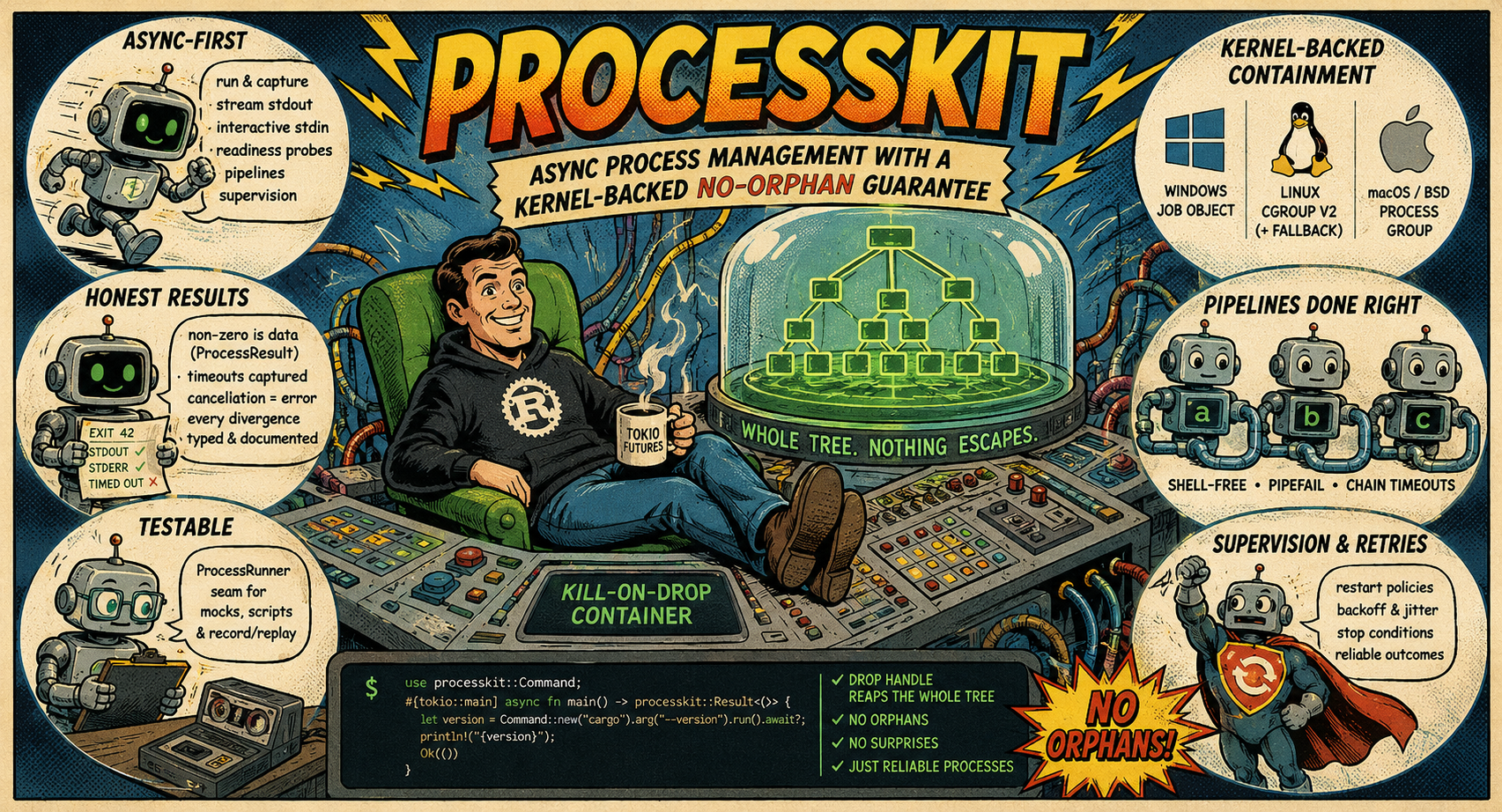



Async child-process management for Rust + tokio with a kernel-backed no-orphan guarantee: every process you start — and everything it spawns — lives in a kill-on-drop container (a Windows Job Object, a Linux cgroup v2, or a POSIX process group), so no descendant ever outlives your program.
Beyond spawning a subprocess: run-and-capture, line streaming, interactive stdin, real pseudo-terminal (PTY) sessions, shell-free pipelines, readiness probes, timeouts & cancellation, supervision with restart/backoff, and a mockable runner seam for subprocess-free tests.
cargo add processkit
use processkit::Command;

#[tokio::main]
async fn main() -> processkit::Result<()> {
    let version = Command::new("cargo").arg("--version").run().await?;
    println!("{version}");
    Ok(())
}
Continue: find a recipe · learn the command model · browse the API
Why processkit?
std::process and tokio::process reach (at most) the direct child. The
processes it spawned — a build tool's compiler children, the real payload
behind a wrapper (cmd /c …, sh -c …), a test's helper servers — can survive
a timeout, a panic, or a dropped future and keep running as orphans.
processkit puts every child inside the operating system's own containment
primitive. Teardown is one operation over the whole process tree, not a
best-effort signal to one PID:
- Nothing escapes silently. Dropping a run or group reaps every descendant;
the active
Mechanismtells you which OS guarantee is in effect. - Terminal when you need one. The opt-in
ptyfeature gives terminal-only tools a real controlling terminal while keeping the same containment and kill-on-drop lifecycle. - Honest outcomes. A non-zero exit remains inspectable data until you ask for success; timeouts, cancellation, spawn failures, and resource limits stay distinct in the typed error model.
- Async and testable. Streaming, pipelines, readiness, and supervision are
tokio-native, while the
ProcessRunnerseam replaces real processes with scripted or record/replay doubles in tests.
3.0 highlights
- PTY support is here. With the opt-in
ptyfeature,Command::use_pty()gives terminal-only tools a real controlling terminal:openptyon Unix andCreatePseudoConsole(ConPTY) on Windows. The terminal has one merged output stream, supports interactive input plus initial/live window sizing, and stays inside the same kill-on-drop containment as a piped run. Start with the PTY dialog and window-size sections, then check the platform matrix. - Errors are split by responsibility.
Erroris now a pointer-sized wrapper aroundBox<ErrorReason>; its existing accessors remain the convenient path,reason()exposes the structured variant, andErrorKindis the coarse total classification for routing. See Errors for the model and Upgrading for the 2.x migration. - Lifecycle streaming is end to end. The renamed
events()stream carriesProcessEvent::Started→ ordered output →ProcessEvent::Exited, whilePipeline::start()andSupervisor::start()expose live sessions for observing and stopping multi-stage or restarted workloads. Continue with lifecycle events, live pipelines, and live supervision. - Tree shutdown and ownership are explicit.
ProcessGroup::stop()returns aShutdownReport,update_limits()changes resource caps on a live group, andspawn_detached()is a separate opt-in for the exceptional child that must outlive its launcher. See observable teardown, live limits, and detached children. - Batch streaming and capture are production-ready. Completion-order
output_streamfan-out no longer holds fast results behind slow work; byte-accurate raw tees expose the undecoded stream; andCapturePolicyredacts or reshapes retained lines before they enter a result. See results as they finish, raw output, and redaction at capture. - The host is inspectable before and after launch.
host_containment()reports the effective containment mechanism without spawning;process_info()/process_is_alive()provide reuse-safe PID identity checks; and the newmetricsfeature publishes secret-safe counters and histograms. See Platform support, process identity, and Observability.
The complete release record is in the
v3.0.0 release.
Guides
New to the crate? Start with the Cookbook — short task-to-snippet recipes for everything the crate does — then read Running commands end to end (it's the vocabulary every other guide builds on). Reach for the rest as the need arises, and keep Platform support handy before you ship: it collects every per-OS caveat in one place.
| Guide | Covers |
|---|---|
| Cookbook | "I want to …" → working snippet, for every capability; each recipe links to its deep guide |
| Running commands | The Command builder end to end: args, env, stdin sources, encodings, buffer policies, line handlers, timeouts, retry, privileges — and every consuming verb (run, output_string, probe, …) with its error semantics |
| Building typed CLI clients | CliClient and cli_client!: wrapper structure, defaults and precedence, typed parsing/JSON, errors, scripted tests, and record/replay fixtures |
| Running many at once | Bounded output_all / output_all_bytes fan-out, shared versus independent containment, and wait_any / wait_all races and joins |
| Comparative benchmarks | End-to-end processkit vs. plain Tokio and standard-library baselines across capture, streaming, and concurrent fan-out |
| Process groups | Kill-on-drop containment: creating groups, spawning/adopting, teardown verbs, whole-tree signals, suspend/resume, member listing, resource limits, stats sampling |
| Streaming & interactive I/O | start() and the live RunningProcess: line streaming, interactive stdin, PTY dialogs/window resize/output hygiene, readiness probes (wait_for_line / wait_for_port / wait_for), racing children with wait_any, per-run profiling |
| Pipelines | a | b | c without a shell (the | operator works too): wiring, pipefail attribution, unchecked_in_pipe() stages for the | head pattern, timeouts, stdin/stdout at the ends, re-running chains |
| Timeouts, retries & cancellation | How a deadline is captured vs when it errors, retry policies and their classifier, and cancellation: per-command tokens and the client-level default_cancel_on |
| Errors | The Error wrapper, every ErrorReason variant, ErrorKind, subtle look-alikes (Timeout vs Cancelled, NotReady vs Timeout, NotFound vs Spawn, CassetteMiss), classifiers, and how retries/supervision use them |
| Troubleshooting | Symptom-first diagnosis for surviving children, missing tools, unavailable limits, silent or ANSI-heavy output, stuck waits, Windows graceful stop, and readiness-vs-run deadlines |
| Supervision | Keeping a child alive: restart policies, backoff & jitter math, the failure-storm guard, stop conditions, outcomes, supervising inside a shared group |
| Observability | The tracing event seam and the metrics counters/histograms over data the crate already computes — what's measured, the secret-hygiene guarantee (never argv/env), label cardinality, and wiring a backend exporter |
| Testing your code | The ProcessRunner seam — bulk and streaming: ScriptedRunner (incl. scripted start() with canned, paced lines), RecordingRunner, MockRunner, record/replay cassettes, and building hermetically-testable CLI wrappers with CliClient |
| Platform support | The containment mechanisms, every per-feature support matrix in one place, and the platform caveats worth knowing before you ship |
| Running in containers | Docker/Kubernetes specifics: which mechanism you actually get, PID 1 signal/reaping behavior, graceful shutdown on the orchestrator's SIGTERM, minimal musl/Alpine images, and container limits vs. the crate's own limits |
| Running untrusted children | A hardening checklist for launching a program you don't trust: containment, resource limits, privilege drop order, environment hygiene, output/wall-time bounds — what the crate guarantees, what it doesn't, and where to go for real isolation |
| Upgrading | Per-version consumer upgrade notes, including the 2.x → 3.0 ErrorReason and lifecycle-event migrations |
| What's next | Where the containment/runner approach is headed beyond this Rust crate |
Feature flags
Every flag is additive and only gates visibility — the kill-on-drop tree guarantee is unconditional in every configuration.
| Feature | Default | Adds | Extra dependency |
|---|---|---|---|
stats | off | ProcessGroup::stats / sample_stats, RunningProcess::cpu_time / peak_memory_bytes / profile | windows-sys/ProcessStatus (Windows) |
process-control | on | Signal, ProcessGroup::{signal, suspend, resume, members, adopt, adopt_external} | — |
limits | off | Whole-tree resource caps on ProcessGroupOptions (max_memory / max_processes / cpu_quota), ErrorReason::ResourceLimit; implies stats | — |
mock | off | A mockall-generated MockRunner for expectation-style tests (test-only; its expect_* surface is semver-exempt, tracking mockall — prefer ScriptedRunner/RecordingRunner for a stable double) | mockall |
tracing | off | Events on the processkit target: spawn/exit, timeout & cancel firing, per-transition graceful teardown (soft_signal → grace_started → drained/escalated/spared), retries, supervisor storms, teardown anomalies (never argv/env) | tracing |
metrics | off | Counters/histograms over already-computed run data: run/spawn counters, run-duration histograms, an exit-code/timeout/cancel tally, retry/restart/storm events — into any metrics recorder you install (never argv/env). See Observability | metrics |
record | off | RecordReplayRunner JSON cassettes over the runner seam | serde, serde_json |
json | off | Typed whole-output JSON verbs (Command::output_json, …) and line-wise NDJSON streaming (RunningProcess::stdout_json_lines), with bounded, location-rich parse diagnostics | serde, serde_json |
report-serde | off | serde::Serialize for the report types (ProcessResult, RunProfile, ProcessGroupStats, ShutdownReport, MemberInfo, LimitEvidence, supervision events/outcome/status), every enum tagged by its stable name() identifier. Serialize only, and never captured output/argv/env — see Errors | serde |
pty | off | Real pseudo-terminal launch mode (openpty on Unix, ConPTY on Windows), interactive master input, merged output, initial/live window sizing | windows-sys/Win32_System_Pipes (Windows) |
[dependencies]
processkit = { version = "3", features = ["limits"] }
The 60-second tour
use processkit::{Command, ProcessGroup, Stdin};

#[tokio::main]
async fn main() -> processkit::Result<()> {
    // One-shot: capture everything. A non-zero exit is data, not an Err.
    let head = Command::new("git").args(["rev-parse", "HEAD"]).output_string().await?;
    println!("HEAD = {}", head.stdout().trim());

    // Success-checking: non-zero exit / timeout / signal-kill become typed errors.
    let version = Command::new("cargo").arg("--version").run().await?;

    // Stdin, timeout, streaming, pipelines, supervision … see the guides.
    let sorted = Command::new("sort")
        .stdin(Stdin::from_string("b\na\n"))
        .timeout(std::time::Duration::from_secs(5))
        .run()
        .await?;

    // Containment: anything spawned through a group dies with it.
    let group = ProcessGroup::new()?;
    let _server = group.start(&Command::new("dev-server")).await?;
    drop(group); // the server — and everything *it* spawned — is reaped

    let _ = (version, sorted);
    Ok(())
}
API reference
The rustdoc on docs.rs is the authoritative per-item reference; these guides are the narrative layer on top — they explain how the pieces compose, with the platform fine print collected in Platform support.
These examples are compiler-checked. Every fenced Rust block across these
guides and the root README.md is compiled (and, unless annotated no_run or
ignore, actually run) as an ordinary doctest by cargo test --all-features
(as CI does) — a signature change that stops matching a guide's snippet fails
CI instead of silently lying to a reader. The hidden harness only builds under
--all-features, so a plain cargo test with the default features does
not exercise this check. See src/doc_examples.rs for the (test-only,
hidden) harness.