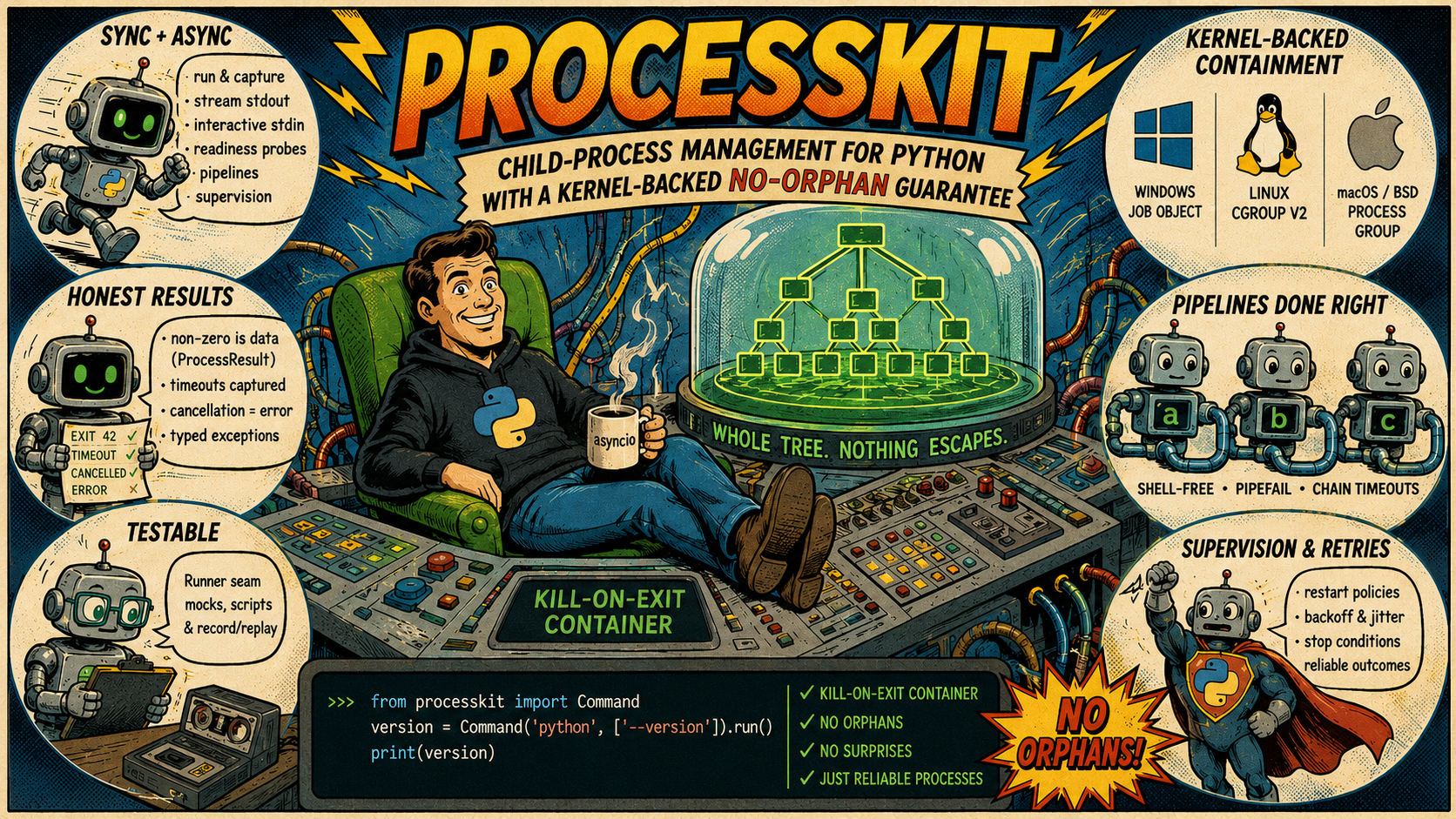


Async-and-sync child-process management for Python with a kernel-backed no-orphan guarantee: every process you start — and everything it spawns — lives in a kill-on-exit container (a Windows Job Object, a Linux cgroup v2, or a POSIX process group). Subject to the documented POSIX escape caveats, normal completion, errors, timeouts, cancellation, and context-manager exit reap descendants as a unit. Abrupt owner-death coverage is platform-specific and reported explicitly.
Beyond spawning a subprocess: run-and-capture, line streaming, interactive stdin, opt-in pseudo-terminals, shell-free pipelines, readiness probes, timeouts & cancellation, supervision with restart/backoff, resource-limited sandboxes, and a mockable runner seam for subprocess-free tests — each in a synchronous and an asyncio-native form.
from processkit import Command

# Require success and get trimmed stdout; a failure raises a typed exception.
version = Command("python", ["--version"]).run()
print(version)
Why processkit?
subprocess and asyncio.subprocess reach (at most) the direct child. The
processes it spawned — a build tool's compiler children, the real payload
behind a wrapper (cmd /c …, sh -c …), a test's helper servers — survive a
timeout, an exception, or a cancelled task, and keep running as orphans.
processkit spawns every child into the operating system's own containment
primitive — a Job Object on Windows, a cgroup v2 on Linux (with a
process-group fallback), a POSIX process group on macOS/BSD — so teardown is
a kernel operation over the whole tree, not a best-effort signal to one pid:
- Nothing escapes silently. Exiting a
with/async withblock reaps every descendant, grandchildren included. Where a mechanism has a genuine weakness (asetsidchild can escape a POSIX process group),ProcessGroup.mechanismreports the active backend instead of pretending — never a silent downgrade. - Sync and async, first-class. The run-&-capture verbs, pipelines, and
supervision each exist as a plain synchronous call and an
a-prefixed asyncio coroutine, sharing one set of types. The inherently-streaming surfaces — live line streaming, interactive stdin, readiness probes — are asyncio-native (awaited on a started process), not duplicated as blocking calls. - Honest results. A non-zero exit is data (
ProcessResult) until you ask for success; a timeout is captured in the result; a cancellation is always an error; every platform divergence raisesUnsupportedor is documented. Raised exceptions carry structured fields and alias the stdlib's (Timeoutis aTimeoutError,ProcessNotFoundaFileNotFoundError,PermissionDeniedaPermissionError). - Testable. One runner seam swaps the real spawner for scripted doubles or record/replay cassettes — no subprocess in your tests.
How it compares
| whole-tree kill-on-exit | async | sync | limits / stats | streaming · pipelines · supervision | |
|---|---|---|---|---|---|
subprocess | — | — | ✓ | — | — |
asyncio.subprocess | — | ✓ | — | — | — |
processkit | ✓ | ✓ | ✓ | ✓ | ✓ |
The first column is the differentiator: a child's descendants are contained and reaped as a unit (Job Object / cgroup v2 / process group), not just the direct child.
Stable API. The public API has been stable since 1.0 and follows Semantic Versioning: breaking changes land only in a new major version, so
1.xupgrades are backward-compatible. See CHANGELOG.md, and ROADMAP.md for how it was built.
Guides
New here? Start with the Cookbook — short task-to-snippet
recipes for everything the package does — then read Running commands
end to end (it's the vocabulary every other guide builds on). Coming from the
standard library? Coming from subprocess maps your existing
subprocess / asyncio.subprocess patterns onto their processkit equivalents.
Reach for the rest as the need arises, and keep Platform support
handy before you ship: it collects every per-OS caveat in one place.
| Guide | Covers |
|---|---|
| Cookbook | "I want to …" → working snippet, for every capability; the fastest way in |
| Coming from subprocess | Side-by-side translation of subprocess / asyncio.subprocess patterns, the exception mapping, and the whole-tree containment the stdlib can't give |
| Running commands | The Command builder end to end — args, env/sandboxing, stdin, PTY mode, stdout/stderr redirection, encodings, output caps, timeouts, privileges — and every consuming verb (output, run, probe, …) with its error semantics |
| Process groups | Kill-on-drop containment: creating groups, spawning, observable graceful stop, teardown, whole-tree signals, suspend/resume, member listing, resource limits, stats |
| Sandboxing untrusted tools | The agent/LLM-tool recipe: locked-down env → bounded output → group resource limits → timeout → teardown, a checklist, and an honest threat model (what this does and does not protect against) |
| Streaming & interactive I/O | astart() and the live RunningProcess: line streaming, interactive stdin and PTYs, readiness probes (wait_for_line / wait_for_port / wait_until), per-run profiling |
| Pipelines | Shell-free command pipelines — chain with .pipe() or the pipe operator: wiring, pipefail attribution, chain timeouts, binary tails |
| Timeouts & cancellation | How a deadline is captured vs when it raises, interrupting a blocked sync call (Ctrl+C), and asyncio cancellation that reaps the whole tree |
| Supervision | Keeping a child alive: restart policies, live sessions/status, backoff & jitter, stop conditions, outcomes |
| Testing your code | The ProcessRunner seam — ScriptedRunner (incl. scripted streaming start()), record/replay cassettes, the RecordingRunner spy, the CliClient wrapper, and the autoloaded pytest plugin (ready-made fixtures + a no-real-spawn guard) |
| Command-line usage | python -m processkit run -- ...: containment and resource limits for a shell command with no Python to write, flags, exit codes |
| Performance & overhead | Why the workload is syscall-bound, what each benchmark in benchmarks/ measures, how to reproduce them locally, and qualitative throughput/scaling expectations |
| Async runtimes & event loops | Which event loops the asyncio-native surface runs on — asyncio and uvloop (yes), anyio-on-asyncio (yes), native trio / anyio-on-trio / curio (no) — and why |
| Platform support | The containment mechanisms, every per-feature support matrix in one place, and the caveats worth knowing before you ship |
| Troubleshooting | A symptom-to-guide map for resource-limit, signaling, event-loop, cassette, privilege-drop, and teardown errors |
Packaging
Unlike the Rust crate's compile-time feature flags, the Python wheel ships one surface with everything enabled — resource limits, signals/stats, record/replay, and opt-in logging are all present in every published wheel. There is nothing to opt into at install time:
pip install processkit-py # import name: processkit
On a platform without a prebuilt wheel, build from source (uv run maturin develop) — see the
README.
Distributed as abi3 wheels for CPython 3.10+ (one wheel per OS/arch runs on every supported minor version, 3.14 included), plus a version-specific free-threaded wheel for CPython 3.14t (PEP 703). See Platform support for the wheel matrix and the free-threaded note.
The 60-second tour
import asyncio
from processkit import Command, ProcessGroup

# One-shot, sync: capture everything. A non-zero exit is data, not an exception.
head = Command("git", ["rev-parse", "HEAD"]).output()
print("HEAD =", head.stdout.strip(), head.code)

# Success-checking: a non-zero exit / timeout / signal-kill becomes a typed exception.
version = Command("python", ["--version"]).run()


async def main():
    # Asyncio: the same verbs with an `a` prefix; cancelling reaps the whole tree.
    result = await Command("git", ["status", "--short"]).aoutput()

    # Stream a child's stdout; the context manager reaps the tree on exit.
    async with await Command("my-build", ["--watch"]).astart() as proc:
        async for line in proc.stdout_lines():
            print(line)

    # A managed PTY for tools that buffer behind pipes or require a tty.
    async with await Command("interactive-tool").pty(cols=120, rows=40).astart() as pty_proc:
        pty_proc.resize_pty(160, 50)

    # Containment: anything started in the group dies with it (grandchildren too).
    async with ProcessGroup() as group:
        await group.astart(Command("dev-server"))
    # async-with exit reaps the whole tree


asyncio.run(main())
API reference
The API reference is the complete, per-symbol index of the
public surface — every class, function, protocol, type alias, and exception,
plus the processkit.testing submodule. It is generated straight from the type
stubs and docstrings (the same source your IDE and mypy read), so it never
drifts from the real API. These guides are the narrative layer on top — they
explain how the pieces compose, with the platform fine print collected in
Platform support. The underlying algorithms (the OS containment
mechanisms, race-free spawn) live in the
processkit Rust crate.
For LLM assistants
This site publishes two machine-readable files following the llmstxt.org convention, so an AI assistant can pull an accurate, current slice of the docs instead of guessing from a stale summary:
- llms.txt — an annotated index of every guide, in reading order, each linked with a one-line description drawn from the guide itself.
- llms-full.txt — the full text of all guides concatenated, for loading the whole documentation set into an assistant's context at once.
Both are generated straight from these guides (scripts/gen_llms_txt.py, drift-guarded
like the API reference) and served as static assets of this book.
processkit cookbook
Task-oriented snippets — "I want to … → do this." Every example assumes
from processkit import …. Each recipe is a quick hit; for the full treatment of
any area — every knob, the error semantics, the platform fine print — follow the
links into the guide set: Running commands,
Process groups,
Streaming & interactive I/O, Pipelines,
Timeouts & cancellation,
Supervision, Testing your code, and
Platform support.
The whole library has two parallel surfaces: a synchronous one (plain method
names) and an asyncio one (the same names with an a prefix). Use whichever
fits your code; they share the same types and the same no-orphan guarantee.
ProcessStdin's write methods and the stdout_lines() / output_events()
iterators are async-only. A RunningProcess's consuming methods —
outcome/aoutcome, finish/afinish, output/aoutput,
output_bytes/aoutput_bytes, profile/aprofile, shutdown/ashutdown —
each come in a sync/async pair like everywhere else in the library: the plain
name blocks the calling thread, the a-prefixed twin is a coroutine (see
Streaming for the full table). Its stdout_lines() /
output_events() / take_stdin() / kill() are synchronous setup calls
(it's the iterator/handle they return that you await). A RunningProcess is
still usable as a sync or async context manager for deterministic teardown.
Run a command and capture its output
A non-zero exit is data, not an exception:
from processkit import Command

result = Command("git", ["rev-parse", "HEAD"]).output()
print(result.stdout.strip())  # the commit hash
print(result.code)  # 0
print(result.is_success)  # True
Async:
result = await Command("git", ["rev-parse", "HEAD"]).aoutput()
Require success and just get stdout
run() returns trimmed stdout and raises on a non-zero exit, a timeout, or a
signal-kill:
commit = Command("git", ["rev-parse", "HEAD"]).run() # or: await ....arun()
Check whether a command succeeds
clean = Command("git", ["diff", "--quiet"]).probe()  # True if exit 0, False if 1
code = Command("mytool").exit_code()  # the raw exit code
Accept non-zero exit codes
Some tools use non-zero as a normal result (grep 1 = no match, diff 1 =
differs). success_codes replaces the success set (default {0}) — list every
code you accept:
differs = not Command("diff", ["a", "b"]).success_codes([0, 1]).probe()  # 0 same, 1 differs
Command("grep", ["needle", "file"]).success_codes([0, 1]).run()  # 1 (no match) is OK
success_codes affects run() and result.is_success; exit_code() (raw) and
probe() (0/1) are unchanged.
Set a timeout
result = Command("slow-tool").timeout(5.0).output()  # result.timed_out == True on expiry
Command("slow-tool").timeout(5.0).run()  # raises Timeout on expiry

# Graceful: signal, wait, then hard-kill.
Command("server").timeout(30.0).timeout_signal("term").timeout_grace(5.0).run()
Pass input on stdin
out = Command("tr", ["a-z", "A-Z"]).stdin_text("hello\n").run()  # "HELLO"
Command("sha256sum").stdin_bytes(b"\x00\x01\x02").run()
Feed a large file to stdin without loading it into memory
# Streams straight from disk to the child — no full read into Python bytes,
# so this works just as well for a multi-gigabyte dump/archive/log.
Command("psql", ["mydb"]).stdin_file("dump.sql").run()
Command("tar", ["-xf", "-"]).stdin_file("archive.tar").cwd("/tmp/extract").run()
Let a child read the parent's real stdin
# The child inherits *this* process's stdin — the real terminal, file, or pipe —
# instead of a crate-managed pipe. Its $EDITOR opens on the actual terminal.
Command("git", ["commit"]).inherit_stdin().run()

# Forward a shell pipeline's stdin straight through to the child:
#   cat notes.txt | python -m your_tool
Command("less").inherit_stdin().run()
inherit_stdin() is mutually exclusive with a mediated stdin source
(stdin_bytes() / stdin_text() / stdin_file()) or keep_stdin_open();
combining them raises ProcessError at launch, not when you build the command.
Set the working directory and environment
Command("ls").cwd("/tmp").output()
Command("printenv", ["TOKEN"]).env("TOKEN", "secret").run()

# Set several at once, or drop an inherited one:
Command("worker").envs({"HOST": "127.0.0.1", "PORT": "8080"}).run()
Command("worker").env_remove("HTTP_PROXY").run()

# Start from an empty environment (reproducible / locked-down child), then add
# back only what you need:
Command("untrusted-tool").env_clear().env("PATH", "/usr/bin").run()
Capture binary (non-UTF-8) output
output_bytes() returns a BytesResult whose stdout is bytes (stderr stays
decoded text):
result = Command("convert", ["in.png", "out:-"]).output_bytes()  # or: await ....aoutput_bytes()
png = result.stdout  # bytes
print(result.code, result.is_success)
Cap captured output (untrusted children)
Bound how much output is retained. To bound the parent's memory, cap
max_bytes — a max_lines-only cap doesn't, because one newline-free flood is a
single (unbounded) line:
from processkit import Command, OutputTooLarge

# Keep only the most recent 1 MiB; older output is dropped (the default):
tail = Command("chatty-tool").output_limit(max_bytes=1024 * 1024).output()

# For an untrusted child, treat hitting the byte cap as a failure:
try:
    Command("untrusted-tool").output_limit(max_bytes=8 * 1024 * 1024, on_overflow="error").run()
except OutputTooLarge as e:
    print(e.total_bytes, e.max_bytes)
on_overflow is "drop_oldest" (keep most recent, the default), "drop_newest"
(keep earliest), or "error" (raise OutputTooLarge). A max_lines cap bounds
only line-captured output (raw bytes have no line count), but a max_bytes cap
also bounds the raw stdout of output_bytes() / aoutput_bytes() (since processkit
2.1.0): over the byte ceiling it either raises OutputTooLarge (on_overflow="error")
or keeps a bounded head/tail with BytesResult.truncated set.
Under on_overflow="error" the ceiling (and the total_bytes an
OutputTooLarge reports) counts raw bytes read from the pipe — line
terminators and invalid-UTF-8 bytes included — not the bytes of the decoded text;
a drop-mode cap still bounds the retained decoded content. See
Bounding captured output.
Stream output line by line (async)
proc = await Command("my-build", ["--watch"]).astart()
async for line in proc.stdout_lines():
    print(line)
finished = await proc.afinish()  # outcome + captured stderr
Interleaved stdout + stderr:
async for event in proc.output_events():
    print(event.stream, event.text)  # "stdout" / "stderr"
Clean ANSI/VT escapes from PTY output
TTY-sensitive tools may emit colors, cursor movement, and OSC metadata into a PTY's merged output. Sanitize the captured and streamed text before logging, parsing, or asserting on it:
from processkit import Command

result = Command("colorful-tool", ["status"]).pty().sanitize_vt().output()
print(result.stdout)  # plain text; terminal escape sequences removed
In pipe mode, use stdout_sanitize_vt() or stderr_sanitize_vt() to clean only
one captured stream. Sanitization runs after decoding and line splitting. A
simultaneous stdout_tee() still receives the original escape-laden decoded
lines, so it can remain a faithful terminal log while result.stdout is clean.
Stream a log to a file and still get the captured result
stdout_tee(path) / stderr_tee(path) write the live stream to a file and
leave the full output in the captured result — no manual stdout_lines() loop,
and the one-shot verbs (output(), run()) still work:
from processkit import Command

result = Command("cargo", ["build"]).stdout_tee("build.log").output()
# build.log has the live, line-by-line stream; result.stdout has the whole thing.
print(result.stdout)  # capture is untouched — the tee is a copy
The file is opened when you call the builder (a bad path raises OSError
there, not at run) and truncated by default — pass append=True to grow an
existing log. Separate files for each stream:
Command("noisy-tool").stdout_tee("out.log").stderr_tee("err.log").run()
The sink can be a file path (as above) or a Python writer — any object
with a write() method (io.StringIO, sys.stderr, a text-mode file, a
logger wrapper) — to mirror the child's output straight into your own
console, buffer, or logger while still capturing it. See
Streaming for backpressure, the no-op
conditions, and write-error isolation.
Get live progress from a synchronous run
stdout_lines() / output_events() need an event loop; on_stdout_line(callback)
/ on_stderr_line(callback) give the plain, blocking .output() / .run()
call the same live view — callback fires on every decoded line as it streams
in, not just once the run finishes:
from processkit import Command

result = (
    Command("cargo", ["build", "--release"])
    .on_stdout_line(lambda line: print("build:", line))
    .output()
)
# capture is untouched — result.stdout still has the whole output.
Works the same on the async verbs and on a streamed run — one callback, every
path. A raising callback never derails the run (it goes to
sys.unraisablehook instead). See
Streaming for the no-op conditions and
the one-handler-per-stream rule.
Tear a standalone process down deterministically
A RunningProcess is a context manager. Exiting the block kills the process —
for a standalone astart() / start() handle that means a hard kill of its
whole private tree — even if the block raises, without waiting on Python's GC:
from processkit import Command

async with await Command("flaky-server").astart() as proc:
    async for line in proc.stdout_lines():
        if "ready" in line:
            break
# proc (and its children) are reaped here

# Sync handles work too — start() is the synchronous twin of astart():
with Command("worker").start() as proc:
    ...  # do other work
# proc torn down here
If you consume the handle inside the block (proc.output()/.outcome()/
.finish()/.shutdown(...), or their a-prefixed async twins), exit is a
no-op.
Talk to a process interactively (async)
proc = await Command("python", ["-i"]).keep_stdin_open().astart()
stdin = proc.take_stdin()
await stdin.write_line("print(1 + 1)")
await stdin.close()  # EOF
async for line in proc.stdout_lines():
    print(line)
await proc.aoutcome()
Contain a process tree (no orphans)
Everything started in the group — and everything those processes spawn — is reaped when the block exits:
from processkit import Command, ProcessGroup

with ProcessGroup() as group:
    group.start(Command("dev-server"))
    group.start(Command("worker"))
    # ... use them ...
# the whole tree, grandchildren included, is gone here
Async:
async with ProcessGroup() as group:
    await group.astart(Command("dev-server"))
If another library already started the process, adopt it by pid instead of recreating the launch:
import subprocess

from processkit import ProcessGroup, Unsupported

external = subprocess.Popen(["dev-server"])
try:
    with ProcessGroup() as group:
        try:
            group.adopt_external(external.pid)
        except Unsupported:
            raise RuntimeError("pid-only adoption is unsupported on this platform")
        print(external.pid in group.members())
finally:
    if external.poll() is None:
        external.kill()
    external.wait()
The group now covers the adopted process for signalling and teardown, but it
does not reap it or expose an exit status. The original parent still calls
wait(). A process's future descendants are included by Windows Job Objects
and Linux cgroup v2; the POSIX process-group fallback normally tracks only the
adopted process. See Existing processes and
containment for pid
identity, platform errors, and the host-level alternative.
Cancel a run and reap its tree (async)
Cancelling the awaiting task — directly, or via asyncio.wait_for /
asyncio.timeout — tears the whole tree down:
task = asyncio.ensure_future(Command("long-job").aoutput())
task.cancel()  # the process tree is reaped; CancelledError propagates
Wait for a server to be ready
from processkit import (
    Command,
    ProcessGroup,
    wait_until,
    wait_for_named_pipe,
    wait_for_path,
    wait_for_port,
    wait_for_unix_socket,
    wait_for_http,
    wait_for_line,
)

async with ProcessGroup() as group:
    proc = await group.astart(Command("my-server"))
    await wait_for_port("127.0.0.1", 8080, timeout=10)  # poll the port
    # or probe an HTTP health endpoint (ready only on a 2xx, not merely an open
    # port — a warming-up server accepts the port while still replying 503):
    # await wait_for_http("127.0.0.1", 8080, "/health", timeout=10)
    # or wait for a log line (a plain string is a substring-match shorthand):
    # await wait_for_line(proc.stderr_lines(), "listening", timeout=10)
    # or wait for a Unix socket to accept connections (stronger than a path check):
    # await wait_for_unix_socket("/run/my-server.sock", timeout=10)
    # or wait for a Windows named pipe (a busy server is ready too):
    # await wait_for_named_pipe(r"\\.\pipe\my-server", timeout=10)
    # or wait for a pid file to appear:
    # await wait_for_path("/run/my-server.pid", timeout=10)
    # or poll any (sync or async) condition:
    # await wait_until(lambda: health_check_passes(), timeout=10, interval=0.1)
Wait for a unix socket or pid file to appear
Some daemons (Docker, PostgreSQL, many others) announce readiness through a
Unix-domain socket or a pid file rather than a TCP connection or log line. A
socket's filesystem entry can appear before its daemon accepts connections, so
use wait_for_unix_socket for the socket case; keep wait_for_path for a pid
file or another marker that only needs to exist:
from pathlib import Path
from processkit import Command, ProcessGroup, wait_for_path, wait_for_unix_socket

socket_path = Path("/run/my-daemon.sock")
pid_path = Path("/run/my-daemon.pid")

async with ProcessGroup() as group:
    await group.astart(Command("my-daemon", ["--socket", str(socket_path)]))
    await wait_for_unix_socket(socket_path, timeout=10, interval=0.05)
    # socket_path accepts connections; a pid-file-only daemon uses:
    # await wait_for_path(pid_path, timeout=10, interval=0.05)
A WaitTimeout (also a TimeoutError) is raised if the path never appears
within timeout seconds — it carries .path for diagnostics.
On Windows, use the symmetric named-pipe probe for services that publish a pipe instead of a Unix socket:
from processkit import wait_for_named_pipe

await wait_for_named_pipe(r"\\.\pipe\my-daemon", timeout=10, interval=0.05)
An occupied pipe counts as ready because its server is live; on non-Windows
platforms this probe raises Unsupported.
Build a shell-free pipeline
top = (Command("ps", ["aux"]) | Command("grep", ["python"])).run()
# or: Command(...).pipe(Command(...)).run() / .arun()

# Binary tail (e.g. `... | gzip`): capture raw bytes.
blob = (Command("cat", ["big.txt"]) | Command("gzip")).output_bytes().stdout
A pipeline is run-to-completion (no astart() streaming). If
Pipeline.timeout() fires, its capture verbs retain the best-effort stdout and
stderr already emitted by the last stage before the deadline. A pipeline has
no output_limit cap of its own — bound a flooding pipeline with timeout().
That whole-chain timeout is distinct from a per-stage Command.timeout().
Set per-stage env/cwd on each Command before piping.
Run many commands at once
output_all runs a batch with bounded concurrency (default: the CPU count
available to the process, respecting affinity/cgroup quotas where the platform
reports them; fallback: 4) and returns each result in input order. A command
that fails to spawn (or hits an I/O error) appears as a ProcessError in its
slot (a non-zero exit is still data on a ProcessResult):
from processkit import Command, ProcessResult, output_all  # or: await aoutput_all(...)

results = output_all([Command("git", ["-C", d, "rev-parse", "HEAD"]) for d in repos], concurrency=8)
heads = [r.stdout.strip() for r in results if isinstance(r, ProcessResult) and r.is_success]
concurrency bounds how many run at once, but every result is retained until the
whole batch returns — peak memory is the sum of all captured outputs, not just
concurrency of them. For a large or untrusted batch, cap each command's output
(.output_limit(max_bytes=…)).
For raw-bytes output use output_all_bytes / aoutput_all_bytes — the same
batch, with each slot a BytesResult (or a ProcessError).
All four accept runner= too, driving the whole batch through a double (see
Test code without spawning processes)
instead of the real runner — no real processes spawned in a batch test.
Stream results as they finish
output_all and its twins are collect-all — nothing is visible until the whole
batch is done. For a large fan-out where you want progress, or to react to early
finishers instead of blocking on the slowest command, aoutput_as_completed is
an async iterator that yields each (index, result) pair the moment its command
completes — in completion order, not input order, with the index (the command's
position in the input) re-associating a result with the command that produced it:
from processkit import Command, ProcessResult, aoutput_as_completed

commands = [Command("convert", [f"{i}.png", f"{i}.jpg"]) for i in range(200)]
async for index, result in aoutput_as_completed(commands, concurrency=8):
    if isinstance(result, ProcessResult) and result.is_success:
        print(f"page {index} converted")
Same hard concurrency cap (never more than concurrency children alive at once)
and the same per-slot-error contract as the collect-all verbs — a command that
fails to spawn yields its ProcessError in its own pair without aborting the
stream. Cancelling the consuming task, or breaking out of the loop early, tears
down every command still in flight, leaving no orphaned children. Use
aoutput_as_completed_bytes for undecoded bytes output.
Runnable version: examples/08_batch_as_completed.py.
Wrap a CLI tool
CliClient binds a program to default timeout/env, so repeated calls pass only
their args:
from processkit import CliClient

git = CliClient("git", default_timeout=30.0)
head = git.run(["rev-parse", "HEAD"])  # or: await git.arun([...])
clean = git.probe(["diff", "--quiet"])
Modern tools (gh, kubectl, docker, az, jj) emit machine-readable JSON.
For a one-off call, Command.run_json() / arun_json() decode it directly;
CliClient.run_json() / arun_json() add reusable program defaults. Both run
like run (requiring a zero exit) and hand back the already-parsed object, so
you skip the run(...) + json.loads(...) + error-mapping boilerplate:
from processkit import CliClient, Command, InvalidJson

version = Command("tool", ["version", "--json"]).run_json()

gh = CliClient("gh")
try:
    pr = gh.run_json(["pr", "view", "42", "--json", "title,state"])
except InvalidJson as exc:
    # `run_json()`/`arun_json()` always attach `.stdout` (unlike the streaming
    # `RunningProcess.stdout_json_lines()` case, where it is `None`) — narrow the
    # type before slicing it.
    stdout = exc.stdout or ""
    raise SystemExit(f"{exc.program} did not return JSON: {stdout[:80]!r}")
print(pr["title"], pr["state"])  # or: await gh.arun_json([...])
A non-zero exit still raises NonZeroExit (exactly as run does); only a
zero-exit run whose stdout will not parse raises InvalidJson — a ProcessError
carrying the program and a bounded stdout fragment, never a bare
json.JSONDecodeError.
For testable code, pass runner= (a ScriptedRunner and friends from
processkit.testing) to drive every verb through a double instead of the real
runner — see Testing your code.
Stream NDJSON output line by line
An agent/LLM tool or a build tool with a streaming --json mode that emits one
object per line — stdout_json_lines() is stdout_lines()'s typed twin: same
one-shot setup call, but each item is already the decoded object, no manual
json.loads() loop:
from processkit import Command, InvalidJson

proc = await Command("agent-tool", ["--emit", "ndjson"]).astart()
async for event in proc.stdout_json_lines():
    print(event["type"])
finished = await proc.afinish()
A malformed line raises InvalidJson (its message already reports the NDJSON
line number and a bounded fragment of that line, plus the real column/byte
offset for a genuine JSON syntax error — see
Streaming NDJSON output for the rare
non-syntax case that has no parser position to report) and the stream
continues with the next line rather than ending.
Check a tool is installed before running it
Fail early with a friendly message instead of a spawn error deep in a workflow.
resolve_program() (or the module-level which()) locates the executable a run
would start — reusing the same PATH/PATHEXT/execute-bit lookup — without
starting any process:
from processkit import CliClient, ProcessNotFound

git = CliClient("git")
try:
    git.resolve_program()
except ProcessNotFound as exc:
    raise SystemExit(f"git is required but was not found (searched: {exc.searched})")

head = git.run(["rev-parse", "HEAD"])
print(head)
which("tool") is the shorthand for a one-off check against the process PATH;
Command(...).resolve_program() and CliClient(...).resolve_program()
additionally honor a prefer_local directory and a relocated child PATH. All
three are synchronous and side-effect-free (a few stats, no spawn), and raise
ProcessNotFound (also a FileNotFoundError) with a searched diagnostic on a
miss — the exact error a real run would raise.
Run a tty-sensitive or pipe-buffered tool
Some CLIs block-buffer output when connected to a pipe, suppress interactive features, or refuse to run without a tty. Give the child a managed PTY while keeping process-tree teardown:
from processkit import Command

command = Command("interactive-tool").pty(cols=120, rows=40).keep_stdin_open()
with command.start() as proc:
    stdin = proc.take_stdin()
    proc.resize_pty(160, 50)
Read proc.stdout_lines() for the merged terminal stream. In async code,
await stdin.send_control("c") delivers a real terminal Ctrl-C. Do not combine
PTY mode with inherited/null/file-redirected stdio; the builder rejects those
conflicts before launch.
Keep a service alive (supervision)
from processkit import Command, Supervisor

outcome = Supervisor(
    Command("flaky-worker"),
    restart="on_crash",  # "always" | "never" | "on_crash"
    max_restarts=10,
    backoff_initial=0.5,
    backoff_factor=2.0,
    max_backoff=30.0,
).run()  # or: await ....arun()
print(outcome.restarts, outcome.stopped)
The stop_when= predicate receives each run's ProcessResult and returns a
bool; inspect the passed result rather than calling a synchronous run verb inside
it (a nested sync call from within the supervisor's own loop is unsupported). A
predicate that raises aborts supervision and is re-raised to the caller; it is
never silently interpreted as "don't stop".
Supervisor also accepts runner= — pass a ScriptedRunner with
.on_sequence(...) (fail a few times, then succeed) to test a restart/backoff
policy hermetically, with no real flaky process behind it.
Sandbox an untrusted tree with resource limits
Enforced by the Windows Job Object or a Linux cgroup-v2 root. Under a
container / systemd session / non-root cgroup the kernel forbids them and
ResourceLimit is raised:
from processkit import Command, ProcessGroup

# Lock down the command too: empty env (allowlisting PATH), cap output, and tie
# its lifetime to ours. All cross-platform.
tool = (
    Command("untrusted-tool")
    .env_clear()
    .inherit_env(["PATH"])
    .kill_on_parent_death()  # die with us even without explicit teardown
    .output_limit(max_bytes=8 * 1024 * 1024)
)
with ProcessGroup(max_memory=512 * 1024 * 1024, max_processes=64, cpu_quota=1.0) as group:
    group.start(tool)
    stats = group.stats()
    print(stats.active_process_count, stats.peak_memory_bytes)
On POSIX you can also drop privileges to run as an unprivileged user — but set
all three of gid / groups / uid (builder order doesn't matter; the
crate applies them in the kernel-correct order, supplementary groups and gid
before uid):
nobody = (
    Command("untrusted-tool").gid(65534).groups([65534]).uid(65534)  # run as nobody:nogroup
)
Setting uid (and gid) without groups([...]) leaves the child holding the
parent's supplementary groups — often including privileged ones (0/root,
docker, wheel, sudo) when launched from root or in CI — which is a real
sandbox escape. Always clear/replace the supplementary groups with groups([...])
(pass the unprivileged group, or groups([]) to drop them entirely). These
builders make the run raise Unsupported on Windows (a privilege drop is
never silently skipped), so apply them only when targeting POSIX.
Watch a group's resource usage live (async)
sample_stats(group, every) turns group.stats() into a periodic series — no
self-rolled polling loop:
from processkit import Command, ProcessGroup, sample_stats

async with ProcessGroup(max_memory=512 * 1024 * 1024) as group:
    await group.astart(Command("untrusted-tool"))
    async for snap in sample_stats(group, every=1.0):
        print(snap.active_process_count, snap.peak_memory_bytes)
The series is fused: the first failed sample (e.g. the group has since been
torn down) ends it for good, and that failure's own exception propagates out of
the async for rather than the series just quietly stopping — break out of
the loop yourself once you have what you need.
Signal, suspend, or resume a tree
with ProcessGroup() as group:
    group.start(Command("worker"))
    group.suspend()  # pause the whole tree
    group.resume()
    group.signal("term")  # term | kill | int | hup | quit | usr1 | usr2
    group.kill_all()  # immediate hard kill
Handle errors
from processkit import NonZeroExit, Timeout, ProcessNotFound

try:
    Command("git", ["push"]).run()
except NonZeroExit as e:
    print(e.code, e.stderr)  # structured fields, not just a message
except Timeout as e:
    print(e.timeout_seconds)
except ProcessNotFound as e:
    print("missing:", e.program)
Every exception derives from ProcessError. Three also derive from the builtin
the stdlib raises for the same condition, so familiar except clauses work:
Timeout is also a TimeoutError (as asyncio.TimeoutError is),
ProcessNotFound is also a FileNotFoundError (as subprocess raises), and
PermissionDenied is also a PermissionError. The async readiness helpers
(wait_for_port / wait_for_http / wait_for_line / wait_for_path /
wait_for_unix_socket / wait_until) raise
builtin TimeoutError, so except TimeoutError catches both run and
readiness timeouts.
Test code without spawning processes
Write your code against a runner, then inject a ScriptedRunner in tests. The
doubles live in the processkit.testing submodule; Runner is top-level:
from processkit import Command, Runner
from processkit.testing import Reply, ScriptedRunner


def latest_commit(runner):
    return runner.run(Command("git", ["rev-parse", "HEAD"]))


# production
latest_commit(Runner())

# test
scripted = ScriptedRunner()
scripted.on(["git", "rev-parse"], Reply.ok("deadbeef"))
assert latest_commit(scripted) == "deadbeef"
Reply.ok / .fail / .timeout / .signalled / .lines / .pending cover
the outcomes; ScriptedRunner.start() even returns a streamable scripted
RunningProcess. .on_sequence(prefix, replies) scripts a sequence of
replies for successive matching calls (fail once, then succeed — the shape a
retry/supervision test needs), repeating the last reply once exhausted.
output_all/aoutput_all (and their _bytes twins), Supervisor, and
CliClient all accept the same doubles via a runner= keyword, so batches,
supervised commands, and CLI wrappers are just as testable as raw Command
code — see Testing your code for the full picture.
To capture real tool output once and replay it deterministically offline, use
RecordReplayRunner — both share the Runner verb surface:
from processkit.testing import RecordReplayRunner

rec = RecordReplayRunner.record("cassette.json")  # records via the real runner
recorded = latest_commit(rec)  # spawns git once, captures it
rec.save()

rep = RecordReplayRunner.replay("cassette.json")  # offline; no process spawned
assert latest_commit(rep) == recorded
To assert on what your code ran (not just its output), inject a
RecordingRunner spy — it replies uniformly and records every call:
from processkit import Command
from processkit.testing import RecordingRunner, Reply


def deploy(runner):
    runner.run(Command("git", ["push", "--tags"]))


spy = RecordingRunner.replying(Reply.ok(""))
deploy(spy)

inv = spy.only_call()  # the one call (raises unless exactly one)
assert inv.program == "git"
assert inv.args == ["push", "--tags"]
For a --dry-run/--echo mode — assert on (or print) the rendered command
line, with no reply to script and no output to replay — inject a
DryRunRunner. It never spawns, renders each command to its display-quoted
line, and returns a synthetic success:
from processkit import Command
from processkit.testing import DryRunRunner


def prune(runner):
    runner.run(Command("rm", ["-rf", "build"]))


dry = DryRunRunner()
prune(dry)
assert dry.only_command() == "rm -rf build"  # nothing spawned
# dry.on_invocation(print) would echo each line live instead.
Use the pytest fixtures
Installing processkit registers a pytest plugin (via a pytest11 entry point) —
nothing to add to conftest.py. It hands you the doubles as fixtures, so
injecting one is a single parameter:
from processkit import Command
from processkit.testing import Reply


def latest_commit(runner):
    return runner.run(Command("git", ["rev-parse", "HEAD"]))


def test_latest_commit(scripted_runner):  # fixture: a fresh ScriptedRunner
    scripted_runner.on(["git", "rev-parse"], Reply.ok("deadbeef"))
    assert latest_commit(scripted_runner) == "deadbeef"


def test_deploy_pushes_tags(recording_runner):  # fixture: a RecordingRunner spy
    recording_runner.run(Command("git", ["push", "--tags"]))
    assert recording_runner.only_call().args == ["push", "--tags"]
The record_replay_runner fixture serves a per-test cassette — replay by
default, record with pytest --processkit-record (or the PROCESSKIT_RECORD
env var / processkit_record ini). Point processkit_cassette_dir (ini) at a
committed fixtures directory to keep cassettes. Mark a test
@pytest.mark.no_real_spawn to make any real spawn inside it fail loudly. Full
details in Testing your code.
See what processkit runs (logging)
Opt in once with enable_logging() and processkit forwards its internal run
events to Python's logging:
import logging
from processkit import Command, enable_logging

logging.basicConfig(level=logging.DEBUG)
enable_logging()  # idempotent; returns False if another library already
# owns the process-global tracing subscriber

Command("git", ["rev-parse", "HEAD"]).run()
# DEBUG:processkit:child spawned program=git pid=Some(12345) mechanism=…
# DEBUG:processkit:process exited program=git outcome=Exited(0) elapsed_ms=7
(mechanism is the platform's containment — JobObject on Windows, a process
group / cgroup on POSIX. Fields are forwarded verbatim, so pid shows the core's
Some(…) rendering.)
Records land on the processkit logger (filter it like any other) — DEBUG for a
normal run, WARNING for an edge case. argv and env are never logged (the core
omits them — they routinely carry secrets). It's a deliberate opt-in: enabling
it installs a process-global subscriber and adds a little per-run overhead, so it's
a debugging/observability switch, off by default.
Coming from subprocess
You already know subprocess (or asyncio.subprocess). This guide maps the
patterns you write today onto their processkit equivalents, so porting existing
code is mechanical — and then shows the one thing the stdlib can't do that is the
reason to switch: containing the whole process tree.
Every snippet assumes from processkit import .... For the full treatment of any
verb, follow the links into Running commands.
The mental-model shift
subprocess couples running a command with deciding whether it failed:
run(...) gives you a returncode to inspect, run(..., check=True) raises. In
processkit those are two different verbs:
Command(...).output()captures the result — a non-zero exit, a timeout, and a signal-kill are all data on aProcessResult, never an exception.Command(...).run()requires success — it returns trimmed stdout and raises a typed exception on a non-zero exit, a timeout, or a signal-kill.
Pick the verb by what you want; you no longer thread a check= flag through.
See Picking a verb for the full set.
Running a command (sync)
You wrote (subprocess) | Now write (processkit) |
|---|---|
run(cmd, capture_output=True, text=True) → inspect .returncode / .stdout | Command(prog, args).output() → ProcessResult (.code, .stdout, .is_success, .timed_out) |
run(cmd, capture_output=True, text=True, check=True).stdout | Command(prog, args).run() (returns trimmed stdout, raises on failure) |
run(cmd).returncode | Command(prog, args).exit_code() (raw code) |
run(cmd).returncode == 0 | Command(prog, args).output().is_success (total); .probe() is a shortcut for 0/1-exit predicate tools |
run(cmd, capture_output=True).stdout (bytes) | Command(prog, args).output_bytes() → BytesResult (.stdout is bytes) |
from processkit import Command

# subprocess: subprocess.run(["git", "rev-parse", "HEAD"], capture_output=True, text=True)
result = Command("git", ["rev-parse", "HEAD"]).output()
print(result.stdout.strip(), result.code, result.is_success)

# subprocess: subprocess.run([...], check=True, capture_output=True, text=True).stdout
commit = Command("git", ["rev-parse", "HEAD"]).run()  # trimmed stdout, raises on failure
Note the two differences from run() in subprocess: .output().stdout is the
full captured text (not stripped — strip it yourself), while .run() returns
it trimmed; and a non-zero exit is only an error for .run(), never for
.output().
One more divergence to know: unlike subprocess's numeric .returncode, the
checking verbs (exit_code, probe, run) raise on a timeout or a
signal-kill instead of returning a code (and probe() also raises on any exit code
other than 0/1). Reach for .output() when you want an abnormal exit as
inspectable data (.timed_out, .signal) rather than an exception.
The common flags
subprocess keyword | processkit builder |
|---|---|
timeout=5 | .timeout(5.0) — captured on .output() (result.timed_out), raised by .run() |
input="text" / input=b"..." | .stdin_text("text") / .stdin_bytes(b"...") |
cwd="/path" | .cwd("/path") |
env={...} (replaces the whole environment) | .env_clear().envs({...}) |
| add/override one variable on the inherited env | .env("KEY", "value") / .envs({...}) |
| — (no equivalent) | .success_codes([0, 1]) — replaces the success set with the listed codes (grep/diff) |
# subprocess: subprocess.run(["slow"], timeout=5) -> raises TimeoutExpired
Command("slow").timeout(5.0).run()  # raises Timeout on expiry
result = Command("slow").timeout(5.0).output()  # result.timed_out is True instead

# subprocess: subprocess.run(["tr","a-z","A-Z"], input="hello\n", text=True)
Command("tr", ["a-z", "A-Z"]).stdin_text("hello\n").run()

# subprocess: subprocess.run(["grep","x","f"], check=True)  # exit 1 = "no match" -> would raise
Command("grep", ["x", "f"]).success_codes([0, 1]).run()  # 1 (no match) is not a failure
env= in subprocess replaces the entire environment; the direct equivalent
is .env_clear().envs({...}). To add to the inherited environment (the more
common intent), use .env(...) / .envs(...) without env_clear(). More in
Environment and sandboxing.
Shell pipelines, without the shell
subprocess pipelines usually mean shell=True (and a shell-injection footgun) or
hand-wiring two Popens. processkit pipes are shell-free:
# subprocess: subprocess.run("ps aux | grep python", shell=True)
from processkit import Command

out = (Command("ps", ["aux"]) | Command("grep", ["python"])).run()
See Pipelines for pipefail attribution and binary tails.
Async
If you reach for asyncio.subprocess, every verb has an a-prefixed twin that
shares the same types:
# asyncio: proc = await asyncio.create_subprocess_exec("git","status", stdout=PIPE)
#          out, _ = await proc.communicate()
result = await Command("git", ["status", "--short"]).aoutput()

# Streaming stdout line by line (asyncio-native):
proc = await Command("my-build", ["--watch"]).astart()
async for line in proc.stdout_lines():
    print(line)
finished = await proc.afinish()
Streaming, interactive stdin, and readiness probes are covered in Streaming & interactive I/O.
Exceptions
The exception hierarchy is independent, but the three that mirror a stdlib builtin
also subclass it — so your existing except clauses keep working:
subprocess raises | processkit raises | Also a subclass of |
|---|---|---|
CalledProcessError (from check=True) | NonZeroExit (.code, .stderr) | — |
TimeoutExpired | Timeout (.timeout_seconds) | TimeoutError |
FileNotFoundError (missing program) | ProcessNotFound (.program) | FileNotFoundError |
PermissionError | PermissionDenied (.program, str | None — None for a program-less permission-denied OS error, not just a spawn-time denial) | PermissionError |
# This subprocess-style handler keeps working, because ProcessNotFound *is* a
# FileNotFoundError and Timeout *is* a TimeoutError:
from processkit import Command

try:
    Command("mytool").timeout(5.0).run()
except FileNotFoundError:
    print("not installed")
except TimeoutError:
    print("timed out")
Every exception derives from ProcessError; see Errors.
What you actually gain: containing the tree
Everything above is convenience — the reason to switch is that subprocess and
asyncio.subprocess reach only the direct child. The processes it spawns (a
build tool's compilers, the real payload behind a sh -c wrapper, a test's helper
servers) survive a timeout, an exception, or a cancelled task and keep running as
orphans. processkit spawns every child into the operating system's own
containment primitive, so teardown is one kernel operation over the whole tree:
from processkit import Command, ProcessGroup

with ProcessGroup() as group:
    group.start(Command("dev-server"))
    group.start(Command("worker"))
    # ... use them ...
# leaving the block reaps the whole tree — grandchildren included
Even a single one-shot verb gets this for free: Command(...).output() runs inside
a private group that dies with the call, and cancelling an awaited aoutput()
reaps its tree. On top of the guarantee you also get whole-tree resource limits
(memory / process-count / CPU caps) for sandboxing untrusted children — something
subprocess cannot express at all. See Process groups and
Resource limits.
When to stay with subprocess
processkit earns its place when you run process trees, need them reaped
reliably, or want resource-limited sandboxes. If you only ever run leaf commands
that never spawn children of their own, don't need async cancellation to be
leak-safe, and want zero third-party dependencies, the stdlib is a perfectly good
choice — processkit is deliberately not a general subprocess-convenience
replacement. The wedge is the no-orphan guarantee.
Next: Running commands · Cookbook
Running commands
Command is the entry point of the runner layer: a builder that describes what
to run and how, plus a family of verbs that decide what you get back. Every
one-shot verb spawns the child into a fresh, private, kill-on-exit process tree,
so an early return, an exception, or a cancelled task can never leak a child.
- The two surfaces: sync and async
- Picking a verb
- Program, arguments, working directory
- Local program search
- Environment and sandboxing
- Standard input
- Redirecting stdout and stderr
- Text decoding
- Bounding captured output
- Timeouts
- Privileges and spawn flags
- CPU affinity
- I/O scheduling priority
- Detached launch: the deliberate containment opt-out
- Pseudo-terminal mode
- Results
- Errors
- Pipelines
The two surfaces: sync and async
The capture verbs come in two flavors: a synchronous one with a plain name,
and an asyncio one with the same name under an a prefix. They share the same
builder, the same result types, and the same no-orphan guarantee — pick whichever
fits the call site. (start() / astart() hand back a live RunningProcess for
streaming and interactive I/O — see Streaming & interactive I/O.
That handle's consuming verbs (outcome/aoutcome, finish/afinish,
output/aoutput, …) come in sync/async pairs too, like everywhere else in
this library — use whichever matches your code, regardless of whether the
handle came from start() or astart().)
from processkit import Command

head = Command("git", ["rev-parse", "HEAD"]).run()  # sync
head = await Command("git", ["rev-parse", "HEAD"]).arun()  # asyncio
The rest of this guide shows the sync form and only repeats the async form where
the behavior differs. A blocked synchronous call on the main thread is
interruptible by Ctrl+C: it raises KeyboardInterrupt and reaps the process tree
on the way out (off the main thread CPython can't deliver the signal — use the
async API or a timeout() there). Deeper:
Timeouts & cancellation.
Picking a verb
| Verb | Returns | Non-zero exit | Timeout / signal-kill | Use when |
|---|---|---|---|---|
output() | ProcessResult | captured (.code) | captured (.timed_out / .signal) | You want to inspect the outcome yourself |
output_bytes() | BytesResult | captured | captured | stdout is binary (images, archives) |
run() | trimmed stdout str | raises NonZeroExit | raises Timeout / Signalled | "Give me the answer, or fail" |
run_json() | decoded JSON value | raises NonZeroExit | raises Timeout / Signalled | A one-off tool emits machine-readable JSON |
exit_code() | int (raw) | returns the code | raises (no -1 sentinel) | The exit code is the answer |
probe() | bool | 0→True, 1→False, else raises | raises | Predicate tools: git diff --quiet, grep -q |
start() / astart() | RunningProcess | — | — | Streaming / interactive I/O — see Streaming |
The capturing verbs (output, output_bytes) treat a non-zero exit, a timeout,
and a signal-kill as data — they never raise on the child's outcome. The
checking verbs (run, exit_code, probe) turn those into exceptions. Async
twins: aoutput, aoutput_bytes, arun, arun_json, aexit_code, aprobe,
astart.
result = Command("git", ["merge", "feature"]).output()
print(result.code, result.is_success, result.stdout)  # nothing raised
run_json() is the checked JSON twin of run(): it requires a zero exit and
passes stdout through json.loads, returning ordinary Python dictionaries,
lists, scalars, booleans, or None. A successful command with malformed JSON
raises InvalidJson (a ProcessError) carrying the program and a bounded stdout
fragment; a process failure remains the same NonZeroExit/Timeout/Signalled
that run() would raise.
metadata = Command("tool", ["metadata", "--json"]).run_json()
metadata = await Command("tool", ["metadata", "--json"]).arun_json()
Program, arguments, working directory
Arguments are a list — there is no shell between you and the child, so no
quoting, no word-splitting, and no injection surface. Build them up one at a time
or in bulk; cwd sets the working directory. The program, the arguments, and
cwd accept a str or any os.PathLike[str] (e.g. pathlib.Path) — so a Path
argument needs no str(). (bytes paths are not accepted.)
from pathlib import Path

out = (
    Command("git")
    .arg("log")  # one at a time...
    .args(["--oneline", "-n", "10"])  # ...or in bulk
    .cwd(Path("/srv/repo"))  # run there
    .run()
)
The program name reaches the OS verbatim: a bare name is resolved on PATH by
the OS, and cwd does not re-anchor a relative program path against the new
directory. Pass an absolute program path when you combine a relative tool with a
cwd.
Read back what you built with the program / arguments properties (arguments,
not args — that name is already the builder method that appends args), or
render the whole thing as a single shell-quoted line with command_line() — for
display only (logs, error messages, a dry-run echo): it never invokes a shell,
and the escaping targets human legibility, not any shell's actual parsing rules.
Unlike the redacted repr(), command_line() does include argv, so render it
only into a sink you control.
cmd = Command("login", ["--password", "hunter2"])
cmd.program  # "login"
cmd.arguments  # ["--password", "hunter2"]
cmd.command_line()  # "login --password hunter2" — includes the secret!
repr(cmd)  # redacted: shows arg COUNT, never values
Overriding argv[0]
arg0(value) overrides the child's argv[0] independently of program — for
a multicall binary (BusyBox/Toybox) or a login-shell convention (-bash):
Command("busybox").arg0("ls").args(["-l"]).run() # busybox dispatches on argv[0]
Program lookup, prefer_local, preflight, spawn diagnostics, and containment
all keep using program; only the argument vector delivered to the child
changes. Read back what's configured with configured_arg0 (None if
unset); a repeat call is last-write-wins.
arg0 is an argv value like any other, so the redaction above covers it too:
repr() renders it as arg0: Some("<redacted>"), never the configured string.
configured_arg0 and command_line() (busybox [argv0=ls] -l) stay the opt-in
ways to read the real value.
Unix only. On a non-Unix platform a run raises Unsupported rather than
silently passing the executable name instead — configured_arg0 stays
observable there even though a run can never use it.
Local program search
Use prefer_local(dir) when a bare-name program should resolve from a project or
toolchain directory before falling back to the system PATH: for example
node_modules/.bin, target/debug, or a vendored tool directory. The directory
argument accepts str and os.PathLike[str], like cwd.
out = (
    Command("ruff")
    .prefer_local(Path(".venv/bin"))
    .prefer_local(Path("tools/bin"))
    .arg("--version")
    .run()
)
Repeated calls accumulate in priority order, so the first preferred directory is
searched first, then the next, then the normal PATH. The search reuses the same
platform behavior as PATH resolution, including PATHEXT on Windows.
prefer_local affects only bare-name programs such as "ruff" or "cargo".
Path-form programs such as "./ruff", "tools/ruff", or an absolute path are
used as written. It also does not rewrite the child's own PATH; it only changes
how processkit finds the executable to spawn. If the program is not found, the
preferred directories are included in the failure diagnostics along with the
normal search locations.
Here is a self-contained example that creates two local tool directories and
prefers both before the system PATH:
import os
import stat
import tempfile
from pathlib import Path

from processkit import Command

name = "demo-tool"


def write_tool(directory: Path, text: str) -> Path:
    directory.mkdir(parents=True)
    if os.name == "nt":
        tool = directory / f"{name}.cmd"
        tool.write_text(f"@echo off\necho {text}\n", encoding="utf-8")
    else:
        tool = directory / name
        tool.write_text(f"#!/bin/sh\necho {text}\n", encoding="utf-8")
        tool.chmod(tool.stat().st_mode | stat.S_IXUSR)
    return tool


with tempfile.TemporaryDirectory() as tmp:
    project = Path(tmp)
    first = write_tool(project / "node_modules" / ".bin", "node tool")
    second = write_tool(project / "target" / "debug", "debug tool")

    # Search order for the bare name "demo-tool":
    #   1. ./node_modules/.bin
    #   2. ./target/debug
    #   3. the parent process PATH
    out = Command(name).cwd(project).prefer_local(first.parent).prefer_local(second.parent).run()
    assert out == "node tool"

    # The child still receives the inherited PATH unless you change it with
    # env(...). prefer_local only affects processkit's spawn-time lookup.
    assert str(first.parent) not in os.environ.get("PATH", "")

    # Path-form programs bypass prefer_local and are used exactly as written.
    assert Command(second).prefer_local(first.parent).run() == "debug tool"
    old_cwd = Path.cwd()
    os.chdir(project)
    try:
        assert (
            Command(f"target{os.sep}debug{os.sep}{second.name}").prefer_local(first.parent).run()
            == "debug tool"
        )
    finally:
        os.chdir(old_cwd)

    print(out)
Preflight: is a program installed?
Sometimes you want to check that a tool is present before you run it — a
"doctor" subcommand, or a friendlier error than a spawn failure surfacing deep
in a workflow. resolve_program() locates the executable a run would spawn,
without starting any process:
from processkit import Command, ProcessNotFound

try:
    path = Command("ruff").resolve_program()
    print(f"ruff is installed at {path}")
except ProcessNotFound as exc:
    print(f"ruff is not installed (searched: {exc.searched})")
The lookup reuses the same resolution the real launch performs — a bare name
against any prefer_local() directories first, then PATH, honoring PATHEXT
on Windows and the execute bit on Unix; a path-form program ("./tool", an
absolute path) probed directly. So a hit is exactly what a spawn of the same
command would run, and a miss is exactly the ProcessNotFound it would raise —
searched diagnostic included. It also honors a relocated child PATH
(env() / env_clear() / inherit_env()), so the preflight never disagrees
with the actual spawn. It is synchronous and cheap (a few stats); there is no
a-prefixed async twin, because no runtime is involved.
For a one-off check against the process PATH, the module-level which() is
shorthand for Command(program).resolve_program():
import processkit

interpreter = processkit.which("python3")  # absolute path, or raises ProcessNotFound
print(interpreter)
A CliClient offers the same preflight for the tool it wraps, with the client's
defaults (including a default_env that relocates PATH) applied:
from processkit import CliClient, ProcessNotFound

client = CliClient("git")
try:
    client.resolve_program()  # is git installed, per this client's config?
except ProcessNotFound:
    raise SystemExit("git is required but was not found")
Environment and sandboxing
The environment builders compose, applied in a fixed order at spawn:
# Mutate the inherited environment.
Command("worker").env("RUST_LOG", "debug").env_remove("HTTP_PROXY").run()
Command("worker").envs({"HOST": "127.0.0.1", "PORT": "8080"}).run()

# Allow-list: clear everything, then copy only the named parent variables.
Command("sandboxed-tool").inherit_env(["PATH", "HOME", "LANG"]).env("MODE", "ci").run()

# Scorched earth: the child starts with an empty environment.
Command("hermetic-tool").env_clear().env("PATH", "/usr/bin").run()
inherit_env is the sandboxing middle ground: it implies env_clear, then copies
the listed variables from the parent at each spawn (a re-run sees fresh values),
and repeated calls accumulate names. A name the parent doesn't have is skipped,
not set to empty. Explicit env / env_remove still apply on top.
Standard input
By default stdin is closed at spawn — the child reads EOF immediately and can
never hang waiting for input. Feed a one-shot payload with stdin_text (a str)
or stdin_bytes (raw bytes):
loud = Command("tr", ["a-z", "A-Z"]).stdin_text("hello\n").run()  # "HELLO"
Command("sha256sum").stdin_bytes(b"\x00\x01\x02").run()
The payload is written on a background task, so a large input can't deadlock against the child's own output; the pipe is closed afterward to signal EOF.
For a large input already sitting in a file — a database dump piped into psql,
an archive fed to tar, a multi-gigabyte log run through a filter — use
stdin_file(path) instead of reading the file into Python bytes yourself. The
file streams straight to the child's stdin in chunks, so it never has to fit in
Python memory:
Command("psql", ["mydb"]).stdin_file("dump.sql").run()
Command("tar", ["-xf", "-"]).stdin_file("archive.tar").cwd("/tmp/extract").run()
stdin_file() doesn't touch the filesystem when you call it — the path is
opened lazily when the command actually spawns, so a not-yet-existing path is
not an error there. If the file turns out to be missing or unreadable once the
command runs, that surfaces as a generic ProcessError from the run/output
verb (not FileNotFoundError), since the child process has, by then, already
spawned successfully.
For a conversational, request/response exchange — write a line, read the answer,
repeat — call keep_stdin_open() and drive the process through the streaming API
instead. Deeper: Streaming & interactive I/O.
To let the child read the parent's own stdin directly — the real terminal, a
file, or a pipe this process was launched with — call inherit_stdin(). It is
the stdin counterpart of stdout("inherit"): the child shares the parent's
stream instead of the crate mediating it. Use it when the child must reach the
real terminal — git commit opening $EDITOR, a tool prompting for a password
or a yes/no confirmation, or forwarding a shell pipeline's stdin straight
through:
# The editor opens on the real terminal; the crate doesn't touch stdin.
Command("git", ["commit"]).inherit_stdin().run()
The crate neither feeds nor captures that input, so there is no writer to
take_stdin() — but stdout/stderr are untouched, so run() / output() still
return the child's captured stdout as usual. inherit_stdin() is mutually
exclusive with any mediated stdin: a stdin_bytes() / stdin_text() /
stdin_file() source, or keep_stdin_open(). A child either reads the parent's
stdin or has its stdin driven by the crate, not both. Building the conflicting
combination does not raise; the contradiction is rejected as a ProcessError
from the run/output verb when the command actually launches, not when you
build the Command (the same guard fires on the test doubles too — see
Interactive stdin).
Redirecting stdout and stderr
Each stream defaults to "pipe" (captured). You can also "inherit" the
parent's stream or send it to "null":
Command("long-build").stdout("inherit").stderr("inherit").start()
This matters: the one-shot capturing verbs (output, output_bytes, run,
exit_code, probe) need a piped stdout to do their job. If you set stdout to
"inherit" or "null", those verbs raise — only start() / astart() plus
streaming work with a non-piped stdout, because there is nothing to capture. Redirect
streams only when you intend to stream or to discard.
Redirecting a stream straight to a file
To send a stream directly to a file — the child writes to the file's own
descriptor, with no parent-side pump or capture in between — use stdout_file()
/ stderr_file(). This is the direct-redirect cousin of stdout_tee(): the tee
also captures and mirrors every decoded line, while these simply hand the child
the file (a > / >> shell redirect, minus the shell). append=False (the
default) creates or truncates the file on each spawn; append=True creates
or appends — the mode for a shared log across Supervisor incarnations or
retry() attempts, which write to one file with no separator.
from processkit import Command, Supervisor

# Truncate a fresh file on each spawn (the default).
with Command("build", ["--all"]).stdout_file("build.log").start() as proc:
    proc.outcome()

# Append across restarts — one shared log for every Supervisor incarnation.
Supervisor(
    Command("worker").stdout_file("worker.log", append=True).stderr_file("worker.log", append=True)
).run()
Unlike stdout_tee(), the file is opened at spawn time, not when you build
the command — so a not-yet-existing path is not an error here, and each re-run or
retry reopens it. An unopenable path (a missing parent directory, a permission
denial) surfaces from the run verb when the command launches.
Because a file-redirected stdout has no pipe for the parent to read, the
verbs that actually read stdout back — output(), run(), output_bytes()
(and their a-twins), plus start() + stdout_lines() / output_events() —
raise the same "not piped" ProcessError as stdout("null"). exit_code()
and probe() are not capture verbs: they discard output entirely and never
touch the stdout pipe, so they work fine with a file-redirected stdout — they
(and their async twins aexit_code() / aprobe()) are the recommended way to
drive such a command to completion, alongside start() + outcome() /
aoutcome() (as the example above does). A file-redirected stderr leaves
stdout piped, so output() keeps working there; the child's stderr just lands
in the file and result.stderr comes back empty. A later stdout(...) /
stderr(...) call clears the redirect and restores the normal stdio mode,
so the builder chain stays composable.
Text decoding
Output is decoded line by line, UTF-8 by default; invalid bytes become U+FFFD
rather than raising. Legacy-encoding tools can override per stream. Labels are
WHATWG encoding labels (as the web platform uses) — e.g. "iso-8859-1",
"windows-1252", "windows-1251", "shift_jis". Common Python codec
aliases are accepted too ("latin_1", "utf_8", "euc_jp", …), normalized to
the WHATWG form. One caveat to know: WHATWG's "iso-8859-1" (and the Python
"latin_1" that maps to it) decodes as windows-1252, which differs from
strict ISO-8859-1 only in the 0x80–0x9F range. The Windows ANSI code page
("mbcs"/"ansi") has no portable label — pass it explicitly (e.g.
"windows-1251"). An unmappable label raises ValueError naming the WHATWG form.
out = Command("legacy-tool").encoding("shift_jis").output()  # both streams
out = Command("tool").stdout_encoding("iso-8859-1").output()  # ...or each its own
# .stderr_encoding(...) sets stderr independently
When stdout is genuinely binary, skip decoding entirely with output_bytes()
(below) instead of guessing an encoding.
Bounding captured output
Captured lines are held in memory; a multi-gigabyte log would grow the buffer to
match. output_limit bounds retention — the pipe is always fully drained, so
the child never blocks on a full buffer.
from processkit import Command, OutputTooLarge

# Keep only the most recent 1 MiB; older output is dropped (the default).
tail = Command("chatty-tool").output_limit(max_bytes=1024 * 1024).output()

# For an untrusted child, treat hitting the cap as a failure.
try:
    Command("untrusted-tool").output_limit(max_bytes=8 * 1024 * 1024, on_overflow="error").run()
except OutputTooLarge as e:
    print(e.total_bytes, e.max_bytes)
on_overflow is "drop_oldest" (keep the newest, the default), "drop_newest"
(freeze the head), or "error" (raise OutputTooLarge). To bound the parent's
memory against an untrusted child, cap max_bytes: a max_lines-only cap
does not, because one newline-free flood is a single, unbounded line. A
max_lines cap applies to line-captured output only — raw bytes have no line
count, so it never bounds the stdout of output_bytes(). A max_bytes cap
applies to both that line-captured output and the raw stdout of
output_bytes() / aoutput_bytes() (since processkit 2.1.0 — earlier the byte
ceiling bounded only the line-pumped stderr and raw stdout was always unbounded).
Over the byte cap an output_bytes() run either raises OutputTooLarge (with
max_lines=None) under on_overflow="error", or keeps a bounded head/tail with
BytesResult.truncated set under a drop mode.
What max_bytes actually counts
Which bytes the cap counts depends on on_overflow — the asymmetry is deliberate
upstream, so check which half applies to you before sizing a cap:
on_overflow="error"— the ceiling counts the raw bytes read from the child's output pipe, before decoding and cumulatively over the whole run (a streaming consumer draining lines frees buffer space but does not reset it). The line terminator each line arrived with (\n, or both bytes of a\r\n) and bytes that are not valid UTF-8 are charged against it, even though neither survives intoProcessResult.stdout.OutputTooLarge.total_bytesreports that same raw count, so it can exceedlen(result.stdout.encode())for the same output. Changed in processkit 3.0.0: this ceiling used to count decoded line content, so a cap sized against decoded text now trips slightly sooner — by one byte per line for ordinary UTF-8 output, more for CRLF or binary-ish output.on_overflow="drop_oldest"/"drop_newest"— the cap bounds what is retained, measured in the bytes of the decoded line content, terminators excluded. Unchanged in 3.0.0: a drop-mode cap keeps exactly the head/tail it always did.
Either way max_bytes is a real bound on the parent's memory — the reason to
prefer it over max_lines for an untrusted child — the two modes just measure at
different points: what was read for the fail-loud ceiling, what is kept for
the ring buffers.
Raw stdout captured by output_bytes() is never decoded, so there is no
distinction to draw there: its byte cap counts the bytes as they were read, in
every mode, exactly as it did before 3.0.0.
Timeouts
result = Command("slow-tool").timeout(5.0).output()  # result.timed_out is True on expiry
Command("slow-tool").timeout(5.0).run()  # raises Timeout on expiry

# Graceful shutdown: send a signal, wait, then hard-kill.
Command("server").timeout(30.0).timeout_signal("term").timeout_grace(5.0).run()
Durations are floats of seconds — never a duration object. timeout kills the
whole process tree at the deadline; on the capturing verbs the expiry is captured
(ProcessResult.timed_out), on the checking verbs it raises Timeout. The
signal name in timeout_signal is one of term | kill | int | hup | quit | usr1 | usr2, or a raw platform signal number (an int, POSIX only — Windows raises
Unsupported for anything but a hard kill, same as the named variants).
Deeper: Timeouts & cancellation.
no_timeout() runs without a deadline, and — unlike simply never calling
timeout() — also opts out of a CliClient's default_timeout gap-fill
(useful for the one deliberately unbounded call — a tail -f, a watch loop —
against a client that otherwise imposes a deadline on every call). Whichever
of timeout() / no_timeout() you call last wins.
idle_timeout — a silence watchdog
idle_timeout(seconds) bounds a silent gap rather than total runtime: it kills
the child if it emits no watched output line for that long — for a tool that
hangs silently while a healthy long job keeps printing. It composes with
timeout() (whichever threshold is reached first wins) and validates like it
(finite, > 0).
from processkit import Command, IdleTimeout

proc = Command("./flaky-build").timeout(600.0).idle_timeout(30.0).start()
try:
    async with proc:
        async for event in proc.output_events():
            print(event.text)
except IdleTimeout as e:
    print(f"silent for {e.idle_timeout_seconds}s — killed")
It fires as a distinct IdleTimeout (a ProcessError sibling of Timeout,
carrying idle_timeout_seconds), never the wall-clock timed_out/Timeout, so
the two timeout classes stay tellable apart. Boundaries: idle monitoring
rides the per-line output channel, so it is enforced only on the
streaming/interactive surface (start()/astart() +
stdout_lines()/stderr_lines()/output_events()/lifecycle_events()). The
stdout-only iterator resets its window only for stdout lines; the other three
use the merged event stream, so either piped stream counts as activity. The
one-shot capture verbs, Pipeline, and
Supervisor do not enforce it (processkit's core has no native idle-timeout —
that awaits upstream support). A redirected stdout (stdout_file/inherit/
null) carries no line events, so the streaming verbs raise the usual "stdout is
not piped" ProcessError there — the combination is diagnosed, not silently
un-watched; redirect only stderr if you still want stdout watched.
Deeper: Timeouts & cancellation.
Retrying a run
Command("flaky-fetch").retry(
    "transient_or_timeout",  # or "transient" — see below
    max_retries=3,  # up to 4 total attempts (default)
    initial_backoff=0.1,  # seconds before the first retry (default)
    multiplier=2.0,  # exponential growth per retry (default)
    max_backoff=30.0,  # cap on a single delay (default)
    jitter=True,  # spread the wait over [0, delay] (default)
).run()
Honored only by the success-checking verbs (run/exit_code/probe) — the
non-erroring output()/output_bytes() never retry, since they never raise
in the first place. retry_if is a named preset over the error-classification
accessors, not an arbitrary predicate: "transient" covers a bare-retry-clears
spawn/IO condition (interrupted, would-block, a busy resource);
"transient_or_timeout" also retries a .timeout() expiry. Each attempt
re-executes the whole command from scratch — only retry operations safe to
repeat (a git push that already reached the server, then dropped the
connection, will be replayed if retried). A one-shot stdin_bytes()/
stdin_text() source can't survive a retry, so a command built with one is
never retried at all. Ignored by Supervisor (its own restart policy governs
keep-alive restarts — a different concern), output_all, and Pipeline.
CliClient has the same knobs, prefixed default_ (default_retry_if=,
default_max_retries=, …) — default_retry_if is the required opt-in gate;
setting a tuning knob without it raises ValueError.
Privileges and spawn flags
Spawn-time controls for sandboxing and service launch:
# POSIX: drop privileges (groups and gid before uid) and detach.
(
    Command("worker")
    .gid(1000)
    .groups([1000])
    .uid(1000)  # a correct drop sets all three
    .setsid()  # new session: survives the controlling terminal
    .run()
)

# Windows: don't flash a console window from a GUI app.
Command("helper").create_no_window().run()

# Windows: give a console child a CTRL_BREAK to shut down cleanly before the hard kill.
Command("service").windows_graceful_ctrl_break().timeout(30.0).timeout_grace(5.0).run()

# Take the direct child down even if THIS process is killed before teardown runs.
Command("worker").kill_on_parent_death().start()

# Ask what scope that hardening actually reaches on THIS platform (build-time
# fixed; no prior kill_on_parent_death() needed).
scope = Command.kill_on_parent_death_scope()  # "whole_tree" | "direct_child_only" | "unsupported"
Platform honesty, not silent no-ops:
uid/gid/groups/setsidare POSIX-only. On Windows the run raisesUnsupportedrather than silently skipping a privilege drop. A correct drop sets all three ofuid/gid/groups— dropping the uid alone leaves the child holding the parent's (often root's) supplementary groups.create_no_windowis a harmless no-op outside Windows.windows_graceful_ctrl_breakis a Windows-only opt-in: at a graceful timeout (timeout_grace) or a group shutdown it sends the direct console child aCTRL_BREAKbefore the grace window, so a child that handles it can exit cleanly before the hardTerminateJobObjectfallback (Windows otherwise has no soft-signal tier). Console-only — inert undercreate_no_window/ detached, and it deliversCTRL_BREAK, notCTRL_C. A harmless no-op outside Windows (Unix's graceful tier already sends a real signal), likecreate_no_window— not one of the POSIX-only knobs that raiseUnsupported.kill_on_parent_deathis best-effort by design: kernel-guaranteed on Windows,PR_SET_PDEATHSIGon the direct child on Linux, a documented no-op on macOS/BSD. The gracefulwith-block teardown holds everywhere regardless.Command.kill_on_parent_death_scope()reports that reach programmatically —"whole_tree"on Windows,"direct_child_only"on Linux,"unsupported"on macOS/BSD — so you can read the actual abrupt-death scope instead of trusting the prose caveat. It is a static capability query fixed at build time: it needs no priorkill_on_parent_death()call (read it off the class or any instance) and describes only abrupt owner death — graceful teardown still kills the whole tree everywhere.
Per-process resource limits
rlimit(resource, soft, hard) sets a POSIX setrlimit(2) limit for the
child, installed after fork and before exec — before it has run any of
its own code:
# Cap the child's open-file-descriptor count and CPU time, and disable core
# dumps for a process that may handle secrets.
(Command("worker").rlimit("no_file", 256, 256).rlimit("cpu", 30, 30).rlimit("core", 0, 0).run())
resource is one of the RlimitResourceName presets: "cpu" (seconds),
"core" (bytes), "data" (bytes), "file_size" (bytes), "no_file" (a
count), "stack" (bytes) — an unknown name raises ValueError immediately.
soft/hard use each resource's native unit; soft must not exceed hard
— an invalid pair is a predictable error before the child is ever spawned,
never a silent correction. Calls for different resources accumulate; a
repeated call for the same resource is last-write-wins. Descendants inherit
the values but may lower them further (and raise a lowered soft value back up
to hard).
rlimit is POSIX-only: on Windows the run raises Unsupported, the same
platform-honest contract as uid / gid / groups / setsid above. It
complements the whole-tree caps on ProcessGroup — max_memory=... /
max_processes=... / cpu_quota=..., see
Sandboxing untrusted tools — with a finer, per-command knob
that also works where a cgroup limit isn't available: a non-root cgroup, or
macOS/BSD, which have no cgroup equivalent at all.
CPU affinity
cpu_affinity(cpus) pins the child to logical CPU indices; descendants inherit
the mask unless they later change their own affinity:
worker = Command("indexer").cpu_affinity([0, 2])
Linux applies the set before exec; Windows applies it while the child is still
suspended, before it joins the Job Object and resumes. The sequence must be
non-empty and representable by the platform. Duplicates are removed, stored in
ascending order, and repeated calls are last-write-wins. macOS and BSD reject a
configured affinity at launch with Unsupported rather than silently ignoring
it. This is distinct from cpu_quota: affinity chooses which cores may run the
tree, while a quota caps total CPU time.
I/O scheduling priority
On Linux, io_priority asks the kernel to lower or raise the child's disk-I/O
scheduling class independently of CPU priority:
# Best-effort levels run from 0 (highest) to 7 (lowest).
background = Command("indexer").io_priority("best_effort", level=7)
idle_only = Command("cleanup").io_priority("idle")
"best_effort" and "real_time" require level=0..7; "idle" accepts no
level. Real-time I/O can require elevated privilege. The setting is Linux-only:
building the command remains portable, but launching it on Windows, macOS, or
BSD raises Unsupported rather than silently running with ordinary I/O
priority. Last write wins, like CPU priority().
Detached launch: the deliberate containment opt-out
spawn_detached() is the one API that intentionally inverts processkit's
no-orphan guarantee. It creates a child outside this library's per-run container
and returns a separate DetachedChild carrying only its spawn-time pid:
child = (
    Command("self-updater", ["--apply"])
    .stdout_file("updater.log", append=True)
    .stderr_file("updater.log", append=True)
    .spawn_detached()
)
print(child.pid)
The module-level process_info(child.pid) and process_is_alive(child.pid, saved_start_time) helpers can inspect whether that pid still names the same
process instance without taking ownership. Save MemberInfo.start_time when
available to reject pid reuse; neither helper adds wait or kill semantics.
Dropping child does not kill or reap the process. There is deliberately no
kill, wait, timeout, capture, or interactive-stdin method: after launch,
processkit no longer owns it. Stdio is null by default; file redirects are the
only supported output destination, because an ownerless pipe can fill and
deadlock the child.
Use this only for a daemon, updater, or handoff helper that must outlive its
launcher. Prefer start() or a one-shot verb everywhere else. Any setting that
needs an owner or output pump — timeouts (including idle_timeout), retries,
cancellation, PTY, open stdin, capture callbacks/limits/tees, inherited stdio,
or parent-death cleanup — is rejected with Unsupported, never ignored.
"Detached" means outside processkit's container, not outside a surrounding CI
job, Windows Job Object, cgroup, service, or container imposed by the host.
Runnable version: examples/09_spawn_detached.py.
Pseudo-terminal mode
Pipe mode remains the default. Opt into a real pseudo-terminal when a program buffers output behind a pipe, requires a tty, or needs terminal control semantics:
from processkit import Command

command = Command("interactive-tool").pty(cols=120, rows=40).keep_stdin_open()
with command.start() as proc:
    proc.resize_pty(160, 50)
PTY mode is supported on Windows and POSIX. The terminal has one merged output
stream: both child stdout and stderr arrive through the existing stdout
capture/streaming APIs, while the stderr capture is empty. With
keep_stdin_open(), take_stdin() writes to the terminal master and
send_control("c") is interpreted by the terminal as Ctrl-C, rather than
merely writing byte 0x03 to a pipe.
Provide cols and rows together and use positive values. PTY mode owns the
child's stdio, so it cannot be combined with inherit_stdin(), inherited/null
stdout or stderr, or stdout_file() / stderr_file(); the conflicting builder
call raises before a child can spawn. Use non-interactive flags instead when a
PTY is unnecessary — for example ssh -o BatchMode=yes or
GIT_TERMINAL_PROMPT=0. Deeper: Streaming & interactive I/O.
Runnable version: examples/06_interactive_pty.py.
Results
The capturing verbs hand back a ProcessResult:
r = Command("git", ["merge", "feature"]).output()

r.stdout  # str (decoded)
r.stderr  # str
r.code  # int | None — None means killed (timeout / signal), no code
r.signal  # int | None — the signal number on Unix, else None
r.is_success  # code is in success_codes (default {0})
r.timed_out  # the run's own deadline expired
r.program  # the program name, for diagnostics
r.duration_seconds  # wall-clock duration
r.truncated  # an output_limit cap dropped output
r.combined  # stdout + stderr concatenated (property)
output_bytes() returns a BytesResult with the same fields (minus combined,
which can't join bytes stdout with str stderr), except stdout is raw bytes
(stderr stays decoded str). On a BytesResult, truncated is set when an
output_limit cap dropped output — the line-captured stderr under any cap, and
(since processkit 2.1.0) the raw bytes stdout too when a max_bytes ceiling bounds
it to a head/tail. A max_lines cap never truncates raw stdout (bytes have no line
count); only a max_bytes cap does.
png = Command("convert", ["in.png", "png:-"]).output_bytes().stdout # bytes
By default the success set is {0}. success_codes([...]) replaces it — list
every code you accept. It affects run() and is_success, but not
exit_code() (always the raw int) or probe() (always 0/1). An empty sequence
raises ValueError (it would accept nothing).
# diff exits 1 when files differ; treat that as success, not a failure.
differs = not Command("diff", ["a.txt", "b.txt"]).success_codes([0, 1]).probe()
Command("grep", ["needle", "log"]).success_codes([0, 1]).run()  # 1 (no match) is OK
Errors
Every exception derives from ProcessError. The checking verbs raise these; the
capturing verbs do not (call ProcessResult.ensure_success() /
BytesResult.ensure_success() on an already-captured result to raise the same
exception after the fact — it returns self unchanged on success, so it
composes: cmd.output().ensure_success().stdout). Each carries structured
fields, not just a message:
| Exception | Raised when | Fields |
|---|---|---|
NonZeroExit | a checking verb saw a non-success exit code | program, code, stdout, stderr, stdout_bytes (bytes | None), diagnostic |
Timeout | the run's deadline killed it | program, timeout_seconds, stdout, stderr, stdout_bytes (bytes | None), diagnostic |
Signalled | the process was killed by a signal | program, signal, stdout, stderr, stdout_bytes (bytes | None), diagnostic |
ProcessNotFound | the program couldn't be located / spawned | program |
PermissionDenied | the program couldn't be spawned for lack of permission (e.g. a non-executable file), or a permission-denied OS error surfaced from elsewhere in the run (e.g. a group signal the OS refused) | program (str | None — None for the broader "refused OS operation" case, where no program is being named) |
OutputTooLarge | an on_overflow="error" cap was crossed | program, max_lines, max_bytes, total_lines, total_bytes |
ResourceLimit | a memory / process / CPU cap was invalid or couldn't be enforced | — (reason is str(exc)) |
Unsupported | the platform can't perform the requested operation | operation |
Cancelled | a wired CancellationToken fired | program |
diagnostic (on the three stream-bearing exceptions) is the best human-facing
message — captured stderr if it carries text, otherwise captured stdout,
None if both streams are blank — so a generic except ProcessError handler
can log something useful without knowing which of the three it caught.
from processkit import Command, NonZeroExit, Timeout, ProcessNotFound

try:
    Command("git", ["push"]).run()
except NonZeroExit as e:
    print(e.code, e.stderr)  # structured, not a parsed message
except Timeout as e:
    print(e.timeout_seconds)
except ProcessNotFound as e:
    print("missing:", e.program)
Three exceptions also derive from the builtin the stdlib raises for the same
condition, so familiar except clauses keep working: Timeout is also a
TimeoutError (as asyncio.TimeoutError is), ProcessNotFound is also a
FileNotFoundError (what subprocess raises), and PermissionDenied is also a
PermissionError. Cancelling an awaited run via asyncio (task.cancel(),
asyncio.wait_for, asyncio.timeout) surfaces as asyncio.CancelledError
instead of raising Cancelled (that's for an explicit CancellationToken wired
with .cancel_on()) — either way the tree is reaped.
Deeper: Timeouts & cancellation.
Secrets in diagnostics
repr(Command(...)) is redacted: it shows the program, the argument count,
and env variable names — never argv values or env values. So a secret passed as
a flag or an env(...) value does not leak through a REPL echo, an %r log,
or a traceback frame.
The remaining channels carry raw values, so handle them with care:
- Exception
stdout/stderrfields carry the child's raw output verbatim, and the exception message appends a bounded last-line excerpt of the captured output (stderr's last line, or stdout's when stderr is blank) — so if a tool echoes a token on failure, it can land in both. Don't forward exception text/fields to a low-trust log sink unredacted. - argv is visible to the OS regardless of this library — any local user can
read it via
ps//proc/<pid>/cmdlinewhile the child runs. So for real secrets, preferenv(...)over a command-line flag: the env value is kept out of thereprand out of record/replay cassettes (only the variable name is recorded), and isn't exposed in the process listing.
Pipelines
To connect stages a | b | c without a shell, use a Pipeline — either the |
operator or .pipe(). It runs to completion and exposes the same verbs:
top = (Command("ps", ["aux"]) | Command("grep", ["python"])).run()
blob = (Command("cat", ["big.txt"]) | Command("gzip")).output_bytes().stdout
Deeper: Pipelines.
Next: Streaming & interactive I/O · Process groups · Timeouts & cancellation · Supervision · Testing your code · Cookbook · Platform support
Process groups
A ProcessGroup ties the lifetime of a whole child-process tree to a
context manager: every process you start in the group — and everything those
processes spawn — is killed when the block exits. A returning, raising, or
cancelled owner never leaks subprocesses, because the kernel object that
contains the tree (a Windows Job Object, a Linux cgroup, or a POSIX process
group) catches grandchildren you never knew about.
You rarely need an explicit group for one-shot runs: a standalone
Command(...).astart() / Runner().start(...) handle already owns a private
tree that its own context manager reaps (see Running commands).
Reach for ProcessGroup when several children should share one fate, or
when you want the group verbs below — whole-tree signals, suspend/resume,
member listing, resource limits, and stats.
- Creating a group and the mechanism
- Spawning into the group
- Existing processes and containment
- Tearing down
- Signalling the whole tree
- Suspending and resuming
- Inspecting members
- Resource limits: the sandbox
- Stats
- Live monitoring
Creating a group and the mechanism
The constructor is keyword-only. With no arguments you get a plain container with the default graceful-shutdown grace (a short window, then escalate to a hard kill):
from processkit import ProcessGroup, host_containment

host = host_containment()  # no group creation or process spawn
print(host.mechanism, host.soft_stop_scope, host.parent_death_cleanup)

with ProcessGroup() as group:
    print(group.mechanism)  # "job_object" | "cgroup_v2" | "process_group" | "unknown"
    print(group.soft_stop_scope)  # "whole_tree" | "opt_in_members" | "none"
mechanism reports what you actually got at runtime. On a Linux host without
cgroup-v2 delegation it quietly reads "process_group" instead of
"cgroup_v2" — the same fallback that decides which features below are
available. FreeBSD's ProcessReaper is currently reported as "unknown"
because the binding preserves unrecognized variants of the crate's
non-exhaustive mechanism enum. See Platform support for the
per-OS matrix; the short version is Windows strongest, macOS weakest.
host_containment() predicts the host-level mechanism and maximum graceful
stop reach before a group exists, plus abrupt parent-death cleanup and the
underlying Rust crate version. A real group's soft_stop_scope is more specific:
on Windows it can narrow from host-level "opt_in_members" to "none" when
the current membership has no console-CTRL or windowed process. On Unix it is
"whole_tree".
Tune the teardown timing at construction:
group = ProcessGroup(shutdown_grace=10.0, escalate_to_kill=True)
shutdown_grace is a float of seconds. The resource-limit keywords
(max_memory, max_processes, cpu_quota) are covered under
Resource limits.
Spawning into the group
start() (sync) and astart() (async) put a full Command — capture,
streaming, timeouts, all of it — into the shared group and hand back a
RunningProcess:
from processkit import Command, ProcessGroup

with ProcessGroup() as group:
    server = group.start(Command("dev-server"))
    worker = group.start(Command("worker"))
    # ... use them ...
# both, and every grandchild they forked, are gone here
async with ProcessGroup() as group:
    server = await group.astart(Command("dev-server"))
A child started into a shared group does not own a private tree: its
owns_group is False. That distinction matters for teardown. Exiting that
child's own context manager (or dropping it) kills only that one child; it is
the group's teardown that reaps the whole tree.
with ProcessGroup() as group:
    proc = group.start(Command("worker"))
    assert proc.owns_group is False
    with proc:  # this block kills only `proc`...
        ...
    # ...but other group members keep running until the group exits
The streaming and consuming surface of the returned RunningProcess
(stdout_lines(), take_stdin(), outcome()/aoutcome(), finish()/
afinish(), …) is documented in Streaming & interactive I/O.
Since a ProcessGroup is itself a runner, you can also run a one-shot command
as a shared member without ever getting a RunningProcess handle back — the
same verb surface Runner/ScriptedRunner/… expose:
with ProcessGroup() as group:
    result = group.output(Command("check-something"))  # a non-zero exit is data
    version = group.run(Command("tool", ["--version"]))  # requires a zero exit
Existing processes and containment
A ProcessGroup can establish containment in two ways: processkit can create a
root through the group's start() / astart() / runner verbs, or an already
running process can be enrolled with adopt_external(pid). The latter is for a
process started by subprocess, asyncio.create_subprocess_exec() /
asyncio.create_subprocess_shell(), another library, an outside supervisor, or
a pidfile.
import subprocess

from processkit import ProcessGroup, Unsupported

external = subprocess.Popen(["my-service"])
try:
    with ProcessGroup() as group:
        try:
            group.adopt_external(external.pid)
        except Unsupported:
            raise RuntimeError("pid-only adoption is unsupported on this platform")
        assert external.pid in group.members()
    # The group's teardown has killed the adopted process; its real parent
    # still owns completion observation and must reap it.
finally:
    if external.poll() is None:
        external.kill()
    external.wait()
pid is an address, not a process handle. During the call, the crate captures
its own identity anchor for the process currently named by that number. Later
pid reuse is therefore rejected by the group's probes, signals, and teardown.
The crate cannot check the earlier race between the caller reading the pid and
passing it to adopt_external(), so look the number up as late as possible.
Adoption is containment and teardown only. It never reaps the adopted process,
and this API exposes no completion handle or exit status for it. Use
members() / members_info() to list it and the group's signal or teardown
verbs to control it. The process's actual parent (the caller, an outside
supervisor, or init after re-parenting) remains responsible for wait() and
the exit status. On the process_group fallback, an adopted process that exits
without being reaped can remain a zombie during the configured shutdown grace;
only its parent can clear that state.
The containment boundary depends on group.mechanism:
- On Windows Job Objects and Linux cgroup v2, descendants spawned after the adoption inherit the job/cgroup. Descendants that were already spawned keep their original containment.
- On macOS and the Linux
process_groupfallback, a foreign process normally cannot be regrouped withsetpgid, so adoption succeeds with individual tracking. Its future descendants are not included. This isOk, not a silent failure. - Linux cgroup-v2 membership is exclusive: adoption moves the process out of its previous cgroup, so that supervisor's limits and teardown no longer apply. Windows may nest a process already in another Job Object, but the kernel can reject the assignment depending on the existing jobs and call order; do not treat one host's result as a universal rule.
- FreeBSD and other BSDs return
Unsupportedbecause the crate cannot capture the identity anchor needed for safe pid-only tracking. The process is not tracked by a bare number.
pid=0 and the current process's own pid are rejected as invalid input. A
number naming no process, including an already-reaped process, is rejected as a
not-found I/O error. Through this binding both cases surface as ProcessError;
ProcessNotFound remains reserved for a program that could not be located.
To observe a foreign process without taking ownership, use the module-level
process_info() and process_is_alive() lookup helpers documented in
Commands.
If adoption is unsupported or several independent launchers must live under one operational umbrella, run the entire supervisor inside a host-managed container, Job Object, or cgroup. That outer boundary belongs to the deployment environment, not to this library.
Tearing down
Prefer the context manager — its exit path is the no-orphan guarantee. For explicit control you also have three verbs:
| Verb | What it does |
|---|---|
with / async with exit | Graceful teardown of the whole tree — the same as shutdown() (signal → wait up to shutdown_grace → hard-kill survivors if escalate_to_kill). Always on, even if the block raises. |
group.kill_all() | Immediate hard kill of the whole tree, mid-flight; idempotent. |
group.shutdown() / await group.ashutdown() | Graceful: signal → wait up to shutdown_grace → hard-kill survivors if escalate_to_kill; closes the Python group handle. |
group.stop(grace, escalate=True) / await group.astop(...) | Gracefully stop the current tree and return a ShutdownReport; the group remains open for later starts. |
group = ProcessGroup(shutdown_grace=5.0, escalate_to_kill=True)
with group:
    group.start(Command("my-service"))
    ...
    group.shutdown()  # SIGTERM, give it 5s to flush, then SIGKILL stragglers
async with ProcessGroup(shutdown_grace=5.0) as group:
    await group.astart(Command("my-service"))
    await group.ashutdown()
A child that handles SIGTERM and exits ends the grace early —
shutdown / ashutdown returns as soon as the tree is empty, not after the
full timeout. Use kill_all() when you want the tree gone now with no
grace at all.
Use stop() when teardown telemetry matters:
with ProcessGroup() as group:
    group.start(Command("my-service"))
    report = group.stop(5.0, escalate=True)

print(report.soft_signal, report.attempted_signal)
print(report.members_before, report.members_after)
print(report.drained_within_grace, report.escalated, report.elapsed_seconds)
soft_signal is "sent", "unsupported", "failed", or the forward-compatible
"unknown"; attempted_signal names the signal when one was attempted. Unlike
shutdown(), stop() does not close the group, so the same object can contain a
later child tree. Either member count is None when the platform membership
query itself failed. On the POSIX process-group fallback, members_after can
temporarily include a killed but not-yet-reaped zombie; atomic Job Object and
cgroup membership drop it at exit.
The no-orphan guarantee and its platform asymmetry. The with /
async with exit path reaps the tree on every platform, and so does cancelling
an awaited run (task.cancel(), asyncio.wait_for, asyncio.timeout).
Surviving a hard kill of the Python parent itself — SIGKILL,
os._exit — is a Windows-only property, enforced by the kernel's
KILL_ON_JOB_CLOSE; on Linux and macOS teardown runs from the normal exit
path, which a hard kill skips. There is no Python destructor guarantee:
__del__ and atexit do not run under SIGKILL / os._exit, so never lean on
them. Lean on the context manager. Full matrix in
Platform support.
The process_group backend's setsid()/setpgid() escape. On
macOS/BSD, and on Linux whenever the group falls back from cgroup_v2 to
process_group (no cgroup-v2 delegation — see
the mechanism), every teardown path
above — the graceful with-exit and kill_all() — reaches the tree via
killpg against the POSIX process group. A child that calls setsid() or
setpgid() to leave that group before teardown runs is no longer a member,
so killpg does not reach it: it survives even a normal, non-crashing
with-exit, not just a hard kill of the parent. This is the standard trick
hostile code uses to outlive a sandbox; an ordinary double-fork that never
calls setsid()/setpgid() stays in the group and is reaped normally. The
Windows Job Object and the Linux cgroup-v2 backend have no such escape —
membership there is kernel-tracked, not session-based, so a descendant
cannot opt itself out. If a child appears to have escaped, see
Troubleshooting.
Deeper: keeping a service alive across crashes is Supervision.
Signalling the whole tree
signal(name) broadcasts a POSIX signal to every member. Accepted names are
"term", "kill", "int", "hup", "quit", "usr1", "usr2":
with ProcessGroup() as group:
    group.start(Command("my-server"))
    group.signal("hup")  # "reload your configuration"
    group.signal("usr1")  # whatever the tool defines
signal("kill") and kill_all() take the same atomic whole-tree kill
path, so they cannot miss a process forked mid-broadcast. Every other signal is
a best-effort per-member broadcast against a tree that may be forking at that
instant.
Signals are POSIX-real on Linux, macOS, and BSD. On Windows only "kill"
maps onto the Job Object terminate; every other name, including "term",
raises Unsupported. Catch it if you target multiple platforms:
from processkit import Unsupported

try:
    group.signal("hup")
except Unsupported:
    ...  # no SIGHUP on this platform — reload some other way
Suspending and resuming
Freeze a tree (to snapshot it, to starve a runaway while you investigate, to pause background work), then thaw it:
with ProcessGroup() as group:
    group.start(Command("cpu-hog"))
    group.suspend()  # the whole tree stops consuming CPU
    # ... inspect, snapshot, wait for the user ...
    group.resume()
Suspend/resume work on every current backend (anywhere a container exists — all supported platforms). Two gotchas bite in practice:
- Resume before starting new work. Under the cgroup mechanism a child
spawned into a frozen group starts frozen, and
start()may not return until youresume(). - Resume before a graceful shutdown.
shutdownopens with a signal a frozen tree can't act on, so it would wait out the wholeshutdown_grace. An immediate hard kill (kill_all()orsignal("kill")) works on a frozen tree regardless; thewith-exit is itself a graceful shutdown, so it carries the same caveat —resume()first.
Inspecting members
members() returns the live member pids as a point-in-time snapshot:
with ProcessGroup() as group:
    group.start(Command("worker-a"))
    group.start(Command("worker-b"))
    print(group.members())  # e.g. [4123, 4124]
What "members" means depends on the mechanism. On Windows and the Linux cgroup backend it is the whole tree — every descendant pid. On the POSIX process-group backends (macOS/BSD, Linux without cgroup) it is the tracked group leaders, one pid per started child; their descendants are contained but not enumerated. A tree that is forking races the snapshot.
members_info() returns that same set of members — the same point-in-time
snapshot, the same mechanism-dependent matrix above — but carries each pid in a
MemberInfo alongside best-effort metadata (parent pid, image name, start time):
with ProcessGroup() as group:
    group.start(Command("worker"))
    for member in group.members_info():
        print(member.pid, member.ppid, member.exe_name, member.start_time)
Every field beyond pid is None wherever the platform can't report it —
ppid/exe_name/start_time are populated on Windows, Linux, and macOS, and
are all None on the BSDs (no wired-up per-process reader). Values are never
fabricated: a member that exits mid-snapshot is simply omitted rather than
reported with invented fields.
start_time is not a wall-clock timestamp — it is an opaque per-process
identity token whose unit and epoch are platform-specific (a Windows creation
FILETIME, Linux clock ticks since boot, macOS microseconds since the Unix
epoch). Do not interpret it or compare it across platforms; its sole use is
pairing with pid — two snapshots whose pid and start_time both match name
the same process instance — to tell a recycled pid apart from the original. And,
like the crate's tracing output, MemberInfo deliberately never carries the
raw command line or environment on any platform: an argv routinely holds
secrets, and redaction is a policy the consumer must own.
Resource limits: the sandbox
The three limit keywords turn the group into a sandbox. They are enforced by the same kernel object that contains the tree:
from processkit import Command, ProcessGroup

with ProcessGroup(
    max_memory=512 * 1024 * 1024,  # bytes, whole tree
    max_processes=64,  # fork-bomb ceiling
    cpu_quota=1.0,  # one core (0.5 = half, 2.0 = two)
) as group:
    group.start(Command("untrusted-tool"))
update_limits(*, max_memory=None, max_processes=None, cpu_quota=None) changes
those caps without recreating the group or restarting its children. It is a
full replacement, not a merge: every call describes all three axes, and an
omitted axis becomes unbounded. Reissuing the complete desired set is therefore
idempotent when the previous update was attempted. update_limits() can return
ProcessError("busy") while another operation on the same group is in flight
(including an incomplete await group.arun(...)). Wait for that operation to
complete, then retry the complete desired set:
with ProcessGroup(max_memory=512 * 1024 * 1024) as group:
    group.start(Command("worker"))
    group.update_limits(
        max_memory=1024 * 1024 * 1024,
        max_processes=64,
        cpu_quota=1.0,
    )
    group.update_limits(max_processes=32)  # memory and CPU are lifted
The method is synchronous; the core update does no asynchronous work. Invalid
values and platform failures use the same typed ResourceLimit path as the
constructor: the message distinguishes an invalid value, a mechanism without
whole-tree accounting, and a capable mechanism that could not enforce the
request.
Applying several OS caps is not atomic. A failure does not roll back writes that already succeeded, so the live container may hold a mix of old and new caps; retry the complete desired set or tear the group down. Every axis named by an update that reached the OS is nevertheless added to the sticky cap record, whether the call succeeds or fails. That record remains conservative and never supports a fabricated "not tripped" verdict for a possibly-applied cap.
cpu_quota is a fraction of a single core. On Windows it is converted
against the host CPU count and is approximate (a CPU-rate cap, not a hard
quota); on the Linux cgroup it is exact.
Limits need a real container — a Windows Job Object or a Linux cgroup-v2
root. If a requested cap can't be enforced, construction or update_limits() raises
ResourceLimit rather than handing you a silently-unbounded group:
from processkit import ResourceLimit

try:
    group = ProcessGroup(max_memory=256 * 1024 * 1024)
except ResourceLimit:
    ...  # no Job Object / cgroup-v2 root here — limits unavailable
On Linux this requires the process to run at the real cgroup-v2 root. The
kernel's "no internal processes" rule forbids it under a container, a systemd
session/scope/service, or any non-root cgroup — so an ordinary container fails
too. macOS/BSD and the Linux process-group fallback have no whole-tree
limits at all. The prerequisites live in Platform support; pair
limits with a locked-down Command (env_clear().inherit_env(["PATH"]),
output_limit(...)) per the Cookbook. For a quick diagnosis of a
ResourceLimit failure in those environments, see
Troubleshooting.
Stats
stats() returns a point-in-time ProcessGroupStats snapshot:
with ProcessGroup() as group:
    group.start(Command("worker"))
    snap = group.stats()
    print(snap.active_process_count)  # int
    print(snap.peak_memory_bytes)  # int | None
    print(snap.total_cpu_time_seconds)  # float | None
    print(snap.io_read_bytes)  # int | None, cumulative
    print(snap.io_write_bytes)  # int | None, cumulative
    print(snap.peak_process_count)  # int | None, high-water mark
active_process_count is always available. peak_memory_bytes and
total_cpu_time_seconds are populated only where the kernel accounts for the
whole tree (Windows, Linux cgroup); on the process-group backends they stay
None and only the count is reported.
The three additional fields retain the upstream containment mechanism's semantics rather than normalizing different operating systems into one measurement:
| Field | Windows Job Object | Linux cgroup v2 | process_group fallback (macOS and non-FreeBSD BSDs; Linux without cgroup delegation) | FreeBSD ProcessReaper |
|---|---|---|---|---|
io_read_bytes | Cumulative IO_COUNTERS read-transfer bytes for the whole tree; file, pipe, and device transfers count | io.stat block-layer read bytes, when an io controller is enabled; this binding does not enable that controller, so normally None | None | None |
io_write_bytes | Cumulative IO_COUNTERS write-transfer bytes for the whole tree; file, pipe, and device transfers count | io.stat block-layer write bytes, when an io controller is enabled; this binding does not enable that controller, so normally None | None | None |
peak_process_count | None; Job Objects expose neither a kernel peak nor a sampled substitute | pids.peak when the pids controller and file are available; it counts kernel tasks, including every thread | None | None |
The I/O counters are cumulative: a member that has already exited remains in
the total. They are not directly comparable between Windows and Linux. Windows
counts bytes moved by read/write operations against any target, while Linux
io.stat counts bytes that reached the block layer. Linux page-cache hits,
pipes, sockets, and tmpfs traffic therefore do not have a Windows-equivalent
meaning here; a write may also be accounted after the member that dirtied the
page exits. An accounted zero is a real zero, while None means that the
mechanism cannot provide that measurement — it is never substituted with 0.
peak_process_count is a kernel high-water mark, not the largest
active_process_count observed by calls to stats(). On Linux it is a peak
task count, so a multithreaded member contributes all of its threads. It is
available only when the cgroup's pids controller is enabled (this binding
enables it for a requested max_processes cap) and the kernel exposes
pids.peak; otherwise it is None.
These are group counters, not per-run telemetry. RunningProcess.profile()
and RunProfile remain unchanged: they describe the process started by one
run, whereas group I/O counters and process peaks cannot be divided between
multiple runs sharing one containment object.
For a single run's end-to-end resource profile, use RunningProcess.profile(),
covered in Streaming & interactive I/O.
Live monitoring
stats() alone is a snapshot you poll yourself. sample_stats(group, every)
turns that into a periodic series — a pure-Python async generator (no
ProcessGroup verb of its own) built directly on stats(), for a dashboard,
adaptive throttling, or an alert as the tree approaches a resource cap:
from processkit import Command, ProcessGroup, sample_stats

async with ProcessGroup(max_memory=512 * 1024 * 1024) as group:
    await group.astart(Command("untrusted-tool"))
    async for snap in sample_stats(group, every=1.0):
        print(snap.active_process_count, snap.peak_memory_bytes)
        if snap.active_process_count == 0:
            break
The first snapshot is taken immediately, then one every every seconds, for as
long as you keep consuming — there is no overall deadline; break out of the
loop (or otherwise stop iterating) when you're done.
Fused, and louder than the crate's stream. The crate's StatsSampler
swallows the error on the first failed sample and the series just ends
silently. This generator instead lets stats()'s own exception (e.g.
ProcessError — "ProcessGroup is already closed" — once the group has torn
down) propagate out of the async for untouched, so you learn why the
series stopped instead of just that it did. That failure still ends the
series for good: the exception is never retried, and — because it is an
ordinary Python async generator — a further iteration attempt afterwards
raises StopAsyncIteration rather than calling stats() again. If the group
is already closed/invalid before you ever start iterating, that same
exception surfaces on the very first async for step, not as a silently
empty series.
Deeper: testing code that drives a group without spawning is Testing your code.
Next: Streaming & interactive I/O · Supervision · Platform support · Cookbook
Sandboxing untrusted tools
Agent/LLM frameworks routinely hand a model the ability to run a "tool" it picked itself, with arguments it generated itself — a shell command, a code interpreter, a scraper. That tool is, by construction, less trusted than code you wrote: it should never be able to outlive your process, exhaust the host, or run forever. This guide is not a new capability — it is a composition of pieces documented individually elsewhere: Running commands (environment, output caps), Process groups (whole-tree resource limits), and Timeouts & cancellation (deadlines). It ties them into one recipe, a checklist, and — most importantly — an honest statement of what this buys you and what it does not.
- The threat model
- The recipe
- Checklist: run an untrusted tool safely
- Never detach untrusted code
- Full example
The threat model
Be precise about what a ProcessGroup sandbox is — and is not — before
leaning on it for anything that matters.
processkit protects against:
- Process-tree leakage — on Windows, and on Linux at a cgroup-v2 root.
Every process the tool spawns, and everything that spawns, dies when the
sandbox exits — enforced by the kernel container (Job Object / cgroup v2),
not a best-effort signal to one pid. The
process_groupbackend — macOS/BSD always, and Linux whenever it falls back from cgroup v2 without delegation (see the mechanism) — is not in this category: its teardown iskillpg, which cannot reach a child that calledsetsid()/setpgid()to leave the group before teardown runs — a standard daemonization trick, and exactly how hostile code escapes it. (An ordinary double-fork that never callssetsid()/setpgid()stays in the group and is still reaped.) See the no-orphan guarantee and its escape. - Resource exhaustion — only when the kernel container is real.
Whole-tree memory, process-count (fork bombs), and CPU caps are enforced by
the kernel on Windows, and on Linux only when this process runs at a
cgroup-v2 root (see
Resource limits). A
container, a systemd session/scope/service, or any non-root cgroup gets you
nothing — the kernel's "no internal processes" rule forbids delegation
there — same as macOS/BSD having no whole-tree limit primitive at all (see
Platform support). The Python API fails closed:
ProcessGroup(...)raisesResourceLimit/Unsupportedrather than handing back a silently-uncapped group.python -m processkit, however, catches that and silently re-spawns the child in an uncappedProcessGroup(), only warning on stderr (see Resource limits: hard cap or best effort?) — if the cap exists to contain hostile code, treat that stderr warning as a hard failure, not something to shrug off and continue. Captured output is bounded independently of these caps, so a chatty or malicious child cannot grow the parent's memory without limit (see Bounding captured output). - Runaway execution time. A timeout kills the whole tree at a deadline — see Timeouts & cancellation.
- Ambient credential/environment leakage.
env_clear()/inherit_env([...])starts the child from nothing rather than handing it the parent's full environment, secrets included — see Environment and sandboxing. On POSIX you can additionally drop privileges — see Privileges and spawn flags.
processkit does NOT protect against:
- Filesystem access. The tool can read and write anything the OS permits its (possibly privilege-dropped) user to touch. processkit does not chroot, bind-mount, or otherwise virtualize the filesystem.
- Network access. No firewalling or network namespace is applied; a sandboxed tool can still make outbound connections unless you restrict that another way (a container, a network policy, an egress proxy).
- Syscall/namespace isolation. This is not seccomp, and not a PID/mount/user-namespace container. A Job Object, cgroup, or process group bounds a tree's lifetime and resource consumption — it does not restrict which syscalls the tree may issue.
- Vetting the tool's behavior. processkit does not sanitize, statically analyze, or judge what the program does — it bounds the blast radius (time, memory, CPU, process count, orphaned children), not the tool's actions within those bounds.
In short: this is resource and lifetime containment, not security isolation. If you need syscall, filesystem, or network isolation, pair processkit with an actual sandbox — a container, a VM, gVisor, a seccomp profile, a restricted service account — processkit composes cleanly with any of those; it just spawns and bounds whatever program you point it at. Do not let this guide's checklist read as "fully isolated" — it is not.
The recipe
Compose these five ingredients, in this order, for a locked-down run of an untrusted tool:
from processkit import Command, ProcessGroup, ResourceLimit, Unsupported

tool = (
    Command("untrusted-tool")
    .env_clear()
    .inherit_env(["PATH"])  # 1
    .output_limit(max_bytes=8 * 1024 * 1024, on_overflow="error")  # 2
    .timeout(30.0)  # 4
    .kill_on_parent_death()
)

try:
    with ProcessGroup(  # 3
        max_memory=512 * 1024 * 1024,
        max_processes=64,
        cpu_quota=1.0,
    ) as group:
        group.start(tool)
        ...
    # 5. the `with` block's exit reaps the whole tree here — no orphans, ever.
except (ResourceLimit, Unsupported) as exc:
    ...  # no Job Object / cgroup-v2 root here (container, non-root cgroup, macOS)
1. Locked-down environment
Start the child from nothing and allow-list only what it needs — never hand
an untrusted tool the parent's full environment (which routinely carries
credentials). Full treatment, including the ordering of env/env_remove
on top: Environment and sandboxing.
2. Bounded output
Cap max_bytes so a chatty or malicious tool cannot grow the parent's memory
without bound (a max_lines-only cap does not — one newline-free flood is a
single, unbounded line). on_overflow="error" turns hitting the cap into a
failure rather than a silent drop, which is usually what you want for a tool you
don't trust — and in that mode the ceiling counts the raw bytes read from the
child's pipe, so it holds even for output that is binary or not valid UTF-8. (A
drop mode bounds the retained output instead, measured in decoded line content;
see what max_bytes counts.) Full
treatment: Bounding captured output.
3. Whole-tree resource limits
max_memory / max_processes / cpu_quota on the ProcessGroup cap the
whole tree — not just the direct child — at the kernel level. This needs a
real container (a Windows Job Object or a Linux cgroup-v2 root); where one
isn't available, the constructor raises ResourceLimit rather than handing
back a silently-unbounded group. Full treatment, including the platform
matrix: Resource limits: the sandbox.
For a long-lived sandbox, group.update_limits(max_memory=..., max_processes=..., cpu_quota=...) replaces the caps on the live kernel
container without restarting its children. The call is a full replacement:
an omitted axis is lifted, not retained. A failed multi-axis update is not
rolled back and may have applied some axes, so retry the complete desired set;
the crate's sticky cap record includes every requested capped axis even on that
failure path. If another operation on the group is in flight,
update_limits() raises ProcessError("busy"); wait for that operation to
complete, then retry the complete desired set.
4. A timeout
Untrusted code should never run unbounded. .timeout(seconds) kills the
whole process tree at the deadline; pair it with .timeout_grace(...) for a
graceful signal-then-kill if the tool might want to clean up first. Full
treatment: Timeouts & cancellation.
5. Teardown
Prefer the context manager (with ProcessGroup() as group: ... / with Command(...).start() as proc: ...) over any manual verb — its exit path is
the no-orphan guarantee, on every platform, even if the block raises. Never
lean on __del__ / atexit: neither runs if the parent itself is hard-killed.
Full treatment: Tearing down.
Checklist: run an untrusted tool safely
-
Environment locked down:
env_clear()+inherit_env([...])(or an explicit allow-list built fromenv(...)calls) — never inherit the parent's full environment into an untrusted child. -
Captured output bounded:
output_limit(max_bytes=...)— amax_lines-only cap does not bound memory. -
Whole-tree resource limits set on a
ProcessGroup:max_memory,max_processes,cpu_quota— withResourceLimit/Unsupportedhandled where the kernel container isn't available. -
A timeout set (
Command.timeout(...), andPipeline.timeout(...)for a piped chain) — untrusted code should never run unbounded. -
Teardown via a context manager, never
__del__/atexit. -
kill_on_parent_death()set on the tool, so it dies even if your own process crashes before teardown runs — on POSIX this covers only the direct child (LinuxPR_SET_PDEATHSIG; not inherited by grandchildren, resettable by the child itself viaprctl(PR_SET_PDEATHSIG, 0), and cleared by credential changes or by executing a setuid/setgid/capability-bearing binary; ordinaryexecvepreserves it), and is a documented no-op on macOS/BSD. A tree-wide guarantee against a hard kill of your own process is Windows-only (Job Object). See Privileges and spawn flags. -
(POSIX only, if running as a privileged user) privileges dropped with
all three of
uid/gid/groups([...])set together —uidalone leaves the child holding the parent's supplementary groups. For this incomplete-drop symptom, see Troubleshooting. - Read the threat model above — this checklist buys resource and lifetime containment, not syscall/filesystem/network isolation.
Never detach untrusted code
Do not call Command.spawn_detached() for an untrusted tool. Detached launch is
an explicit opt-out from processkit's lifetime containment: it has no owning
handle, timeout, output bound, or teardown path, and dropping its pid-only
DetachedChild does nothing. It exists for a trusted updater or daemon that is
supposed to outlive the launcher. In a sandbox, that behavior is precisely the
orphan escape this guide is designed to prevent; use a contained one-shot verb,
start() context manager, or ProcessGroup instead.
Full example
examples/04_sandbox_resource_limits.py runs this recipe end to end for an
agent making a couple of tool calls in one sandboxed session: a locked-down,
output-capped, per-call-timeout command; whole-tree memory/process/CPU limits
on the shared group; and teardown on context-manager exit — degrading
gracefully to "contained, but uncapped" where the kernel container isn't
available (a container, a non-root cgroup, macOS).
python examples/04_sandbox_resource_limits.py
Next: Process groups · Running commands · Timeouts & cancellation · Cookbook · Platform support
Streaming & interactive I/O
The one-shot verbs in Running commands — output(), run(),
output_bytes() — buffer the whole output and hand it back at exit. That is
exactly what you want for a git rev-parse. It is exactly what you don't want
for a long-running or conversational child: a dev server you watch, a build you
follow, an interpreter you talk to. For those, await Command(...).astart()
returns a live RunningProcess you drive yourself — stream stdout as it
arrives, write stdin incrementally, probe for readiness, profile a run, and tear
the tree down deterministically.
- Lifecycle
- Streaming stdout or stderr
- Streaming NDJSON output
- Tee output to a file
- Live per-line callbacks
- Interleaved stdout and stderr
- Full lifecycle event stream
- Interactive stdin
- Interactive PTY sessions
- Readiness probes
- Live introspection and per-run telemetry
- Deterministic teardown
Lifecycle
from processkit import Command, Runner

# Async setup — the handle owns a private process tree:
proc = await Command("dev-server").astart()

# Sync setup, same live handle (the consuming verbs below have a sync twin too):
proc = Command("dev-server").start()  # or: Runner().start(Command("dev-server"))
# …or hand the tree to a group that owns its fate instead of the handle:
#   proc = group.start(Command("dev-server"))   # see Process groups

proc.pid  # int | None — None once the handle is consumed
proc.elapsed_seconds  # float | None — wall time since spawn
proc.owns_group  # True for a standalone start()/astart() handle; False under a group
Whichever way you start it, consume the handle exactly one way — each of
these comes in a sync/async pair (like everywhere else in this library) and
spends the handle (afterward the getters return None and a second
consuming verb raises):
| Verb pair | Returns | Use when |
|---|---|---|
proc.outcome() / await proc.aoutcome() | Outcome | you only need the exit; output is discarded |
proc.finish() / await proc.afinish() | Finished | after streaming stdout — exit + captured stderr, without buffering stdout |
proc.output() / await proc.aoutput() | ProcessResult | capture everything (same as the one-shot output()) |
proc.output_bytes() / await proc.aoutput_bytes() | BytesResult | capture, stdout as bytes |
proc.profile(every_seconds) / await proc.aprofile(every_seconds) | RunProfile | full outcome + CPU/memory samples; output discarded |
proc.shutdown(grace_seconds) / await proc.ashutdown(grace_seconds) | Outcome | graceful signal → wait → hard-kill |
(outcome/aoutcome, not wait/await — await is a reserved word, so it
can't be a method name.) Use whichever half of a pair matches your calling
code — the sync half blocks the calling thread (the same interruptible driver
as Command.output()), the async half is a coroutine.
Outcome carries code: int | None, signal: int | None, timed_out: bool,
and exited_zero: bool (literal "exit code 0" — it has no success_codes
context; for the command's own verdict use ProcessResult.is_success). There is
also a synchronous proc.kill() (like subprocess.Popen.kill()) for "stop it
now, I'll read the code myself with proc.outcome() / await proc.aoutcome()."
start(), astart(), and Runner().start() put the child in a private group
the handle owns: tearing the handle down kills the whole tree, and
shutdown()/ashutdown() work on it — named to match
ProcessGroup.shutdown()/ashutdown(). The shared-group variant —
group.start(cmd) — gives the same handle, but the group controls the
tree's fate (owns_group is False), so shutdown()/ashutdown() raise
Unsupported there; tear such a child down via the group (or kill()). See
Process groups.
Streaming stdout or stderr
stdout_lines() is a synchronous setup call that returns a StdoutLines async
iterator of decoded lines, yielded as the child produces them — no waiting for
exit, no full-output buffering:
from processkit import Command

proc = await Command("cargo", ["build", "--release"]).astart()

async for line in proc.stdout_lines():
    print("build:", line)

# The stream ended (stdout closed). finish() collects the outcome and stderr —
# stderr was drained in the background the whole time, so a noisy child could
# never block on a full pipe.
finished = await proc.afinish()
if not finished.exited_zero:
    print(finished.outcome.code, finished.stderr)
Finished exposes outcome, stderr: str, code: int | None, and
exited_zero: bool (same "exit code 0" meaning as Outcome.exited_zero). Things
to know:
- Call
stdout_lines()once. stdout is consumed a single time; a secondstdout_lines()/output_events()call, or a non-piped stdout, raises rather than yielding a silently-empty stream. - The command's
.timeout(d)bounds the stream on an own-group handle: at the deadline the tree is killed, the pipes close, and the iterator ends — a streamed run can't hang past its deadline. The followingfinish()reflects it (outcome.timed_out). - For an ad-hoc bound, wrap the loop in
asyncio.timeout(...)and let the teardown kill the tree (shown below). - The line counters tick live:
proc.stdout_line_count/proc.stderr_line_countare cheap progress gauges while you stream.
When a service announces readiness on stderr, use stderr_lines() directly:
from processkit import Command, wait_for_line

proc = await Command("my-server").astart()
banner = await wait_for_line(proc.stderr_lines(), "listening", timeout=10)
stderr_lines() drains stdout in the background but yields only decoded stderr
lines. It consumes the same one-shot output as stdout_lines(),
output_events(), and lifecycle_events(), so choose one of those four for a
handle; afterwards use finish()/afinish() or outcome()/aoutcome() to
report the run. Because the
current core adapter starts from the merged stream, stdout must remain piped.
Deeper: output buffering and capture limits apply to streamed runs too — Running commands.
Streaming NDJSON output
Some tools (agent/LLM CLIs, build tools with a --json streaming mode) emit one
JSON object per line as they run. stdout_json_lines() is stdout_lines()'s
typed twin: same synchronous setup call, same one-shot-stdout and
consuming/streaming-conflict rules, but each item is already the decoded
object instead of a raw str:
from processkit import Command, InvalidJson

proc = await Command("agent-tool", ["--emit", "ndjson"]).astart()

async for event in proc.stdout_json_lines():
    print(event["type"], event.get("message"))

finished = await proc.afinish()
No manual json.loads() loop, and a malformed line raises InvalidJson
instead of a bare json.JSONDecodeError — the stream continues with the next
line rather than ending, matching every other malformed-item case in this
library:
stream = proc.stdout_json_lines()
while True:
    try:
        event = await anext(stream)
    except StopAsyncIteration:
        break
    except InvalidJson as exc:
        # str(exc) already reports the NDJSON line number and a bounded
        # fragment of that line — no need to reconstruct it yourself. For a
        # genuine JSON syntax error it also reports the real column/byte
        # offset; for the rare non-syntax decode failure (e.g. a bare integer
        # literal past Python's `sys.set_int_max_str_digits()` limit, which
        # has no parser position at all) it says so honestly instead of
        # inventing one.
        log.warning("skipping malformed line from %s: %s", exc.program, exc)
    else:
        handle(event)
InvalidJson.stdout is None here (unlike Command.run_json() /
arun_json()'s bounded whole-payload fragment): a streamed run never buffers
the whole payload before parsing, so there is nothing to attach under that
name — the per-line diagnostic already lives in str(exc).
Tee output to a file
Sometimes you want both: a live log written somewhere and the captured
result in hand — a build whose output tails into build.log while you still get
the final ProcessResult to inspect. stdout_tee(sink) / stderr_tee(sink) do
that in one line, with no manual loop over stdout_lines():
from processkit import Command

result = Command("cargo", ["build", "--release"]).stdout_tee("build.log").output()

# The file received the live stream, line by line, as it was produced …
assert open("build.log").read().startswith("   Compiling")
# … and capture is untouched — the tee does not steal output from the result.
print(result.stdout)  # the full captured stdout, same as without the tee
Each decoded line is written to the sink as it lands, followed by a \n (a CRLF
terminator is normalized to \n). The tee runs independently of capture, so
result.stdout still holds the whole output. It also works with the streaming
verbs — start() + stdout_lines() / output_events() — not just the one-shot
capture verbs; the same lines flow to the iterator and the sink.
The sink can also be a Python writer — any object with a write() method
(io.StringIO, sys.stderr, a text-mode file, a logger wrapper) — to mirror
the child's output straight into your own console, buffer, or logger while still
capturing it:
import io
from processkit import Command

buf = io.StringIO()
result = Command("cargo", ["build", "--release"]).stdout_tee(buf).output()

# Each decoded line (plus a "\n") was passed to buf.write() as a str, live …
assert buf.getvalue().startswith("   Compiling")
# … and capture is still whole — the object is only mirrored to, never drained.
print(result.stdout)
Things to know:
-
A file path or a Python writer. The sink is either a filesystem path (
stroros.PathLike[str]) or an object with a callablewrite()— the two are told apart by whether the argument exposeswrite(neitherstrnorpathlib.Pathdoes). A writer is a text sink: each decoded line is passed towrite()as astr, so pass a text-mode object (io.StringIO,sys.stderr, a file opened in text mode, a logger wrapper), not a binary one (io.BytesIO, a"wb"file) whosewrite(str)would raiseTypeError. The writer is not owned — it is never closed for you, so you keep using yoursys.stderr/ open file after the run.appendtunes only how a file path is opened (see below); passingappend=Truewith a writer raisesValueErrorrather than being silently ignored. -
A file is opened now, at build time.
stdout_tee(path)opens the file the moment you call it (the crate takes a concrete sink, not a lazy factory), not when the command runs. So an unopenable path — a missing parent directory, a directory, a permission denial — raises the matchingOSError(FileNotFoundError,IsADirectoryError,PermissionError, …) right at the builder call, before any run verb. (A writer object is used as-is, so nothing is opened — this timing applies only to the path form.) -
Truncate by default, or append (file paths). A file sink is created if absent and truncated; pass
append=Trueto open it in append mode instead (to grow an existing log). Because the open handle is shared across re-runs of the same builtCommand(retries, a reused command,Supervisorincarnations), those sequential runs append to the one file with no delimiter, and concurrent clones (pipeline stages) interleave. For per-run separation, build a freshCommand(a fresh path) per run. -
A slow sink applies backpressure, it does not block the runtime. The tee write is awaited on the capture pump, so a slow disk slows the pump, fills the OS pipe, and makes the child block on its next write — rather than stalling the event loop. A Python writer gets the same treatment: each
write()is dispatched to the runtime's blocking pool (re-acquiring the GIL there), so even awrite()that sleeps applies backpressure without blocking the async event loop or deadlocking the runtime. A sink that blocks forever (not merely slow) parks the pump until teardown; a plain file or a prompt writer never does this. -
A tee write error is isolated. If a write to the sink fails mid-run, the tee is disabled for the rest of the run and a warning is emitted (under
enable_logging()) — the run itself and its captured result are unaffected, never broken by the sink. For a Python writer, awrite()(orflush()) exception is additionally reported viasys.unraisablehook, so it is visible even withoutenable_logging()(and catchable in a test via a custom hook).An invalid integer count from
write()— negative, zero before the buffer is empty, or larger than the remaining buffer — also disables the tee and is reported viasys.unraisablehook, making it visible on stderr even without logging. This report is separate from, and visible alongside, exception-based errors. -
No-op unless the line pump runs. The tee fires from the line-capture pump, so it is inert under
stdout("inherit")/stdout("null")(no pump) and underoutput_bytes()(raw capture, no line pump). Reach for it with the line verbs —output()/aoutput(),run(), orstart()+stdout_lines()/output_events().
Raw byte tee
stdout_tee() / stderr_tee() mirror decoded lines. stdout_raw_tee(sink)
/ stderr_raw_tee(sink) are their undecoded cousins: the raw pipe bytes,
before any decoding or line splitting — for a caller that needs a byte-exact
copy of exactly what the child wrote (a checksum/digest, a binary log, a
protocol that isn't line-oriented):
from processkit import Command

result = Command("some-tool").stdout_raw_tee("out.raw").output()
# out.raw has the exact bytes the child wrote to stdout: non-UTF-8 bytes
# untouched, CRLF and a lone "\r" un-normalized, no fabricated final newline.
Same two sink forms as the decoded tee — a file path or a Python writer — but
since the whole point is byte-exact fidelity, a writer here receives each
chunk as bytes, so it must be a binary writer (io.BytesIO, a "wb"
file), not a text one (sys.stderr, io.StringIO, whose write(bytes) would
raise TypeError). It is independent of stdout_tee/stderr_tee/
on_stdout_line — all configured stdout sinks fire from the same pump — and
requires that stream to be piped: a no-op under stdout("inherit") /
stdout("null") / a stdout_file() redirect (no capture pump runs), and
under output_bytes() too (its own return value already is the raw stdout,
a separate raw drain with no line pump — reach for the raw tee alongside the
line/streaming verbs instead). A write error disables it for the rest of the
run, the same isolation as the decoded tee.
Live per-line callbacks
stdout_lines() / output_events() are async-only — they hand back an async
iterator, so they need an event loop to drive. on_stdout_line(callback) /
on_stderr_line(callback) give the synchronous surface the same live
observation: callback runs on every decoded line as it is produced, even
while .output() / .run() is still blocking:
from processkit import Command


def log_line(line: str) -> None:
    print("build:", line)


result = Command("cargo", ["build", "--release"]).on_stdout_line(log_line).output()
# "build: ..." printed live, one call per line, while output() was still blocking.
print(result.stdout)  # capture is untouched — the callback observes, it doesn't consume.
They work identically on the async verbs and on a streamed run (start()/
astart() + stdout_lines() / output_events()) — one callback, every path;
adding them does not turn the sync surface async-only, and does not replace the
streaming iterators (which stay the only way to consume lines one at a time
from Python — a callback only observes).
Things to know:
- At most one handler per stream. A repeat call replaces the previous
one (builder semantics, like
timeout()); compose inside a single Python callable to fan out to more than one observer. - A raising callback never derails the run. An exception raised inside
callbackis reported viasys.unraisablehook(visible on stderr, or catchable in a test via a customsys.unraisablehook) instead of propagating — the run and its captured result are unaffected either way. - No-op unless that stream's line pump runs, same family as
stdout_tee/stderr_tee:on_stdout_lineis inert understdout("inherit")/stdout("null")and underoutput_bytes()(stdout is captured raw there, bypassing the line pump).on_stderr_lineis inert understderr("inherit")/stderr("null")— but not underoutput_bytes(): that verb only bypasses the stdout line pump, stderr keeps decoding through it exactly as underoutput(). - Runs independently of
stdout_tee/stderr_tee. Set both and both fire per line — a callback and a file tee are not mutually exclusive.
Interleaved stdout and stderr
When the interleaving matters — a --watch build that prints progress to
stdout and diagnostics to stderr — output_events() returns an OutputEvents
async iterator that merges both streams in arrival order:
proc = await Command("vite", ["build", "--watch"]).astart()

async for ev in proc.output_events():
    tag = "ERR" if ev.is_stderr else "out"
    print(f"[{tag}] {ev.text}")  # ev.stream is "stdout" / "stderr"
Each OutputEvent has stream: Literal["stdout", "stderr"], is_stderr: bool,
and text: str. Like
stdout_lines(), this consumes the pipes once — pick stdout_lines() or
output_events(), not both.
Things to know:
-
Only output lines are yielded. Underneath, the core stream carries the child's whole lifecycle (it reports process start and exit as well as output), but those non-line events are filtered out here rather than handed to you as an
OutputEventwith an emptytext— which would be indistinguishable from a real blank line the child printed, and would quietly corrupt anything that counts or joins lines. What they carry is already on surfaces you have: the start isproc.pid, the exit is what the finisher below returns. -
Iterate fully, then finish. Draining the iterator also drives the run to completion, so the usual order terminates:
async for ev in proc.output_events(): ... finished = await proc.afinish() # or: await proc.aoutcome()finish()/afinish()reports the outcome (itsstderris empty — you already received stderr as events), andoutcome()/aoutcome()reports the exit alone. -
The capture verbs do not apply to such a run.
output()/output_bytes()/profile()(and theira-twins) raise aProcessErrornamingoutput_events()once that stream has taken the run over — which it does as soon as it sees the child exit, and always by the time the iterator ends: stdout was consumed by the iterator and stderr was delivered as events, so there is nothing left for them to capture, and the run is already complete so there is nothing left to sample. Reach forfinish()/outcome()instead. (A breaking change that came with the processkit 3.0 migration: those verbs used to return empty captures alongside the run's real outcome.) -
Leaving the loop early is fine — with one boundary.
breakout whenever you like:finish()/afinish()andoutcome()/aoutcome()report the run either way, and dropping the handle (or exiting itswithblock) still tears the tree down — including after the stream has taken the run over, where the teardown claims the run from it (see Deterministic teardown). The three capture verbs above are the exception, and when you stopped decides which of two behaviours you get:when you stopped iterating finish()/outcome()output()/output_bytes()/profile()the stream had already seen the child exit — always so once the iterator ended, and possible after a breaktoo, out of a command that finished while you were reading itreport the run raise ProcessErrorthe child was still running report the run as before 3.0: wait for exit and return empty captures ( profile()samples the rest of the run)Which row a given
breaklands in follows the child's timing rather than how you wrote the loop, so treat the capture verbs as unavailable once you have streamed events and use a finisher.
Full lifecycle event stream
Runnable version: examples/07_lifecycle_events.py.
For structured logging that needs the pid and terminal outcome in the same
ordered channel as output, use lifecycle_events() instead:
proc = await Command("worker").astart()

async for event in proc.lifecycle_events():
    if event.kind == "started":
        print("started", event.pid)
    elif event.kind in {"stdout", "stderr"}:
        print(event.stream, event.text)
    elif event.kind == "exited":
        assert event.outcome is not None
        print("exit", event.outcome.code)

finished = await proc.afinish()
The sequence begins with started, contains zero or more stdout/stderr
events, and ends with exited. Fields that do not apply to a kind are None.
LifecycleEvent is an immutable value object: equality and hash() use its
kind, pid, text, and outcome, and pickle round-trips preserve those
fields for every event kind.
The iterator and output_events() are two views over the same one-shot stream,
so choose exactly one. Draining either iterator drives the run to completion;
the following finish()/afinish() or outcome()/aoutcome() reports the
same run. output_events() remains output-only for compatibility.
Interactive stdin
Conversational tools — write a request, read the response, repeat. Keep stdin
open with keep_stdin_open() on the Command, then take the writer with
take_stdin():
# bc evaluates each stdin line and prints the result.
proc = await Command("bc").keep_stdin_open().astart()
stdin = proc.take_stdin()  # ProcessStdin (raises if stdin wasn't kept open)
answers = proc.stdout_lines()

await stdin.write_line("2 + 2")  # writes "2 + 2\n", flushed
print("=", await anext(answers))  # 4

await stdin.write_line("6 * 7")
print("=", await anext(answers))  # 42

await stdin.close()  # send EOF — bc exits (idempotent)
finished = await proc.afinish()
assert finished.exited_zero
Full runnable example: examples/05_interactive_stdin.py — a request/response
conversation (multiple exchanges) with a small inline calculator REPL.
ProcessStdin is fully awaitable: await write(bytes), write_line(str)
(newline + flush), send_control(str), flush(), and close() (EOF).
send_control() accepts exactly one recognized control character and writes
the mapped control byte to the child's stdin pipe: for example,
await stdin.send_control("c") writes Ctrl-C (\x03) and
await stdin.send_control("d") writes Ctrl-D (\x04). Invalid input raises
ValueError.
In the default pipe mode this is only a byte; it affects children that read and
interpret it. Under Command.pty(), the same writer targets the terminal master,
so send_control("c") receives real terminal handling (Ctrl-C / SIGINT on
POSIX, and the corresponding ConPTY control input on Windows).
Interactive PTY sessions
Runnable version: examples/06_interactive_pty.py.
Use a PTY for programs that change buffering or interaction when stdout is not a terminal:
from processkit import Command

proc = await Command("interactive-tool").pty(cols=120, rows=40).keep_stdin_open().astart()
stdin = proc.take_stdin()
lines = proc.stdout_lines()  # merged terminal output: stdout plus stderr

await stdin.write_line("status")
print(await anext(lines))
proc.resize_pty(160, 50)
await stdin.send_control("c")
outcome = await proc.aoutcome()
The PTY has one merged terminal stream, exposed as stdout; stderr is empty.
Existing line framing still applies, including
line_terminator("carriage_return") for progress displays that redraw with
bare \r. resize_pty(cols, rows) requires positive dimensions and raises
ProcessError for a non-PTY or already-exited process.
Terminal-aware tools often fill that merged stream with ANSI colors, cursor
movement, alternate-screen switches, and OSC titles or hyperlinks. Add
sanitize_vt() when the consumer needs plain text for logging, parsing, or
assertions:
result = Command("colorful-tool").pty().sanitize_vt().output()
assert "\x1b" not in result.stdout
sanitize_vt() targets both capture channels; stdout_sanitize_vt() and
stderr_sanitize_vt() target one channel in ordinary pipe mode. The processing
order is fixed and identical for stdout, stderr, and PTY's merged stdout: raw
bytes are decoded with the configured encoding, decoded text is split using the
configured line terminator, then each line is sanitized before entering the
capture backlog. ProcessResult, run()/output(), and the streaming
stdout_lines()/stderr_lines()/output_events() APIs therefore see clean
text without changing line boundaries.
The sanitizer deliberately does not rewrite independent output paths.
Per-line callbacks and decoded stdout_tee()/stderr_tee() sinks see the
original decoded lines. output_bytes() preserves raw stdout bytes, but stderr
remains line-decoded and is therefore sanitized when stderr sanitization is
enabled. Direct stdout_file()/stderr_file() redirects preserve original
bytes. It is also inert for an inherited or null stream because no capture pump
runs. This makes it safe to keep a faithful terminal log in a tee while parsing
the cleaned capture.
PTY mode is mutually exclusive with inherited, null, or file-redirected stdio. Conflicts are rejected while constructing the command. It preserves the same private-tree containment and context-manager teardown as an ordinary launch.
take_stdin() raises ProcessError if the Command didn't
keep_stdin_open() or the writer was already taken — so a missing setup fails
right here, not later on a None.
Not the same as inherit_stdin(). keep_stdin_open() + take_stdin() hands
you a crate-managed pipe you write to from Python — the crate mediates every
byte. inherit_stdin() is the opposite: it gives
the child the parent's real stdin (the actual terminal / file / pipe this
process was launched with), so the crate touches nothing and there is no writer
to take (take_stdin() returns nothing there, exactly as for a run that never
kept stdin open). Reach for inherit_stdin() when a child must talk to the real
terminal — git commit opening $EDITOR, a password prompt — and for the
byte-by-byte conversational exchange above, keep_stdin_open(). The two are
mutually exclusive: setting both is rejected as a ProcessError at launch
(not when you build the Command).
Avoid the full-duplex deadlock. A child's stdout pipe has a finite OS
buffer; once it fills, the child blocks writing stdout until something reads
it. The bc exchange above is safe because it interleaves one small write with
one read. But if you push a large interactive stdin while nothing drains the
child's stdout, the child stops reading stdin (blocked on stdout), your write
parks waiting for stdin buffer space, and neither side progresses. When you both
feed a sizable stdin and the child talks back, drain stdout from one task
while writing stdin from another:
import asyncio

proc = await Command("filter-tool").keep_stdin_open().astart()
stdin = proc.take_stdin()


async def feed():
    for chunk in big_payload:
        await stdin.write(chunk)
    await stdin.close()


async def drain():
    async for line in proc.stdout_lines():
        handle(line)


await asyncio.gather(feed(), drain())
await proc.aoutcome()
Deeper: the non-interactive stdin_text / stdin_bytes sources never deadlock
— they're pumped on a background task. See Running commands.
Readiness probes
"Start a server, then use it" needs ready, not merely started. Seven
free async helpers replace the arbitrary asyncio.sleep, each bounded by its
own deadline (an eighth kind — waiting on an un-terminated prompt — is a
handle method instead; see Waiting for a prompt
below):
from processkit import (
    Command,
    wait_until,
    wait_for_named_pipe,
    wait_for_path,
    wait_for_port,
    wait_for_unix_socket,
    wait_for_http,
    wait_for_line,
)

proc = await Command("my-server").astart()
lines = proc.stdout_lines()  # bind once — you reuse this same iterator

# 1. A line on stdout (returns the matching line) — a plain string is a
#    substring-match shorthand for a str-yielding iterator:
banner = await wait_for_line(lines, "listening on", timeout=10)
# …or a callable predicate, which also works over any async iterator, not
# just str lines (e.g. `proc.output_events()`'s OutputEvent items):
banner = await wait_for_line(lines, lambda l: "listening on" in l, timeout=10)

# 2. A TCP port accepting connections:
await wait_for_port("127.0.0.1", 8080, timeout=10)

# 3. An HTTP endpoint answering with an acceptable status (2xx by default) — a
#    stronger signal than the port alone, which a warming-up server accepts
#    while still replying 503. `expected_status` takes a set/range or a predicate:
await wait_for_http("127.0.0.1", 8080, "/health", timeout=10)

# 4. A Unix-domain socket accepting connections (stronger than a path check):
await wait_for_unix_socket("/run/my-server.sock", timeout=10)

# 5. A Windows named-pipe server. A busy pipe is ready too: it proves the
#    server exists even when all pipe instances currently have clients:
await wait_for_named_pipe(r"\\.\pipe\my-server", timeout=10)

# 6. A path appearing on the filesystem (a pid file or other marker, …):
await wait_for_path("/run/my-server.sock", timeout=10)

# 7. Any predicate — sync bool OR an awaitable (a DB ping, …):
await wait_until(lambda: health_check_passes(), timeout=10, interval=0.1)

# ready — keep consuming from the SAME iterator:
async for line in lines:
    ...
(Named wait_until, not wait_for — the latter would collide with
asyncio.wait_for, whose semantics differ: it bounds one awaitable, not a
polled predicate.)
Semantics, deliberately uniform:
- The seven probes are
wait_for_line,wait_for_port,wait_for_http,wait_for_unix_socket,wait_for_named_pipe,wait_for_path, andwait_until.wait_for_named_piperaisesUnsupportedoutside Windows;wait_for_unix_socketraises it when the Unix connector is unavailable. wait_for_httprequires the response status token to contain exactly three ASCII digits before applying the default or custom accepted-status predicate. A malformed status line remains a failed attempt even when, for example,expected_status={2000}would accept a loosely parsed integer.- A probe that can't pass within its deadline raises
WaitTimeout(ProcessError,TimeoutError) — soexcept TimeoutErrorcatches both run and readiness timeouts, and.timeout_secondsreads the configured deadline either way.wait_for_portadditionally sets.host/.port,wait_for_httpsets.host/.port/.path, andwait_for_path/wait_for_named_pipe/wait_for_unix_socketset.path.wait_for_port/wait_for_http/wait_for_named_pipe/wait_for_unix_socketalso chain the last failed attempt (a connection error, or — forwait_for_http— the last unexpected status or malformed status line) as__cause__. wait_for_lineadditionally raisesProcessErrorif the stdout stream ends before a match — no waiting out a 10s deadline on a dead server. It consumes items up to (and including) a match; iteration may continue afterward only when a match was found — exactly how far it advanced past the last inspected item on a timeout is unspecified, so don't rely on the iterator's position there.wait_for_port/wait_for_http/wait_for_path/wait_for_named_pipe/wait_for_unix_socket/wait_untildon't touch the process output pipes at all.- A failed probe never kills the child — you decide: retry, log, or tear down.
wait_until/wait_for_port/wait_for_http/wait_for_path/wait_for_named_pipe/wait_for_unix_socketpoll everyintervalseconds (ValueErrorifinterval <= 0). A syncwait_untilpredicate runs on the event loop, so keep it non-blocking; for blocking work, pass an awaitable.
Waiting for a prompt (partial output)
Every probe above is line-shaped or endpoint-shaped. An interactive prompt is
neither: Password: , (y/N) , a REPL >>> are written without a trailing
newline and then blocked on, so they never become a line at all — wait_for_line
cannot see them until the stream ends, which for a tool waiting on your answer is
never. PTY sessions are made almost entirely of such prompts.
RunningProcess therefore carries its own probe over the live partial tail —
the decoded output the pump has not yet split into a line — as the usual
sync/async pair (plus a stderr twin for tools that prompt on stderr):
from processkit import Command

proc = await Command("unlock-tool").pty().keep_stdin_open().astart()

# 1. Wait for the un-terminated prompt itself (str = substring of the tail):
await proc.await_for_output("passphrase", timeout=10)

# 2. …answer it over the stdin writer the handle still owns…
stdin = proc.take_stdin()
await stdin.write_line(passphrase)

# 3. …and wait for whatever the tool prints next — a callable predicate here:
prompt = await proc.await_for_output(lambda tail: tail.endswith("$ "), timeout=10)

outcome = await proc.aoutcome()
wait_for_output / await_for_output watch stdout (which is also a PTY's single
merged terminal stream); wait_for_stderr_output / await_for_stderr_output
watch stderr. Their semantics:
predicateis astr(substring of the tail) or a callablepredicate(tail) -> bool, exactly likewait_for_line, andtimeoutis keyword-only seconds with the sameValueErroron NaN/negative. The matching tail is returned.- The deadline raises
WaitTimeoutlike every other probe, and a failed probe never kills the child nor arms the run's owntimeout()watchdog. If the stream ends before a match, it raisesProcessErrorimmediately instead of waiting out the deadline — the same "stream ended" rulewait_for_linehas. - Non-consuming and repeatable: the tail is only peeked at, so a multi-turn
dialog is a sequence of probe → answer turns, and
pid/kill()/take_stdin()/ context-manager teardown keep working throughout. Answer a prompt before waiting for the next one — a still-standing tail matches again. - The tail is the whole current partial line, not just the newest fragment:
a tool that prints two prompts with no newline between them yields both at once.
Match with
in/endswith, not equality. - The tail is raw. Capture redaction and
sanitize_vt()both run per completed line, so a terminal's escape sequences are still in there (ConPTY even renders the space in"Password: "as a cursor-move). Match a prompt's plain text —"Password:"— or strip inside a callable, and never assume the fragment is scrubbed. - stdout and stderr are not symmetrical: the stderr twin raises
ProcessErrorwhen stderr is not piped, which includes everypty()run (a PTY has one merged stream — usewait_for_outputthere) and anystderr("null")/stderr("inherit")/stderr_file(...)command. - Probing installs stdout's one line pump, just like the crate's line probes. So
bind
stdout_lines()/stdout_json_lines()/output_events()/stderr_lines()/lifecycle_events()before your first probe if you want both — they then coexist, since the tail is a side channel that steals nothing from the iterator — while a stream opened after a probe raisesProcessError.finish()/outcome()/output()still report the run afterwards;output_bytes()does not (raw bytes are gone once stdout is decoded to lines).
Deeper: bounding the whole run (not just the wait) is Timeouts & cancellation.
Live introspection and per-run telemetry
A running child reports its own resource usage live; the getters are properties
(not calls), and each returns None once the handle is consumed:
proc = await Command("crunch").astart()
proc.pid  # int | None
proc.elapsed_seconds  # float | None — wall time
proc.cpu_time_seconds  # float | None — user + kernel so far
proc.peak_memory_bytes  # int | None
proc.stdout_line_count  # int | None — progress while you stream
proc.stdout_bytes_seen  # int | None — raw pipe bytes, before decoding/line-splitting
proc.stderr_bytes_seen  # int | None — same, for stderr
stdout_bytes_seen / stderr_bytes_seen are the byte-counter siblings of
stdout_line_count / stderr_line_count: monotonic counters of the raw pipe
bytes read so far (including bytes an OutputBufferPolicy later discards),
stable once the process and its pump have finished. They read 0 — not a
sentinel — for a stream that is never pumped (a file redirect,
stdout("null"), stdout("inherit")).
Or turn a whole run into a summary with profile()/aprofile(), which
samples the child every every_seconds until exit (the run's normal timeout
still applies; like outcome()/aoutcome(), the output is drained and
discarded, not returned). RunProfile is a superset of Outcome: it
carries the full outcome (code / signal / timed_out) and the
resource samples:
proc = await Command("crunch").astart()
prof = await proc.aprofile(every_seconds=0.1)

print(
    f"exit={prof.code} signal={prof.signal} timed_out={prof.timed_out} "
    f"wall={prof.duration_seconds:.2f}s cpu={prof.cpu_time_seconds} "
    f"peak_rss={prof.peak_memory_bytes} "
    f"avg_cpu_cores={prof.avg_cpu_cores} ({prof.samples} samples)"
)
# prof.outcome is the same Outcome outcome()/aoutcome() would return.
# avg_cpu_cores = cpu / wall — e.g. 1.7 ≈ 1.7 cores busy
These read the child process itself, and availability follows the platform —
full CPU/memory on Windows and Linux, None where the kernel doesn't account
per-process cheaply. See Platform support.
Deeper: whole-tree (grandchildren included) resource stats live on Process groups.
Deterministic teardown
A RunningProcess is a context manager — sync and async. For a standalone
start() / astart() / Runner().start() handle, exiting the block hard-kills
its whole private tree (best-effort; see Platform support), even
if the block raises, without waiting on Python's GC:
async with await Command("flaky-server").astart() as proc:
    async for line in proc.stdout_lines():
        if "ready" in line:
            break
# proc and its whole private tree are reaped here
This composes with an ad-hoc time bound — wrap the loop, let the exit clean up:
import asyncio

async with await Command("tail", ["-f", "app.log"]).astart() as proc:
    try:
        async with asyncio.timeout(5):
            async for line in proc.stdout_lines():
                print(line)
    except TimeoutError:
        pass
# context-manager exit kills the tree on the way out
Three rules close the loop:
- A consumed handle is spent. If you consume inside the block (
await proc.output()/.outcome()/.finish()/.shutdown(...)— or theira-prefixed async twins), the exit is a no-op — the verb already settled the run. Afterward the getters returnNoneand a second consuming verb raises. - Streaming events does not weaken it. Once an
output_events()stream has taken the run over the completion of that run is being driven for you in the background — and leaving the block still ends the tree there, by claiming that work back rather than waiting on it. This is the case that matters after an earlybreak: the child may be gone while a grandchild still holds its pipe, and the block's exit is what stops that grandchild from outliving it (on Windows, that also means the files and directories it holds open are released before thewithreturns, not moments later). - Prefer
shutdown()/ashutdown()for a graceful stop.await proc.ashutdown(grace_seconds=5)signals the tree, waits up tograce_seconds, then hard-kills — and returns theOutcome. Reach for the context manager when you just want the tree gone; reach forshutdown()when the child deserves a chance to flush. (After anoutput_events()stream has taken the run over there is nothing left to signal — the child has exited — soshutdown()reports that run's real outcome, waiting for its output to finish draining exactly asfinish()does, rather than escalating against surviving grandchildren. When the bound matters more than the outcome, leave the block.)
Cancellation is plain asyncio here: task.cancel() on the task awaiting a
consuming verb tears the tree down and propagates CancelledError. The full
treatment — deadlines, cooperative shutdown — is in
Timeouts & cancellation.
Deeper: drive this entire surface with no subprocess at all — a
ScriptedRunner.start() returns a streamable handle whose canned lines flow
through the same pump. See Testing your code.
Next: Process groups · Timeouts & cancellation · Cookbook
Pipelines
a | b | c without a shell. Each stage's stdout feeds the next stage's
stdin through an in-process relay — there is no shell string anywhere, so no
quoting rules, no word splitting, no injection surface. Every stage spawns into
its own kill-on-exit process-group sub-group. A checked
stage failure, chain timeout, or cancellation fans teardown across every
sub-group, so the chain still lives and dies as a unit while a per-stage timeout
can first reap that stage's entire subtree.
from processkit import Command

# git log --format=%an | sort | uniq -c
authors = (
    Command("git", ["log", "--format=%an"]) | Command("sort") | Command("uniq", ["-c"])
).run()
print(authors)
Building a pipeline
Command.pipe(next) starts a Pipeline; chain more stages with
Pipeline.pipe. The | operator is sugar for the same thing — a | b | c is
exactly a.pipe(b).pipe(c):
authors = (
    Command("git", ["log", "--format=%an"])
    .pipe(Command("sort"))
    .pipe(Command("uniq", ["-c"]))
    .run()
)
Python's | binds looser than a method call, so parenthesize the whole chain
before a terminal verb — (a | b).run(), never a | b.run() (which would call
run() on b alone). The .pipe(...).pipe(...) form chains cleanly without the
extra parentheses.
The verbs mirror a single Command's, each folding the pipefail outcome
(below). Every verb has an a-prefixed asyncio twin:
| Sync | Async | Returns | A failing stage is… |
|---|---|---|---|
output() | aoutput() | ProcessResult | …reported in the result (code/stderr/program of the first unclean stage) |
output_bytes() | aoutput_bytes() | BytesResult | …same, with the last stage's stdout captured as raw bytes |
run() | arun() | trimmed final stdout (str) | …raised as that stage's exception |
exit_code() | aexit_code() | int | …its attributed code |
probe() | aprobe() | bool | 0 → True, 1 → False, else raises |
output()/output_bytes() capture a non-zero exit, timeout, or signal as
data on the result; run()/exit_code()/probe() raise per the pipefail
attribution. An exception that isn't a clean process outcome — a stage that
couldn't be spawned, broken plumbing — surfaces as ProcessError, never as a
mere non-zero exit. See Running commands for the full error model
and the structured exception fields.
The pipefail outcome
The outcome is pipefail, like set -o pipefail in a shell:
stdoutis always the last stage's output — that's what the chain produced.code,stderr, and the reportedprogramcome from the first stage that didn't exit cleanly (non-zero, signal-killed, or timed out) — or from the last stage when every stage succeeded.
result = (
    Command("cat", ["data.txt"])
    | Command("grep", ["ERROR"])  # suppose grep exits 2 (bad pattern)
    | Command("wc", ["-l"])
).output()

result.stdout  # whatever wc managed to print (the last stage)
result.code  # 2 — grep, the first unclean stage
result.program  # "grep"
result.is_success  # False
run() requires every stage to succeed and returns the trimmed final
stdout; if any stage exits uncleanly it raises that stage's exception
(NonZeroExit, Timeout, or Signalled) carrying that stage's code, stderr,
and program. So the chain above would raise NonZeroExit(code=2, program="grep").
One honest edge: in the producer | head shape, a downstream that stops reading
early (head exits after one line and closes the pipe) leaves the producer to
die on a broken pipe at its next write. Under strict pipefail that counts as
the producer's failure — unless that stage was built with
.unchecked_in_pipe(), which exempts it from pipefail attribution (its
unclean exit, including a SIGPIPE, is skipped when the chain decides what to
report, and never shields a checked stage's own failure):
top = (
    Command("producer").unchecked_in_pipe()  # SIGPIPE from `head` closing early is expected
    | Command("head", ["-1"])
).run()
Outside a Pipeline, unchecked_in_pipe() is a no-op — a single run's status
is already plain data on its own ProcessResult, and ensure_success() stays
opt-in.
Merging a stage's stderr into the pipe
Command.merge_stderr_in_pipe() is the shell-free equivalent of
command 2>&1 | next — set on a non-final stage, it sends that stage's
stderr into its own stdout pipe (cloned handles to the same anonymous-pipe
writer, so the OS preserves write order), so the downstream stage reads both
combined over its stdin:
merged = (
    Command("tool").merge_stderr_in_pipe()  # tool's stderr joins its stdout
    | Command("grep", ["WARN"])
).run()
It is opt-in per stage and a no-op outside a Pipeline or on the final
stage — a pipeline only activates it on a stage with a downstream neighbor, so
marking the last stage (or a standalone Command) has no effect.
Pipefail diagnostic trade-off. Once a stage's stderr enters the downstream
pipe it is no longer available as that stage's own stderr capture: if pipefail
attributes the chain's failure to this stage, ProcessResult.stderr is empty
for it — the merged bytes may instead surface in the final stage's stdout,
having passed through the rest of the pipeline.
stdin and stdout at the ends; per-stage env/cwd
The ends of the chain behave like a single Command:
- The first stage's stdin source is honored — set
stdin_text(...)/stdin_bytes(...)on it to feed the whole chain from a string or bytes. - Inner stages read from the pipe, full stop; any stdin set on them is ignored. Only the last stage's stdout reaches you; inner stderr is captured per-stage for the pipefail diagnostics.
# Feed the chain from a string; inner stages read the pipe.
unique = (
    Command("sort").stdin_text("b\na\nb\nc\n") | Command("uniq") | Command("wc", ["-l"])
).run()
print(unique)  # "3"
Per-stage env and cwd are plain Command builders — set them on each stage
before piping:
counts = (
    Command("git", ["log", "--format=%an"]).cwd("/srv/repo")
    | Command("sort")
    | Command("uniq", ["-c"])
).run()
Timeouts bound the chain
Pipeline.timeout(seconds) bounds the whole chain. At the deadline the
teardown fans across every stage's sub-group; the result reports timed_out
(and run() raises Timeout). Its program is the composite pipeline name,
with every stage joined by " | ", because no individual stage caused this
chain-level deadline. Durations are floats of seconds:
result = (Command("producer") | Command("consumer")).timeout(30.0).output()

result.timed_out  # True if the 30s deadline fired
Unlike a single command's captured timeout, a timed-out pipeline keeps the
best-effort stdout and stderr already captured from the last stage before the
deadline, using the same buffer policy as a normal capture. A pipeline has no
output_limit cap of its own. A per-stage Command.timeout(...) is a separate
mechanism: it first reaps that stage's whole subtree; the resulting checked
Timeout then tears down the remaining stage sub-groups and is attributed to
the timed-out stage under pipefail. See
Timeouts & cancellation; cancelling an awaited
arun()/aoutput() reaps the whole chain's tree the same way, and so does
firing a CancellationToken wired with Pipeline.cancel_on(token) — gap-fill
here, not override: a stage with its own explicit Command.cancel_on(...) keeps
it, only stages without one pick up the pipeline-level token.
Binary tails
For a chain that ends in a binary producer (... | gzip), capture the last
stage's stdout raw with output_bytes() — its stdout is bytes, while stderr
stays decoded text:
blob = (Command("cat", ["big.txt"]) | Command("gzip")).output_bytes().stdout
# blob is bytes — the gzip stream
The pipeline runs to completion and buffers the tail; this is a captured result, not a streaming splice.
Limitations
- Run-to-completion only. A
Pipelinehas noastart()and no line-streaming surface — it consumes its last stage in full to fold the pipefail outcome. Stream a single Command when you need incremental output, or run the pipeline inside a process group alongside other handles. - No
output_limitof its own. A pipeline can't cap retained output the way a singleCommandcan. Bound a flooding chain with.timeout(...); cap a single noisy stage by running it on its own withoutput_limit(...)first.
Next: Running commands · Process groups · Timeouts & cancellation · Cookbook · Platform support
Timeouts & cancellation
Two ways a run can end early, with two different philosophies:
- a timeout is part of the run's contract, so its expiry is data — captured on the capture verbs, raised on the success verbs;
- a cancellation is an abandonment — the caller changed its mind, so the
run's tree is torn down and there is no result to inspect. Sync →
KeyboardInterrupt; async →asyncio.CancelledError.
The one thing to internalize first: the same deadline surfaces differently
by verb — captured as timed_out on the capture verbs, raised as Timeout on
the success verbs. Cancellation is never captured: it is always terminal.
- Setting a timeout
- Idle (inactivity) timeout
- Graceful timeout
- Interrupting a blocked sync call (Ctrl+C)
- Cancelling an awaited async run
- Timeout vs. cancellation
- Readiness-probe timeouts are separate
Setting a timeout
.timeout(seconds) bounds the whole run and kills the entire process tree at
the deadline — a wrapper script's grandchildren die too, not just the direct
child. Durations are plain floats of seconds.
Where the expiry lands depends only on the verb:
from processkit import Command

# Capture verbs: the deadline is DATA. The run does not raise.
result = Command("slow-tool").timeout(5.0).output()
if result.timed_out:
    print("killed at the deadline; partial output:", result.stdout)

# Success verbs: the deadline is an ERROR.
Command("slow-tool").timeout(5.0).run()  # raises Timeout on expiry
Async is identical with the a-prefixed verbs:
result = await Command("slow-tool").timeout(5.0).aoutput() # result.timed_out
| Verb | Deadline expiry becomes |
|---|---|
output() / aoutput(), output_bytes() / aoutput_bytes() | a result with result.timed_out == True, result.code == None, partial output kept |
run() / arun(), exit_code(), probe() | raises Timeout (partial output attached) |
The Timeout exception carries structured fields — program,
timeout_seconds, stdout, stderr — so a hung tool's last words survive the
kill:
from processkit import Timeout

try:
    Command("slow-tool").timeout(5.0).run()
except Timeout as e:
    print(e.program, e.timeout_seconds)
    print("last output before the kill:", e.stderr)
Timeout is also a builtin TimeoutError, so except TimeoutError catches
it too — handy for callers that don't import the processkit hierarchy.
Deeper: Running commands for the full verb surface.
Idle (inactivity) timeout
.timeout(...) bounds total runtime; .idle_timeout(seconds) bounds a
silent gap instead — it tears the child down if it produces no watched
output line for that long. This is the "hung tool" case a wall-clock timeout handles
poorly: a legitimately long job (a build, a test suite, a data export) keeps
printing progress, so you can bound its silence tightly without guessing a
generous ceiling for its total runtime. The two compose — set both, and
whichever threshold is reached first wins.
Idle-timeout fires as a distinct IdleTimeout exception — a ProcessError
sibling of Timeout, deliberately not the wall-clock timed_out/Timeout
signal — so "the child went silent" and "the run took too long overall" stay
tellable apart, and the captured timed_out contract is untouched (an
idle-timeout never sets it):
from processkit import Command, IdleTimeout

# A build that keeps printing is fine; one that hangs silently for 30s is killed.
proc = Command("./flaky-build").idle_timeout(30.0).start()
try:
    async with proc:
        async for event in proc.output_events():
            print(event.text)  # live progress, line by line
except IdleTimeout as e:
    print(f"no output for {e.idle_timeout_seconds}s — killed the hung build")
Idle monitoring rides the per-line output channel, so it is enforced on the
streaming/interactive surface — start()/astart() +
stdout_lines()/stderr_lines()/output_events()/lifecycle_events() (piped
stdout, the default). stdout_lines() watches stdout alone; the other three
consume the merged event stream, so a line on either piped stream resets their
window. It is not
enforced by the one-shot capture verbs (output/run/exit_code/probe and
their a-twins), Pipeline, or Supervisor: those run entirely inside the
Rust core, which has no native idle-timeout to observe per-line activity mid-run,
so honoring it there awaits upstream support. The setting is carried on the
command regardless, so nothing breaks if you set it and use a one-shot verb — it
simply doesn't fire there.
Because monitoring needs line events, a redirected stdout cannot be watched —
and that combination is diagnosed, not silently dropped. Under stdout_file()
/ stdout("inherit") / stdout("null") the streaming verbs already raise
ProcessError ("stdout is not piped …") at setup, so an idle_timeout() on a
redirected stdout surfaces there. stderr_file() is the asymmetric case: it
leaves stdout piped, so idle monitoring keeps working on the stdout channel while
stderr goes to the file.
From the CLI, python -m processkit run --idle-timeout SECONDS applies the same
mechanism and exits 123 (distinct from --timeout's 124) on a silent child —
see the CLI reference.
Deeper: Running commands for the builder's boundaries.
Graceful timeout
By default the deadline hard-kills at once. .timeout_grace(g) instead asks
the tree to clean up first: at the deadline it sends the terminate signal, gives
the tree up to g seconds to exit, then hard-kills whatever is still alive.
# At 30s: send SIGTERM, wait up to 5s, then SIGKILL the tree.
Command("server").timeout(30.0).timeout_grace(5.0).run()
Choose the first signal with .timeout_signal(name) — one of term (default),
kill, int, hup, quit, usr1, usr2:
Command("nginx").timeout(30.0).timeout_signal("quit").timeout_grace(5.0).run()
A signal-handling child that exits early ends the grace early. result.timed_out
is True (or Timeout is raised) regardless of whether the child obeyed the
signal or was hard-killed after the grace — the deadline is what fired, not
the manner of death. This is the same SIGTERM → wait → SIGKILL tier that
Process groups use for graceful shutdown.
Mind the platform asymmetry: Windows has no signal tier, so timeout_grace /
timeout_signal are accepted but the deadline kills the job atomically. See
Platform support.
Interrupting a blocked sync call (Ctrl+C)
A synchronous verb blocked on a child honors Ctrl+C (SIGINT). Instead of
hanging until the child decides to exit, it raises KeyboardInterrupt promptly
and tears down the run's process tree on the way out:
try:
    Command("long-batch-job").run()  # blocks here…
except KeyboardInterrupt:
    # Ctrl+C: the child tree is already reaped; the exception is re-raised at once.
    print("interrupted by the user")
This holds for every sync verb (output(), run(), exit_code(), probe(),
…) — no orphaned grandchildren are left behind.
Main-thread only. CPython delivers signals to the main thread, so this prompt
Ctrl+Cinterruption works only when the sync verb runs on the main thread. A sync verb called from athreading.Thread(more tempting on a free-threaded build) blocks until the child exits — it cannot observe the signal. Off the main thread, prefer the async API and cancel the task.
The async surface uses task cancellation instead, below.
Cancelling an awaited async run
Cancelling the task awaiting a run — directly with task.cancel(), or via
asyncio.wait_for(...) / asyncio.timeout(...) — tears down the whole process
tree and surfaces as asyncio.CancelledError:
import asyncio
from processkit import Command

# Direct cancel: stop a run from elsewhere.
task = asyncio.ensure_future(Command("long-export").aoutput())
# ... later — a shutdown handler, a sibling failure, a UI action ...
task.cancel()  # the tree is reaped; awaiting `task` raises CancelledError

# Caller-side deadline via asyncio: the run is cancelled, then re-raised to you.
try:
    await asyncio.wait_for(Command("long-export").arun(), timeout=10)
except TimeoutError:  # asyncio re-raises the cancellation as TimeoutError
    ...  # the run's process tree was already torn down
asyncio.wait_for (and asyncio.timeout, 3.11+) cancel the inner run exactly
like task.cancel(), then translate the cancellation into a builtin
TimeoutError at the await boundary — so inside, the run was cancelled, even
though you catch TimeoutError. Either way the tree is gone.
Cancellation surfaces as asyncio.CancelledError when you cancel through
asyncio itself, as above (a BaseException, deliberately not a
ProcessError) — there is no separate processkit exception on this path.
Cancelling with an explicit CancellationToken
For a cancel switch that isn't tied to one asyncio task — shared across
several runs, fired from sync code, or from a different task entirely — wire
a CancellationToken instead:
from processkit import Command, Cancelled, CancellationToken

token = CancellationToken()
cmd = Command("long-export").cancel_on(token)

# elsewhere — a signal handler, a UI action, another task:
token.cancel()

try:
    await cmd.arun()  # (or cmd.run() from sync code)
except Cancelled:
    ...  # the whole tree was already torn down
Unlike asyncio cancellation, this surfaces as Cancelled — a ProcessError
subclass carrying .program, catchable alongside every other processkit
exception, on either the sync or async surface. A cancelled token stays
cancelled forever (never use it to mean "pause" — see
ProcessGroup.suspend()/resume() for that), and a
cancelled run is never retried (Command.retry()) or restarted
(Supervisor) — another attempt could only fail the same way.
Command.cancel_on() replaces any previously set token (last write
wins); the gap-fill containers Pipeline.cancel_on() and CliClient's
default_cancel_on= leave an explicit per-stage/per-command token intact,
only filling in where none was set — the same gap-fill convention
default_timeout uses. token.child_token() derives a token cancelled
automatically when the parent fires, but cancellable independently — for
scoping a broader shutdown token down to one operation while still reacting
to the parent.
Timeout vs. cancellation
The two can both stop a run, but they are different kinds of event:
| Timeout | asyncio cancellation | CancellationToken | |
|---|---|---|---|
| Meaning | the deadline was part of the contract | the caller abandoned the run | an explicit cancel switch fired |
Capture verbs (output*) | captured as result.timed_out | terminal — no result | terminal — no result |
Success verbs (run/exit_code/probe) | raises Timeout | terminal — no result | raises Cancelled |
| Sync surface | Timeout | KeyboardInterrupt | Cancelled |
| Async surface | Timeout | asyncio.CancelledError | Cancelled |
A timeout still leaves something to inspect on the capture verbs; a cancellation
never does — the run was abandoned, so there is nothing to report but the
cancellation itself. When a cancel and a timeout race on the same run,
cancellation wins: you asked the run to stop mattering, so no timed_out
result is synthesized.
On a shared ProcessGroup handle, a timeout or cancellation that hits one child kills that child only — the group's siblings keep running.
Readiness-probe timeouts are separate
The timeout on the readiness helpers — wait_until, wait_for_port,
wait_for_line — is a different deadline from a run timeout. It bounds how
long you wait for a condition, and on expiry it raises WaitTimeout (also a
builtin TimeoutError) without killing the child — the process keeps
running; only your wait gave up:
from processkit import wait_for_port

await wait_for_port("127.0.0.1", 8080, timeout=10)  # TimeoutError if not listening in 10s
Because Timeout is itself a TimeoutError, a single except TimeoutError
catches both a run timeout and a readiness timeout — but only the run timeout
reaped a tree.
Deeper: Streaming & interactive I/O.
Bounding pipelines & tuning group shutdown
- A pipeline bounds the whole chain with
Pipeline.timeout(seconds). Its capture verbs retain best-effort stdout and stderr already captured by the last stage before the deadline, while its success verbs raiseTimeoutwith that partial output attached. This whole-chain timeout is distinct from a per-stageCommand.timeout(...). - A ProcessGroup's graceful teardown timing is set at
construction with
shutdown_grace=andescalate_to_kill=, independent of any per-run timeout. Note: cancelling an in-flightawait group.ashutdown()(or anasync withexit) falls back to an immediate hard kill — the tree is still reaped (no orphan), but the graceful signal-then-wait window is skipped.
Keeping a flaky thing alive
A timeout stops a single run; it does not restart anything by itself. For a
single command replayed on transient failure (including a timeout expiry),
see Command.retry(retry_if, ...) (default is
retry_never() — no retries unless opted in). For a service kept alive
across crashes — a different, non-exclusive concern from per-command retry —
that is Supervision — Supervisor(...) with a restart
policy and backoff.
Next: Supervision · Streaming & interactive I/O · Async runtimes & event loops · Process groups · Cookbook
Supervision
A timeout or a cancelled task bounds one run — it
caps a single invocation, and then it's over. A Supervisor answers the opposite
need: keep a long-lived child alive. It runs a Command, and
whenever that command exits it restarts it per policy — with a bounded restart count
and exponential, jittered backoff — until a stop condition is met. Think of it as a
pocket systemd/runit: a keeper loop you can drop into a script. It is
platform-agnostic.
- A supervised server
- Restart policies
- Backoff and jitter
- Stopping: the predicate
- Reading the outcome
- Liveness health checks
- Live supervision sessions
- Sync vs async
A supervised server
The supervisor takes a normal Command — build it with all the usual knobs (args,
env, cwd, timeout, …) and they apply to every restart:
from processkit import Command, Supervisor

outcome = Supervisor(
    Command("my-server", ["--port", "8080"]).env("LOG", "info"),
    restart="on_crash",  # the default
    max_restarts=5,  # default: unlimited
    backoff_initial=0.2,  # seconds; base delay (default 0.2)
    backoff_factor=2.0,  # multiplier (default 2.0)
    max_backoff=30.0,  # seconds; cap (default 30.0)
).run()  # or: await ....arun()

print(outcome.restarts, outcome.stopped)
Each restart is one full captured run of the command. The one-shot stdin caveat
applies from the second run onward — see Running commands. Leave a
knob unset (None) and the crate default shown above is used.
Contrast this with a one-shot run wrapped in a hand-rolled while True: loop: you'd
reimplement backoff, jitter, and the stop gates yourself. The supervisor is that
loop, written once and correctly.
Restart policies
restart= decides what is worth restarting. A crash is any run that is not a
success — an exit code outside the accepted set (default {0}, widened by the
command's success_codes), a timeout, or a signal-kill:
restart= | Restarts after… |
|---|---|
"on_crash" (default) | crashes only; a clean exit ends supervision (stopped == "policy_satisfied") |
"always" | every completed run, clean or not — pair with stop_when=/max_restarts= or it loops forever |
"never" | nothing: one run, reported as-is |
Because success_codes defines success, a command built with .success_codes([0, 2]) that
exits 2 is clean, so "on_crash" treats it as a satisfied policy, not a crash.
Backoff and jitter
Between restarts the supervisor sleeps. The n-th restart (0-based) waits:
delay(n) = min(backoff_initial × backoff_factor**n, max_backoff) × jitter
with jitter drawn uniformly from [0.5, 1.5) per restart. With the defaults
(0.2, 2.0, cap 30.0):
restart #0 → ~0.2s #1 → ~0.4s #2 → ~0.8s … #7 → ~25.6s #8+ → 30.0s (cap)
Jitter is on by default so a fleet of supervised workers knocked over by one
incident doesn't stampede back in lockstep. Pass jitter=False for deterministic
delays (handy in tests). backoff_factor is a finite multiplier >= 1.0, and it
rides along with backoff_initial — set the base to opt into a custom schedule.
Stopping: the predicate
Four gates are checked, in order, after every completed run:
-
stop_when=— a callable handed each run'sProcessResult; returningTrueends supervision regardless of policy (stopped == "predicate"). The classic "exit 0 is done" underrestart="always":outcome = Supervisor( Command("flaky-worker"), restart="always", stop_when=lambda r: r.code == 0, # stop on the first clean exit ).run() -
The policy —
"on_crash"stops on a clean exit;"never"stops after one run. -
give_up_when=— a callable consulted only for a crash the policy would otherwise restart, ahead ofmax_restarts=and the storm guard. It classifies a permanent failure so supervision gives up instead of restarting forever. It receives one argument mirroring the crate'sGiveUpAttemptsum type, dispatched withisinstance: aProcessResultfor a crashed run that produced a result (classify by e.g.attempt.code), or aProcessErrorsubclass for a launch that never produced one (classify by e.g.isinstance(attempt, ProcessNotFound)for a missing binary). ReturningTruefor a crash verdict stops withoutcome.stopped == "gave_up"; a launch-failure verdict has no result to report and surfaces the classified error directly fromrun()/arun(). -
max_restarts=n— at most n restarts (= n + 1 total runs); an exhausted budget reports the last result (stopped == "restarts_exhausted").max_restarts=0means exactly one run.
Two honest caveats about stop_when=:
- Inspect the passed result — don't call a synchronous run verb inside it. Read
r.code/r.is_success/r.stdoutoff the argument. The predicate runs on the runtime, so a nested sync call (Command(...).run()/.probe()/…) can't drive the runtime again — it raises a clearProcessError("cannot call a synchronous processkit verb from inside an async context or a callback"). That error is then re-raised from the supervisor's terminal verb, so supervision aborts rather than turning the failed check into a false verdict. If you must run a check, precompute it before the supervised run, or use the result handed to the predicate. - A predicate that raises aborts supervision. The original Python exception is
re-raised from
run()/arun()or the session's terminal verb; a broken predicate is never silently interpreted as "don't stop".
Reading the outcome
run() (and arun()) resolve to a SupervisionOutcome:
outcome.final_result  # ProcessResult of the LAST run
outcome.restarts  # restarts performed (run #1 is not a restart)
outcome.stopped  # "policy_satisfied" | "predicate" | "restarts_exhausted"
# | "gave_up" | "unhealthy" | "unknown" (forward-compat
# fallback, not emitted by the pinned crate version)
outcome.storm_pauses  # how many failure-storm pauses were taken (see below)
outcome.liveness_kills  # how many wedged incarnations a health check force-killed
# (see "Liveness health checks"; 0 unless one is enabled)
A returned outcome means supervision concluded, not that the child succeeded —
inspect final_result (e.g. outcome.final_result.is_success) for the child's own
verdict.
final_result.stdout is the last run's output, and for a long-lived
supervised process it is kept to a bounded tail (the most recent ~1000 lines)
rather than buffered in full — so final_result.truncated may be True. Treat it
as a diagnostic tail, not a complete transcript. Widen or re-bound the cap with
Supervisor's own capture_max_bytes=/capture_max_lines=/capture_on_overflow=
constructor kwargs (mirroring Command.output_limit's kwargs — set at least one
of the two cap sizes), or give the base Command an explicit
output_limit (respected as-is) before wrapping it in a
Supervisor; otherwise stream the process yourself. capture_max_bytes uses the
same unit as output_limit(max_bytes=...), which depends on the overflow mode:
capture_on_overflow defaults to "drop_oldest", where the cap bounds the
retained decoded line content (unchanged in processkit 3.0.0); pass
capture_on_overflow="error" and it becomes a fail-loud ceiling on the raw bytes
read from the pipe instead. See
what max_bytes counts.
Each real-run incarnation normally receives a fresh private ProcessGroup.
Pass max_memory=, max_processes=, or cpu_quota= to Supervisor to create
those groups with the matching whole-tree cap. A cap the active platform cannot
enforce raises ResourceLimit before that incarnation is spawned. Resource
caps cannot be combined with runner=: injected runners own their execution
semantics, so silently wrapping one in a real process group would break the
test-double boundary.
Resource-capped supervision is capture-only. run()/arun() retain their full
result and restart semantics, but a start()/astart() session cannot expose a
live child handle: status.pid stays None, while status.started_at still
reports when the current incarnation began. stop() uses the session
cancellation path rather than signalling the current child gracefully. The
private limited group is still dropped and the whole incarnation tree is
contained; only live pid introspection and graceful child signalling are
unavailable.
The failure-storm guard
Backoff slows individual restarts; the failure-storm guard distinguishes "fails
once in a blue moon" from "crash-looping" and takes a single collective pause
instead of hammering restarts at backoff speed. It is off by default — enable
it by setting storm_pause:
outcome = Supervisor(
    Command("flaky-worker"),
    restart="on_crash",
    storm_pause=30.0,  # ENABLES the guard: pause 30s when a storm is detected
    failure_threshold=5.0,  # decaying failure score that trips the pause (optional)
    failure_decay=60.0,  # the score halves every 60s (optional)
).run()

if outcome.storm_pauses:
    log.warning("flaky-worker crash-looped: %d storm pauses", outcome.storm_pauses)
Each failure adds to a score that decays every failure_decay; once it crosses
failure_threshold the supervisor takes one storm_pause and increments
outcome.storm_pauses. With storm_pause unset, the guard is inactive and
storm_pauses stays 0 — only the per-restart backoff and the lifetime
max_restarts cap apply.
A Supervisor is single-shot: run()/arun() consume it, so build a fresh one to
supervise again.
Liveness health checks
Restart policies react to a process that exits. But a long-lived service can wedge
without exiting — a deadlocked server, a stuck event loop, a worker that stopped
answering — and an exit-driven policy would happily call that "still running" forever.
A liveness health check closes that blind spot: an opt-in probe, re-run on a fixed
cadence, that force-restarts the child when it stops looking healthy. It is the
Supervisor's take on systemd's WatchdogSec or a container liveness probe, and it is
off by default.
import socket

from processkit import Command, Supervisor


def is_healthy() -> bool:
    # A fast, non-blocking liveness probe: can we still reach the server's port?
    try:
        with socket.create_connection(("127.0.0.1", 8080), timeout=0.5):
            return True
    except OSError:
        return False


outcome = Supervisor(
    Command("my-server", ["--port", "8080"]),
    health_check=is_healthy,  # sync () -> bool; True == healthy
    health_check_interval=5.0,  # seconds between probes — REQUIRED with health_check
    health_check_failures=3,  # consecutive failures before a force-restart (default 3)
    max_restarts=10,
).run()

print(outcome.liveness_kills)  # wedged incarnations that were force-killed
health_check= is a synchronous callable () -> bool — not a coroutine —
returning True for healthy. It is the liveness twin of stop_when=/give_up_when=
and runs on the supervision runtime, so keep it fast and non-blocking (a quick socket
connect, an HTTP /healthz GET, a heartbeat-file check); a slow probe merely stretches
the effective cadence. health_check_interval= is its required partner — the crate
takes probe and cadence together, so passing either one alone raises ValueError. The
first probe fires one interval after an incarnation starts (startup grace), then
repeats for that incarnation's life; a healthy child is never disturbed.
A probe that fails health_check_failures= checks in a row (default 3; one
healthy probe resets the streak, so a single blip is forgiven) force-restarts the
child. A failed streak is treated exactly like a crash: it flows through the restart
policy, backoff, the storm guard, and max_restarts just as a real crash would — but
it does not consult stop_when= (there is no cleanly-completed run to judge). So:
- under
restart="never", the single force-killed run is the final one, reported asoutcome.stopped == "unhealthy"; - under a restart-wanting policy (
"on_crash"/"always"), it restarts and surfaces — if it ends supervision at all — as the usual"gave_up"/"restarts_exhausted".
Either way each force-kill is counted in outcome.liveness_kills (and, because it
counts as a crash, is also reflected in outcome.restarts when the policy restarted
it), and the final synthetic result is a non-success signal-kill. A probe that raises
or returns a non-bool cannot answer "healthy": it is treated as unhealthy and its
error is surfaced to the caller from run()/arun() — not swallowed into a spurious
liveness kill — the same fail-loud contract as stop_when=/give_up_when=.
Live supervision sessions
run() is ideal when the caller only needs the final outcome. Use start() when
you need to observe or stop the keeper loop while it is running:
from processkit import Command, Supervisor

with Supervisor(Command("my-server"), restart="always").start() as session:
    status = session.status
    print(status.is_active, status.pid, status.restarts)
    print(status.started_at, status.is_storm_paused)
    outcome = session.stop(5.0)
status is an atomic snapshot. pid and started_at are None between
incarnations, during backoff, and after completion. Capture-only runners,
including resource-capped supervisors, report the current incarnation's
started_at while keeping pid as None. wait() consumes the session and waits for its natural outcome;
stop(grace_seconds) requests graceful termination and reports
outcome.stopped == "stopped". Terminal verbs are one-shot.
The async twins are lazy awaitables:
session = await Supervisor(Command("my-server"), restart="always").astart()
async with session:
    print(session.status.pid)
    outcome = await session.astop(5.0)
Use await session.await_wait() to await natural completion. Exiting either
context-manager form stops an open session with a one-second grace window;
calling a terminal verb inside the block makes the later exit a no-op. Call
stop() / astop() explicitly when that grace must be configured.
Sync vs async
Both verbs return the same SupervisionOutcome; pick the one that matches your call
site. Durations are plain floats of seconds throughout.
# Synchronous — blocks the calling thread (Ctrl+C interrupts it):
outcome = Supervisor(Command("my-server"), max_restarts=3).run()

# Asyncio — awaitable, integrates with the event loop:
outcome = await Supervisor(Command("my-server"), max_restarts=3).arun()
arun() is lazy — nothing runs until you await it. Like every
a-prefixed verb, arun() returns an awaitable that starts no supervision
until it is first awaited. So an arun() you build but never await — a
dropped awaitable, or asyncio.ensure_future(sv.arun()) you never follow up
on — starts no restart loop at all; dropping it releases the supervisor and
every stop_when=/give_up_when= callback it captured, rather than pinning
them (and whatever they close over) for the life of the interpreter. The flip
side is that an unawaited arun() never supervises anything, so await what
it returns — and, for an unbounded restart="always", give it a
max_restarts=/stop_when= so supervision also has a defined end:
# Bounded and awaited — runs, then stops after at most 5 restarts:
outcome = await Supervisor(Command("flaky-worker"), restart="always", max_restarts=5).arun()

# Backgrounded — keep the task and await it, so supervision actually runs:
task = asyncio.ensure_future(
    Supervisor(Command("flaky-worker"), restart="always", max_restarts=5).arun()
)
outcome = await task
A Supervisor keeps one command alive across restarts; to contain a whole tree
of processes under kill-on-exit semantics, reach for a
process group instead. To exercise restart/stop logic without
spawning anything real, see Testing your code, and for the broader
task-oriented recipes, the Cookbook.
Next: Timeouts & cancellation · Process groups · Cookbook
Testing your code
Code that shells out is miserable to test — unless the subprocess sits behind a
seam. In processkit-py that seam is a plain object: a runner. Write your
code against a runner parameter, call its verbs, and never name a concrete
runner inside the logic. In production you pass Runner() — the real thing. In
tests you pass a double — a ScriptedRunner with canned replies, a replaying
RecordReplayRunner, a RecordingRunner spy, or a DryRunRunner that only
renders each command — and no subprocess is ever spawned. The objects that come
back are genuine ProcessResult / RunningProcess values, so the code under
test can't tell the difference.
The doubles —
ScriptedRunner,RecordReplayRunner,RecordingRunner,DryRunRunner, theReplybuilder, and theInvocationrecord — live in theprocesskit.testingsubmodule (mirroring the crate's ownprocesskit::testingsplit).Runnerand theProcessRunnerprotocol stay on the top-levelprocesskit— they are production code, not test scaffolding.
- The runner seam
- The pytest plugin: ready-made fixtures
- Scripting replies: ScriptedRunner
- Scripted streaming: a live handle, no child
- Record/replay cassettes: RecordReplayRunner
- Asserting on calls: RecordingRunner
- Rendering commands without running: DryRunRunner
- Wrapping a CLI tool: CliClient
The runner seam
Runner() is the real implementation; every double exposes the same verb
surface, so swapping one in is the whole technique. Each verb takes a
Command and returns the same type the bare Command methods do:
| Sync | Async | Returns | Notes |
|---|---|---|---|
output(cmd) | aoutput(cmd) | ProcessResult | full result; a non-zero exit is data, not a raise |
output_bytes(cmd) | aoutput_bytes(cmd) | BytesResult | raw-bytes stdout |
run(cmd) | arun(cmd) | str | trimmed stdout; raises on failure |
exit_code(cmd) | aexit_code(cmd) | int | the raw exit code |
probe(cmd) | aprobe(cmd) | bool | exit 0 as a boolean |
start(cmd) | astart(cmd) | RunningProcess | a live handle for streaming / readiness probes |
Write production code against the seam; hand it the real runner there:
from processkit import Command, ProcessRunner, Runner


def current_branch(runner: ProcessRunner) -> str:
    return runner.run(Command("git", ["branch", "--show-current"]))


# Production: the real runner, which actually spawns git.
branch = current_branch(Runner())
Annotate the injected runner as ProcessRunner — a typing.Protocol that
describes the verb surface. Runner, ScriptedRunner, RecordReplayRunner,
RecordingRunner, and DryRunRunner all satisfy it structurally, so the
annotation type-checks (strict mypy) against any of them. A custom double can implement the capture/check verbs directly; the
streaming start/astart verbs must return a RunningProcess (no public
constructor), so reach for ScriptedRunner when you need a streaming double rather
than building one from scratch. CliClient is also a ProcessRunner: its sync
and async capture/check verbs accept either per-call Args (combined with its
bound program) or a Command (whose explicit settings win over client
defaults). It is not a StreamingRunner, because it has no start/astart.
The sync and async surfaces are twins (run ↔ arun), so async code injects
the very same runner objects and awaits the a-prefixed verbs.
These doubles are the real ones — they return genuine
ProcessResult/RunningProcessobjects, so the code under test behaves identically. (The Rust crate also ships amockCargo feature — amockall-generated mock of its runner trait — but that is for Rust tests; it has no Python use, so the binding does not enable it. You get your doubles here, not from a mocking library.)
Deeper: the verb vocabulary and what each return type carries — Running commands.
The pytest plugin: ready-made fixtures
Installing processkit registers a pytest plugin — a pytest11 entry point,
autoloaded in every pytest session, with nothing to add to your conftest.py. It
turns the doubles above into fixtures, so wiring one into a test is a single
parameter rather than a line of construction. The runner fixtures yield the
doubles below, so they satisfy the same ProcessRunner seam and spawn no real
process. A companion fixture configures cassette redaction:
| Fixture | Yields | Notes |
|---|---|---|
scripted_runner | a fresh ScriptedRunner | teach it replies with .on() / .when() / .fallback() |
recording_runner | a RecordingRunner spy | replies Reply.ok("") (a clean exit 0, empty stdout — the neutral default) to every call and records each one |
record_replay_runner | a RecordReplayRunner cassette | replay by default, record on demand — see below |
processkit_cassette_scrubber | None by default | override with a deterministic (field, text) -> str callback to redact the cassette fixture in both modes |
dry_run_runner | a fresh DryRunRunner | renders each command to text instead of running it |
from processkit import Command
from processkit.testing import Reply


def latest_commit(runner):
    return runner.run(Command("git", ["rev-parse", "HEAD"]))


def test_latest_commit(scripted_runner):
    scripted_runner.on(["git", "rev-parse"], Reply.ok("deadbeef"))
    assert latest_commit(scripted_runner) == "deadbeef"  # no git spawned
The cassette fixture: record ↔ replay
record_replay_runner binds a cassette
to the test. Which way it runs is a switch, off (replay) by default so CI
never spawns by accident — chosen the way vcr-like tools do it, in precedence
order:
pytest --processkit-record(CLI flag) forces record mode; otherwise- the
PROCESSKIT_RECORDenvironment variable, when set, decides by its truthiness (1/true/yes/on→ record); otherwise - the
processkit_recordini option (a bool) decides; defaulting to replay.
In record mode the cassette is captured against real processes and save()d on
teardown; in replay mode it is served offline, never spawning. The file lives
under the test's tmp_path by default — set the processkit_cassette_dir ini
option (a relative path resolves against the rootdir) to a committed fixtures
directory to keep cassettes across runs. Its name is derived deterministically
from the test's node id, so each test gets its own. If replay reports that the
cassette is absent, see
Troubleshooting.
The workflow is the usual vcr one — record once, replay forever:
# pytest.ini (or [tool.pytest.ini_options] in pyproject.toml)
[pytest]
processkit_cassette_dir = tests/cassettes
import sys
from processkit import Command


def test_offline(record_replay_runner):
    # `pytest --processkit-record` once: spawns for real and writes the cassette.
    # Every run after: served from tests/cassettes/…json, no process spawned.
    out = record_replay_runner.run(Command(sys.executable, ["--version"]))
    assert out.startswith("Python")
Cassettes store
program/args/cwd/stdout/stderrverbatim and can carry secrets unless a scrubber is configured. Override theprocesskit_cassette_scrubberfixture for cassettes kept in VCS (see Record/replay cassettes for the full semantics and the redaction boundary).
The no-real-spawn guard
Mark a test @pytest.mark.no_real_spawn and any real process spawn through
Command / Pipeline / Runner / ProcessGroup inside it fails loudly (via
pytest.fail, which no except in the code under test can swallow) — so a
forgotten double can't quietly reach the OS:
import pytest
from processkit import Command


@pytest.mark.no_real_spawn
def test_stays_hermetic(scripted_runner):
    scripted_runner.fallback(Reply.ok("ok"))
    assert my_code(scripted_runner) == "ok"  # injected double: fine
    # Command("git", ["status"]).run()        # would fail the test, loudly
The marker is registered by the plugin, so it passes --strict-markers. Injected
doubles keep working — only the real-spawn primitives are blocked. The interception
replaces those verbs on the compiled classes for the duration of the test (the
reliable seam, since PyO3 forbids subclassing or per-instance patching of them),
which catches a spawn even through a Command reference imported before the test
ran. The honest boundary: the injection-point APIs (CliClient, output_all and
friends, Supervisor) reach the OS entirely inside the Rust extension when given
the default real runner, with no Python seam to intercept — so pass them a
test-double runner= in a guarded test rather than relying on the guard to catch
their default path.
Scripting replies: ScriptedRunner
ScriptedRunner is the work-horse double: it returns a canned Reply for each
command you teach it. Match rules with .on(prefix, reply); add an optional
.fallback(reply) for everything else.
from processkit import Command
from processkit.testing import Reply, ScriptedRunner


def current_branch(runner):
    return runner.run(Command("git", ["branch", "--show-current"]))


def test_detects_the_branch():
    runner = ScriptedRunner()
    # Match by program + argument PREFIX (element-wise; the program is the first
    # element). Rules are tried in registration order; first match wins.
    runner.on(["git", "branch", "--show-current"], Reply.ok("main\n"))
    runner.fallback(Reply.ok(""))  # optional catch-all
    assert current_branch(runner) == "main"
Build the canned outcomes with the Reply factories:
Reply.ok(stdout)— exit 0 with this stdout.Reply.fail(code, stderr)— a non-zero exit;run/exit_coderaiseNonZeroExit, whileoutputreports it as data.Reply.lines([...])— exit 0 with the lines joined (and streamed one-by-one on a scriptedstart).Reply.timeout()— a timed-out run;runand the checking verbs raiseTimeout.Reply.signalled(signal=None)— a signal-killed run;runraisesSignalled.Reply.pending()— parks the call like a hung child; pair it withasyncio.wait_for/ aCommand.timeout()to prove your orchestration actually cancels a blocked call..with_stdout(text)— an instance method that attaches stdout to any reply (e.g. theCONFLICT …text git prints on a failing merge)..with_line_delay(seconds)— sleepsecondsbefore each scripted stdout line on astart()/astart()run, so a hermetic streaming test can observe genuinely incremental delivery instead of every line arriving at once.
Prefix matching is element-wise over the program name then the arguments, so
on(["git", "branch"]) matches git branch --show-current but not git branchx (and not hg branch). An unmatched command with no fallback raises
a plain ProcessError (not ProcessNotFound/FileNotFoundError — a miss is
a scripting gap, not a missing program) — loud enough that an unexpected
invocation can't slip through a test silently, but distinguishable from a
genuinely missing binary.
Reply each of several successive calls in turn with .on_sequence(prefix, replies) — the declarative form for "fail once, then succeed" retry
scenarios: the first matching call gets replies[0], the second replies[1],
and so on; once exhausted, the last reply repeats forever.
runner = ScriptedRunner()
runner.on_sequence(["deploy"], [Reply.fail(1, "transient"), Reply.ok("deployed")])
For a match that isn't a plain argv prefix, .when(predicate, reply)
replies with reply when predicate(command) accepts it — inspecting
command.cwd/command.arguments/whatever Command's own inspection
accessors expose:
runner = ScriptedRunner()
runner.when(lambda cmd: "--dangerous" in cmd.arguments, Reply.fail(1, "blocked"))
runner.fallback(Reply.ok(""))
predicate is infallible from the crate's perspective, like
Supervisor.stop_when: a raising or non-bool predicate is treated as "does
not match" rather than propagating, with the error surfaced via
sys.unraisablehook
(visible on stderr) so a buggy predicate is noisy, not silently wrong.
Deeper: outcome semantics and the exception hierarchy — Running commands.
Scripted streaming: a live handle, no child
ScriptedRunner.start(cmd) (and astart) returns a real RunningProcess
backed by the canned reply instead of an OS child. The scripted stdout flows
through the same line pumps a real child uses, so stdout_lines(),
readiness probing, and finish() all behave identically — letting you test a
readiness-gate orchestration hermetically:
import asyncio
from processkit import Command
from processkit.testing import Reply, ScriptedRunner


async def becomes_ready(runner):
    proc = runner.start(Command("server", ["serve"]))
    async for line in proc.stdout_lines():
        if "listening" in line:
            break
    return (await proc.afinish()).exited_zero


def test_server_becomes_ready():
    runner = ScriptedRunner()
    runner.on(["server", "serve"], Reply.lines(["booting", "listening on 8080"]))
    assert asyncio.run(becomes_ready(runner))  # satisfied by the canned banner
Reply.lines([...]) scripts the stdout lines and the scripted run "exits" after
the last one; Reply.pending() scripts a run that never ends on its own (bound
it with the command's own timeout()). The honest boundary: a scripted handle
has no OS identity — pid is None and profile reports empty samples — so it
tests orchestration logic, not real I/O timing.
Deeper: the live streaming surface (stdout_lines, output_events, take_stdin) — Streaming & interactive I/O.
Record/replay cassettes: RecordReplayRunner
RecordReplayRunner closes the loop: capture real runs to a JSON cassette
once, then replay them offline — fast, deterministic, no subprocess in CI. It
shares the Runner verb surface, so it drops into the same seam.
from processkit import Command
from processkit.testing import RecordReplayRunner

CMD = Command("python", ["-c", "import random; print(random.random())"])

# Record once against the real tool (an opt-in test run, say):
rec = RecordReplayRunner.record("fixtures/random.json")  # records via the real Runner
recorded = rec.run(CMD)  # spawns python once, captures it
rec.save()  # write the cassette to disk

# Replay everywhere else — NEVER spawns:
rep = RecordReplayRunner.replay("fixtures/random.json")
assert rep.run(CMD) == recorded
That last assertion is the no-respawn proof: the recorded command prints a fresh random number every real run, so if replay equals the recorded value, nothing was spawned. (This is exactly how our suite proves it.)
start() is covered too: the cassette records a streamed run (capture-whole — the
child runs to completion, then the handle replays its captured lines through a real
RunningProcess) and replays it offline, so a readiness-gated start flow tests
hermetically. Two limits: an interactive run fed stdin mid-stream can't be
cassette-recorded (bound it with Command.timeout(), or script it with
ScriptedRunner); and output_bytes is not supported through a cassette — it
stores lossy-UTF-8 text, so it can't reproduce exact bytes and raises
Unsupported (capture bytes from a real or scripted runner instead).
Semantics worth knowing before you commit a cassette:
| Aspect | Behavior |
|---|---|
| Match key | program + args + a stdin source digest; cwd is stored for visibility but is not matched by default |
| Environment | override values never reach the file — only sorted variable names; env is not matched, so env differences can't cause spurious misses |
| Duplicates of one key | replayed in capture order, then the last entry repeats — a changing sequence (rev-parse HEAD before/after a commit) replays faithfully, while a retry/probe loop keeps getting a stable final answer |
| Miss | an invocation absent from the cassette is a strict error — replay never spawns a surprise subprocess, so a stale cassette fails loudly |
Only environment values are omitted automatically. program, args, cwd,
stdout, and stderr are otherwise stored verbatim and can carry secrets. Use
the opt-in scrub= hook for arguments, cwd, and captured output:
import os
from pathlib import Path


def scrub_cassette(field: str, text: str) -> str:
    if field in {"argument", "stdout", "stderr"}:
        return text.replace(os.environ["TOOL_TOKEN"], "<token>")
    if field == "cwd":
        return text.replace(str(Path.home()), "<home>")
    return text


rec = RecordReplayRunner.record("fixtures/tool.json", scrub=scrub_cassette)
# ... run commands, then rec.save()

# The same deterministic callback preserves redacted argument match keys.
rep = RecordReplayRunner.replay("fixtures/tool.json", scrub=scrub_cassette)
Record-mode callers still receive the real unsanitized result; only the stored entry is transformed. Replay returns the fixture-safe stored output. A scrubber exception or non-string result aborts the runner verb and uses a fail-closed placeholder internally, never the raw field. The program name is deliberately not scrubbed because it is the stable tool identity.
For the pytest fixture, override one companion fixture in conftest.py; the
plugin applies it in both modes:
import pytest


@pytest.fixture
def processkit_cassette_scrubber():
    return scrub_cassette
save() writes the file owner-only (0600 on Unix) and refuses to follow a
symlink, but still review a fixture before committing it.
Record from a single thread. The capture buffer is per-runner; recording the same
RecordReplayRunner from several threads at once (only possible on a free-threaded
build) can interleave entries non-deterministically. Replay is read-only and has no
such constraint.
Deeper: how a ProcessResult is shaped before it's captured — the Cookbook.
Asserting on calls: RecordingRunner
RecordingRunner is the spy: it replies to every command with one canned
Reply and records each call, so a test can assert on what your code ran —
not just react to a reply. It shares the Runner verb surface.
from processkit import Command
from processkit.testing import RecordingRunner, Reply


def deploy(runner) -> None:
    runner.run(Command("git", ["push", "--tags"]))


def test_deploy_pushes_tags() -> None:
    runner = RecordingRunner.replying(Reply.ok(""))
    deploy(runner)

    inv = runner.only_call()  # the one call (raises unless exactly one)
    assert inv.program == "git"
    assert inv.args == ["push", "--tags"]
    assert inv.has_flag("--tags")
replying(reply)— every command getsreply, built with the sameReplyfactories asScriptedRunner.new(inner)— wrapinner(any ofRunner,ScriptedRunner,RecordReplayRunner, or anotherRecordingRunner), recording every call made through it. The general form behindreplying(), for combining recording with a double you've already built (e.g. aRecordReplayRunnercassette, or aScriptedRunnerwith several.on()rules already wired up) instead of a fresh runner that just replies with one cannedReply.calls()— every recordedInvocation, in call order.only_call()— the single invocation, or aProcessErrorif there wasn't exactly one.
Each Invocation exposes program, args, cwd, env (a dict[str, str | None]; a None value is an env_remove), has_stdin, and a has_flag(flag)
helper. The values are there for your assertions, but its repr is redacted
(program, arg count, cwd, env names, has_stdin — never argv or env values), like
Command's — a failing assertion that prints the invocation won't leak a
secret-bearing flag.
Reach for RecordingRunner when the call is what matters (did my code push the
tags?); for canned per-command replies use
ScriptedRunner, and to replay real output
offline use RecordReplayRunner.
Rendering commands without running: DryRunRunner
DryRunRunner is the double behind a tool's own --dry-run/--echo mode: it
never spawns anything, renders each command to its display-quoted line, and
returns a synthetic success. There is nothing to script — a dry run has no real
output to fake, only a command line to show — so every call just succeeds
(empty stdout; an exit code drawn from the command's own success_codes, so
the checking verbs stay in agreement even for a command whose accepted set
excludes 0). It shares the Runner verb surface, so it drops into the same
seam.
from processkit import Command
from processkit.testing import DryRunRunner


def prune(runner) -> None:
    runner.run(Command("rm", ["-rf", "build"]))
    runner.run(Command("rm", ["-rf", "dist"]))


def test_prune_targets_the_right_dirs() -> None:
    runner = DryRunRunner()
    prune(runner)  # nothing spawned
    assert runner.commands() == ["rm -rf build", "rm -rf dist"]
commands()— the rendered command line of every call so far, in order, each produced byCommand.command_line()(the same display quoting you'd reach for by hand).only_command()— the single rendered line, or aProcessErrorif there wasn't exactly one call (likeRecordingRunner.only_call()).on_invocation(callback)— callcallback(line)with each rendered line as the call happens — e.g. to print the echo live for a real--dry-runflag — in addition to the collectedcommands()snapshot. The callback is a fire-and-forget side effect: a raising one is surfaced viasys.unraisablehookrather than derailing the run it was only observing.
runner = DryRunRunner()
runner.on_invocation(print)  # echo each command as it's "run"
deploy_plan(runner)  # prints: kubectl apply -f manifest.yaml, …
Reach for DryRunRunner when the rendered command line is what you want to
assert on (or echo), with no reply to script and no output to replay — the
--dry-run seam. When a call needs a specific canned outcome, use
ScriptedRunner; when you also need the
structured call record (cwd/env/stdin), use
RecordingRunner.
Wrapping a CLI tool: CliClient
CliClient binds a program to per-call defaults, so repeated calls usually
pass only their Args. Every sync and async capture/check verb (run,
output, output_bytes, exit_code, probe, plus the a-prefixed twins)
accepts Args | Command: args are combined with the bound program and client
defaults; a Command can carry per-call customization, whose explicit settings
win over client defaults. This broader input type makes CliClient a valid
ProcessRunner implementation. It is not a StreamingRunner, because it does
not provide start/astart:
from processkit import CliClient

git = CliClient("git", default_timeout=30.0)
head = git.run(["rev-parse", "HEAD"])  # or: await git.arun([...])
clean = git.probe(["diff", "--quiet"])
git.run(["fetch", "--quiet"])  # raises on failure; ignore the stdout
CliClient accepts an optional runner= too, driving every verb through the
given runner instead of the real one — a ScriptedRunner (or RecordingRunner
/ RecordReplayRunner) makes a CliClient-based wrapper hermetically testable
without restructuring it around a runner parameter of its own:
from processkit import CliClient
from processkit.testing import Reply, ScriptedRunner

scripted = ScriptedRunner()
scripted.on(["git", "rev-parse", "HEAD"], Reply.ok("deadbeef\n"))
git = CliClient("git", runner=scripted)
assert git.run(["rev-parse", "HEAD"]) == "deadbeef"  # no real git spawned
run_json / arun_json run like run (requiring a zero exit) but parse the
stdout as JSON and return the decoded object — the wrapper for tools that speak
JSON (gh, kubectl, docker, az, jj). They go through the same runner=
seam, so a scripted reply's stdout is parsed exactly as a real tool's would be —
no process, no filesystem:
from processkit import CliClient
from processkit.testing import Reply, ScriptedRunner

scripted = ScriptedRunner()
scripted.on(["gh", "pr", "view", "42", "--json", "state"], Reply.ok('{"state": "OPEN"}'))
gh = CliClient("gh", runner=scripted)
assert gh.run_json(["pr", "view", "42", "--json", "state"]) == {"state": "OPEN"}
Stdout that is not valid JSON raises InvalidJson (a ProcessError carrying the
program and a bounded stdout fragment) rather than a bare
json.JSONDecodeError, and a scripted reply exercises that path too:
from processkit import CliClient, InvalidJson
from processkit.testing import Reply, ScriptedRunner

scripted = ScriptedRunner()
scripted.on(["gh", "pr", "view"], Reply.ok("not json at all"))
gh = CliClient("gh", runner=scripted)
try:
    gh.run_json(["pr", "view"])
except InvalidJson as exc:
    assert exc.program == "gh"
    # `run_json()`/`arun_json()` always attach `.stdout` (unlike the streaming
    # `RunningProcess.stdout_json_lines()` case, where it is `None`) — narrow the
    # type before indexing/membership-testing it.
    assert exc.stdout is not None
    assert "not json at all" in exc.stdout
output_all/aoutput_all (and their _bytes twins) and Supervisor accept
the same runner= keyword, for the same reason — a batch or a supervised
command can be driven through a double in a test, with the real Runner
the default when runner= is omitted.
Deeper: per-client defaults and the full verb set — the Cookbook → "Wrap a CLI tool".
Next: Running commands · Streaming & interactive I/O · Supervision · Cookbook
Command-line usage
Most of this package's value lives behind Python code — but sometimes the
caller is a shell script or a CI step, not a Python program. python -m processkit run is a thin CLI wrapper over Command / ProcessGroup for
exactly that case: kill-on-exit containment and resource limits for a single
shell command, with no Python to write. python -m processkit supervise
exposes restart-based keep-alive supervision (Supervisor) the same way, and
python -m processkit doctor is run's read-only companion: a preflight
diagnosis of what this environment's kernel actually grants, without running
anything (see below).
After pip install processkit-py, the same wrapper is also on PATH as the
short processkit command — processkit run -- pytest -x and processkit doctor work exactly like their python -m processkit ... equivalents below,
sharing the identical flag set and exit-code contract (both forms delegate to
the same entry point). python -m processkit remains fully supported and is
what the rest of this page uses throughout — reach for it explicitly when
several interpreters are on the machine and the processkit command on
PATH might not be the one you mean.
- Basic usage
- Flags
--profile: machine-readable resource usage- Exit codes
- supervise
- Resource limits: hard cap or best effort?
doctor: preflight-diagnose the environment- What you don't get here
Basic usage
python -m processkit run -- pytest -x
# or, once installed, the shorter console script (identical behavior):
processkit run -- pytest -x
Everything after the first -- is the child's own argv, untouched — a
second -- in there belongs to the child, not to this wrapper:
python -m processkit run -- git log -- README.md
#                          ^ separator            ^ the child's own "--"
The child runs inside a ProcessGroup: even for one command, its whole
process tree — every grandchild it forks — is torn down when this wrapper
exits, and by default its stdin/stdout/stderr are inherited straight through
to your terminal: the child reads from the same stdin and its output is live,
not buffered up and dumped at the end. Output-control flags below deliberately
replace that default for the selected streams.
# Bound the whole run to 30 seconds.
python -m processkit run --timeout 30 -- pytest -x

# Cap memory and process count too (needs a real container — see below).
python -m processkit run --max-memory 536870912 --max-processes 64 -- ./build.sh
Flags
| Flag | Maps to | Notes |
|---|---|---|
--timeout SECONDS | Command.timeout(seconds) | Kills the whole tree once the deadline passes. |
--timeout-grace SECONDS | Command.timeout_grace(seconds) | Signal first, hard-kill after SECONDS. Requires --timeout; a usage error otherwise. |
--idle-timeout SECONDS | Command.idle_timeout(seconds) | Kill the child if it emits no output line for SECONDS. Exit 123 (distinct from --timeout's 124). Pipes and re-emits stdout/stderr line-by-line; incompatible with --profile and --stdout-file. See below. |
--max-memory BYTES | ProcessGroup(max_memory=...) | Whole-tree memory cap; accepts 1..=2^64-1 bytes. |
--max-processes N | ProcessGroup(max_processes=...) | Fork-bomb ceiling for the tree; accepts 1..=2^32-1. |
--cpu-quota FLOAT | ProcessGroup(cpu_quota=...) | Fraction of a single core (0.5 = half, 2.0 = two cores). |
--env-clear | Command.env_clear() | Start the child with an empty environment. |
--inherit-env NAME | Command.inherit_env([...]) | Allow-list a parent variable through (implies --env-clear). Repeatable. |
--env-file PATH | Repeated Command.env(key, value) | Load docker-style KEY=VALUE lines. Blank lines and lines beginning with # are ignored. Repeatable. |
--env KEY=VALUE | Command.env(key, value) | Set/override a child environment variable. Repeatable. A value without = is a usage error. |
--cwd DIR | Command.cwd(dir) | Run the child with DIR as its working directory. |
--profile [FILE] | RunningProcess.profile(...) | After the child exits, emit a JSON resource profile — to stderr if FILE is omitted, or written to FILE otherwise. See below. |
--create-no-window | Command.create_no_window() | Do not create a console window for the child. No-op outside Windows (same as the underlying binding method). |
--output-limit BYTES | Command.output_limit(max_bytes=..., on_overflow="error") | Pipe and re-emit output line-by-line, failing with 125 if captured stdout/stderr exceeds the raw-byte ceiling. Incompatible with --profile and --stdout-file. |
--sanitize-vt | Command.sanitize_vt() | Strip ANSI/VT terminal escapes from captured stdout/stderr and re-emit clean text line-by-line. Incompatible with --profile and --stdout-file. |
--stdout-file PATH | Command.stdout_file(path) | Redirect stdout directly to a newly created or truncated file. |
--stderr-file PATH | Command.stderr_file(path) | Redirect stderr directly to a newly created or truncated file. |
--kill-on-parent-death | Command.kill_on_parent_death() | Best-effort abrupt-owner-death cleanup; platform scope is unchanged from the API. |
--priority LEVEL | Command.priority(level) | CPU priority: idle, below_normal, normal, above_normal, or high. |
--io-priority CLASS[:LEVEL] | Command.io_priority(...) | Linux I/O priority: idle, best_effort:0..7, or real_time:0..7; unsupported elsewhere. |
--cpu-affinity CPU[,CPU...] | Command.cpu_affinity([...]) | Pin the child tree to logical CPUs on Linux/Windows; unsupported elsewhere. |
--pty | Command.pty(...) | Allocate a pseudo-terminal and relay its one merged terminal stream on stdout. The child does not inherit the wrapper's stdin; use the Python API for an interactive writer. |
--pty-cols N / --pty-rows N | Command.pty(cols=..., rows=...) | Initial terminal size. Requires --pty; provide both dimensions together. |
Every numeric flag rejects zero and negative values at the argument-parsing
stage (a usage error, not a traceback). See docs/process-groups.md and
docs/commands.md for what each underlying builder method does in full —
including how the environment builders (env_clear / inherit_env / env)
compose regardless of call order. CLI environment layers have a fixed
precedence: the inherited base (or --env-clear), then --inherit-env, then
--env-file values in file/argument order, then explicit --env flags. A later
entry in the same layer wins; explicit flags therefore override every file.
Files are UTF-8 (an optional BOM is accepted); values are literal and may contain
additional = characters. Missing/unreadable files and non-comment lines
without = are usage errors with the file and line number, never tracebacks.
The resource and restart limits are parsed against the widths of their binding
types before a ProcessGroup or Supervisor is constructed: --max-memory
accepts 1..=2^64-1 (u64), while --max-processes and --max-restarts
accept 1..=2^32-1 (u32). Values above those bounds are argparse usage
errors; the other positive-integer flags keep their existing contracts.
--sanitize-vt: clean terminal output
Use --sanitize-vt for a color-sensitive tool whose output must become plain
text for CI logs or downstream parsing. It is particularly useful with --pty,
where stdout and stderr are one escape-heavy terminal stream:
python -m processkit run --pty --sanitize-vt -- colorful-tool status
The flag selects the managed line relay even without --pty: bytes are decoded,
split into lines, sanitized through Command.sanitize_vt(), and then re-emitted
to the wrapper's stdout/stderr. This preserves stream identity in pipe mode and
uses stdout for PTY's merged stream. It is incompatible with --profile
(which consumes the live handle through the profiling wait) and --stdout-file
(which removes the stdout capture pipe).
--profile: machine-readable resource usage
Without --profile, run only ever reports an exit code — the resource side
of the run (wall time, CPU time, peak memory) is invisible from the CLI, even
though the binding already tracks it end-to-end (RunningProcess.profile() /
RunProfile, see Streaming & interactive
I/O). --profile
exposes exactly that, for a CI step that wants a machine-readable resource
accounting of a containerized run without writing any Python:
# Print the profile to stderr once the child exits.
python -m processkit run --profile -- pytest -x

# Or write it to a file instead.
python -m processkit run --profile /tmp/run-profile.json -- pytest -x
Either way, the child's own stdin/stdout/stderr are still inherited straight
through exactly as without the flag — the profile is only ever emitted
after the child has fully exited (the same point outcome() itself
returns at), so it never interleaves with the child's own output. It is one
line of JSON with these fields:
| Field | Type | Meaning |
|---|---|---|
duration_seconds | float | Wall-clock time the run took. |
cpu_time_seconds | float | null | User + kernel CPU time consumed by the whole run. |
peak_memory_bytes | int | null | Peak memory observed during the run. |
avg_cpu_cores | float | null | cpu_time_seconds / duration_seconds — e.g. 1.7 means ~1.7 cores kept busy on average. |
samples | int | How many resource samples were taken while the child ran. |
code | int | null | Same meaning as the process's own exit code (null if the run ended some other way). |
signal | int | null | Set if the child was killed by a signal (POSIX only). |
timed_out | bool | Whether --timeout expired. |
The cpu_time_seconds / peak_memory_bytes / avg_cpu_cores fields need the
same kernel-level accounting ProcessGroup's own resource limits do (a
Windows Job Object or a Linux cgroup-v2 root — see Resource limits: hard cap
or best effort? above); where the
environment doesn't grant that, they serialize as JSON null rather than
failing the run — duration_seconds/samples/code/signal/timed_out are
always available. --profile's own exit-code contract is otherwise unchanged
from the table above — it never introduces a new exit code, and a failure
writing the profile to FILE (e.g. an unwritable path) surfaces as the
existing internal-failure code 125, with a one-line message on stderr.
--idle-timeout: a silence watchdog
--idle-timeout SECONDS maps to Command.idle_timeout(seconds) — it kills the
child if it produces no output line for that long, for a tool that hangs
silently while a healthy long job keeps printing. It exits 123, deliberately
distinct from --timeout's 124, so the two timeout classes stay tellable
apart by exit code.
# Kill the build if it goes quiet for 30s, even though its total budget is high.
python -m processkit run --timeout 3600 --idle-timeout 30 -- ./flaky-build
Idle monitoring needs the per-line output channel, so with this flag run
pipes the child's stdout/stderr and re-emits each decoded line (one at a
time, with a trailing newline) instead of inheriting the raw streams. That is a
deliberate fidelity trade taken only when the flag is set: output is UTF-8
decoded and line-framed, and the child's streams are not a TTY. For the same
reason --idle-timeout is incompatible with --profile (they need
different consuming operations on the one handle) — combining them is a usage
error. It is also incompatible with --stdout-file, because streaming requires
a piped stdout; redirect stderr instead when stdout activity alone is a useful
silence signal.
--output-limit uses that same line pump without adding an idle deadline. Its
on_overflow="error" policy counts raw bytes read from both pipes, kills the
run when the cap is crossed, and reports the existing internal-failure exit
code 125; output beyond the ceiling is never relayed. Direct --stdout-file
redirection has no stdout pipe to monitor, so combining it with
--output-limit is a usage error. --stderr-file remains compatible: stderr
goes directly to the file and the ceiling applies to the still-captured stdout.
--pty also uses the line pump, but the source is a real pseudo-terminal: tools
that require isatty() see a terminal and stdout/stderr arrive as one merged
stream on the wrapper's stdout. Optional dimensions must be supplied together.
PTY owns the child's stdio, so direct file redirects and --profile are usage
errors; --output-limit, idle/wall-clock timeouts, resource limits, and
--create-no-window keep their normal semantics. This CLI mode is intended for
non-interactive TTY-sensitive tools and does not forward the wrapper's stdin;
use Command.pty().keep_stdin_open() plus take_stdin() for interactive input.
If the platform cannot allocate a PTY, the request fails through the existing
Unsupported/internal-error path (125) rather than silently using pipes.
--idle-timeout is not available under supervise: each supervised
incarnation runs through Supervisor's one-shot verbs, which processkit's core
gives no idle-timeout hook, so passing it there is a usage error until upstream
support lands. Use run --idle-timeout for a single command.
Exit codes
This wrapper's own exit code mirrors the child's — plus a small set of
reserved codes for cases where there is no child exit code to report,
following the same convention GNU coreutils' timeout and POSIX shells use:
| Exit code | Meaning |
|---|---|
| (the child's own code) | Normal completion — passed through unchanged. |
119 | This wrapper could not deliver its own buffered output (see How the wrapper terminates). Shared by every subcommand. |
123 | --idle-timeout expired; the child produced no output line in time and was killed. Distinct from 124. |
124 | --timeout expired; the tree was killed. |
125 | An internal / containment failure (see below). |
126 | The program was found but could not be executed. |
127 | The program could not be found. |
128 + N | The child was killed by signal N (POSIX only). |
128 + SIGINT (130) | python -m processkit itself was interrupted (Ctrl+C) — anywhere, including during startup, argument parsing, or doctor. |
None of these ever surface as a raw Python traceback — every documented
processkit exception (Timeout, Signalled, ProcessNotFound,
PermissionDenied, ResourceLimit, Unsupported) is caught and turned into
one of the codes above, with a one-line message on stderr. Ctrl+C is part of
that promise too: it always ends as 128 + SIGINT with a single
processkit: interrupted line, never a KeyboardInterrupt traceback.
How the wrapper terminates
python -m processkit flushes its own stdout/stderr, raises SystemExit with
the selected code, and then runs ordinary interpreter finalization (atexit
hooks, garbage-collected finalizers, and module teardown included).
--idle-timeout is the one path that drives the async surface. Its completion
handoff wakes the event loop through a socket and resolves the Future on the
loop thread, so no detached tokio thread remains inside Python after the await
resumes; normal finalization cannot race the bridge. See
Async runtimes & event loops.
Two exit duties remain explicit so their outcomes stay part of the CLI's documented contract rather than depending on CPython's fallback behavior:
- The final flush of its own stdout/stderr. Redirected into a pipe,
stdout is block-buffered, so this is what makes the last lines arrive at
all. If that flush fails in a way that loses output — a full or failing
disk, a stream closed underneath the process — the wrapper exits 119
with one line on stderr instead of the code it was about to report. That is
deliberate: reporting the child's own code would claim a complete,
faithfully relayed run. A receiver that simply went away
(
BrokenPipeError, e.g.python -m processkit run ... | head) is not that case and stays silent — no exit code can deliver output to a closed pipe. - Ctrl+C that lands outside
run/supervise's own guarded blocks — during startup, argument parsing, ordoctor. It exits128 + SIGINT(130) with the same one-lineprocesskit: interruptedmessage the guarded paths print, on every platform. Fordoctorthis matters beyond tidiness:1is a validdoctorverdict, so an interrupted probe must never be reported as one.
supervise
Basic usage:
python -m processkit supervise [OPTIONS] -- PROGRAM [ARG ...]
supervise keeps a command alive by restarting it according to a selected
policy, with configurable exponential backoff. Its child's stdin is inherited
exactly as with run (Command.inherit_stdin()). Stdout/stderr are handled
differently than run, though: Supervisor requires a piped stdout to
capture each incarnation's result (to evaluate the restart policy and
populate SupervisionOutcome.final_result) — a non-piped stdout errors every
incarnation. To still stream live to this terminal, this wrapper pipes both
streams and tees every decoded line straight through to its own inherited
stdout/stderr (Command.stdout_tee/stderr_tee); output still appears live,
just line-buffered rather than a byte-for-byte fd passthrough.
| Flag | Description |
|---|---|
--restart {always,on_crash,never} | Restart policy passed to Supervisor. |
--max-restarts N | Stop after N restarts; accepts 1..=2^32-1 (u32). |
--backoff-initial SECONDS | Initial delay before a restart. Must be positive. |
--backoff-factor FLOAT | Multiplier for successive restart delays. Must be at least 1. |
--max-backoff SECONDS | Upper bound for restart delay. Must be positive. |
--no-jitter | Disable restart-delay jitter; jitter is enabled by default. |
--timeout SECONDS | Apply Command.timeout(seconds) independently to every incarnation. A final timed-out incarnation exits 124. |
--max-memory BYTES | Cap every incarnation's whole process tree memory; accepts 1..=2^64-1 bytes (u64). |
--max-processes N | Cap every incarnation's process-tree size; accepts 1..=2^32-1 (u32). |
--cpu-quota FLOAT | Cap every incarnation's CPU as a fraction of one core. |
--cpu-affinity CPU[,CPU...] | Pin every incarnation to logical CPUs on Linux/Windows. |
--create-no-window | Apply Command.create_no_window() to every incarnation. |
--health-port HOST:PORT | Probe a TCP endpoint; bracket IPv6 literals, for example [::1]:8080. Mutually exclusive with --health-http. |
--health-http URL | Probe an absolute HTTP(S) URL; any 2xx response is healthy. Mutually exclusive with --health-port. |
--health-interval SECONDS | Probe cadence, default 5; requires a health probe. |
--health-timeout SECONDS | Per-probe network timeout, default 1; requires a health probe. |
--env-clear | Start the child with an empty environment. |
--inherit-env NAME | Allow-list a parent variable (implies --env-clear). Repeatable. |
--env-file PATH | Load docker-style KEY=VALUE lines. Repeatable; later files win and --env wins over files. |
--env KEY=VALUE | Set or override a child variable. Repeatable. |
--cwd DIR | Run the child with DIR as its working directory. |
python -m processkit supervise --restart always --max-restarts 5 -- some_command
Health checks are synchronous, bounded probes passed to Supervisor's
health_check= hook. The first probe runs after one interval, giving the child
a startup grace period; three consecutive failures use the binding's default
threshold and force-kill the wedged incarnation. A restart policy then treats
that kill like any other crash. With --restart never, a POSIX signal kill
uses 128 + N; on a platform that reports no signal it uses the existing
internal-failure code 120 with a health-check diagnostic.
| Exit code | Meaning |
|---|---|
| (the final child result's code) | Supervision stopped because the restart policy was satisfied. |
119 | This wrapper could not deliver its own buffered output — the entry-point-wide code from How the wrapper terminates, not a supervise one. |
120 | An internal command/supervisor failure, including a missing or unexecutable program. |
121 | The restart policy required another attempt, but --max-restarts was exhausted. |
122 | Supervision gave up due to a give_up_when condition (reserved for API-driven outcomes). |
124 | The final incarnation hit its per-incarnation --timeout. |
128 + N | The final incarnation was killed by signal N (POSIX only) — mirrors run's own convention. |
128 + SIGINT (130) | python -m processkit itself was interrupted with Ctrl+C. |
Resource limits: hard cap or best effort?
The run and supervise forms of --max-memory / --max-processes /
--cpu-quota need a real container — a
Windows Job Object or a Linux cgroup-v2 root (see
Process groups and
Platform support). Inside an ordinary container, a systemd
user session, or on macOS, the kernel refuses these caps outright.
Rather than fail the operation over a cap the environment can't grant, this
CLI degrades: it prints a warning to stderr and runs (or supervises) the
child in a plain, uncapped ProcessGroup — "contained, but uncapped" — the same
fallback examples/04_sandbox_resource_limits.py uses. The no-orphan
containment guarantee still applies either way; only the specific numeric
caps are dropped. If your script depends on the cap actually being enforced,
check stderr for that warning rather than assuming it always held.
doctor: preflight-diagnose the environment
--max-memory/--max-processes/--cpu-quota depend on kernel primitives
that are not guaranteed to be there (see above) — until now, the only way to
find out was to run run for real and read a warning on stderr, or catch
ResourceLimit/Unsupported from the Python API. python -m processkit doctor answers the same question up front, without running anything:
python -m processkit doctor
processkit doctor
  graceful-stop scope     : whole_tree
  parent-death cleanup    : whole_tree
  processkit-rs version   : 3.1.0
  containment mechanism : cgroup_v2
  resource limits        : available
  verdict: OK - containment and resource limits are both available (exit 0)
Degraded (containment holds, but the kernel refuses at least one resource
limit — the typical container / systemd user session / non-root cgroup /
macOS case; --max-memory, --max-processes, and --cpu-quota are probed
independently, since on Linux cgroup-v2 they are separate controllers
that can be unavailable one without the others):
processkit doctor
  graceful-stop scope     : opt_in_members
  parent-death cleanup    : direct_child_only
  processkit-rs version   : 3.1.0
  containment mechanism : process_group
  resource limits        : unavailable --max-memory (ResourceLimit: cgroup v2 root required)
  note: --max-memory/--max-processes/--cpu-quota need a Windows Job Object or
  a Linux cgroup-v2 root; the kernel typically refuses them inside
  containers, systemd user sessions, and non-root cgroups, and always on
  macOS (docs/cli.md#resource-limits-hard-cap-or-best-effort).
  verdict: DEGRADED - containment is enforced, but resource limits are not (exit 1)
It never spawns a child process — only constructs (and immediately drops) a
few throwaway ProcessGroup instances to see what the kernel actually
grants (one for the containment mechanism, one per resource-limit
controller). doctor has its own exit-code namespace, deliberately disjoint
from run's codes above (124/125/126/127/128 + signal) and from
argparse's own usage-error code 2 (the same code run itself uses for a
bad invocation) — doctor never returns 2 as a diagnostic verdict, so a
CI gate can always read 2 as "you called this wrong", unambiguous from any
of the codes below:
| Exit code | Meaning |
|---|---|
0 | Resource limits are available (containment and all three caps hold). |
1 | Containment is enforced, but at least one resource limit is not — the same "contained, but uncapped" gap run degrades around. |
2 | (not returned by doctor itself) — a usage error, e.g. an unknown flag or doctor's disallowed trailing command; reserved to keep it unambiguous from a real diagnostic result. |
3 | Containment itself is unavailable (should not happen on any supported platform). |
4 | A probe raised an unexpected operational error (OSError/PermissionError, e.g. failing to read cgroup state) rather than a definitive result — the environment's actual availability could not be determined. |
The two entry-point-wide codes from
How the wrapper terminates — 119 (output the
wrapper could not deliver) and 128 + SIGINT (130, interrupted) — are
disjoint from those verdicts by construction, so a CI gate reading doctor's
code never has to disambiguate them from a diagnosis. In particular an
interrupted doctor reports 130, never 1.
For CI, doctor --json replaces that text report with one JSON object on
stdout while preserving the same exit code. Its stable base schema is:
{
  "mechanism": "cgroup_v2",
  "host_containment": {
    "mechanism": "cgroup_v2",
    "soft_stop_scope": "whole_tree",
    "parent_death_cleanup": "whole_tree",
    "crate_version": "3.1.0"
  },
  "verdict": "OK",
  "exit_code": 0,
  "resource_limits": {
    "max_memory": true,
    "max_processes": true,
    "cpu_quota": true
  },
  "caveat": "--max-memory/--max-processes/--cpu-quota need a Windows Job Object or a Linux cgroup-v2 root; the kernel typically refuses them inside containers, systemd user sessions, and non-root cgroups, and always on macOS (docs/cli.md#resource-limits-hard-cap-or-best-effort)."
}
mechanism, verdict, and caveat are strings; exit_code is an integer;
all host_containment fields are strings; and all resource_limits fields are
booleans. verdict is one of OK,
DEGRADED, UNAVAILABLE, or ERROR, matching exit codes 0, 1, 3, and
4. When an OSError prevents a definitive probe result, the payload also
contains error_probe_failures, a list of error strings.
doctor takes only -h/--help and --json — in particular, no trailing
-- PROGRAM ... (it is diagnostic-only and never runs a command).
What you don't get here
This is a v1, deliberately minimal wrapper — reach for the Python API
directly for anything beyond it: piping several commands together
(Pipelines), advanced supervision callbacks such as stop_when and give_up_when
(Supervision), line-by-line streaming (Streaming &
interactive I/O), or running a batch of commands concurrently
(output_all / aoutput_all). There is also no --dry-run mode yet — a
plausible follow-up, not implemented today.
Next: Process groups · Timeouts & cancellation · Cookbook
Performance & overhead
Short answer: the bridge adds no silly overhead. Spawning a child process
is fundamentally syscall-bound — fork/exec/posix_spawn on POSIX,
CreateProcess plus Job Object setup on Windows — and that OS-side cost
dominates the total wall-clock time of a run by a wide margin. The PyO3 glue
between Python and the processkit Rust crate (argument marshaling, the
async-runtime hop for the asyncio surface, error mapping) adds a small,
constant-time cost on top of a syscall path that already dominates the total.
This page explains what "no silly overhead" means concretely, points at the
benchmark suite that backs the claim with a real number instead of a loose
pass/fail bound, and shows how to reproduce it yourself.
Why the workload is syscall-bound
Every one-shot verb (output(), run(), …) and every ProcessGroup.start()
does the same thing under the hood: ask the kernel to create a process (and,
for a group, first create and enter its containment mechanism — a Windows Job
Object, a Linux cgroup v2, or a POSIX process group), wait for it to produce
output and/or exit, then tear the containment down. None of that work can be
made faster by changing what happens above the crate boundary — the crate
already does the minimum number of syscalls the OS requires, with no
busy-polling. See Architecture for
where the binding crate's thin glue ends and the processkit crate's platform
logic begins; the binding layer never reimplements any OS mechanism, so it
never becomes a bottleneck.
Because process creation is what dominates, the per-call overhead in the Python↔Rust boundary is lost in the noise next to a kernel-side operation costing orders of magnitude more — see What each benchmark measures below for the harness that turns this into a reproducible number instead of a fixed figure here. That is the whole argument behind "no silly overhead": not that the bridge is free, but that its cost is negligible relative to the workload it wraps.
What each benchmark measures
The benchmarks/
suite (pytest-benchmark based) turns that qualitative argument into
reproducible numbers, answering the question
ROADMAP.md's
Phase 5 asks with a real measurement instead of only the loose sanity bound in
tests/test_hardening.py::test_no_silly_per_call_overhead:
test_spawn_capture.py— spawn + capture a single short-lived command:processkit'sCommand(...).output()against the two stdlib "naive" equivalents,subprocess.run(..., capture_output=True)andasyncio.create_subprocess_exec(...)+communicate(). Same payload on all three, so the comparison isolates per-call overhead rather than a differing workload.test_process_group.py—ProcessGroupstart/exit: creating the group's kernel container, entering it, starting one short-lived child, and tearing the whole tree down. This is the cost of containment itself, on top of a bare spawn.test_streaming_throughput.py—RunningProcess.stdout_lines()(see Streaming & interactive I/O) draining a known number of lines end to end, i.e. sustained line-streaming throughput rather than a single spawn/exit round trip.test_output_all.py—output_all()/aoutput_all()(see Cookbook) at 1/10/50-way concurrency, i.e. how batched fan-out scales as concurrency grows.test_pty.py— merged PTY output relay over a bounded fixed-width workload. POSIX runs use the native pty path; Windows runs require ConPTY (Windows 10 1809 or newer).test_lifecycle_events.py— the completelifecycle_events()stream, including start, mixed stdout/stderr output, and exit events.test_aoutput_as_completed.py— completion-order delivery from a boundedaoutput_as_completed()batch, including per-slot result handling.test_supervisor.py— a liveSupervisorsession that performs a fixed number of crash restarts and then waits for the restart policy to finish.
The PTY benchmark is intentionally platform-aware. The nightly benchmark job runs on Ubuntu, so its PTY result represents the POSIX implementation only; Windows ConPTY measurements are useful on their own host class and are not promised to be directly comparable with that nightly point. Unsupported PTY platforms skip the scenario instead of contributing a misleading measurement.
Reproducing locally
The suite is not part of the PR gate — it lives in its own bench
dependency-group and is excluded from testpaths, so an ordinary
pytest/uv run pytest never collects it. Install the group and run it
explicitly:
uv sync --group bench
uv run pytest benchmarks/ --benchmark-only -p no:xdist -o addopts=""
-p no:xdist -o addopts="" disables -n auto (the repo's default
addopts) — pytest-benchmark needs to run in the main process, in a single
worker, to produce meaningful timings; under pytest-xdist it silently skips
measuring instead. See
benchmarks/README.md
for the full set of useful flags (--benchmark-compare,
--benchmark-autosave, --benchmark-json, …).
Qualitative expectations
Rather than pin numbers here — which drift with hardware, OS, and Python version, and would go stale the moment they were written down — this section sets expectations you can sanity-check against your own run of the harness above:
- Single-call overhead is small relative to spawn cost. The gap between
processkit'soutput()and the stdlib equivalents intest_spawn_capture.pyshould be a small fraction of the total per-call time, not a multiple of it — the bulk of the time in every one of the three compared approaches is the OS spawning and reaping the child. - Containment adds a bounded, one-time setup/teardown cost per group, not
a per-member one — creating and entering a Job Object / cgroup / process
group happens once in
ProcessGroup.start()/__aenter__, so starting many members into an already-open group is cheap relative to opening the group itself. - Line-streaming throughput scales with the amount of output, not with a
fixed per-line Python↔Rust round trip —
stdout_lines()batches reads on the Rust side, so throughput should stay close to linear as line count grows. output_all()/aoutput_all()scale sub-linearly with concurrency up to the point where the workload becomes bound by the number of OS threads/CPUs available to run children concurrently, not by anything in the binding layer.
Batch default concurrency
Leaving concurrency unset uses the CPU count available to the process, not
merely the host-wide hardware count. The Rust batch verbs use
std::thread::available_parallelism(); the streaming Python helpers use
os.process_cpu_count() on Python 3.13+ and fall back to os.cpu_count() on
Python 3.10-3.12. These sources account for CPU affinity and cgroup quotas where
the platform exposes them. If no count is available, every batch entry point
uses 4. Pass an explicit positive concurrency to choose a different cap;
zero and negative values raise ValueError.
Continuous tracking
The bench job in
nightly-hardening.yml
runs this suite on the same schedule/workflow_dispatch triggers as the
stress job — never on push/pull_request — and publishes the results as a
table in the job summary, so a regression shows up as a trend across nights
rather than only when someone happens to run the harness locally.
Async runtimes & event loops
processkit's async surface is asyncio-native. Every a-prefixed verb
(aoutput, arun, astart, …) and every streaming handle (stdout_lines(),
output_events(), interactive stdin) is bridged onto the running asyncio event
loop by pyo3-async-runtimes, so it needs a real asyncio loop underneath.
This page says exactly which runtimes provide one — and which don't.
Support at a glance
| Runtime | Supported | Why |
|---|---|---|
| asyncio (stdlib) | Yes — native | The bridge targets it directly |
| uvloop | Yes | A drop-in asyncio loop policy — the bridge sees an ordinary running asyncio loop |
| anyio on the asyncio backend | Yes | anyio's asyncio backend runs a real asyncio loop; the bridged awaitables await normally |
| anyio on the trio backend | No | No asyncio loop is present |
| trio (native) | No | No asyncio loop, and the bridge has no trio backend |
| curio | No | Same reason as trio |
The dividing line is simple: is a real asyncio event loop running? If yes
(plain asyncio, uvloop, or anyio-on-asyncio), the whole async surface works
unchanged. If no (trio, anyio-on-trio, curio), the a-prefixed verbs can't be
awaited — the sync surface (output(), run(), ProcessGroup, …) still works
from any thread, since it doesn't touch an event loop at all.
asyncio & uvloop
The default. Nothing to configure:
import asyncio
from processkit import Command


async def main():
    result = await Command("git", ["rev-parse", "HEAD"]).aoutput()
    print(result.stdout.strip())


asyncio.run(main())
uvloop is a faster asyncio loop implementation, installed as the loop policy. Because it is an asyncio loop, processkit needs no special handling — install the policy and every verb behaves identically (only with faster I/O scheduling):
import asyncio
import uvloop
from processkit import Command


async def main():
    await Command("./build.sh").arun()


uvloop.install()  # or asyncio.set_event_loop_policy(uvloop.EventLoopPolicy())
asyncio.run(main())  # 3.12+: asyncio.run(main(), loop_factory=uvloop.new_event_loop)
anyio
anyio runs on one of two backends. On its default asyncio backend, processkit works today with no changes — anyio does not hide the underlying asyncio loop, so the bridged awaitables await normally, and asyncio cancellation (which anyio maps onto its own cancel scopes) still tears the tree down:
import anyio
from processkit import Command


async def main():
    result = await Command("git", ["status", "--short"]).aoutput()
    print(result.stdout)


anyio.run(main)  # default backend="asyncio" — supported
On the trio backend (anyio.run(main, backend="trio")) there is no asyncio
loop, so the a-prefixed verbs cannot be awaited — see below.
trio
Native trio (and anyio's trio backend, and curio) are not supported. A
trio program runs trio's own scheduler, not an asyncio loop, so the awaitables
processkit hands back — asyncio.Futures produced by the asyncio-wired bridge —
aren't trio-awaitable, and the binding refuses with a clear "no running asyncio
event loop" error anyway. For a quick symptom-to-solution map, see
Troubleshooting.
If you're on trio and need processkit, the pragmatic bridge is
trio-asyncio, which runs an asyncio loop inside a trio program; processkit's
verbs then execute in that asyncio context. That is a user-side integration
this package does not ship or test — treat it as unsupported-but-possible, not
a guarantee. The reliable alternative is the synchronous surface
(output(), run(), ProcessGroup, …), which needs no event loop and is
usable from a trio worker thread.
Why asyncio-native
This is a deliberate, standing decision (project ROADMAP, Open decision #2), not an oversight or a v1-only stopgap:
- The async surface is bridged tokio ↔ asyncio by
pyo3-async-runtimes, which targets asyncio and ships no trio backend. Native trio would mean writing a loop-agnostic bridge from scratch. - That bridge is the single highest-risk part of the binding. Re-implementing
it against trio's cancellation model — level-triggered cancel scopes and
checkpoints, versus asyncio's edge-triggered
CancelledError— while preserving the kill-on-cancel no-orphan guarantee is a research effort in its own right, on a binding whose whole thesis is to stay thin and not reimplement hard concurrency logic. - The anyio ecosystem is not actually shut out — anyio-on-asyncio works — so the excluded slice is specifically the trio-family loops, a smaller segment.
The path if this is ever revisited: port the pure-Python readiness helpers to
anyio primitives first (cheap, and it makes wait_for_port / wait_until
loop-agnostic), then evaluate a loop-agnostic compiled bridge once
pyo3-async-runtimes grows a trio backend or a concrete demand signal appears.
Interpreter shutdown and the async bridge
Completed async operations are handed back on the event-loop thread. The
tokio task stores a type-erased outcome in Rust memory and wakes one shared
socket per event loop; loop.sock_recv(...) receives the wakeup and performs
the Python value conversion plus Future.set_result() / set_exception() on
the loop itself. Repeated stream steps reuse that same dispatcher rather than
opening a socket for every __anext__.
sock_recv is supported by the standard selector and Windows proactor loops,
uvloop, and anyio's asyncio backend, so this safety property does not narrow
the supported event-loop set.
This design matters at process exit. The previous upstream completion path
entered Python from a detached tokio blocking thread and called
loop.call_soon_threadsafe(...). The awaiting coroutine could resume while
that foreign thread was still returning through Python frames; a short-lived
program whose last act was the await could then begin Py_FinalizeEx
underneath it and intermittently die from SIGSEGV after all useful work had
finished. The socket handoff never enters Python from the completing runtime
thread, so once the await resumes there is no bridge thread left inside the
interpreter. Ordinary interpreter finalization is safe; no os._exit or
post-await delay is required.
Cancellation keeps the same contract: cancelling the backing asyncio Future
signals the tokio work to drop and cancels the private socket receive, which
preserves asyncio.CancelledError and process-tree teardown.
The readiness helpers
The readiness helpers (wait_for_port,
wait_for_line, wait_for_path, wait_until) are pure Python but built on
asyncio primitives, so they follow the same rule as the rest of the surface:
they need a running asyncio loop (asyncio, uvloop, or anyio-on-asyncio). In
particular wait_for_line consumes a RunningProcess stream, which is itself
asyncio-bridged — so there is no configuration in which the streaming surface is
asyncio-only while the helpers are not.
sample_stats (see Process groups) is the
same story: pure Python built on asyncio.sleep, needing the same running
asyncio loop as everything else here.
Next: Timeouts & cancellation · Streaming & interactive I/O · Platform support · Cookbook
Platform support & caveats
processkit's guarantee is strongest on Windows and weakest on macOS. This is
inherent to what each OS offers, and it is documented here rather than hidden.
host_containment() reports the expected mechanism, host-level soft-stop reach,
abrupt parent-death cleanup, and Rust crate version without creating a group or
spawning. ProcessGroup.mechanism and ProcessGroup.soft_stop_scope then report
the actual mechanism and current per-group soft-stop reach at runtime.
Teardown (the no-orphan guarantee)
| Mechanism | When the with / async with block exits | If the Python process is hard-killed (SIGKILL, os._exit) | |
|---|---|---|---|
| Windows | Job Object | Whole tree reaped (kernel-enforced) | Still reaped — KILL_ON_JOB_CLOSE fires when the last handle closes |
| Linux | cgroup v2 (else process group) | Whole tree reaped | No whole-tree cleanup. Opt-in kill_on_parent_death() kills the direct child only; grandchildren survive |
| macOS / BSD | process group | Tree reaped, except children that called setsid() | No automatic cleanup; the platform has no parent-death signal equivalent |
The takeaway: the with / async with exit path (and ordinary GC) reaps the
tree on every platform. Whole-tree cleanup after a hard kill of the parent is a
Windows-only property. Command.kill_on_parent_death_scope() reports the
actual abrupt-death capability as "whole_tree", "direct_child_only", or
"unsupported". Lean on the context managers; don't rely on __del__ or
atexit, which don't run on SIGKILL / os._exit.
Cancelling an awaited run (task.cancel(), asyncio.wait_for,
asyncio.timeout) reaps the run's tree on every platform — the dropped future
tears it down.
Resource limits (ProcessGroup(max_memory=…, max_processes=…, cpu_quota=…))
| Support | |
|---|---|
| Windows | Job Object enforces memory / active-process / CPU-rate caps |
| Linux | cgroup v2 — only when this process runs at the cgroup-v2 root. Under a container, a systemd session/scope/service, or any non-root cgroup, the kernel's "no internal processes" rule forbids it and ResourceLimit is raised |
| macOS / BSD | No whole-tree limit primitive — requesting any limit raises ResourceLimit (a fail-fast, never a silently-unbounded group) |
If you need limits inside a container, run the process at the container's cgroup root (the create-leaf / migrate-self / enable-controllers dance), or use a runtime that grants cgroup delegation. For the symptom-first version of this failure, see Troubleshooting.
Signals, suspend/resume, stats
signal() / suspend() / resume() | stats() | |
|---|---|---|
| Windows | Only kill is deliverable — it terminates the job; every other name, including term, raises Unsupported. suspend/resume freeze/thaw the job | Memory + process count via the OS process APIs |
| Linux | Real signals to the cgroup/process group; freeze via cgroup or SIGSTOP/SIGCONT | cgroup + /proc |
| macOS / BSD | Real signals to the process group | Process count only; CPU / peak-memory are None (no whole-tree kernel accounting) |
Operations a platform can't perform raise Unsupported — catch it if you target
multiple platforms.
Pseudo-terminals (Command.pty())
| Launch and resize | Terminal control input | Output | |
|---|---|---|---|
| Windows | ConPTY; initial cols/rows and RunningProcess.resize_pty() | ProcessStdin.send_control() targets the pseudo-console | One merged terminal stream exposed as stdout |
| Linux / macOS / BSD | Native PTY; initial size and TIOCSWINSZ resize | Terminal line discipline turns controls such as Ctrl-C into signals | One merged terminal stream exposed as stdout |
PTY mode is opt-in and keeps the same containment backend as an ordinary launch. It is incompatible with inherited, null, or file-redirected stdio; conflicts fail while the command is built rather than becoming platform-specific no-ops.
The command-line wrapper exposes the non-interactive form as python -m processkit run --pty [--pty-cols N --pty-rows N] -- PROGRAM ...; its merged
terminal stream is relayed on stdout. Interactive input and live resizing remain
available through the Python RunningProcess API.
I/O scheduling priority (Command.io_priority())
| Platform | Behavior |
|---|---|
| Linux | Applies the requested idle, best_effort (0–7), or real_time (0–7) kernel I/O class at launch; privilege failures remain errors |
| Windows / macOS / BSD | Launch raises Unsupported; the request is never silently ignored |
This is independent of the cross-platform CPU Command.priority() setting.
CPU affinity (Command.cpu_affinity())
| Platform | Behavior |
|---|---|
| Linux | Applies a sched_setaffinity mask before exec; descendants inherit it. |
| Windows | Applies a process affinity mask while the child is suspended, before resume. |
| macOS / BSD | Launch raises Unsupported; the request is never silently ignored. |
Affinity selects allowed logical CPUs; ProcessGroup(cpu_quota=...) separately
limits aggregate CPU consumption.
Multiprocessing: use spawn or forkserver, not fork
processkit runs a tokio runtime with background worker threads, started lazily
the first time you call any verb. A bare POSIX fork() copies that runtime into
the child without its worker threads — fork() carries only the calling
thread across — and any lock a worker held at fork time stays locked forever in
the child. Driving the copied runtime there (any further processkit call) would
deadlock or panic with no recovery. This is the standard "don't fork() a
multi-threaded process" hazard; processkit is not special here, but its runtime
makes the process multi-threaded as soon as you use it.
What processkit does about it. Rather than hang, a processkit verb called
from a process that fork()ed after the runtime was initialized fails fast
with a clear ProcessError (it detects the PID change and refuses before
touching the dead runtime). Nothing is spawned, so nothing is orphaned. It does
not transparently rebuild the runtime in the child: the managed runtime lives
in a process-global that cannot be soundly reset, so a clean refusal is the safe
contract.
What you should do. Choose a fork-free start method for multiprocessing /
concurrent.futures.ProcessPoolExecutor whenever the workers use processkit:
import multiprocessing as mp

ctx = mp.get_context("spawn")  # or "forkserver"
with ctx.Pool() as pool:
    ...
spawn and forkserver start each worker from a fresh interpreter, so every
worker initializes its own runtime cleanly. On macOS and Windows spawn is
already the default; on Linux the default is still fork for multiprocessing
below Python 3.14, so set the context explicitly there. If you must call
os.fork() directly, do it before the first processkit call in the parent —
a child that forks before the runtime is initialized simply builds its own.
Python build
- Distributed as abi3 wheels for CPython 3.10+ (one wheel per OS/arch runs on every supported minor version, 3.14 included).
- Free-threaded CPython (PEP 703) is supported. The extension declares
gil_used = false, so importing it on a free-threaded build does not re-enable the GIL. Because the limited API (abi3) isn't available on free-threaded builds, this ships as a version-specific wheel for CPython 3.14t (where free-threading is officially supported, per PEP 779) alongside the abi3 GIL wheel. The full test suite runs on the free-threaded interpreter in CI. The binding holds no unsynchronized shared state, so calling it from many threads is memory-safe — PyO3's per-object borrow checking still serializes mutating calls on a single shared handle (a concurrent mutate raises rather than racing), so give each thread its ownCommand/RunningProcess/ runner as you would any object.
Wheel availability
Published on PyPI with prebuilt wheels covering:
| Platform | Architectures |
|---|---|
| Linux (manylinux, glibc) | x86_64, aarch64 |
| Linux (musllinux, musl — Alpine) | x86_64, aarch64 |
| macOS | arm64 (Apple Silicon), x86_64 (Intel) |
| Windows | x64, arm64 |
Each row ships both the abi3 GIL wheel (CPython 3.10+) and the free-threaded
cp314t wheel, with an sdist alongside for source builds anywhere. The Windows
arm64 and Linux aarch64 wheels are built natively on GitHub's ARM runners (the
free-for-public-repos windows-11-arm and ubuntu-24.04-arm). The Intel macOS
wheel is cross-compiled from the arm64 (Apple Silicon) runner — GitHub retired
the free Intel macos-13 runner, but Rust cross-compiles darwin-x86_64
trivially. Not prebuilt: 32-bit targets (incl. 32-bit musl, which has no Rust
toolchain) — there, pip install processkit-py builds from the sdist, which
needs a Rust toolchain.
Troubleshooting & FAQ
Use this page to map a symptom to the guide that explains the full platform or runtime contract. The entries are deliberately short; follow the links for the complete behavior and examples.
ResourceLimit under Docker, systemd, or a non-root cgroup
On Linux, whole-tree limits require a real cgroup-v2 root; the kernel's "no internal processes" rule rejects the setup from a container, systemd session/scope/service, or another non-root cgroup. Check whether the process is at the cgroup root or has delegated controllers, then see Resource limits: the sandbox and Platform support.
Unsupported from signal("term") on Windows
Windows Job Objects can terminate the whole job, but they do not deliver POSIX
signals, so only signal("kill") is supported and "term" raises
Unsupported. Use a platform-appropriate shutdown path; see Signalling the
whole tree and Platform
support.
A child escaped a POSIX process group with setsid()
ProcessGroup.mechanism honestly reports "process_group" when Linux cannot
use cgroup-v2 delegation and falls back to a POSIX process group. A child that
calls setsid() or setpgid() leaves that group, so killpg cannot reach it;
see Tearing down for the escape boundary and
the stronger backends.
A process started by another library survives group teardown
Use group.adopt_external(process.pid) when the process is already running and
you have its pid. Adoption places the process under the group's signal and
teardown boundary, but it does not give processkit a child handle: the original
parent must still call wait() for completion and exit status. If the platform
returns Unsupported (FreeBSD and other BSDs), move creation to a Command /
ProcessGroup, or put the whole supervisor under a host-managed containment
boundary. See
Existing processes and
containment.
a-prefixed verbs report no running asyncio event loop
The async surface is asyncio-native, so aoutput(), arun(), and related
verbs need an active asyncio loop; native trio, curio, and anyio on trio do not
provide one. Use asyncio/uvloop or the synchronous surface as appropriate; see
Async runtimes & event loops.
record_replay_runner cassette not found
The pytest fixture replays by default, so a missing cassette means it has not
been recorded at the expected fixture path. Run pytest once with
--processkit-record and configure processkit_cassette_dir if the cassette
must persist; see Record/replay cassettes:
RecordReplayRunner.
Privilege drop sets uid but not gid and groups
Dropping only uid leaves the inherited supplementary groups in place, which
can retain privileges you meant to remove. Set groups, then gid, then uid;
see Sandboxing untrusted tools and Privileges and spawn
flags.
The parent is hard-killed with SIGKILL or os._exit
Normal context-manager teardown cannot run after a hard kill; only Windows Job Objects retain a kernel-enforced whole-tree cleanup when their last handle closes. Linux and macOS/BSD are best-effort in that case, so design the child lifetime accordingly; see Tearing down and Platform support.
Release notes
All notable changes to processkit are documented in this file.
The format is based on Keep a Changelog, and this project adheres to Semantic Versioning.
Unreleased
Added
- Give
LifecycleEventimmutable value semantics based onkind,pid,text, andoutcome, including matching hashes and pickle round-trips for every lifecycle variant.
Changed
Fixed
- Include the repository's root commit when auto-generating notes for a first release; later releases remain bounded by the previous release tag.
- Report failures while looking up
flushon CLI stdout or stderr as output loss at exit code 119, retaining the original error in emergency diagnostics and preventing interpreter finalization from retrying the failed stream. - Keep
processkit supervisesetup best-effort when looking up or invokingreconfigureon a non-standard output stream fails; supervision continues without line buffering instead of aborting. - Preserve a fresh
CancelledErrordelivered while async completion-order iterators drain cancelled slots: both text and bytes iterators still settle every slot before re-raising it. - Report non-
AttributeErrorfailures while looking up optionalflushon Python tee writers throughsys.unraisablehook; capture and mirroring continue, while missing or non-callableflushremains optional. - Keep CLI output-loss termination at exit code 119 when even looking up
sys.stderr.writefails; emergency diagnostics remain best-effort. - Reject HTTP responses whose status token is not exactly three ASCII digits
in
wait_for_http, even when a customexpected_statuswould accept a loosely parsed short or long integer. - Update the bundled ProcessKit-rs core to 3.3.4 so an unconfirmed timeout,
cancellation, or pipeline teardown surfaces as
ProcessErrorinstead of a misleading terminal outcome; Windows ConPTY rejects unrepresentable sizes and rolls back failed startup, and Windows process-group enumeration errors no longer look like clean completion. This retains the restricted/legacy Linux cgroup thaw fix included since core 3.3.1.
1.5.0 - 2026-08-08
Added
- Add cumulative whole-tree I/O counters (
ProcessGroupStats.io_read_bytesandio_write_bytes) and the optional kernel high-water markProcessGroupStats.peak_process_count. Availability and units remain mechanism-dependent: Windows Job Objects report transfer bytes, Linux cgroup v2 may report block-layer bytes and task counts, and unsupported measurements are exposed asNonerather than a synthetic zero. - Add
ProcessGroup.adopt_external(pid)to bring an already-running external process under group signalling and teardown when only its pid is available. Adoption captures process identity during the call, never reaps the process or exposes its exit status, and documents the Windows, Linux cgroup, POSIX-fallback, and BSD support boundaries. - Add
Command.arg0()/configured_arg0,Command.merge_stderr_in_pipe(),Command.stdout_raw_tee()/stderr_raw_tee(), andRunningProcess.stdout_bytes_seen/stderr_bytes_seen— the last remaining small binding gaps against theprocesskitcore: a Unix-onlyargv[0]override (raisingUnsupportedoff-Unix), a per-stage2>&1 |-equivalent pipeline marker, an undecoded byte-exact stdout/stderr tee alongside the existing decodedstdout_tee()/stderr_tee(), and raw pipe byte counters alongside the existingstdout_line_count/stderr_line_count. - Add partial-tail readiness probes on
RunningProcess—wait_for_output()/await_for_output()for stdout andwait_for_stderr_output()/await_for_stderr_output()for stderr — which match an un-terminated prompt (Password:,(y/N), a REPL>>>) that the line-oriented probes can never see, so a PTY or CLI dialog can wait for a prompt and answer it overtake_stdin(). Non-consuming and repeatable, they raiseWaitTimeouton their own deadline without ever killing the child. - Add
Command.sanitize_vt(),stdout_sanitize_vt(), andstderr_sanitize_vt()for clean captured and streaming terminal text, plusprocesskit run --sanitize-vtfor ANSI-free CLI relay output. - Add a
processkitconsole-script entry point (processkit run -- pytest -x,processkit doctor), alongside the still-supportedpython -m processkitform, sharing the identical exit-code contract. - Add
ProcessGroup.update_limits(*, max_memory=None, max_processes=None, cpu_quota=None)for full-replacement, synchronous, dynamic adjustment of a live group's resource limits without recreating the group. - Add
Command.rlimit(resource, soft, hard)for POSIX per-processsetrlimit(2)limits (RlimitResourceName:"cpu","core","data","file_size","no_file","stack"), raisingUnsupportedoff-POSIX. - Add
RunningProcess.stdout_json_lines()for built-in NDJSON line streaming — an async iterator that decodes each stdout line as a standalone JSON value, the streaming counterpart toCommand.run_json()/arun_json(). - Add nightly benchmark coverage for PTY relay, lifecycle events, completion-order batches, and live Supervisor restart sessions, with platform-specific PTY handling documented.
- Add
wait_for_named_pipe()readiness probing for Windows services, including busy-server detection and symmetricUnsupportedbehavior elsewhere. - Add Linux/Windows child CPU affinity through
Command.cpu_affinity(...)and therun/superviseCLI--cpu-affinityflag. - Add reuse-safe
process_info()/process_is_alive()helpers for bare pids returned by detached launches, supervision, and process groups. - Add spawn-free
host_containment()capability reports, the currentProcessGroup.soft_stop_scopegraceful-stop reach, and the same host details to human-readable and JSONdoctorreports. - Add deterministic cassette secret scrubbing through
RecordReplayRunner.record(..., scrub=)/replay(..., scrub=)and the overridableprocesskit_cassette_scrubberpytest fixture, backed by ProcessKit-rs 3.1.0's symmetric scrub hook. - Add
--ptywith optional--pty-cols/--pty-rowstopython -m processkit run, exposing a merged pseudo-terminal output stream for tools that require a TTY. - Add runnable examples for managed PTY sessions, lifecycle events, completion-order batches, intentionally detached helpers, shell-free pipelines, and hermetic runner/cassette testing seams.
- Expand
python -m processkit runwith fail-loud captured-output limits, direct stdout/stderr file redirects, abrupt-parent-death cleanup, and CPU/I/O priority controls. - Expand
python -m processkit supervisewith per-incarnation timeouts and resource caps, headless Windows launches, and proactive TCP or HTTP health checks.Supervisornow accepts the matchingmax_memory=,max_processes=, andcpu_quota=constructor options. - Add
RunningProcess.stderr_lines()for stderr-only line streaming and direct use with readiness helpers such aswait_for_line. - Add
Command.run_json()/arun_json()with the same typed JSON decoding andInvalidJsondiagnostics asCliClient. - Add a CLI Runner link immediately after the Rust version in the Pages navigation.
- Add opt-in pseudo-terminal launches with
Command.pty(...)and live terminal resizing throughRunningProcess.resize_pty(...). PTY output is a single merged stdout stream, and interactive stdin uses the existing writer API. - Add live
Supervisor.start()/astart()sessions with status snapshots, graceful stop, completion waits, and sync/async context management. - Add
ProcessGroup.stop()/astop()with aShutdownReportdescribing the graceful signal, remaining members, elapsed time, and hard-kill escalation. - Add
RunningProcess.lifecycle_events()for one ordered stream containing the start pid, stdout/stderr lines, and finalOutcome, while preserving the output-onlyoutput_events()contract. - Add Linux disk-I/O scheduling controls through
Command.io_priority(...); launching a configured command on another platform raisesUnsupported. - Add the deliberately uncontained
Command.spawn_detached()escape hatch and pid-onlyDetachedChildfor helpers that must outlive their launcher. - Add repeatable
--env-file PATHsupport to therunandsuperviseCLI commands for docker-styleKEY=VALUEfiles with deterministic overrides. - Add a generated Release notes page to the documentation site, kept in sync with this changelog by local and CI drift checks.
Changed
- Widen
InvalidJson.stdoutfromstrtostr | None: it isNoneonly when the exception comes from the newRunningProcess.stdout_json_lines()streaming iterator, which cannot buffer the full payload, whilerun_json()/arun_json()still always populate it. Typed consumers should narrow the type before use; the full diagnostic remains available throughstr(exc)regardless of the source. - Bump the bundled ProcessKit-rs core to 3.3.0, preserving the existing Python
API and feature set while bringing upstream fixes for merged-stderr pipe
teardown, failed PTY-launch cleanup, pipeline pipefail attribution,
process-identity-safe metrics, and cassette version validation. The upstream
ProcessGroupStatsstatistics additions are exposed by the binding as documented under Added. - Bump the bundled ProcessKit-rs core to 3.2.0, preserving the existing Python API and cancellation defaults while bringing upstream compatibility fixes for ConPTY, PTY EOF, readiness, pipelines, environment resolution, and supervision.
- Document and pin idle monitoring per iterator:
stdout_lines()watches stdout activity, while merged-event and stderr-only streams count both pipes. - Exercise Windows ARM64 in regular and nightly test matrices, and add a sharded nightly cargo-mutants signal for the Rust binding layer.
Fixed
- Reject CR/LF, control, and whitespace characters in a
wait_for_httphost before HTTP serialization, preventing header injection. - Reject CLI resource and restart limit values above their binding widths with
an argparse usage error before constructing a
ProcessGrouporSupervisor. - CLI duration, CPU, backoff, and health-check numeric options now reject non-finite values before constructing a command or supervisor.
- Keep Nightly hardening actionable: its mutation sandbox now includes the
changelog required by release-note drift tests, first-run benchmark history
can initialize its branch without runner-global git identity, the detached
helper example waits for its process to release Windows resources, and the
PTY alias/status tests no longer race short-lived incarnations. Resource-capped
supervision documentation now also reflects the observable contract:
status.pidis unavailable, whilestatus.started_atidentifies the current capture-only incarnation. - Python writer objects used by decoded and raw output tees now retry partial
integer
write()counts to completion without truncating mirrored output;Noneand other non-integer return values remain supported and mean the full buffer was accepted, while invalid integer counts are reported viasys.unraisablehook. - Close the completion hub's socket at the OS level when Python-level cleanup raises, preventing pending anyio-on-asyncio reader tasks and socket-resource warnings after an awaited operation is cancelled during loop shutdown.
- Deliver the output
python -m processkitrelays itself line by line when its own stdout or stderr is a pipe rather than a terminal: therunmodes that re-emit the child's output (--idle-timeout,--output-limit,--pty) and the live tee ofsupervise. A piped reader —| grep, a log collector, a CI step — previously got those lines in ~8 KiB blocks or in one dump when the run ended, unlike the inherited-stream default; both paths now match the live outputdocs/cli.mddescribes. - Block every direct
Commandspawn path under pytest'sno_real_spawnmarker, including JSON, async JSON, and deliberately detached launches. - Preserve completion-hub rearm errors while still attempting every pending awaiter cancellation when secondary cleanup fails.
- Let
python -m processkit superviserun when the parent interpreter has no stdout or stderr stream by omitting the unavailable live-output tee. - Reject an empty key passed through the CLI's
--envflag with the same usage error used for--env-fileentries. - Treat every accepted spelling of piped stdout/stderr consistently when
combining
Command.stdout()orstderr()with PTY mode. - Prevent a concurrent lifecycle-event finisher from making a still-reportable
RunningProcessappear consumed or letting context-manager teardown become a silent no-op. - Stop
Supervisorimmediately on the first failingScriptedRunner.whenpredicate, including under an unbounded restart policy. - Accept bracketed IPv6 literals in
wait_for_httpand keep scoped IPv6 hosts from being percent-encoded twice between socket andHostheader forms. - Prevent the command-line wrapper's own intermediate output (
doctor, idle streaming, diagnostics, and--profile) from producing a traceback when a pipe closes or another output write fails. A vanished receiver stays silent; other write failures use exit code 119. - Keep async batch result conversion and
CliClient.arun_json()parsing on the Python event-loop thread, and make worker-side error conversion safe during interpreter finalization. - Let
OutcomeandFinishedpickle payloads be restored without entering the Tokio runtime, including from supervisor callbacks and post-fork children.
1.4.2 - 2026-07-26
Added
- New
python -m processkitexit code 119, shared byrun,supervise, anddoctor: the command finished, but the wrapper could not deliver its own buffered output (a final flush that failed with e.g.ENOSPC/EIO, or on a stream closed underneath the process). It is reported instead of the code the run would otherwise have returned — including the child's own — because that code would claim a complete, faithfully relayed run. A receiver that simply went away (BrokenPipeError, e.g.... | head) is deliberately not this case and stays silent, as before. See "Exit codes" and "How the wrapper terminates" indocs/cli.md.
Changed
-
Migrate the Rust core to processkit 3.0.0 (a breaking major release;
Cargo.tomlnow requires3, resolved to 3.0.1). The Python API is unchanged:OutputEvent,OutputEventsandRunningProcess.output_events()keep their names, signatures and meaning — the core's rename of those types (OutputEvent→ProcessEvent,OutputEvents→ProcessEvents,output_events()→events()) stays an internal detail of the binding, and itsError→Error/ErrorReasonsplit changes nothing about the exception classes or their structured fields. The enabled feature set is unchanged; 3.0's optional new surface (the PTY launch mode, Linux I/O priority, PTY window-size control, the capture-redaction hook, the flat error classifier) is not adopted here.Two user-visible consequences, both confined to
output_events():- The merged event stream became the child's whole lifecycle in the core,
so it now also reports process start and exit. Those non-line events are
filtered out rather than yielded as an
OutputEventwith an emptytext— which would be indistinguishable from a real blank line the child printed.async for ev in proc.output_events()therefore yields exactly what it always did: output lines. What the lifecycle events carry is already available: process start isRunningProcess.pid, and the exit is what the finisher you call afterwards returns. - The core now delivers that stream's terminal event only when the run is
reaped, which means a consumer that drains the stream and then finishes
would deadlock. The documented Python order — iterate fully, then
await proc.afinish()(oraoutcome()) — is unaffected: the binding drives the run's completion itself once the child is observed to exit, so the iterator ends on its own and the finisher afterwards reports that same run. One deliberate narrowing comes with it — see the BREAKING entry below.
- The merged event stream became the child's whole lifecycle in the core,
so it now also reports process start and exit. Those non-line events are
filtered out rather than yielded as an
-
BREAKING —
output()/output_bytes()/profile()(and theira-twins) now raise aProcessErrornamingoutput_events()once that stream has taken the run over, instead of returning the empty captures they used to: it consumed stdout, delivered stderr as events, and (since the 3.0 migration above) completed the run, so there is nothing left for them to capture or to sample. Usefinish()/afinish()(outcome + stderr) oroutcome()/aoutcome()instead — those report such a run either way. Code that calledoutput()afteroutput_events()and used the result got an emptystdout/stderrwith a real outcome; it now has to read that outcome from a finisher.The stream takes the run over as soon as it observes the child exit. Iterating to the end always reaches that point, but an early
breakcan too — out of a command that finished while you were reading it. Break out while the child is still running and nothing has been taken over: the old behaviour stands there (empty captures with a real outcome;profile()samples the rest of the run). Which side of that line a givenbreakfalls on is a matter of the child's timing, not of how the loop is written, so after streaming events reach for a finisher rather than a capture verb. See "Interleaved stdout and stderr" indocs/streaming.md. -
output_limit(max_bytes=...)underon_overflow="error"— and with it thetotal_bytesanOutputTooLargereports — now counts the raw bytes read from the child's output pipe rather than the bytes of the decoded text, following the same change in the Rust core. Line terminators (\n, or both bytes of a CRLF) and bytes that are not valid UTF-8 are charged against the ceiling too, so a cap sized against decoded text raises marginally sooner: by one byte per line for ordinary UTF-8 output, and by more for CRLF or binary-ish output. The drop modes are unaffected —drop_oldest(the default) anddrop_neweststill bound the retained output by decoded line content, as doesSupervisor'scapture_max_bytes=, whosecapture_on_overflowdefaults todrop_oldest. Raw stdout captured byoutput_bytes()is never decoded, so its cap is unchanged in every mode. No API change; re-check anyon_overflow="error"threshold you sized against decoded text. See "Whatmax_bytesactually counts" indocs/commands.md. -
Ctrl+Cthat interruptspython -m processkitoutsiderun/supervise's own guarded blocks — during startup, argument parsing, ordoctor— now reports the documented128 + SIGINT(130) with the same one-lineprocesskit: interruptedmessage those paths print, instead of ending through the interpreter's own unhandled-KeyboardInterruptpath. This makes the Ctrl+C contract uniform across the entry point and platforms; fordoctorit also keeps an interrupted run distinguishable from its valid1verdict ("containment enforced, limits not").
Fixed
- Fix an intermittent SIGSEGV at interpreter exit after a program's final
processkit
await. The async bridge no longer completes Python Futures from a detached tokio thread throughcall_soon_threadsafe; tokio stores the outcome and wakes one sharedloop.sock_recvdispatcher per event loop, then the event-loop thread converts and resolves it. Repeated stream steps reuse that socket, and the dispatcher closes it after the loop becomes idle rather than leaving a pending receive behind at loop teardown. A short-lived script can now end immediately after anya-prefixed verb without racingPy_FinalizeEx. This also restores ordinary interpreter finalization forpython -m processkit— includingatexithooks and finalizers — instead of the temporaryos._exitworkaround.
1.4.1 - 2026-07-24
Added
- Add
CliClient.run_json(call)/arun_json(call): run a wrapped tool likerun(requiring a zero exit) and return its stdout parsed as JSON — therun(...)+json.loads(...)+ error-mapping boilerplate the many CLIs that emit machine JSON (gh,kubectl,docker,az,jj) otherwise force on every caller. Stdout that does not parse raises a newInvalidJsonexception (aProcessErrorcarrying the client'sprogramand a bounded stdout fragment, with the parser message instr(exc)) instead of a bare, unattributedjson.JSONDecodeError; a non-zero exit still raisesNonZeroExitasrundoes. Both verbs go through the samedefault_env_fn/when-capture pipeline and injectablerunner=seam as the otherCliClientverbs, so they are hermetically testable with aScriptedRunnerand no real process. - Add
Command.idle_timeout(seconds), an inactivity timeout that tears the child down if it produces no stdout/stderr line for that long — for the "hung tool" case a wall-clocktimeout()handles poorly, where a legitimately long job keeps printing progress. It fires as a new, distinctIdleTimeoutexception (aProcessErrorsibling ofTimeout, carryingidle_timeout_seconds), deliberately not the wall-clocktimed_out/Timeoutsignal, so the two timeout classes stay tellable apart and the existing capturedtimed_outcontract is untouched. Enforced on the streaming/interactive surface (start()/astart()+stdout_lines()/output_events()), where the binding drives the per-line output channel; a redirected/inherited stdout is diagnosed by the existing "stdout is not piped" error rather than silently un-watched. Scope note: the one-shot capture verbs (output/run/exit_code/probeand theira-twins),Pipeline, andSupervisordo not enforce it — processkit 2.3.x has no native idle-timeout to observe per-line activity mid-run through those paths, so honoring it there awaits upstream crate support; the setting is carried on the command regardless. - Add
python -m processkit run --idle-timeout SECONDS: kills the child and exits 123 (distinct from--timeout's 124) if it produces no output line for that long. Because idle monitoring rides the per-line channel, this flag pipes and re-emits the child's stdout/stderr (decoded, one line at a time) instead of inheriting them raw, and is incompatible with--profile. The flag is also present onsupervisefor parity but is a usage error there until upstreamSupervisoridle-timeout support lands (its incarnations run through one-shot verbs the idle watchdog cannot observe).
Changed
Fixed
wait_for_httpnow forms a correct HTTP/1.1 request line for edge-casehost/pathvalues: an IPv6 literalhost(e.g."::1") is bracketed in theHostheader per RFC 9112/3986 (Host: [::1]:8080, not the previously ambiguousHost: ::1:8080), and apathcontaining whitespace, a control character (including CR/LF — previously a header-injection-shaped hazard), or a character outside latin-1 now raisesValueErrorup front, before any connection is attempted, instead of silently corrupting the request line or raising a rawUnicodeEncodeError.
1.4.0 - 2026-07-23
Added
- Add an actionlint CI gate for semantic GitHub Actions and shell-script checks
- Add the
superviseCLI subcommand with restart-policy and backoff flags. - Add
wait_for_http(host, port, path="/", *, timeout, interval=0.05, expected_status=None), a readiness helper that polls an HTTP endpoint (a hand-rolled GET over asyncio streams, no new dependency) and succeeds only on an accepted status code (any 2xx by default; a set/range or a predicate overrides) — a stronger signal thanwait_for_portfor a server that accepts connections while still warming up - Add
aoutput_as_completed/aoutput_as_completed_bytes, the streaming counterpart to theaoutput_allfamily: an async iterator that yields each(index, result)pair as its command finishes rather than waiting for the whole batch, with the same hard concurrency cap and no-orphan teardown on cancellation or early exit - Add
python -m processkit run --profile [FILE], emitting a one-line JSON resource profile (duration, CPU time, peak memory, average CPU cores, sample count, exit code/signal, timed-out flag) after the child exits — to stderr ifFILEis omitted, or written toFILEotherwise - Add
python -m processkit run --create-no-window, applyingCommand.create_no_window()to the child so the wrapper does not create a console window on Windows — a no-op outside Windows (same as the underlying binding method) - Add
Command.stdout_file()/stderr_file(), spawn-time direct-redirect sinks that send a stream straight to a file with no parent-side pump or capture in between (append=False, the default, truncates the file on each spawn;append=Trueappends — e.g. a shared log acrossSupervisorincarnations orretry()attempts). A file-redirected stdout makesoutput()/run()/output_bytes()(and their async twins) raise the usual "not piped"ProcessError, butexit_code()/probe()still work since they never touch the stdout pipe; a file-redirected stderr leavesoutput()working, withresult.stderrcoming back empty - Add
ProcessGroup.members_info()/MemberInfo, an enriched process-tree snapshot alongsidemembers(): each pid comes with best-effortppid/exe_name/start_timemetadata (Nonewherever the platform can't report it).exe_nameis a short image name, not a path, andstart_timeis an opaque, platform-specific identity token, not wall-clock — its sole use is pairing withpidacross two snapshots to tell a recycled pid apart from the original - Add
Command.windows_graceful_ctrl_break(), an opt-in Windows-only graceful shutdown: at a graceful timeout (timeout_grace) or a group shutdown it sends the direct console child aCTRL_BREAKbefore the hardTerminateJobObjectfallback, giving a child that handles it a chance to exit cleanly first. Console-only (inert undercreate_no_window/ detached) and a harmless no-op outside Windows - Add opt-in
Supervisorliveness health checks via three new keyword-only constructor parameters:health_check(a synchronous() -> boolcallable),health_check_interval(required alongside it), andhealth_check_failures. Afterhealth_check_failuresconsecutive probe failures the supervisor force-restarts the run; each force-restart increments the newSupervisionOutcome.liveness_killscounter, and the final such stop underrestart="never"reportsSupervisionOutcome.stopped == "unhealthy" - Add
Command.kill_on_parent_death_scope(), a read-only capability query reporting the scope of parent-death cleanup the current platform actually achieves when the owner dies abruptly, as a string:"whole_tree"on Windows (the Job Object reaps the whole tree on owner death),"direct_child_only"on Linux (PR_SET_PDEATHSIGreaches only the direct child; grandchildren survive), or"unsupported"on macOS/BSD (nopdeathsigequivalent). A static query fixed at build time — read it off the class or any instance, with no priorkill_on_parent_death()call — so a caller can state the real reach of the best-effort hardening instead of overpromising a whole-tree guarantee the OS cannot keep
Changed
- Refresh the GitHub Pages landing page from the README: its cover, status badges, no-orphan introduction, runnable example, and capability summary now appear before the guide index.
- Bump the processkit dependency to 2.3.1 (lockfile pinned via
cargo update -p processkit --precise 2.3.1; the Cargo.toml requirement stays at the broad2.3range). 2.3.1 also added new upstream public surface (Command stdout/stderr file-redirect sinks,windows_graceful_ctrl_break,ProcessGroup::members_info/MemberInfo,Supervisorliveness health checks) that this binding has since adopted — see theAddedentries above. - Bump the processkit dependency to 2.3.2 (lockfile pinned via
cargo update -p processkit --precise 2.3.2; the Cargo.toml requirement stays at the broad2.3range). 2.3.2 adds new upstream public surface (Command::kill_on_parent_death_scopeand theParentDeathCleanupenum it returns) that this binding adopts — see theAddedentry above.
Fixed
- Correct the pipeline documentation to describe per-stage kill-on-drop sub-groups, chain-wide teardown fan-out, and composite timeout attribution, matching the processkit 2.3.x core.
- Fix rendered mdBook links that pointed at the nonexistent
README.html, correct the uvloop section anchor, and align contributor/release instructions with the current mdBook-to-GitHub-Pages workflow. - Make the documented
justrecipes run on Windows by selecting PowerShell 7 instead of relying on an unavailableshexecutable.
1.3.0 - 2026-07-19
Added
- Add
sample_stats(group, every), a pure-Python async generator for liveProcessGroupmonitoring: a fused, periodic series ofProcessGroupStatssnapshots built on top ofProcessGroup.stats()
1.2.4 - 2026-07-12
Added
- Add Open Graph and Twitter Card metadata to the docs site
- Add real Rust crate and .NET documentation links
- Add table border, header fill, and row striping to match the reference site
Changed
- Publish the documentation site to GitHub Pages on push to main
- Pin the GitHub Pages deploy actions to a commit SHA
- Reserve navigation placeholders for the Rust crate and .NET variant
- Restyle the docs site navigation and tables to match the ProcessKit look
- Move the Rust crate and .NET nav entries right after Home, then link them directly to their docs sites
- Match the reference site's pinned nav-group title styling, typography, CSS, and table borders/header fill/row striping/dark-theme colors (navy, not coal) more closely
- Move the implementation switcher above Home, then the Rust/Python/.NET version switcher above Overview, in the docs nav
- Rebuild the docs site with mdBook to match the ProcessKit family
- Render API-reference signatures as text and fix the generator's griffe types
- Give a clear diagnostic for
parse_signalwith out-of-range ints and floats, and align the property test with the corrected diagnostic - Convert
Supervisorto the frozen +Mutex<Option<...>>pattern - Unify the named-preset parsers (and their property tests) on case-insensitive matching
- Bump the processkit dependency to 2.2.4
Fixed
- Fix wide-table scrolling specificity and code word-breaking
- Fix doc comment list-bullet misparse and reformat long test line
Removed
- Drop the external crates.io link from the Rust crate placeholder
- Remove stray trailing blank line from mkdocs.yml
1.2.3 - 2026-07-11
Changed
- Bump the processkit dependency to 2.2.3
Fixed
- Fix broken repo-relative README links for PyPI rendering
1.2.2 - 2026-07-10
Changed
ProcessResultandSupervisionOutcomeare no longer picklable — pickling either now raisesTypeError(they were advertised as picklable in 1.2.0). Their equality is the underlyingprocesskitcrate's own comparison, which also spans a command's configuredtimeoutand acceptedsuccess_codes— two fields the crate exposes through no accessor. A pickle could not read them back to reconstruct them, so a result from a command that set.timeout(...)or.success_codes(...)unpickled unequal to its original (identical visible fields andhash(), but!=), silently breaking the round-trip invariant a picklable value type promises. Rather than hand back a subtly-wrong value, both refuse loudly, matchingBytesResult/RunProfile.OutcomeandFinishedremain picklable and round-trip exactly (anOutcomeis fully determined by its Python-visiblecode/signal/timed_out; aFinishedadds only itsstderr). To move a captured result across a process boundary — e.g. back from aconcurrent.futures.ProcessPoolExecutorworker — pickleresult.outcome(anOutcome), or persistresult.stdout/.stderr/.codeyourself.
Fixed
CancellationToken's docstring (Rust doc comment and the.pyistub) no longer claims that achild_token()shares the same cancellation state as its parent and siblings. The actual, already-tested behavior is parent-to-child only: a parent cancels its children, but cancelling a child never affects the parent or its other children.processkit.__version__now matches its own docstring: the first access computes it viaimportlib.metadata.version()and caches the result (including the source-tree"unknown"outcome) for every later access, instead of re-scanning package metadata on every read. The first access is single-flight even under concurrent readers on a free-threaded build.CliClientdefault_env_fnresolvers are now fail-closed: a resolver that raises or returns a non-straborts the triggeringcommand()/verb with that exception, before the runner is reached, so no process is spawned. Previously the failure was only reported via the unraisable hook and the resolved value fell back to an empty string — running the command with a silently-missing credential. Applies uniformly tocommand(), the sync verbs, and the async verbs; a resolver whose key is already set by an explicit per-commandenv()or a staticdefault_envstill never runs (and so cannot abort the call).
1.2.1 - 2026-07-09
Added
- Add
Command.prefer_local, exposing crate 2.2's bare-name resolution override - Add a runnable
Command.prefer_localusage example todocs/commands.md - Add
ProcessStdin.send_controlfor interactive control-byte delivery
Changed
- Broaden the
Command.prioritydocstring privilege caveat to coverabove_normaland a niced-parentnormal - Bump the processkit dependency requirement and lockfile to 2.2.0
- Apply rustfmt to the
send_controlsignature - Bump the processkit dependency to 2.2.1
Fixed
- Fix Windows-incompatible relative path-form assertion in the prefer_local example
1.2.0 - 2026-07-08
Added
Command.stdout_tee/Command.stderr_teenow accept a Python writer object (anything with a callablewrite()—io.StringIO,sys.stderr, a text-mode file, a logger wrapper) in addition to a file path, mirroring the child's output straight into your own console/buffer/logger while still capturing it. Each decoded line (plus a"\n") is passed towrite()as astrvia an async-write bridge: every write is dispatched to the runtime's blocking pool (re-acquiring the GIL there) and awaited on the capture pump, so a slow — even sleeping —write()applies backpressure without blocking the event loop or deadlocking the runtime. The object is discriminated from a path by exposingwrite(neitherstrnorpathlib.Pathdoes) and is never closed for you;append=Trueis meaningful only for a file path and raisesValueErrorif combined with a writer. Awrite()exception disables the tee for the rest of the run (atracingwarning underenable_logging(), the same isolation as the file tee) and is additionally reported viasys.unraisablehook— the run and its captured result are unaffected. The previous "a file path only, an arbitrary Python writer is deliberately not supported" restriction is lifted. Seedocs/streaming.md#tee-output-to-a-file.Command.on_stdout_line(callback)/Command.on_stderr_line(callback): aCallable[[str], None]invoked with every decoded line as it is produced — the way to give the synchronous surface (.output()/.run()) live progress observation during an otherwise-blocking call, without losing the full capture. Also fires on the async verbs and on a streamed run (start()/astart()+stdout_lines()/output_events()); at most one handler per stream (a repeat call replaces the previous one); a raising callback is reported viasys.unraisablehookrather than propagated or breaking the run. Inert understdout("inherit")/stdout("null")(resp.stderr(...)) and, foron_stdout_lineonly, underoutput_bytes()(which captures stdout raw, bypassing the line pump — stderr still goes through it, soon_stderr_linestill fires there). Seedocs/streaming.md#live-per-line-callbacks.- A
benchmarks/suite (pytest-benchmark, newbenchdependency-group) measuring spawn+capture overhead againstsubprocess/asyncio.subprocess,ProcessGroupstart/exit, line-streaming throughput, andoutput_allconcurrency scaling — dev tooling only, no public API change. Runs nightly via thebenchjob innightly-hardening.yml, never in the PR gate; seebenchmarks/README.md. wait_for_path(path, *, timeout, interval=0.05)— a new async readiness helper alongsidewait_until/wait_for_port/wait_for_line, polling until a filesystem path appears (a unix socket, a pid file, or any other marker a daemon creates once ready). Same timeout/interval discipline as its siblings (NaN/negativetimeoutand non-positiveintervalraiseValueError;timeout=0still checks the path at least once) and raisesWaitTimeout(also aTimeoutError) on expiry, now carrying apathfield (WaitTimeout.__init__gained apath: StrPath | None = Noneparameter).python -m processkit run -- <cmd> [args...]: a CLI wrapper that runs a command inside a kill-on-exitProcessGroupwith inherited stdio, for shell scripts and CI steps with no Python to write. Supports--timeout,--timeout-grace,--max-memory,--max-processes, and--cpu-quota; the child's own exit code is passed through unchanged, and a timeout / missing program / rejected resource limit is reported as a one-line stderr message with a documented, GNU-timeout-style exit code instead of a traceback. Seedocs/cli.md.Finishedgainstimed_outandsignalproperties that delegate to the nestedoutcome, so it now mirrorsOutcomefully — matchingcodeandexited_zero, which were already exposed directly — instead of requiringfinished.outcome.timed_out/finished.outcome.signal.Command.stdin_file(path)— feed the child's stdin from a file, streamed in chunks by the crate rather than read whole into a Pythonbytesobject, for large inputs (apsqldump, atararchive, a multi-gigabyte log). Like most other builder methods (stdout_tee/stderr_teeare the deliberate exception), it does not touch the filesystem at build time — the path is opened lazily at spawn, so a missing/unreadable file surfaces as the genericProcessErrorfrom the run/output verb, notFileNotFoundError. Reusable across retries/re-runs, likestdin_bytes/stdin_text; the usual "last stdin method wins" rule applies alongsidestdin_bytes()/stdin_text()/keep_stdin_open().ProcessResultandBytesResultgaindiagnostic: str | None(stderr if it carries text, otherwise stdout, otherwiseNone— the same preference order asNonZeroExit/Timeout/Signalled.diagnosticon the exceptions) andoutcome: Outcome(the same valueRunProfile.outcomeand the checking-verb exceptions expose). A result held as data (output()/output_bytes()withoutensure_success()) no longer requires re-deriving these by hand. (Anoutput_contains_anyconvenience was considered alongside these and rejected: the underlyingprocesskitcrate has no such method, so it wouldn't be parity with the crate or the exceptions likediagnostic/outcomeare — and it's a one-liner callers can already write themselves viacombined, e.g.any(s in result.combined for s in needles).)- Value semantics for the result types:
ProcessResult,BytesResult,Outcome,Finished,RunProfile, andSupervisionOutcomenow define__eq__(comparing every field the underlyingprocesskitcrate's ownPartialEqcompares — notobject's previous identity comparison) and a consistent__hash__(none of their fields are stored floats, so hashing is sound), so two results can now be compared with==and used in asetor as adictkey without a manual field-by-field comparison.ProcessResult/Outcome/Finished/SupervisionOutcomeare also picklable — e.g. to return aProcessResultfrom aconcurrent.futures.ProcessPoolExecutorworker. The underlying crate has no public constructor for any of these types, so unpickling reconstructs one viaprocesskit.testing.ScriptedRunner(an in-memory, no-subprocess replay) — faithful for every field the Python binding exposes, but a command that customizedsuccess_codes()/timeout()is not guaranteed to compare==its original after a round trip (those two fields have no Python accessor to reconstruct exactly).BytesResult(raw stdout may not be valid UTF-8, and the only reconstruction channel available is text-only) andRunProfile(reports live OS resource-sampling telemetry with no synthesis path outside an actual monitored run) explicitly do not support pickling and raise a clearTypeErrorrather than failing silently or fabricating the missing data.
Changed
CliClient(default_env_fn=...)now validates that every value in the mapping is callable at construction time, raisingTypeError(naming the offending key) immediately instead of silently accepting a non-callable value and only discovering the mistake later — once per built command, as an unraisable-hook warning plus an always-empty resolved env var. Valid callables behave exactly as before.
Fixed
Args(from processkit import Args) no longer rejects the single most common real call site — a variable annotatedlist[str](orlist[pathlib.Path]/list[os.PathLike[str]]) passed straight through to an argv-like parameter, e.g.args: list[str] = [...]; cmd.args(args).listis invariant, so the originallist[StrPath] | tuple[StrPath, ...]spelling only ever accepted alist[StrPath]-annotated variable or a literal, not alist[str]/list[Path]/list[os.PathLike[str]]-annotated one, even though the values are runtime-identical — a static-typing-only false positive with no runtime effect.Argsis now a union of the concrete homogeneous list shapes (list[str],list[Path],list[os.PathLike[str]]) instead of the single invariantlist[StrPath]; a mixedstr/os.PathLike[str]argv is still accepted, now spelled as atuplerather than alistliteral (e.g.cmd.args((path, "literal"))). A barestrstill does not type-check asArgs(unchanged; see theArgsdocstring).
1.1.1 - 2026-07-06
Added
Command.line_terminator(mode)/Command.stdout_line_terminator(mode)/Command.stderr_line_terminator(mode)— choose where the line pump splits a stream into lines:"newline"(default, splits on\nonly, unchanged behavior) or"carriage_return"(also splits on a bare\r, delivering each frame of acurl/pip/apt-style redrawn-in-place progress bar live instead of piling it all up into one line at EOF).line_terminatorsets both streams at once; thestdout_/stderr_variants target one stream, leaving the other's framing untouched. Bindsprocesskit2.1.0'sCommand::line_terminator/stdout_line_terminator/stderr_line_terminator(LineTerminator), exposed as the newLineTerminatorNamestring-preset alias.testing.Reply.with_stderr(text)— attach stderr to a scripted reply, including a successful (Reply.ok(...)) one, without resorting toReply.fail(0, ...)as a workaround.processkit.testing.DryRunRunner— a render-only test double that never spawns a process: every verb renders the command to its display-quoted line (via the crate's ownCommand.command_line()quoting) and returns a synthetic success, the seam behind a tool's own--dry-run/--echomode. Inspect the rendered lines withcommands()/only_command(), or stream them live as each call happens withon_invocation(callback). Works at every runner injection point (output_alland friends,Supervisor,CliClient,runner=), like the other doubles. (Bindsprocesskit2.1.0'stesting::DryRunRunner.)Supervisor(..., give_up_when=classifier)— classify a permanent failure so supervision gives up instead of restarting a crash forever, reporting the newSupervisionOutcome.stopped == "gave_up". Bound as a Python callable (likestop_when, not aretry_if-style string preset — the crate's classifier is a per-attempt closure, and a useful verdict is result-specific, not a fixed vocabulary). The callback receives one argument mirroring the crate'sGiveUpAttemptsum type, dispatched withisinstance: aProcessResultfor a crashed run that produced a result (classify by e.g.attempt.code), or aProcessErrorsubclass for a launch that never produced one (classify by e.g.isinstance(attempt, ProcessNotFound)for a missing binary). Consulted only for a crash the policy would otherwise restart, ahead ofmax_restartsand the failure-storm guard. A crash verdict stops withstopped == "gave_up"; a launch-failure verdict has no result to report and surfaces the classified error directly fromrun()/arun(). Off by default — a permanent failure restarts as before. The classifier runs on the runtime thread under the GIL; a raising or non-bool callback reads as "not permanent" (keep restarting) and is surfaced via the unraisable hook, never silently swallowed.Command.umask(mask)— set the child's POSIX file-mode creation mask; on a non-POSIX platform the run raisesUnsupported, matching the existinguid/gid/groups/setsidverbs.Command.priority(level)— set the child's CPU-scheduling priority, one of the named presets"idle","below_normal","normal","above_normal","high"(newPrioritytype alias). Unixnice/setpriority, Windows priority class — unlike the privilege/POSIX-only verbs above, supported on both platform families, so it never raisesUnsupported. Raising to"high"on Unix withoutCAP_SYS_NICE/root raisesPermissionDeniedinstead of silently applying a lower priority.Command.timeout_opt(seconds)— liketimeout(), but takesfloat | None, convenient when a timeout arrives from config asOptional[float]: a value behaves exactly liketimeout(seconds),Noneclears a priortimeout()exactly likeno_timeout().Command.retry_never()— explicitly opt one command out of retrying, even when it runs through aCliClientconfigured with adefault_retry_if.NonZeroExit/Timeout/Signallednow carry astdout_bytes: bytes | Nonefield — the exact raw stdout bytes when the error came from a checking verb overoutput_bytes()(e.g.BytesResult.ensure_success()),Noneon the text path (run()/output()) wherestdoutis already the complete decoded text. When present, these are the exact pre-decode bytesstdoutis a lossy UTF-8 view of (they differ only for non-UTF-8 output). Binds processkit 2.1.0'sError::stdout_bytes().
Changed
Command.output_limit(max_bytes=...)'s byte ceiling now also bounds the raw stdout ofoutput_bytes()/aoutput_bytes(), matching processkit 2.1.0 — previously a byte cap bounded only the line-pumped stderr and raw stdout was always unbounded. Underon_overflow="error"an over-capoutput_bytes()run now raisesOutputTooLarge(withmax_lines=None— raw bytes have no line count) where it once returned all bytes; under a drop mode its retained bytes are bounded to a head/tail withBytesResult.truncatedset. Amax_linescap still never bounds raw stdout. This applies to every inheritedoutput_bytesconsumer that runs aCommandbuilt with such a policy (CliClient,Pipeline,RunningProcess,ProcessGroup, and therunner=doubles). TheSupervisorcapture policy is unaffected — it captures line-based output only and has nooutput_bytesverb.
1.1.0 - 2026-07-06
Breaking
RunningProcess's consuming verbs now come in a sync/async pair, like everywhere else in this library, instead of being coroutine-only. Migration:await proc.wait()→await proc.aoutcome()(renamed —awaitis a reserved word, so the async twin of the new syncoutcome()couldn't be calledawait());await proc.finish()→await proc.afinish();await proc.output()→await proc.aoutput();await proc.output_bytes()→await proc.aoutput_bytes();await proc.profile(...)→await proc.aprofile(...);await proc.shutdown(...)→await proc.ashutdown(...). Each bare name is now a new synchronous method (proc.outcome(),proc.finish(),proc.output(),proc.output_bytes(),proc.profile(...),proc.shutdown(...)), making a handle from the synchronousCommand.start()/Runner.start()genuinely usable end-to-end with no event loop at all — not just for the monitor-and-kill()pattern. No aliasing was possible (the old bare names now mean something different — synchronous — so keeping them pointing at the old async behavior would be actively misleading, not merely redundant).RunningProcess.shutdown()/ashutdown()also now matchProcessGroup.shutdown()/ashutdown()'s naming exactly, closing a trap where the same verb name meant "call it" on one class but "await it" on the other.ProcessRunnerno longer includesstart/astart— it is now the capture/check verb surface only (output/run/exit_code/probeand theira-prefixed twins). A newStreamingRunner(ProcessRunner)protocol addsstart/astartback for code that also needs a liveRunningProcesshandle. Migration: annotate an injection point that only calls the capture/check verbs asProcessRunner(now narrower, easier for a custom double to satisfy); annotate one that also callsstart/astartasStreamingRunner. Every built-in runner (Runner,ScriptedRunner,RecordingRunner,RecordReplayRunner) satisfiesStreamingRunner(and thereforeProcessRunnertoo), so existing injected-runner call sites are unaffected — only code that annotated againstProcessRunnerexpectingstart/astartto be part of it needs to switch toStreamingRunner. The internal_runner.pymodule (never part of the public import path) is renamed_protocols.pyto reflect holding two protocols now, not one.wait_for()is renamedwait_until()— the old name collided withasyncio.wait_for, which bounds one awaitable, not a polled predicate (different semantics entirely). Migration:await wait_for(...)→await wait_until(...), same arguments. No alias was kept — await_foralias sitting next toasyncio.wait_forin the same import line would perpetuate exactly the confusion this rename fixes. All three readiness helpers (wait_until,wait_for_port,wait_for_line) now raiseWaitTimeout(ProcessError,TimeoutError) instead of a bareTimeoutErroron their own deadline — still catchable asexcept TimeoutError, but now carryingtimeout_seconds(and, forwait_for_port,host/port) as structured fields instead of only a message string.
Added
- A pytest plugin, autoloaded via a
pytest11entry point in every pytest session where processkit is installed (nothing to add toconftest.py; the plugin module is pure Python and import-safe). It exposes theprocesskit.testingdoubles as ready-made fixtures —scripted_runner(a freshScriptedRunner),recording_runner(aRecordingRunnerspy replyingReply.ok(""), the neutral default), andrecord_replay_runner(aRecordReplayRunnerbound to a per-test cassette) — so injecting a test double is a single fixture parameter. The cassette fixture is replay-by-default with a vcr-style switch to record (--processkit-recordCLI flag, then thePROCESSKIT_RECORDenv var, then theprocesskit_recordini option, in that precedence); its file lives under the test'stmp_pathunless theprocesskit_cassette_dirini option points at a kept directory, and its name is derived deterministically from the test's node id. A@pytest.mark.no_real_spawnmarker (registered so it passes--strict-markers) makes any real spawn throughCommand/Pipeline/Runner/ProcessGroupinside the marked test fail loudly, while injected doubles keep working. Documented indocs/testing.mdand the cookbook. ArgsandReadableBuffertype aliases (from processkit import Args, ReadableBuffer).Args(list[StrPath] | tuple[StrPath, ...]) replacesSequence[str]/Sequence[StrPath]on every argv-like parameter (Command'sargs,ScriptedRunner.on()/on_sequence()'sprefix,CliClient.command()/its verbs) — deliberately notSequence[StrPath], sincestris itself structurally aSequence[str](each character is astr), so that spelling let a bare string slip through everywhere an argv list was expected (cmd.args("--flag")type-checked, then exploded into one argument per character at runtime). This is a static-typing-only tightening — runtime behavior (and any caller not using mypy) is unaffected; a mypy-strict caller passing something other than alist/tuple(an arbitrary customSequence) at one of these call sites may need to wrap it inlist(...).ReadableBuffer(bytes | bytearray | memoryview) replaces the too-narrowbytesonCommand.stdin_bytes()/ProcessStdin.write()— both already acceptedbytearray/memoryviewat runtime (PyO3's buffer-protocol extraction), so this only catches up the stub to reality, no runtime change.CliClient'scommand()and every verb (run/output/output_bytes/exit_code/probe,a-prefixed twins) now accept astror anyos.PathLike[str]for each argv element, unified withCommand's ownarg/argstyping — previouslyCliClientwasstr-only, so apathlib.Pathargument needed a manualstr()there but not onCommand.- Documented explicitly:
Timeout,ProcessNotFound, andPermissionDeniedare transitivelyOSErrorsubclasses too (since their builtin second base —TimeoutError/FileNotFoundError/PermissionError— has itself been anOSErrorsubclass since Python 3.3), soexcept OSErrorcatches all three alongsideexcept ProcessError. No behavior change — this was already true; it just wasn't written down anywhere. - Fixed:
PermissionDenied.programis now typedstr | None(wasstr) and reliably readsNone— not a missing-attributeAttributeError— on the broader OS-refusal path with no program to name (is_permission_denied()also classifies a program-lessIofailure, e.g. a group signal the OS refused, alongside the ordinary spawn-time denial that does name one). Mirrors the class-level default already used forTimeout.timeout_seconds. CancellationToken— a portable cancel switch:Command.cancel_on(token)(replaces any prior token — last write wins),Pipeline.cancel_on(token)(gap-fill — a stage with its own explicit token keeps it), andCliClient'sdefault_cancel_on=(also gap-fill) tear the run/chain down whentokenfires, surfacing the newCancelledexception.token.cancel()is idempotent;token.child_token()derives a token cancelled automatically with its parent but cancellable independently, for scoping a broader shutdown token down to one operation.Cancelledexception — a run deliberately cancelled via aCancellationToken. Previously such a cancellation surfaced only as a plainProcessError(no dedicated subclass existed sincecancel_onhad no binding yet); now a distinct, terminal exception — never retried byCommand.retry()or restarted bySupervisor, matching the crate's own contract (a cancelled token stays cancelled forever, so a replay could only fail the same way).ScriptedRunner.when(predicate, reply)— reply withreplywhenpredicate(command)accepts it, for a match that isn't a plain argv prefix (on()) — e.g. inspectingcwd/arguments/flags viaCommand's own inspection accessors.predicateis infallible from the crate's perspective, likeSupervisor.stop_when: a raising or non-boolpredicate reads as "does not match", surfaced via the unraisable hook.Reply.with_line_delay(seconds)— sleepsecondsbefore each scripted stdout line on astart()/astart()run, so a hermetic streaming test can observe genuinely incremental delivery instead of every line arriving at once.RecordingRunner.new(inner)— wrap any ofRunner,ScriptedRunner,RecordReplayRunner, or anotherRecordingRunner, recording every call made through it. The general form behind the existingreplying(reply)(a recorder whose inner runner is always a freshScriptedRunnerreplying with one cannedReply) —new()lets a test combine recording with a double it already built (e.g. aRecordReplayRunnercassette) or with the realRunner.ProcessGroupis now itself a runner:group.output(cmd)/.run(cmd)/.exit_code(cmd)/.probe(cmd)/.output_bytes(cmd)(+a-prefixed twins) runcmdas a shared member of the group (not a standalone private tree) — the same verb surfaceRunner/ScriptedRunner/… expose, for code written against that seam that should route every spawn through one shared group. (Not registered as arunner=injection target — aProcessGroupcarries real OS resources and is injected directly by callers who already hold one, not through that kwarg seam.)output_all()/aoutput_all()/output_all_bytes()/aoutput_all_bytes()now rejectconcurrency=0withValueErrorinstead of silently clamping it to1(a confusing "asked for none, got some anyway").Command.no_timeout()— run without a timeout, and (unlike simply leaving it unset) opt out of a client-wideCliClientdefault_timeoutgap-fill. Clears a prior.timeout(); the last of the two wins.Command.stdout_tee(path, *, append=False)/stderr_tee(path, *, append=False)— tee every decoded line of the stream to a file as it is produced (the line plus a\n, CRLF normalized) while the run also keeps capturing the full output: the one-line way to "stream a log to a file and still get the capturedProcessResult", without a manual loop overstdout_lines(). The sink is a file path (str/os.PathLike[str]); teeing to an arbitrary Python object as a live async writer is deliberately not supported yet (a separate, deferred feature — dispatching each line to a thread, re-acquiring the GIL, honoring backpressure across the FFI boundary is its own scope). The file is opened at build time — the crate takes a concrete sink, not a lazy factory — so an unopenable path (missing parent directory, a directory, a permission denial) raises the matchingOSErrorsubclass right at the builder call, not at run; it is created/truncated by default, or appended to withappend=True. Inherited crate semantics: a slow sink applies backpressure (it does not block the runtime); a tee write error disables the tee for the rest of the run without breaking the run or its captured result (warned underenable_logging()); and the tee is inert unless the line pump runs — a no-op understdout("inherit")/stdout("null")and underoutput_bytes()(raw capture), working with the line verbs (output()/aoutput()/run(),start()+stdout_lines()/output_events()). A reused command's shared sink handle appends across sequential re-runs (retries,Supervisorincarnations) and interleaves across concurrent pipeline stages.Command.command_line()— render the command as a single shell-quoted line for display (logs, error messages, a dry-run echo); includes argv, unlike the redactedrepr(). Never used to actually execute anything. PlusCommand.program/Command.argumentsread-only properties (namedarguments, notargs— that name is already the builder method that appends args).Command.unchecked_in_pipe()— exempt a command, as aPipelinestage, from pipefail attribution (its unclean exit, including aSIGPIPE, is skipped when the chain decides what to report); a no-op outside aPipeline.ProcessResult.ensure_success()/BytesResult.ensure_success()— raise the same exception a checking verb would if the result's exit isn't insuccess_codes, for turning an already-capturedoutput()/output_bytes()result into an error after the fact. Returnsselfunchanged on success, so it composes:cmd.output().ensure_success().stdout..diagnostic: str | NoneonNonZeroExit,Timeout, andSignalled— the best human-facing message (captured stderr if it carries text, otherwise captured stdout;Noneif both streams are blank), so a genericexcept ProcessErrorhandler can log/report something useful without knowing which of the three stream-bearing exceptions it caught.Command.timeout_signal()/ProcessGroup.signal()now also accept a raw platform signal number (anint), not just a portable name — the crate'sSignal::Otherescape hatch (Unix only; a raw number isUnsupportedon Windows like every non-Killsignal, same as the named variants).CliClient.command(args)— aCommandforprogram <args>with the client's defaults (timeout/env/retry/cancel) pre-applied; chain more builders for a customized one-off call, then pass the result torun()/output()/ … (which now accept either a plain arg list or such aCommand— theIntoCommandpath). An explicit setting on the returnedCommandalways wins over the client's default; only the gaps get filled.CliClient'sdefault_env_fn={key: resolver, ...}— a per-key zero-arg resolver called fresh each time a command is built (not each retry attempt) to fill an environment variable, for a credential that should be read freshly rather than baked in once at client-construction time (a staticdefault_envvalue). An explicit per-callenv/default_envat the same key still wins — this only fills the gap.Supervisor'scapture_max_bytes=/capture_max_lines=/capture_on_overflow=— bound (or widen) the output captured from each supervised incarnation; the default is already a sensible bounded tail (Command.output_limit's own kwargs, applied here as constructor kwargs instead of a builder method, per the config-struct convention). Setting any of the three requires at least one of the two cap sizes, mirroringoutput_limit's own validation.Command.retry(retry_if, *, max_retries=, initial_backoff=, multiplier=, max_backoff=, jitter=)andCliClient'sdefault_retry_if=(+default_max_retries=/default_initial_backoff=/default_multiplier=/default_max_backoff=/default_jitter=) — retry a run with exponential backoff, a cap, and jitter, whileretry_ifaccepts the resulting error. Honored only by the success-checking verbs (run/exit_code/probe, andCliClient's equivalents); ignored bySupervisor(its ownRestartPolicygoverns keep-alive restarts — a different concern),output_all, andPipeline. Bound as kwargs over the crate'sRetryPolicy, not a mirrored pyclass (the established config-struct convention — seeAGENTS.md).retry_ifis a named preset over the crate's own error-classification accessors, not an arbitrary Python callable crossing the FFI boundary:"transient"(a bare-retry-clears spawn/IO condition — interrupted, would-block, a busy resource) or"transient_or_timeout"(also retries a.timeout()expiry).CliClient's tuning knobs requiredefault_retry_if=to be set (raisesValueErrorotherwise) — the same explicit opt-inCommand.retry()'s requiredretry_ifalready enforces.wait_for_line(lines, predicate, *, timeout)is generalized over the iterator's item type (previously hardcoded toAsyncIterator[str]) — it now works over any async iterator (e.g.RunningProcess.output_events()'sOutputEventitems), not just stdout lines, given a callable predicate.predicatealso accepts a plainstras a substring-match shorthand (wait_for_line(lines, "listening on", timeout=10)) when the iterator yieldsstr. Purely additive: an existing callable-predicate,str-iterator call site is unaffected.Invocation.env_is(name, value)/has_env(name)— the platform-correct (case-insensitive on Windows, last write wins) effective-override check. The existingenvdict is plain Python dict semantics, not platform env-key rules: a same-case duplicate key collapses to its last value, but a differently-cased Windows duplicate ("Path"/"PATH") survives as two separate entries — useenv_is()/has_env()for the correct answer either way.runner=keyword onoutput_all/aoutput_all/output_all_bytes/aoutput_all_bytes,Supervisor(...), andCliClient(...)— drives the batch/supervision/client through an injected runner (Runner,ScriptedRunner,RecordingRunner, orRecordReplayRunner) instead of the real one, so a test double stands in with no real process spawned. Defaults to the realRunnerwhen omitted (no behavior change).CliClientwas previously locked to the real runner; it is now just as testable as rawCommandcode.ScriptedRunner.on_sequence(prefix, replies)— reply with each ofrepliesin turn on successive matching calls (fail a few times, then succeed), then repeat the last reply once exhausted. The declarative form for retry/ supervision test scenarios.- Prebuilt wheels for Intel macOS (x86_64), cross-compiled from the arm64 (Apple Silicon) runner. Previously Intel Mac users installed from the sdist (needing a Rust toolchain); both macOS architectures are now covered.
- Prebuilt wheels for Windows on ARM (arm64), built natively on GitHub's
free-for-public-repos
windows-11-armrunner. Both families ship — the abi3 GIL wheel (CPython 3.10+) and the free-threaded cp314t wheel — so ARM64 Windows users (a growing laptop segment) get a binarypip installinstead of a from-source build needing a Rust toolchain. No cibuildwheel override was needed: it already provides a native ARM64 CPython 3.10 (for the abi3 wheel) and a native ARM64 cp314t, so the existingbuild/skipselectors cover win_arm64 unchanged. - An API reference section on the documentation site — a complete,
per-symbol index of the public surface (every class, function, protocol, type
alias, and exception, plus the
processkit.testingsubmodule), reachable from the site navigation. It is rendered bymkdocstringsstraight from the type stub (_processkit.pyi) and docstrings via griffe's static analysis (no compiled extension needed, so it builds in the extension-free Docs CI), and a drift guard (scripts/gen_api_reference.py --checkplustests/test_api_reference.py) fails if the page ever omits — or invents — a public symbol, so the reference cannot silently diverge from the real API.
Changed
[project.urls] Homepageinpyproject.tomlnow points at the project overview site (https://zelanton.github.io/processkit/) instead of the GitHub repository, which is still linked separately asRepository.
Fixed
- Fixed the macOS x86_64 release wheel build:
delocate-wheelwas rejecting the cross-compiled Intel wheel because the compiled extension's embedded minimum macOS target (10.12, the current Rust default forx86_64-apple-darwin) didn't match the wheel'smacosx_10_9tag. The x86_64 cibuildwheel build now setsMACOSX_DEPLOYMENT_TARGET=10.12explicitly so the tag matches the binary. wait_for()'s deadline handling no longer swallows the caller's own cancellation (turning it into a misleadingTimeoutError) if that cancellation lands while the timed-out predicate is being cancelled and drained; it also no longer cancels a pre-existingasyncio.Future/Taskpassed in as the predicate's own awaitable (only a task it created itself), no longer discards a condition that turns out true in the same tick as the deadline, and no longer swallows aSystemExit/KeyboardInterruptraised by the predicate.wait_for_line()no longer masks a builtin-TimeoutError-family exception raised by the predicate or the stream itself behind the generic timeout message; it now shareswait_for()'s bounding, sotimeout=0reliably evaluates once instead of sometimes short-circuiting first.wait_for(),wait_for_line(), andwait_for_port()now reject a NaNtimeoutwithValueErrorinstead of polling forever;wait_for()andwait_for_port()reject a NaNintervalthe same way (wait_for_line()has nointervalparameter).wait_for_port()now chains the last connection attempt's exception (e.g. a DNS failure) as the raisedTimeoutError's__cause__instead of discarding it.- A consuming verb called without the context it needs — an async verb
(
RunningProcess.wait/finish/output/output_bytes/profile/shutdown/__aexit__,Supervisor.arun,ProcessGroup.ashutdown/__aexit__) called with no runningasyncioevent loop, or a sync verb (Supervisor.run,ProcessGroup.shutdown/__exit__) called from inside an already-running async context — now raises a clear error and leaves the handle intact and reusable. Previously the same misuse destroyed the live process (or spent the handle) as a side effect of the error path. Timeout.timeout_secondsis nowNone(not a misleading0.0) when the deadline wasn't known to the checking verb (a scripted/cassette-replayed timeout with notimeout()configured).ProcessStdin.write()/write_line()/flush()/close()now raise the matching stdlibOSErrorsubclass (e.g.BrokenPipeErrorfor a closed child), not a bareOSError.ProcessGroup.signal()'s docstring no longer claims Windows "emulates" the POSIX signals — a Job Object only deliverskillthere; every other name raisesUnsupported, as it always has.- Error mapping now uses the
processkit1.2.0 crate'sErroraccessors instead of hand-matching each variant, closing two gaps: a cancelled run's exception now carries.program(previously missing); and a spawn/IO failure refused for a permission reason is now consistentlyPermissionDenied(previously only a spawn-time refusal was — e.g. an OS-refusedProcessGroup.signal()used to surface as a plainProcessError). docs/testing.md/docs/cookbook.mdno longer claim an unmatchedScriptedRunnercall with no fallback raisesProcessNotFound(it raises a plainProcessError— that was always the actual behavior, the docs were wrong) or thatCliClientis un-injectable (seerunner=above).
1.0.0 - 2026-07-04
Added
- Synchronous
Commandbuilder over theprocesskitRust crate (pinned at=1.2.0):output()(captures a non-zero exit, timeout, and signal-kill as data),output_bytes()(raw-bytes stdout →BytesResult),run()(returns trimmed stdout, raises on failure),exit_code(), andprobe(), configured witharg/args/cwd/env/envs/env_remove/env_clear/timeout/output_limit. The program and working directory accept anyos.PathLike, not onlystr. - Full environment control on
Command:envs(mapping)(set many at once),env_remove(key), andenv_clear()(start from an empty environment) — for reproducible or locked-down (sandboxed) children. - Output caps on
Command:output_limit(max_bytes=…, max_lines=…, on_overflow="drop_oldest"|"drop_newest"|"error")bounds how much captured output is retained (capmax_bytesto bound the parent's memory against an untrusted child; amax_lines-only cap does not); on"error"overflow the run raisesOutputTooLarge. - More
Commandknobs:success_codes([…])(treat the given exit codes as success, replacing the default{0}— forgrep/diff-style tools),inherit_env([…])(allowlist inheritance),timeout_grace()/timeout_signal()(graceful timeout),stdout("inherit"|"null")/stderr(…)redirection,encoding(…)/stdout_encoding/stderr_encoding(decode non-UTF-8 output),kill_on_parent_death(),create_no_window()(Windows), and POSIXuid/gid/groups/setsid. - Concurrent batch execution:
output_all/aoutput_all(and…_bytesvariants) run many commands with boundedconcurrency, returning eachProcessResult— or aProcessErrorfor a spawn/I/O failure — in input order. CliClient(program, *, default_timeout=…, default_env=…, default_env_remove=…)— a typed wrapper for a tool you call repeatedly, withrun/output/output_bytes/exit_code/probe(+ async) taking just the per-call args.enable_logging()— opt-in observability: forwards the core's per-run events to Python'slogging(aprocesskitlogger; DEBUG for a run, WARNING for an edge case). Idempotent; off by default;argv/envare never logged (secrets). Uselogging.basicConfig(level=…)and filter theprocesskitlogger as usual.RunningProcesslive introspection (elapsed_seconds,cpu_time_seconds,peak_memory_bytes,stdout_line_count/stderr_line_count,owns_group), plusoutput_bytes()andprofile(every_seconds)→RunProfile. ARunProfilecarries the run's fulloutcome(code/signal/timed_out— a superset ofwait()) alongside the CPU/memory samples (cpu_time_seconds,peak_memory_bytes,avg_cpu_cores,samples).- Synchronous
Command.start()— a blocking twin ofastart()returning a liveRunningProcessfor streaming a child from synchronous code (its consuming methodswait/finish/output/ … remain coroutines, awaited from an event loop). RecordReplayRunnertest double —record(path)real runs thensave(), andreplay(path)offline; plusoutput_bytesonRunner/ScriptedRunner. It records and replays the streamingstart()verb too (record is capture-whole; interactive mid-stream stdin can't be cassette-recorded — script those withScriptedRunner);output_bytesthrough a cassette raisesUnsupported(a text fixture can't reproduce exact bytes).RecordingRunnerspy test double —RecordingRunner.replying(reply)answers every command with one cannedReplyand records each call, so a test can assert on what its code ran:calls()returns everyInvocation(in order) andonly_call()the single one. EachInvocationexposesprogram,args,cwd,env,has_stdin, andhas_flag(flag); itsrepris redacted (program- arg count + env names, never values). Completes the test-double set.
ProcessResultwithstdout,stderr,code,is_success,timed_out,signal,program,duration_seconds,truncated, andcombined; plus aBytesResult(raw-bytesstdout, textstderr) fromoutput_bytes()/aoutput_bytes().ProcessGroupcontext manager — a kill-on-drop container for a process tree;start()a command into it, inspectmechanism/members(), and the whole tree (grandchildren included) is reaped onwith-exit orshutdown().RunningProcesshandle exposing the childpid.- Exception hierarchy rooted at
ProcessError:NonZeroExit,Timeout,Signalled,ProcessNotFound,PermissionDenied,Unsupported,OutputTooLarge.Timeoutis also a builtinTimeoutError,ProcessNotFoundis also aFileNotFoundError, andPermissionDeniedis also aPermissionError(matchingasyncio/subprocess), so the stdlibexceptclauses catch them. The data-carrying ones expose structured fields — e.g.NonZeroExit.code/.stdout/.stderr/.program,Timeout.timeout_seconds,Signalled.signal,OutputTooLarge.max_bytes/.total_bytes,Unsupported.operation— so a failure can be inspected programmatically, not just read as a message. (ResourceLimitcarries no extra field; its reason isstr(exc).) - Blocking synchronous calls are interruptible:
Ctrl+C(SIGINT) raisesKeyboardInterruptpromptly and tears down the run's process tree, instead of hanging until the child exits. - Asyncio-native surface (tokio ↔ asyncio bridge). Cancelling an awaited run —
directly, or via
asyncio.wait_for/asyncio.timeout— tears down the whole process tree and raisesasyncio.CancelledError.Command:aoutput(),aoutput_bytes(),arun(),aexit_code(),aprobe(), andastart()(returns aRunningProcessfor streaming/interactive I/O).RunningProcess:async for line in proc.stdout_lines(),output_events()(stdout+stderr asOutputEvents), interactivetake_stdin()→ProcessStdin(write/write_line/flush/close), andawaitablewait()→Outcome,finish()→Finished,output()→ProcessResult, pluskill()/shutdown(grace_seconds). It is also a context manager (with/async with): exiting the block tears the process down deterministically — a hard kill of the whole private tree for a standalonestart()/astart()handle — without relying on Python's GC.ProcessGroup:async with,astart(),ashutdown().
Commandstdin configuration:stdin_bytes()/stdin_text()(feed input upfront) andkeep_stdin_open()(write interactively after start).- New result types:
Outcome,Finished,OutputEvent. - Higher-level features:
- Resource limits on
ProcessGroup: keyword-onlymax_memory,max_processes,cpu_quota,shutdown_grace,escalate_to_kill(enforced via the Windows Job Object or a Linux cgroup-v2 root). - Signals & observability on
ProcessGroup:signal("term"|…),suspend(),resume(),kill_all(), andstats()→ProcessGroupStats. - Pipelines:
Command | Command(or.pipe()) →Pipeline, with the sync/async run verbs (incl.output_bytes()/aoutput_bytes()for a binary tail) andtimeout(). - Supervision:
Supervisor(cmd, restart=…, max_restarts=…, backoff_initial=…, backoff_factor=…, max_backoff=…, jitter=…, stop_when=…, storm_pause=…, failure_threshold=…, failure_decay=…)withrun()/arun()→SupervisionOutcome. Settingstorm_pauseenables the failure-storm guard (crash-loop circuit-breaker), reported viaSupervisionOutcome.storm_pauses. - Readiness probes:
await wait_for_port(host, port, *, timeout),await wait_for_line(lines, predicate, *, timeout), andawait wait_for(predicate, *, timeout)(poll any sync-or-async condition). - New types/exception:
Pipeline,ProcessGroupStats,Supervisor,SupervisionOutcome,ResourceLimit.
- Resource limits on
- Testing seam: a
Runner(real) and aScriptedRunner(test double) with a uniform sync + async (a-prefixed)output/run/exit_code/probe/startinterface, plusReply(ok/fail/timeout/signalled/lines/pending). Inject aRunnerin production and aScriptedRunnerin tests — no real processes spawned; the results returned are genuineProcessResult/RunningProcessobjects. The injected runner is typed by theProcessRunnertyping.Protocol, whichRunner/ScriptedRunner/RecordReplayRunner/RecordingRunnerall satisfy structurally. The test doubles (ScriptedRunner,RecordReplayRunner,RecordingRunner) plusReplyandInvocationlive in theprocesskit.testingsubmodule;RunnerandProcessRunnerare top-level (production). - A full documentation guide set: a task-oriented cookbook plus deep guides for running commands, process groups, streaming & interactive I/O, pipelines, timeouts & cancellation, supervision, and testing, tied together by a progressively-disclosed README with a cover illustration.
- Type stubs (
_processkit.pyi) for the compiled extension. - A platform support & caveats matrix documenting per-OS teardown, resource-limit, signal, and stats behaviour.
- Stability commitment: as of 1.0 the public API follows SemVer — breaking changes land only in a new major version.
- Free-threaded CPython (PEP 703): the extension declares
gil_used = false, so importing it on a free-threaded build (CPython 3.14t) does not re-enable the GIL. Shipped as a version-specific free-threaded wheel alongside the abi3 (GIL) wheel, and the full test suite runs on the free-threaded interpreter in CI. Also adds CPython 3.14 to the supported set (the abi3 wheel already runs there). - musllinux (Alpine/musl) wheels for x86_64 and aarch64, alongside the
existing manylinux (glibc) wheels — so
pip installgets a binary wheel on Alpine-based images instead of building from the sdist. Both the abi3 GIL wheel and the free-threaded cp314t wheel ship per libc. CI builds and smoke-tests the x86_64 musllinux wheels on every push (aarch64 builds natively at release). - Packaging metadata for the PyPI page: Trove classifiers (CPython 3.10–3.14, the supported operating systems, topics) and project URLs (Documentation, Issues).
- Runnable
examples/— self-contained, cross-platform programs, one per target niche (whole-tree no-orphan teardown, a readiness-gated server, supervision-until-healthy, a resource-limited sandbox). Each is exercised in CI. - Docs: a "Coming from subprocess" guide that maps
subprocess/asyncio.subprocesspatterns onto their processkit equivalents (verbs, flags, pipelines, the exception mapping) and shows the whole-tree containment the stdlib can't express.
Changed
- Pipeline timeout results now retain best-effort partial stdout and stderr captured by the last stage before the deadline.
- Renamed
Command.ok_codes()→success_codes()(clearer that it is the whole success set, not an addition), and an empty sequence now raisesValueErrorinstead of being silently ignored. - Renamed
RunProfile.exit_code→code, matching the exit-code field on every other result type (ProcessResult,Outcome, …). Command.encoding()/stdout_encoding/stderr_encodingnow also accept common Python codec aliases (latin_1,utf_8,euc_jp, …) in addition to WHATWG labels, normalized to the WHATWG form; an unmappable label raisesValueErrornaming the WHATWG equivalent. (WHATWGiso-8859-1/ Pythonlatin_1decode as windows-1252.)Command.arg()/args()and theCommand(...)constructor's args accept anyos.PathLike[str](e.g.pathlib.Path), not onlystr, so aPathargument needs nostr(). (bytespaths are not accepted;StrPathwas narrowed tostr | os.PathLike[str]to match.)- Closed-set string parameters and return values are typed as
Literalin the stubs (signal names,restart,mechanism,SupervisionOutcome.stopped,OutputEvent.stream) for editor autocomplete andmypytypo-catching. - Exported the
StrPath(str | os.PathLike[str]) andSignalName(the signal-nameLiteral) type aliases from the package, so your own wrappers can annotate against the same types the API accepts. - Renamed
ProcessGroup(memory_max=…)→max_memory, so every ceiling on the surface follows themax_*convention (max_processes,output_limit(max_bytes=…, max_lines=…),Supervisor(max_restarts=…, max_backoff=…)). The crate builder remainsmemory_max(). - Renamed
RunProfile.avg_cpu→avg_cpu_cores(self-documenting: the value is CPU-cores, e.g.1.7≈ 1.7 cores busy). - Renamed
RunningProcess.start_kill()→kill(), matchingsubprocess.Popen.kill()(fire-and-forget; does not wait for exit). - Renamed
ProcessGroup.terminate_all()→kill_all()and theProcessGroup(shutdown_timeout=…)ceiling →shutdown_grace, so the group's teardown surface reads as what it does — a hard kill of the whole tree, after an optional grace period — and lines up withRunningProcess.kill()andCommand.timeout_grace(). The crate keepsterminate_all()/shutdown_timeout(). - Renamed the
OutputTooLargeoverflow fieldsline_limit/byte_limit→max_lines/max_bytes, so the caps reported on overflow match theoutput_limit(max_bytes=…, max_lines=…)kwargs that set them. - Moved the runner test doubles —
ScriptedRunner,RecordReplayRunner,RecordingRunner, theReplybuilder, and theInvocationrecord — into a newprocesskit.testingsubmodule (mirroring the crate'sprocesskit::testingsplit), so the top-levelprocesskitnamespace is the production surface and the test scaffolding is one explicit import away (from processkit.testing import ScriptedRunner).Runnerand theProcessRunnerprotocol stay top-level. ProcessResult.combinedis now a property (wascombined()), matching the other read accessors (stdout,code, …).- Renamed
Outcome.is_success/Finished.is_success→exited_zero. These test literal "exit code 0" and — unlikeProcessResult.is_success— carry nosuccess_codescontext, so the new name no longer implies the command's own success verdict. UseProcessResult.is_success, or testcodeagainst your set. RunningProcess.take_stdin()now raisesProcessError(instead of returningNone) when stdin was not kept open or was already taken — so a missingkeep_stdin_open()fails at the call, not later with anAttributeError. Its return type is nowProcessStdin(no longer... | None).- The readiness helpers
wait_for()/wait_for_port()/wait_for_line()now taketimeoutas a keyword-only argument, for uniformity.
Removed
Cancelledexception. It was never raised from the Python surface (the binding exposes no cancellation token; cancelling an awaited run surfaces asasyncio.CancelledError), so it was pure catch-list clutter. Re-addable (additive) if a token-style cancellation API is ever exposed.CliClient.run_unit()/arun_unit(). The success-only-> Noneverb existed nowhere else on the surface; userun()/arun()and ignore the returned stdout for the same "run, raise on failure" behavior.ResourceLimit.message. It duplicatedstr(exc)— idiomatic Python 3 exceptions carry no separate.messageattribute. Read the reason viastr(exc).
Fixed
- A synchronous verb called from inside a
Supervisorstop_whenpredicate no longer re-enters the tokio runtime and panics (the panic was previously swallowed, so the predicate silently never fired); it now raises a clearProcessError. Documented that the predicate must read the result handed to it rather than run new verbs. Supervisor(backoff_factor=…)is now applied (and validated) independently ofbackoff_initial— previously the factor was silently dropped unlessbackoff_initialwas also passed.- A
RecordReplayRunner.replay()cassette miss now carries the.programfield, matching every other program-bearingProcessError. wait_for_port()no longer leaks the probe socket if the awaiting task is cancelled just after the connection is accepted.wait_for()now bounds its predicate bytimeout— an async predicate that hangs no longer ignores the deadline — while propagating the predicate's own exception unchanged and cancelling the in-flight predicate (rather than orphaning it) when the awaiting task is cancelled.
Security
repr(Command(...))no longer renders argv (or env values): it now uses the crate's redacted form — program, argument count, and env names only. A repr is emitted everywhere (logging%r, f-strings, tracebacks, test diffs), so this prevents a secret passed as an argument from leaking through any of them. (The Python surface exposes no way to recover the full command line; argv remains visible to the OS viaps//procwhile the child runs.)- Documentation hardening: the sandbox/privilege-drop guidance now sets all of
gid/groups/uid(droppinguidalone leaves the child holding the parent's supplementary groups — a sandbox-escape footgun); documents that record/replay cassettes are written owner-only (0600, no symlink follow) on Unix; and warns that exceptionstdout/stderrstill carry raw values — pass secrets viaenv(...), not flags.
Notes
- This is the 1.0 release: the public API is frozen.
- Distributed as abi3 wheels for CPython 3.10+ (standard/GIL builds), plus a version-specific free-threaded wheel for CPython 3.14t (PEP 703).
- The
RecordReplayRunnertest double enables the crate'srecordfeature, which pullsserde/serde_jsoninto the compiled wheel. enable_logging()enables the crate'stracingfeature; the bridge pullstracing/tracing-subscriber(registry only) into the compiled wheel.
API reference
The complete, per-symbol reference for the public processkit surface —
every class, function, protocol, type alias, and exception exported by the
package, plus the processkit.testing submodule.
It is generated from the type stub (processkit/_processkit.pyi) and the
docstrings, the same source your IDE and mypy read, so it cannot drift from
the real API. The narrative guides explain how the pieces compose;
this page is the exhaustive index. Both surfaces are covered together: the
synchronous verbs and their a-prefixed asyncio twins.
Building & running commands
Construct a command and run it — capturing everything, or checking for success — synchronously or with the a-prefixed asyncio twins. CliClient binds a program to reusable defaults; Pipeline chains commands shell-free; RunningProcess is the live handle a started child hands back.
Command
Command(program: StrPath, args: Args | None = ...)
A command builder. Builder methods return a new Command.
Its a-verbs return custom awaitables, rather than coroutine objects:
await them directly, or pass one to asyncio.ensure_future(...) when a
Task/Future is required.
arg
def arg(arg: StrPath) -> Command
args
def args(args: Args) -> Command
arg0
def arg0(arg0: str) -> Command
Override the child's argv[0] independently of the executable
program — supports multicall binaries (BusyBox/Toybox) and
conventions like a login shell's -bash. Program lookup,
prefer_local, preflight, spawn diagnostics, and containment all
keep using program; only the argument vector delivered to the
child changes.
Unix only. Applied through the OS command's arg0 spawn seam.
On a non-Unix platform the run raises Unsupported rather than
silently passing the executable name instead — configured_arg0
stays observable there even though a run can never use it. Repeated
calls are last-write-wins.
cwd
def cwd(path: StrPath) -> Command
prefer_local
def prefer_local(dir: StrPath) -> Command
Search this directory before PATH when resolving a bare-name
program. Repeated calls accumulate in priority order, path-form
programs are unchanged, and the child's own PATH is not rewritten.
env
def env(key: str, value: str) -> Command
envs
def envs(vars: Mapping[str, str]) -> Command
env_remove
def env_remove(key: str) -> Command
env_clear
def env_clear() -> Command
inherit_env
def inherit_env(names: Sequence[str]) -> Command
stdin_bytes
def stdin_bytes(data: ReadableBuffer) -> Command
stdin_text
def stdin_text(text: str) -> Command
stdin_file
def stdin_file(path: StrPath) -> Command
keep_stdin_open
def keep_stdin_open() -> Command
inherit_stdin
def inherit_stdin() -> Command
Give the child this process's own stdin — it reads directly from
whatever the parent's stdin is connected to (a terminal, a file, a pipe)
instead of a crate-managed pipe. The stdin counterpart of
stdout("inherit"): the child shares the parent's stream. Reach for
it when a child must talk to the real terminal — git commit opening
$EDITOR, a tool prompting for a password/confirmation, or forwarding
the parent's piped stdin straight through. There is no writer to
RunningProcess.take_stdin() (it raises, as for a non-kept-open run);
stdout/stderr are unaffected, so run()/output() still return the
child's stdout. Mutually exclusive with a mediated stdin — a configured
stdin_bytes()/stdin_text()/stdin_file() source or
keep_stdin_open(): the conflict is rejected as a ProcessError at
launch (from the run/output verb), not when you build the Command;
the live Runner and the test doubles reject it identically. Drop the
other stdin knob to resolve it.
timeout
def timeout(seconds: float) -> Command
idle_timeout
def idle_timeout(seconds: float) -> Command
Set an idle (inactivity) timeout: tear the child down if it produces
no watched output line for seconds (finite, > 0 — else
ValueError, exactly like timeout). For the "hung tool" case a
plain timeout handles poorly: a legitimately long job keeps emitting
progress, so you bound its silence instead of guessing a generous
wall-clock ceiling. Composes with timeout; last write wins against an
earlier idle_timeout.
When it fires, the streaming iterator raises IdleTimeout (a
ProcessError sibling of Timeout carrying idle_timeout_seconds)
— a distinct signal, deliberately not the wall-clock timed_out /
Timeout, so the two timeout classes stay tellable apart and the
captured timed_out contract is untouched (an idle-timeout never sets
it).
Enforced on the streaming/interactive surface only — start() /
astart() + one of the output iterators (stdout_lines(),
stderr_lines(), output_events(), or lifecycle_events()) — since idle
monitoring rides that per-line channel. stdout_lines() watches only
stdout activity; the other three use the merged event stream, so either
piped stream resets their window. The one-shot capture verbs
(output/run/exit_code/probe and their a-twins), the
Pipeline, and Supervisor run entirely inside the crate, which has
no native idle-timeout to enforce, so they do not honor it (that needs
upstream support). Monitoring rides the streaming verbs, which the crate
gates on stdout being piped: under
stdout_file/stdout("inherit")/stdout("null") both
all four output iterators raise ProcessError ("stdout is not piped")
at setup, so an idle-timeout on a redirected stdout is
diagnosed there — never silently un-enforced. stderr_file leaves
stdout piped, so idle monitoring keeps working on the stdout channel.
timeout_grace
def timeout_grace(seconds: float) -> Command
timeout_signal
def timeout_signal(name: SignalName | int) -> Command
The signal sent first on a graceful timeout (default "term"): a
name (term/kill/int/hup/quit/usr1/usr2) or a
raw platform signal number (Unix only). A raw number is validated as a
real, deliverable signal — on Unix 1..=SIGRTMAX (0, the existence
probe that delivers nothing, negatives, and out-of-range raise
ValueError); on Windows a raw number raises Unsupported (only
"kill" is deliverable there). A bool raises TypeError — it is
an int subtype that would otherwise silently become raw signal
1/0.
no_timeout
def no_timeout() -> Command
timeout_opt
def timeout_opt(seconds: float | None) -> Command
cancel_on
def cancel_on(token: CancellationToken) -> Command
success_codes
def success_codes(codes: Sequence[int]) -> Command
retry
def retry(
    retry_if: RetryIf,
    *,
    max_retries: int | None = ...,
    initial_backoff: float | None = ...,
    multiplier: float | None = ...,
    max_backoff: float | None = ...,
    jitter: bool | None = ...,
) -> Command
retry_never
def retry_never() -> Command
pty
def pty(*, cols: int | None = ..., rows: int | None = ...) -> Command
Spawn under a pseudo-terminal, optionally with an initial size.
The terminal merges stdout and stderr into the stdout stream. Provide
cols and rows together; both must be positive. Combine with
keep_stdin_open() for interactive input through take_stdin().
Inherited or redirected stdio conflicts are rejected while building the
command, before a child can spawn.
stdout
def stdout(mode: Literal['pipe', 'inherit', 'null']) -> Command
stderr
def stderr(mode: Literal['pipe', 'inherit', 'null']) -> Command
encoding
def encoding(label: str) -> Command
stdout_encoding
def stdout_encoding(label: str) -> Command
stderr_encoding
def stderr_encoding(label: str) -> Command
line_terminator
def line_terminator(mode: LineTerminatorName) -> Command
Choose where the line pump splits both streams into lines.
"newline" (the default) splits on \n only; "carriage_return"
also splits on a bare \r (one not immediately followed by \n),
delivered live — for curl/pip/apt-style \r-redrawn
progress output that would otherwise pile up into a single line until
EOF. A \r\n pair still counts as one terminator. Shared by
stdout_lines()/output_events(), the per-line handlers
(on_stdout_line/on_stderr_line), stdout_tee/stderr_tee,
and output_string alike; set both streams here or independently
with stdout_line_terminator/stderr_line_terminator. Unknown
preset raises ValueError.
stdout_line_terminator
def stdout_line_terminator(mode: LineTerminatorName) -> Command
Choose where the line pump splits stdout into lines (see
line_terminator); stderr framing is left untouched.
stderr_line_terminator
def stderr_line_terminator(mode: LineTerminatorName) -> Command
Choose where the line pump splits stderr into lines (see
line_terminator); stdout framing is left untouched. Handy when
progress output lands on stderr while stdout stays newline-structured.
sanitize_vt
def sanitize_vt() -> Command
Strip VT/ANSI escapes and lone terminal controls from captured stdout and stderr, especially a PTY's merged stdout.
Bytes are decoded first, then split using the configured
line_terminator; sanitization runs on each decoded line immediately
before capture. ProcessResult and the line-streaming iterators
therefore expose clean text with unchanged line boundaries.
Capture-only: per-line callbacks and stdout_tee/stderr_tee see
the original decoded lines. output_bytes() preserves raw stdout
bytes, but stderr remains line-decoded and is therefore sanitized when
stderr sanitization is enabled. Direct stdout_file/stderr_file
redirects preserve original bytes. Inert for an inherited or null
stream because no capture pump runs. Available on every supported
platform and off by default.
stdout_sanitize_vt
def stdout_sanitize_vt() -> Command
Enable sanitize_vt for captured stdout only. Decoding and
line splitting happen first; tees and direct redirects remain raw.
stderr_sanitize_vt
def stderr_sanitize_vt() -> Command
Enable sanitize_vt for captured stderr only. Decoding and
line splitting happen first; tees and direct redirects remain raw.
stdout_tee
def stdout_tee(sink: StrPath | SupportsWrite, *, append: bool = ...) -> Command
Tee every decoded stdout line (line + \n) to sink as it is
produced, while the run also keeps capturing the full output (the sink
does not steal from ProcessResult.stdout).
sink is either a file path (str / os.PathLike[str]) or a
Python writer — any object with a callable write() (an
io.StringIO, sys.stderr, a text-mode file, a logger wrapper),
picked apart by whether it exposes write (neither str nor
pathlib.Path does).
- File path: teed as raw UTF-8 bytes, opened at build time (not at
run) — created if absent and truncated, or append mode when
append=True; an unopenable path raises the matchingOSErrorsubclass right here. - Writer: each decoded line (then
"\n") is passed towrite()as astr(a text sink — a binary writer whosewrite(str)raisesTypeErroris the wrong object here). Every write is dispatched to a blocking thread and awaited on the pump, so a slowwrite()applies backpressure without blocking the event loop; the object is not closed for you.appendis meaningless for a writer — passingappend=Truewith one raisesValueError.
A write error disables the tee for the rest of the run (a tracing
warning under enable_logging()) while the run and its captured result
continue unaffected; a writer's write() exception is additionally
reported via sys.unraisablehook. Inert unless stdout is piped through
the line pump — a no-op under stdout("inherit") / stdout("null")
and under output_bytes() (raw capture).
stderr_tee
def stderr_tee(sink: StrPath | SupportsWrite, *, append: bool = ...) -> Command
Tee every decoded stderr line to sink. Same contract as
stdout_tee — a file path (opened at build time, truncate by default
or append) or a Python writer object with a callable write() (fed
each decoded line as a str via the same blocking-pool async-write
bridge, never closed for you), coexisting with capture, inert unless
stderr is piped through the line pump.
stdout_raw_tee
def stdout_raw_tee(sink: StrPath | SupportsWriteBytes, *, append: bool = ...) -> Command
Tee the child's stdout to sink byte for byte, before any
decoding or line splitting — the raw-bytes cousin of stdout_tee.
Same sink forms as stdout_tee — a file path (opened at build time,
truncated by default or append) or a Python writer with a callable
write() — but since the whole point is byte-exact fidelity, a
writer here receives each chunk as bytes, never decoded, so it must
be a binary writer (io.BytesIO, a "wb" file — not
sys.stderr or an io.StringIO, whose write(bytes) raises
TypeError). Non-UTF-8 output, CRLF, a lone \r, and a missing
final newline all pass through untouched, and a line an
OutputBufferPolicy drops from every decoded sink still reaches this
tee whole.
Independent of the decoded path — coexists with stdout_tee,
on_stdout_line, and ordinary capture; all configured sinks fire
from the same pump. Requires a piped stdout: a no-op under
stdout("inherit") / stdout("null") / a stdout_file()
redirect (no capture pump runs) and under output_bytes() (its own
return value already is the raw stdout, a separate raw drain with no
line pump) — use it alongside the line/streaming verbs instead. A
second call replaces an earlier one; a write error disables the raw
tee for the rest of the run, leaving the run and its captured result
unaffected.
stderr_raw_tee
def stderr_raw_tee(sink: StrPath | SupportsWriteBytes, *, append: bool = ...) -> Command
Tee the child's stderr to sink byte for byte, before any
decoding or line splitting. Same contract as stdout_raw_tee —
verbatim bytes (non-UTF-8, CRLF, a missing final newline, and
buffer-policy-dropped lines all preserved), a binary writer required
for the Python-writer sink form, independent of
stderr_tee/on_stderr_line, and requiring stderr to be piped.
stdout_file
def stdout_file(path: StrPath, *, append: bool = ...) -> Command
Redirect the child's stdout straight to a file, opened at spawn
time — the child writes to the file's own descriptor, with no
parent-side pump, tee, or capture buffer. The direct-redirect cousin of
stdout_tee (which instead also captures and mirrors each line): a
> / >> shell redirect, minus the shell.
The binding folds the crate's three spellings (stdout_file /
stdout_file_append / stdout_file_truncate) into one append=
kwarg, mirroring the sibling stdout_tee(sink, *, append=False) rather
than a 1:1 copy of the core's convenience aliases. append=False (the
default) creates or truncates the file on every spawn; append=True
creates or appends — the mode for a shared log across Supervisor
incarnations / retry() attempts (each re-run appends to the one file
with no separator).
Opened at spawn, not now (unlike stdout_tee). Only the path is
stored; the file is opened when the command launches, so a not-yet-
existing path is not a build-time error and each re-run / retry reopens
it. An unopenable path (a missing parent directory, a permission denial)
surfaces from the run verb at launch, not from this call.
No capture — use a non-capturing verb. With stdout on the file there
is no pipe to read, so the capture/streaming verbs (output() /
run() / output_bytes() / their a-twins, and start() +
stdout_lines() / output_events()) raise ProcessError ("stdout
is not piped … so the capture verbs have nothing to read") instead of
returning empty output — drive it with exit_code() / probe(). A
later stdout("pipe"/"inherit"/"null") clears the redirect and
restores the ordinary stdio mode.
stderr_file
def stderr_file(path: StrPath, *, append: bool = ...) -> Command
Redirect the child's stderr straight to a file, opened at spawn
time. Same contract as stdout_file — a child-owned descriptor with no
parent-side pump/tee/buffer, the path opened lazily at launch (a missing
path is not a build-time error), append=False truncating on every
spawn while append=True appends (the shared-Supervisor-log mode),
and a later stderr("pipe"/"inherit"/"null") clearing the redirect.
Unlike stdout_file, this does not disable the capture verbs: only
a non-piped stdout gates them, so output() / run() keep working
and return the child's stdout while stderr is diverted to the file and
result.stderr comes back empty.
on_stdout_line
def on_stdout_line(callback: Callable[[str], None]) -> Command
Call callback with every decoded stdout line as it is produced —
the way to give the synchronous surface (.output()/.run())
live progress observation during an otherwise-blocking call, without
losing the full capture: callback observes the same decoded lines
that land in ProcessResult.stdout, it does not replace them. Also
fires on the async verbs and on a streamed run (start()/
astart() + stdout_lines()/output_events()) — one callback,
every path.
callback is infallible: an exception raised inside it is reported
via sys.unraisablehook rather than propagated — it never derails
the run or alters the captured result. At most one handler per stream
— a repeat call replaces the previous one (builder semantics, like
timeout()); compose inside one callable to fan out.
Inert under stdout("inherit")/stdout("null") (no pump runs)
and under output_bytes() (stdout is captured raw there, bypassing
the line pump).
on_stderr_line
def on_stderr_line(callback: Callable[[str], None]) -> Command
Call callback with every decoded stderr line as it is produced.
Same contract as on_stdout_line — full capture unaffected, fires on
sync/async/streamed paths alike, infallible (a raising callback goes to
sys.unraisablehook, never propagates), at most one handler per
stream.
Inert under stderr("inherit")/stderr("null"). Unlike
on_stdout_line, not silenced by output_bytes(): that verb
only bypasses the stdout line pump for its raw-bytes capture —
stderr still decodes through the line pump exactly as under
output(), so this callback still fires.
kill_on_parent_death
def kill_on_parent_death() -> Command
Add best-effort hardening for abrupt owner death, beyond ordinary
kill-on-drop teardown. Windows already reaps the whole Job Object tree;
Linux arms PR_SET_PDEATHSIG for the direct child only (grandchildren
survive); macOS/BSD have no equivalent and treat this as a no-op. Use
kill_on_parent_death_scope() to report the platform's actual reach.
kill_on_parent_death_scope
def kill_on_parent_death_scope() -> str
The scope of parent-death cleanup this platform actually achieves
when the owner dies abruptly (a SIGKILL or crash, where graceful
Drop teardown never runs), as a stable string:
"whole_tree"— Windows: the kernel closes the Job Object handle on owner death and kill-on-close reaps the direct child and every descendant."direct_child_only"— Linux:PR_SET_PDEATHSIGreaches only the direct child; grandchildren survive the owner's abrupt death."unsupported"— macOS/BSD: nopdeathsigequivalent, so an abrupt owner death triggers no cleanup at all.
An honest capability report, not a request — read it to state the real
reach of kill_on_parent_death() (best-effort on Unix) instead of
overpromising a whole-tree guarantee the OS cannot keep. It covers only
the abrupt-death path: ordinary graceful teardown still kills the whole
tree on every platform regardless.
A staticmethod — the scope is fixed per target at build time and does
not depend on instance state or on whether kill_on_parent_death() was
called, so call it on the class (Command.kill_on_parent_death_scope())
or on any instance for the same answer.
create_no_window
def create_no_window() -> Command
windows_graceful_ctrl_break
def windows_graceful_ctrl_break() -> Command
Windows: opt in to a graceful teardown — at a graceful timeout
(timeout_grace) or a ProcessGroup shutdown, send the direct
child a console CTRL_BREAK before the grace window, so a console
child (a CLI, Node, Python, or Go service that installs a CTRL_BREAK
handler) can flush and exit cleanly ahead of the hard
TerminateJobObject fallback. Without it Windows has no soft-signal
tier and a graceful timeout collapses straight to an atomic Job Object
kill; any survivor past the grace is still hard-killed.
Boundaries. Console-only — a child spawned create_no_window()
(or otherwise detached) shares no console, never receives the event, and
rides the grace to the hard kill; a GUI/service parent with no console
of its own can't deliver it either. It is CTRL_BREAK, not
CTRL_C, and timeout_signal does not apply. Only the direct
child is addressed — its own descendants get it via the shared
console/group, but an adopted process does not. A harmless no-op
outside Windows (Unix's graceful tier already sends a real signal) —
unlike the POSIX-only uid/gid/groups/setsid/umask,
which raise Unsupported off-platform rather than silently
no-op'ing.
uid
def uid(uid: int) -> Command
gid
def gid(gid: int) -> Command
groups
def groups(gids: Sequence[int]) -> Command
setsid
def setsid() -> Command
umask
def umask(mask: int) -> Command
rlimit
def rlimit(resource: RlimitResourceName, soft: int, hard: int) -> Command
Set a POSIX per-process setrlimit(2) resource limit for the child,
installed after fork and before exec.
resource is one of RlimitResourceName: "cpu", "core",
"data", "file_size", "no_file", "stack" — an unknown
name raises ValueError immediately. soft/hard use the
resource's native unit (bytes for size limits, seconds for CPU, a
count for open files); soft must not exceed hard — an invalid
pair raises a predictable error before spawning, never a silent
correction. Calls for different resources accumulate; repeating the
same resource is last-write-wins. Complements the group-wide
ProcessGroup(max_memory=...) cap with a finer per-command knob
that also works where cgroup limits are unavailable (non-root
cgroup, macOS/BSD). Raises Unsupported off-POSIX, like
uid/gid/groups/setsid/umask.
priority
def priority(level: Priority) -> Command
cpu_affinity
def cpu_affinity(cpus: Sequence[int]) -> Command
Restrict the child tree to logical CPU indices.
Supported on Linux and Windows. Launching elsewhere raises
Unsupported rather than silently ignoring the request. The set must
be non-empty and representable by the platform; duplicates are removed,
indices are sorted, and repeated calls are last-write-wins.
io_priority
def io_priority(class_name: IoPriorityClass, *, level: int | None = ...) -> Command
Set Linux I/O scheduling priority.
idle accepts no level; best_effort and real_time require
level=0..7 (zero is highest). Launching outside Linux raises
Unsupported rather than silently ignoring the requested QoS.
output_limit
def output_limit(
    *,
    max_bytes: int | None = ...,
    max_lines: int | None = ...,
    on_overflow: Literal['drop_oldest', 'drop_newest', 'error'] = ...,
) -> Command
output
def output() -> ProcessResult
output_bytes
def output_bytes() -> BytesResult
run
def run() -> str
run_json
def run_json() -> Any
Require a zero exit and decode stdout with json.loads.
Process failures match run(). Invalid JSON raises InvalidJson
with program and a bounded stdout fragment.
exit_code
def exit_code() -> int
probe
def probe() -> bool
resolve_program
def resolve_program() -> str
Resolve this command's program to a concrete executable path
without launching it — a spawn-free, side-effect-free preflight
("is this tool installed?"). Reuses the same PATH/PATHEXT/execute-bit
lookup a real run performs — a bare name against this command's
prefer_local() directories (priority order) then the effective
PATH, a path-form program directly — honoring a relocated child
PATH (env()/env_remove()/env_clear()/inherit_env()),
so the result is exactly what a spawn of this same command would find.
Returns the resolved absolute path; raises ProcessNotFound (also
a FileNotFoundError, with a searched diagnostic) on a miss. No
a-prefixed async twin — the probe is synchronous and needs no
runtime.
spawn_detached
def spawn_detached() -> DetachedChild
Launch outside processkit containment and return a pid-only handle.
This deliberately opts out of the no-orphan guarantee: dropping the
handle does not kill or reap the child. Owner-dependent configuration
is rejected with Unsupported instead of being ignored.
aoutput
def aoutput() -> Awaitable[ProcessResult]
aoutput_bytes
def aoutput_bytes() -> Awaitable[BytesResult]
arun
def arun() -> Awaitable[str]
arun_json
def arun_json() -> Awaitable[Any]
Async counterpart of run_json().
aexit_code
def aexit_code() -> Awaitable[int]
aprobe
def aprobe() -> Awaitable[bool]
start
def start() -> RunningProcess
astart
def astart() -> Awaitable[RunningProcess]
unchecked_in_pipe
def unchecked_in_pipe() -> Command
merge_stderr_in_pipe
def merge_stderr_in_pipe() -> Command
Merge this stage's stderr into its stdout pipe when it is a
non-final Pipeline stage — the shell-free equivalent of
command 2>&1 | next. Stdout and stderr get cloned handles to the
same anonymous-pipe writer; the OS preserves write order, and the
downstream stage reads the combined byte stream from its stdin.
Opt-in per stage and a no-op outside a Pipeline or on the final
stage — no effect on a standalone command, and a pipeline only
activates it on a non-final stage. On an affected stage it overrides
that stage's configured stdout/stderr destinations, since both
streams must point at the downstream pipe.
Pipefail diagnostic trade-off. Once stderr enters the downstream
pipe it is no longer available as that stage's own stderr capture: if
pipefail attributes the chain's failure to this stage,
ProcessResult.stderr is empty for it — the merged bytes may
instead surface in the final stage's stdout after passing through the
rest of the pipeline.
program
program: str
arguments
arguments: list[str]
configured_arg0
configured_arg0: str | None
The explicit Unix argv[0] override configured via arg0(),
or None if unset. Exposes the routing input to
ScriptedRunner.when() predicates and other command inspection
without conflating it with program, which remains the executable
lookup key. Still set on a non-Unix platform before a run would
reject it (see arg0()).
command_line
def command_line() -> str
pipe
def pipe(other: Command) -> Pipeline
DetachedChild
class DetachedChild
Pid-only handle for a child deliberately outside containment.
Dropping this object has no effect on the child. It intentionally has no kill, wait, capture, timeout, or stdin surface.
pid
pid: int
CliClient
CliClient(
    program: StrPath,
    *,
    default_timeout: float | None = ...,
    default_env: Mapping[str, str] | None = ...,
    default_env_remove: Sequence[str] | None = ...,
    default_env_fn: Mapping[str, Callable[[], str]] | None = ...,
    default_retry_if: RetryIf | None = ...,
    default_max_retries: int | None = ...,
    default_initial_backoff: float | None = ...,
    default_multiplier: float | None = ...,
    default_max_backoff: float | None = ...,
    default_jitter: bool | None = ...,
    default_cancel_on: CancellationToken | None = ...,
    runner: RunnerLike | None = ...,
)
A program bound to default timeout/env/retry, run with the real
Runner by default or an injected runner= (a ScriptedRunner and
friends, for testable code with no real spawns). The verbs take just the
per-call arguments.
command
def command(args: Args) -> Command
A Command for program <args>, the client's defaults pre-applied
— chain more builders, then pass it to a verb below instead of a plain
arg list. An explicit setting on it always wins over the default.
run
def run(call: Args | Command) -> str
run_json
def run_json(call: Args | Command) -> Any
Run like run (require a zero exit) and parse the stdout as JSON,
returning the decoded object (a dict/list/str/number/
bool/None) — the run(...) + json.loads(...) +
error-attribution boilerplate the many CLIs that emit machine JSON
otherwise force on every caller. A non-zero exit raises NonZeroExit
(like run); stdout that does not parse raises InvalidJson (a
ProcessError carrying the client's program and a bounded stdout
fragment), never a bare json.JSONDecodeError. Returns Any: JSON
admits any of those shapes, so narrow the result yourself.
output
def output(call: Args | Command) -> ProcessResult
output_bytes
def output_bytes(call: Args | Command) -> BytesResult
exit_code
def exit_code(call: Args | Command) -> int
probe
def probe(call: Args | Command) -> bool
resolve_program
def resolve_program() -> str
Resolve this client's program to a concrete executable path
without spawning it — the client-level preflight ("is this tool
installed?"), with no side effects. Applies the client's defaults (so a
default_env/default_env_fn that relocates PATH is honored
as at launch), then resolves via the same PATH/PATHEXT/execute-bit logic
a real run uses. Returns the resolved absolute path; a
default_env_fn that raises or returns a non-str aborts it
fail-closed (like the run verbs), and a miss raises ProcessNotFound
(also a FileNotFoundError, with a searched diagnostic). No
a-prefixed async twin — the probe is synchronous.
arun
def arun(call: Args | Command) -> Awaitable[str]
arun_json
def arun_json(call: Args | Command) -> Awaitable[Any]
Async counterpart of run_json() — await it for the decoded JSON
object. Same contract: a non-zero exit propagates NonZeroExit,
stdout that does not parse propagates InvalidJson (never a bare
json.JSONDecodeError), both out of the await.
aoutput
def aoutput(call: Args | Command) -> Awaitable[ProcessResult]
aoutput_bytes
def aoutput_bytes(call: Args | Command) -> Awaitable[BytesResult]
aexit_code
def aexit_code(call: Args | Command) -> Awaitable[int]
aprobe
def aprobe(call: Args | Command) -> Awaitable[bool]
Pipeline
class Pipeline
A shell-free pipeline a | b | c. Each stage runs in its own
kill-on-drop sub-group; checked failure, chain timeout, or cancellation fans
teardown across every sub-group, while outcome attribution follows pipefail
semantics.
By design, no start/astart — see Command.pipe()'s stub/binding
comment: a pipeline is a whole-chain verb, with no natural "handle to a
live chain" to hand back. Stream an individual stage by start()ing that
one Command directly instead.
pipe
def pipe(other: Command) -> Pipeline
timeout
def timeout(seconds: float) -> Pipeline
cancel_on
def cancel_on(token: CancellationToken) -> Pipeline
output
def output() -> ProcessResult
output_bytes
def output_bytes() -> BytesResult
run
def run() -> str
exit_code
def exit_code() -> int
probe
def probe() -> bool
aoutput
def aoutput() -> Awaitable[ProcessResult]
aoutput_bytes
def aoutput_bytes() -> Awaitable[BytesResult]
arun
def arun() -> Awaitable[str]
aexit_code
def aexit_code() -> Awaitable[int]
aprobe
def aprobe() -> Awaitable[bool]
RunningProcess
class RunningProcess
A handle to a started process: stream output, write stdin, wait for exit.
Usable as a (async) context manager — exiting the block tears the process
down (a hard kill of the whole private tree for a standalone
start()/astart() handle). stdout_lines() / stderr_lines() /
output_events() / lifecycle_events() / take_stdin() / kill()
are synchronous setup calls; the
iterator / handle they return is what you await.
Every consuming verb — outcome/finish/output/output_bytes/
profile/shutdown — comes in a sync/async pair, like everywhere else
in this library: the bare name blocks the calling thread (via the same
interruptible driver as Command.output()), the a-prefixed twin is a
coroutine (outcome/aoutcome rather than the unusable wait/
await, since await is a reserved word). Either member of a pair
consumes the handle — afterwards it is spent (pid and the other
getters return None, and every consuming verb raises). Use whichever
matches your calling code, regardless of whether the handle came from
start() or astart().
The partial-tail readiness probes — wait_for_output/await_for_output
and wait_for_stderr_output/await_for_stderr_output — follow the same
naming rule but are not consuming: they only peek at the live output
tail, so the handle stays fully usable (that is what makes the "wait for the
prompt, then answer it over take_stdin()" dialog possible).
pid
pid: int | None
elapsed_seconds
elapsed_seconds: float | None
cpu_time_seconds
cpu_time_seconds: float | None
peak_memory_bytes
peak_memory_bytes: int | None
stdout_line_count
stdout_line_count: int | None
stderr_line_count
stderr_line_count: int | None
stdout_bytes_seen
stdout_bytes_seen: int | None
Raw bytes read from stdout's pipe so far, before decoding or line
splitting (None once consumed). Monotonic; includes bytes
discarded by any OutputBufferPolicy (including oversized lines);
stable after the process and its pump complete. 0 — not a
sentinel — for a stream that is never pumped (a file redirect,
stdout("null"), stdout("inherit")).
stderr_bytes_seen
stderr_bytes_seen: int | None
Raw bytes read from stderr's pipe so far, before decoding or line
splitting (None once consumed). Same contract as
stdout_bytes_seen — monotonic, includes discarded bytes, stable
after completion, 0 (not a sentinel) for an unpumped stream.
owns_group
owns_group: bool | None
stdout_lines
def stdout_lines() -> StdoutLines
stdout_json_lines
def stdout_json_lines() -> JsonLines
Stream stdout as one decoded JSON value per line (strict NDJSON).
A malformed line raises InvalidJson — carrying the line number and a
bounded fragment of that line in its message, plus program, but
(unlike run_json() / arun_json()) no stdout (a
streamed run never buffers the whole payload) — and the stream
continues with the next line. The message also carries a real
column/byte offset for a genuine JSON syntax error (whether caught by
the crate itself or by Python's own json.loads()); the rare
non-syntax decode failure (e.g. a bare integer literal past Python's
sys.set_int_max_str_digits() limit) has no parser position to
report and says so instead of inventing one. Same one-shot-stdout and
consuming/streaming-conflict rules as stdout_lines(): call once,
and never after another consumer already took stdout.
stderr_lines
def stderr_lines() -> StderrLines
Stream decoded stderr lines while background-draining stdout.
Consumes the same one-shot output as stdout_lines(),
output_events(), and lifecycle_events(). Afterwards use
finish()/afinish() or
outcome()/aoutcome() to report the run.
output_events
def output_events() -> OutputEvents
Interleaved stdout+stderr lines as an async iterator (call once).
Consumes both pipes, so pick this or stdout_lines(). Report the
run afterwards with finish()/afinish() (outcome + stderr) or
outcome()/aoutcome() — they report it whether you iterate to the
end or break out early. output()/output_bytes()/profile()
raise once this stream has taken the run over, which it does as soon as
it observes the child exit: its stdout was streamed away and its stderr
was delivered as events, so they have nothing left to capture or
sample. Teardown is unaffected — leaving the handle's context-manager
block (or dropping it) hard-kills the whole tree even after the stream
has taken the run over, which is what stops a grandchild still holding
the pipe from outliving the block.
lifecycle_events
def lifecycle_events() -> LifecycleEvents
The full ordered process lifecycle as an async iterator (call once).
The first event is started with the pid, stdout/stderr events carry
decoded lines, and the final exited event carries the Outcome.
This consumes the same one-shot stream as output_events(); choose
one. Draining it drives the run to completion, after which a finisher
reports the same run.
wait_for_output
def wait_for_output(predicate: str | Callable[[str], bool], *, timeout: float) -> str
Wait until stdout's un-terminated tail matches, and return it.
The expect-style probe for prompts that never become lines —
"Password: ", "(y/N) ", a REPL ">>> ": written without a
trailing newline and then blocked on, so stdout_lines() (and
wait_for_line over it) cannot see them until the stream ends. This
watches the live partial line the output pump has decoded but not yet
split, so you can match a prompt and answer it with take_stdin().
PTY dialogs are the motivating case; a newline-less progress meter on an
ordinary pipe works the same way.
predicate is a str (substring of the tail) or a callable
predicate(tail) -> bool, exactly like wait_for_line. timeout
is keyword-only seconds — ValueError for NaN/negative, and
timeout=0 still checks the current tail once ("whatever is decoded
by now", so it is only meaningful on a handle already probed or
streamed — the call that installs the output pump has nothing decoded
yet). On expiry raises WaitTimeout (a ProcessError and a
TimeoutError, carrying timeout_seconds), like every other
readiness probe here; if the stream ends before a match it raises
ProcessError right away rather than waiting out the deadline, exactly
as wait_for_line does. A failed probe never kills the child and
never arms the run's own timeout() watchdog, so it cannot flip an
outcome to timed-out.
Non-consuming and repeatable — a multi-turn dialog is a sequence of
probe → answer turns. Answer a prompt before waiting for the next: a
still-standing tail matches again, and a tail moves on only once the
child ends that line (making it an ordinary stdout_lines() line).
The tail is the whole current partial line, not just the newest
fragment (two prompts with no newline between them arrive concatenated),
so match with in/endswith rather than equality. It is also
raw — capture redaction and sanitize_vt() both run per completed
line, so on a terminal the tail still carries its escape sequences.
Match the plain text of a prompt, never assume a scrubbed fragment, and
match on prompts rather than on secret-bearing text.
Order against the streaming verbs. Probing installs stdout's one
line pump, like the crate's own line probes: bind stdout_lines() /
stdout_json_lines() / output_events() / stderr_lines() /
lifecycle_events() before the first probe and both work together
(the tail is a side channel and steals nothing from the iterator), but a
stream opened after a probe raises ProcessError.
finish()/outcome()/output() (and their a-twins) still
report the run afterwards; output_bytes()/aoutput_bytes() do not
— raw bytes are unrecoverable once stdout is decoded into lines.
await_for_output
def await_for_output(
    predicate: str | Callable[[str], bool],
    *,
    timeout: float,
) -> Awaitable[str]
Async counterpart of wait_for_output (the a-prefixed twin —
await is a reserved word). Awaiting it never blocks the event loop,
so a task answering the previous prompt keeps running.
wait_for_stderr_output
def wait_for_stderr_output(
    predicate: str | Callable[[str], bool],
    *,
    timeout: float,
) -> str
Wait until stderr's un-terminated tail matches, and return it.
The stderr counterpart of wait_for_output — same predicate shapes,
same keyword-only timeout and WaitTimeout deadline, same
non-consuming, non-killing, repeatable semantics — for tools that prompt
on stderr and keep stdout for data.
The streams are not symmetrical: this raises ProcessError when
stderr is not piped, which includes every pty() run (a PTY has one
merged terminal stream, exposed as stdout — use wait_for_output for
terminal prompts) and any command built with
stderr("null")/stderr("inherit")/stderr_file(...).
await_for_stderr_output
def await_for_stderr_output(
    predicate: str | Callable[[str], bool],
    *,
    timeout: float,
) -> Awaitable[str]
Async counterpart of wait_for_stderr_output.
take_stdin
def take_stdin() -> ProcessStdin
The writable stdin handle. Raises ProcessError if stdin was not kept
open (build the Command with keep_stdin_open()) or was already
taken — so a missing setup fails here, not with a later AttributeError.
resize_pty
def resize_pty(cols: int, rows: int) -> None
Resize a live pseudo-terminal; reject non-PTY or exited runs.
kill
def kill() -> None
Begin tearing the tree down without waiting (like
subprocess.Popen.kill(): fire-and-forget).
outcome
def outcome() -> Outcome
aoutcome
def aoutcome() -> Awaitable[Outcome]
finish
def finish() -> Finished
afinish
def afinish() -> Awaitable[Finished]
output
def output() -> ProcessResult
Wait for exit and capture the full ProcessResult; consumes the handle.
Raises ProcessError once an output_events() stream has taken this
run over — which that stream does as soon as it observes the child exit,
whether or not you iterated to the end: it consumed stdout, delivered
stderr as events and completed the run, so there is nothing left to
capture. Read such a run with finish()/afinish() or
outcome()/aoutcome() instead. Stopping the iteration while the
child is still running leaves the run with this handle, and this still
does what it did before the processkit 3.0 migration: returns empty
captures with a real outcome. Which of the two a given break gets
depends on the child's timing, so after streaming events prefer a
finisher.
aoutput
def aoutput() -> Awaitable[ProcessResult]
Async counterpart of output — same output_events() restriction.
output_bytes
def output_bytes() -> BytesResult
Wait for exit and capture raw stdout as a BytesResult; consumes the
handle. Raises ProcessError once an output_events() stream has
taken the run over, under the same condition and for the same reason as
output.
aoutput_bytes
def aoutput_bytes() -> Awaitable[BytesResult]
Async counterpart of output_bytes — same output_events() restriction.
profile
def profile(every_seconds: float) -> RunProfile
Wait for exit while sampling resource usage every every_seconds,
returning a RunProfile; consumes the handle.
Raises ProcessError once an output_events() stream has taken this
run over — which that stream does as soon as it observes the child exit,
whether or not you iterated to the end: the run is over, so there is no
live run left to sample. Use finish()/afinish() or outcome()/
aoutcome() for its outcome. Stopping the iteration while the child is
still running leaves the run with this handle, and this still profiles
the rest of it.
aprofile
def aprofile(every_seconds: float) -> Awaitable[RunProfile]
Async counterpart of profile — same output_events() restriction.
shutdown
def shutdown(grace_seconds: float) -> Outcome
Graceful teardown (signal -> wait grace_seconds -> hard kill),
returning the Outcome; consumes the handle. Only for a standalone
start()/astart() handle — a handle from ProcessGroup.start()
raises Unsupported; tear such a child down via the group (or kill()).
Named to match ProcessGroup.shutdown()/ashutdown().
After an output_events() stream has taken the run over the child has
already exited, so there is nothing to signal: this reports that run's
real outcome, waiting for its output to finish draining just as
finish() does, rather than escalating against surviving
grandchildren. Leave the handle's context-manager block instead when a
hard bound matters more than the outcome.
ashutdown
def ashutdown(grace_seconds: float) -> Awaitable[Outcome]
Async counterpart of shutdown.
Program resolution
Resolve a program to its concrete executable path without launching it — a spawn-free preflight ("is this tool installed?") that reuses the same PATH/PATHEXT/execute-bit lookup a real run performs, so it never disagrees with what a spawn would find. The module-level which searches the process PATH; Command.resolve_program() and CliClient.resolve_program() additionally honor a prefer_local directory and a relocated child PATH. A miss raises ProcessNotFound.
which
def which(program: StrPath) -> str
Results & outcomes
What a finished (or streamed) run reports back. A non-zero exit, a timeout, and a signal-kill are all data on these types — never raised by the capturing verbs.
ProcessResult
class ProcessResult
The captured result of a finished run. A non-zero exit, a timeout, and a
signal-kill are all reported as data here — never raised by output().
Value semantics: ==/hash() compare every field (program/stdout/stderr/
outcome/success codes — not the incidental duration_seconds/truncated).
Not picklable: equality also spans the configured timeout and accepted
success_codes, which processkit exposes no accessor to read back, so a
pickled result could not reconstruct them and would compare unequal to its
original for any command that set .timeout(...)/.success_codes(...);
pickling raises TypeError. Pickle result.outcome (an Outcome, which
round-trips exactly — e.g. to return it from a
concurrent.futures.ProcessPoolExecutor worker), or persist
result.stdout/.stderr/.code yourself, to cross a process boundary.
stdout
stdout: str
stderr
stderr: str
code
code: int | None
is_success
is_success: bool
timed_out
timed_out: bool
signal
signal: int | None
program
program: str
duration_seconds
duration_seconds: float
truncated
truncated: bool
combined
combined: str
diagnostic
diagnostic: str | None
The best human-facing message: stderr if it carries text, otherwise
stdout, otherwise None if both are blank — the same preference
order as NonZeroExit/Timeout/Signalled.diagnostic.
outcome
outcome: Outcome
The full run outcome (code / signal / timed_out), the
same value RunProfile.outcome and the checking-verb exceptions
expose.
ensure_success
def ensure_success() -> ProcessResult
Raise the same exception a checking verb would if this result's
exit isn't in success_codes; returns self unchanged otherwise,
so it composes: cmd.output().ensure_success().stdout.
BytesResult
class BytesResult
The captured result of a run with raw-bytes stdout (Command.output_bytes());
stderr stays decoded text. A non-zero exit, a timeout, and a signal-kill are
all data here, never raised.
Value semantics: ==/hash() compare every field, same as ProcessResult.
Not picklable — raw stdout may not be valid UTF-8 and processkit has no
way to reconstruct one from arbitrary bytes outside a real run; pickling
raises TypeError. Pickle a ProcessResult (Command.output()) instead,
or persist the fields you need yourself.
stdout
stdout: bytes
stderr
stderr: str
code
code: int | None
is_success
is_success: bool
timed_out
timed_out: bool
signal
signal: int | None
program
program: str
duration_seconds
duration_seconds: float
truncated
truncated: bool
Whether captured output was truncated by an output_limit(...) cap
— the line-captured stderr under any cap, and (since processkit 2.1.0)
the raw stdout too when an output_limit(max_bytes=...) byte ceiling
bounds it to a head/tail. A max_lines cap never truncates raw stdout
(bytes have no line count); only a max_bytes cap does.
diagnostic
diagnostic: str | None
See ProcessResult.diagnostic. Raw stdout is lossily decoded to
text for this message when stderr is blank.
outcome
outcome: Outcome
See ProcessResult.outcome.
ensure_success
def ensure_success() -> BytesResult
See ProcessResult.ensure_success().
Outcome
class Outcome
How a process ended.
There is no is_success here on purpose: an Outcome carries no
success_codes context, so it cannot give the command's own success verdict
the way ProcessResult.is_success does. Use exited_zero for the literal
"exit code 0" test, or compare code against your accepted set.
Value semantics: ==/hash() compare code/signal/timed_out
(equivalently, which variant this is and its payload); picklable.
code
code: int | None
signal
signal: int | None
timed_out
timed_out: bool
exited_zero
exited_zero: bool
Finished
class Finished
A process's outcome plus captured stderr (stdout was streamed).
Mirrors Outcome's code, exited_zero, timed_out, and signal
directly (in addition to the nested outcome), so callers don't need to
reach through .outcome for fields they already use on Outcome. Like
Outcome, it exposes exited_zero (literal "exit code 0"), not an
is_success that would falsely imply success_codes were considered.
Value semantics: ==/hash() compare outcome/stderr; picklable.
outcome
outcome: Outcome
stderr
stderr: str
code
code: int | None
exited_zero
exited_zero: bool
timed_out
timed_out: bool
signal
signal: int | None
RunProfile
class RunProfile
A resource-usage profile sampled across a run (RunningProcess.profile),
plus the run's outcome — profile() is a superset of outcome().
Value semantics: ==/hash() compare every field (outcome/
duration_seconds/cpu_time_seconds/peak_memory_bytes/samples; all
exact underneath, though two are exposed here as float). Not
picklable — it reports live OS resource-sampling telemetry that processkit
has no way to reconstruct outside an actual monitored run; pickling raises
TypeError.
code
code: int | None
signal
signal: int | None
timed_out
timed_out: bool
outcome
outcome: Outcome
duration_seconds
duration_seconds: float
cpu_time_seconds
cpu_time_seconds: float | None
peak_memory_bytes
peak_memory_bytes: int | None
samples
samples: int
avg_cpu_cores
avg_cpu_cores: float | None
Streaming & interactive I/O
The live handles a started RunningProcess hands out: async iterators over its output (line by line, or as interleaved stdout/stderr events) and a writable stdin.
StdoutLines
class StdoutLines
Async iterator over a process's stdout, line by line.
JsonLines
class JsonLines
Async iterator over a process's stdout, one decoded JSON value per line
(strict NDJSON: every line, including a blank one, must independently
parse). A malformed line raises InvalidJson and the stream continues with
the next line — see RunningProcess.stdout_json_lines().
StderrLines
class StderrLines
Async iterator over a process's stderr, line by line.
Backed by the merged lifecycle stream: stdout is drained but not yielded. Choose this or the other one-shot output streams on a process handle.
OutputEvents
class OutputEvents
Async iterator over stdout + stderr as interleaved OutputEvents.
Yields output lines only. The underlying core stream is the child's whole
lifecycle (it also reports process start and exit), but those non-line events
are filtered out here rather than surfaced as an OutputEvent with an empty
text — which would be indistinguishable from a real blank output line.
Process start is RunningProcess.pid; the exit is what the finisher you call
afterwards returns.
Draining this iterator to its end also drives the run to completion, so the
documented order — iterate fully, then await proc.afinish() (or
aoutcome()) — terminates. The finisher then reports that same run.
OutputEvent
class OutputEvent
One captured line and the stream it came from.
Value semantics: ==/hash() compare is_stderr/text; picklable.
stream
stream: Literal['stdout', 'stderr']
is_stderr
is_stderr: bool
text
text: str
LifecycleEvents
class LifecycleEvents
Async iterator yielding started, output-line, and exited events in order.
LifecycleEvent
class LifecycleEvent
One ordered event from a process's full lifecycle stream.
Value semantics: ==/hash() compare kind/pid/text/outcome;
picklable.
kind
kind: Literal['started', 'stdout', 'stderr', 'exited', 'unknown']
pid
pid: int | None
stream
stream: Literal['stdout', 'stderr'] | None
text
text: str | None
outcome
outcome: Outcome | None
ProcessStdin
class ProcessStdin
A writable handle to a running process's stdin (all methods awaitable).
write
def write(data: ReadableBuffer) -> Awaitable[None]
write_line
def write_line(line: str) -> Awaitable[None]
send_control
def send_control(control: str) -> Awaitable[None]
Write one mapped control byte, e.g. "c" -> Ctrl-C (\x03).
With Command.pty() the byte passes through the terminal line
discipline and can produce a real signal. On an ordinary pipe it remains
a byte that only a cooperating child interprets.
flush
def flush() -> Awaitable[None]
close
def close() -> Awaitable[None]
Process groups
Kill-on-drop containment for a whole process tree — start children into it, signal or suspend the group, and reap the entire tree (grandchildren included) on exit. MemberInfo is the enriched per-member snapshot members_info() returns; sample_stats turns a one-shot stats() snapshot into a periodic async series for live monitoring. The lookup helpers inspect arbitrary processes, while HostContainment reports the containment guarantees available on the current host.
ProcessGroup
ProcessGroup(
    *,
    max_memory: int | None = ...,
    max_processes: int | None = ...,
    cpu_quota: float | None = ...,
    shutdown_grace: float | None = ...,
    escalate_to_kill: bool | None = ...,
)
A kill-on-drop container for a process tree; use as a (async) context
manager. Also a ProcessRunner in its own right (see _RunnerVerbs):
its run verbs run command as a shared member of this group (not a
standalone tree) — the same verb surface Runner/ScriptedRunner/…
expose (not an extract_runner target, though — see runner.rs).
mechanism
mechanism: Literal['job_object', 'cgroup_v2', 'process_group', 'unknown']
soft_stop_scope
soft_stop_scope: Literal['whole_tree', 'opt_in_members', 'none']
Current reach of a graceful term/int stop for this group.
members
def members() -> list[int]
members_info
def members_info() -> list[MemberInfo]
An enriched, point-in-time snapshot of the group's members — the same
set as members(), but each pid carried in a MemberInfo alongside
best-effort ppid/exe_name/start_time. Synchronous only (the
crate offers no async twin). See MemberInfo for the per-field platform
matrix and the start_time opacity/pid-reuse note.
adopt_external
def adopt_external(pid: int) -> None
Adopt an already-running external process by pid for containment and teardown. The pid is an address, not a handle: the crate captures the process identity during this call, so a later pid reuse is not signalled; a race before the call, after the caller read the pid, cannot be checked.
Adoption never reaps the process and exposes no completion handle or exit
status. The group can only list it with members() / members_info()
and signal or tear it down. Windows Job Objects and Linux cgroup v2 also
contain future children; the POSIX process-group fallback normally tracks
only the adopted process individually. FreeBSD and other BSDs raise
Unsupported. Linux cgroup-v2 adoption moves the process out of its
previous cgroup; Windows job nesting may be accepted or rejected by the
kernel depending on the existing jobs and call order. pid=0 and the
current process pid, plus a pid naming no process, raise ProcessError;
the latter carries the upstream NotFound IO condition rather than
ProcessNotFound, which is reserved for missing programs.
signal
def signal(name: SignalName | int) -> None
Send a signal to every process in the tree: a name
(term/kill/int/hup/quit/usr1/usr2) or a raw
platform signal number (Unix only). On Windows a Job Object has no POSIX
signals, so only "kill" is deliverable and any other name/number
raises Unsupported. A raw number is validated as a real, deliverable
signal (1..=SIGRTMAX on Unix); 0 (the existence probe), negatives,
and out-of-range values raise ValueError instead of a silent no-op,
and a bool raises TypeError.
suspend
def suspend() -> None
resume
def resume() -> None
kill_all
def kill_all() -> None
stats
def stats() -> ProcessGroupStats
update_limits
def update_limits(
    *,
    max_memory: int | None = ...,
    max_processes: int | None = ...,
    cpu_quota: float | None = ...,
) -> None
Replace the live group's complete resource-limit set.
Omitted axes become unbounded; this is not a partial merge. The method
is synchronous because the core operation does no asynchronous work.
It raises ProcessError with "busy" if another operation on this
group is in flight; after that operation completes, retry the complete
desired set.
stop
def stop(grace_seconds: float, *, escalate: bool = ...) -> ShutdownReport
astop
def astop(grace_seconds: float, *, escalate: bool = ...) -> Awaitable[ShutdownReport]
shutdown
def shutdown() -> None
ashutdown
def ashutdown() -> Awaitable[None]
ProcessGroupStats
class ProcessGroupStats
A snapshot of a ProcessGroup's resource usage.
io_read_bytes and io_write_bytes are cumulative whole-tree counters
when the platform's containment mechanism accounts for them.
peak_process_count is a kernel high-water mark where available; on
Linux cgroup v2 it counts tasks, including threads. None means that the
mechanism does not provide that measurement, never a fabricated zero. The
exact I/O traffic counted is platform-dependent.
active_process_count
active_process_count: int
peak_memory_bytes
peak_memory_bytes: int | None
total_cpu_time_seconds
total_cpu_time_seconds: float | None
io_read_bytes
io_read_bytes: int | None
io_write_bytes
io_write_bytes: int | None
peak_process_count
peak_process_count: int | None
ShutdownReport
class ShutdownReport
Observed facts from one graceful ProcessGroup.stop().
Member counts describe the platform's containment membership and are
None only when that query failed. On the POSIX process-group fallback,
members_after can temporarily include an unreaped zombie.
soft_signal
soft_signal: Literal['sent', 'unsupported', 'failed', 'unknown']
attempted_signal
attempted_signal: Literal['term'] | None
members_before
members_before: int | None
members_after
members_after: int | None
drained_within_grace
drained_within_grace: bool
escalated
escalated: bool
elapsed_seconds
elapsed_seconds: float
MemberInfo
class MemberInfo
An enriched, point-in-time snapshot of one member of a ProcessGroup's
tree — its pid plus best-effort metadata.
The metadata-carrying companion to a bare pid from ProcessGroup.members().
Which members appear follows the same platform matrix as members() (the
whole tree on Windows and the Linux cgroup backend; the tracked group leaders
on the POSIX process-group fallback). Every field beyond pid is
independently None wherever the platform can't report it — never a
fabricated value — and a member that exits mid-snapshot is silently omitted,
not invented.
The raw command line / environment is deliberately never carried, on any platform: an argv routinely holds secrets, and redaction is the consumer's policy to own.
Field availability (None where the platform can't report it): ppid,
exe_name, and start_time are populated on Windows, Linux, and macOS,
and are always None on the BSDs (no wired-up per-process reader).
pid
pid: int
The member's process id — always present. Point-in-time, like a pid
from members(): pair it with start_time to tell a recycled number
apart from the original process.
ppid
ppid: int | None
The member's parent process id, or None where unreadable (always
None on the BSDs).
exe_name
exe_name: str | None
The member's short image base name — never a full path, and never a
command line (the crate never exposes argv/env). None where unreadable
(always None on the BSDs).
start_time
start_time: int | None
An opaque per-process identity token, or None where unreadable —
not a wall-clock timestamp. Its unit and epoch are platform-specific
(Windows creation FILETIME, 100ns intervals since 1601; Linux
/proc/<pid>/stat field 22, clock ticks since boot; macOS microseconds
since the Unix epoch; always None on the BSDs), so do not interpret it
or compare it across platforms. Its sole use is pairing with pid: two
snapshots whose pid and start_time both match name the same
process instance, telling a recycled pid apart from the original.
HostContainment
class HostContainment
A spawn-free snapshot of this host's containment capabilities.
mechanism
mechanism: Literal['job_object', 'cgroup_v2', 'process_group']
soft_stop_scope
soft_stop_scope: Literal['whole_tree', 'opt_in_members', 'none']
parent_death_cleanup
parent_death_cleanup: Literal['whole_tree', 'direct_child_only', 'none']
crate_version
crate_version: str
process_info
def process_info(pid: int) -> MemberInfo | None
Return best-effort metadata for a live pid, or None when it is gone.
process_is_alive
def process_is_alive(pid: int, start_time: int | None = ...) -> bool
Return whether the pid still names the saved process instance.
Pair pid with MemberInfo.start_time to reject a recycled pid. When
either token is unavailable, this honestly degrades to bare-pid liveness.
Inspection errors raise OSError rather than being misreported as dead.
host_containment
def host_containment() -> HostContainment
Return a side-effect-free report without creating a group or spawning.
sample_stats
async def sample_stats(
    group: ProcessGroup,
    every: float,
) -> AsyncIterator[ProcessGroupStats]
Sample group.stats() on an interval, forever, as an async series of
ProcessGroupStats snapshots — a pure-Python analogue of the crate's
ProcessGroup::sample_stats (its StatsSampler borrows the group by
lifetime and has no FFI-safe equivalent here; this is plain Python built
directly on the already-public group.stats(), living alongside the
readiness helpers above for the same reason).
async for snapshot in sample_stats(group, every): ... — the first
snapshot is taken immediately (no initial sleep), then one every every
seconds, for as long as you keep consuming. There is no overall deadline;
stop by breaking out of the loop or otherwise abandoning/closing the
generator yourself.
Fused, and louder than the crate's stream. The crate's StatsSampler
swallows the error on the first failed sample and just ends the series
silently — a caller has to separately call stats() to learn why. This
generator instead lets group.stats()'s own exception (a ProcessError —
e.g. "ProcessGroup is already closed" once the group has torn down, or an
Unsupported/OS-error-derived failure from the platform's resource query)
propagate out of the async for untouched — the underlying cause is
never hidden behind a quiet end-of-series. That still fuses the series:
once this generator function raises, it is exhausted by Python's own
async-generator protocol, so a further __anext__ (another loop
iteration, a second async for over the same object) raises
StopAsyncIteration rather than calling group.stats() again or
replaying the same error. If the group is already closed/invalid before
the first snapshot (e.g. iteration starts only after group.shutdown()
already ran), that same exception surfaces on the very first async for step, not silently as an empty series.
every is validated up front: NaN and negative values raise
ValueError (the shared convention with the readiness helpers'
timeout/interval). Unlike the crate — which clamps a zero period
to 1 ms because tokio panics on a zero-duration interval — every=0
is accepted here as-is: asyncio.sleep(0) has no such restriction, so it
means "sample as fast as the event loop allows," with no artificial floor.
Supervision
Keep a command alive: restart it per a policy, with backoff and jitter, until a stop condition is met.
Supervisor
Supervisor(
    command: Command,
    *,
    restart: Literal['always', 'on_crash', 'never'] | None = ...,
    max_restarts: int | None = ...,
    backoff_initial: float | None = ...,
    backoff_factor: float | None = ...,
    max_backoff: float | None = ...,
    jitter: bool | None = ...,
    stop_when: Callable[[ProcessResult], bool] | None = ...,
    give_up_when: Callable[[ProcessResult | ProcessError], bool] | None = ...,
    storm_pause: float | None = ...,
    failure_threshold: float | None = ...,
    failure_decay: float | None = ...,
    capture_max_bytes: int | None = ...,
    capture_max_lines: int | None = ...,
    capture_on_overflow: Literal['drop_oldest', 'drop_newest', 'error'] | None = ...,
    health_check: Callable[[], bool] | None = ...,
    health_check_interval: float | None = ...,
    health_check_failures: int | None = ...,
    max_memory: int | None = ...,
    max_processes: int | None = ...,
    cpu_quota: float | None = ...,
    runner: RunnerLike | None = ...,
)
Keep a command alive: restart per policy with backoff until a stop condition.
max_memory, max_processes, and cpu_quota apply whole-tree
resource caps to the fresh private process group created for every real-run
incarnation. They cannot be combined with runner because an injected
runner owns its execution semantics. These caps use a capture-only runner:
start()/astart() sessions still support status, wait, and stop, but
status has no pid/start time and stop cancels the run instead of gracefully
signalling a live child handle.
run
def run() -> SupervisionOutcome
arun
def arun() -> Awaitable[SupervisionOutcome]
start
def start() -> SupervisionSession
astart
def astart() -> Awaitable[SupervisionSession]
SupervisionSession
class SupervisionSession
A live one-shot handle to background supervision.
wait and stop (or one of their async twins) are terminal, one-shot
operations. Dropping an open session aborts supervision and tears down its
current private process tree.
status
status: SupervisionStatus
wait
def wait() -> SupervisionOutcome
Wait for supervision to end naturally and consume this session.
await_wait
def await_wait() -> Awaitable[SupervisionOutcome]
Async counterpart of wait (await itself is reserved).
stop
def stop(grace_seconds: float) -> SupervisionOutcome
Gracefully stop the current incarnation and consume this session.
astop
def astop(grace_seconds: float) -> Awaitable[SupervisionOutcome]
Async counterpart of stop.
SupervisionStatus
class SupervisionStatus
A consistent point-in-time snapshot of a live supervision session.
pid and started_at are None between incarnations, during a
backoff or storm pause, and after completion. A capture-only runner cannot
expose a pid, but still reports the current incarnation's start time.
Resource-capped supervisors use that capture-only path.
is_active
is_active: bool
restarts
restarts: int
is_storm_paused
is_storm_paused: bool
pid
pid: int | None
The current live child pid, or None. Resource-capped supervisors
run capture-only and therefore always report None here.
started_at
started_at: float | None
Unix timestamp for the current incarnation, or None between runs.
SupervisionOutcome
class SupervisionOutcome
The result of a Supervisor.run().
Value semantics: ==/hash() compare every field (final_result via
ProcessResult's own comparison, plus
restarts/stopped/storm_pauses/liveness_kills).
Not picklable: its identity includes final_result (a ProcessResult),
which cannot be faithfully reconstructed from a pickle (its timeout/
success_codes have no accessor to read back), so pickling raises
TypeError. Read the fields you need, or pickle final_result.outcome (an
Outcome, which round-trips exactly), to cross a process boundary.
final_result
final_result: ProcessResult
restarts
restarts: int
stopped
stopped: Literal['policy_satisfied', 'predicate', 'restarts_exhausted', 'gave_up', 'unhealthy', 'stopped', 'unknown']
storm_pauses
storm_pauses: int
liveness_kills
liveness_kills: int
Cancellation
A portable cancel switch, wired into a run via Command.cancel_on(), Pipeline.cancel_on(), or CliClient's default_cancel_on=.
CancellationToken
class CancellationToken
A cancel switch: fire it to tear down every run wired to it via
Command.cancel_on() / CliClient's default_cancel_on= /
Pipeline.cancel_on() — surfacing Cancelled. Cheap to clone/share:
every clone refers to the same underlying state, so cancelling any clone
cancels every run wired to it. A cancelled token stays cancelled forever.
child_token() derives a separate, scoped token: it is cancelled
automatically when this one is, but cancelling it back does NOT
propagate to this token or to its other children — cancellation only
flows parent-to-child, never child-to-parent or between siblings.
cancel
def cancel() -> None
is_cancelled
def is_cancelled() -> bool
child_token
def child_token() -> CancellationToken
A new token that is cancelled automatically when this one is, but can also be cancelled independently — cancelling the child does not affect this token or its other children.
Batch execution
Run many commands with bounded concurrency, each result — or a ProcessError for a spawn/I/O failure — in its own slot. The output_all family is collect-all (every result in input order once the whole batch finishes); aoutput_as_completed and its _bytes twin instead stream each (index, result) pair as it finishes, for progress and early reaction on a large fan-out.
output_all
def output_all(
    commands: Sequence[Command],
    *,
    concurrency: int | None = ...,
    runner: RunnerLike | None = ...,
) -> list[ProcessResult | ProcessError]
Run a collect-all batch in input order. With concurrency=None, use
the process-available CPU count (CPU affinity/cgroup-aware), falling back to
4 if it cannot be determined. A non-positive value raises ValueError.
output_all_bytes
def output_all_bytes(
    commands: Sequence[Command],
    *,
    concurrency: int | None = ...,
    runner: RunnerLike | None = ...,
) -> list[BytesResult | ProcessError]
Raw-bytes output_all with the same concurrency default and validation.
aoutput_all
def aoutput_all(
    commands: Sequence[Command],
    *,
    concurrency: int | None = ...,
    runner: RunnerLike | None = ...,
) -> Awaitable[list[ProcessResult | ProcessError]]
Async output_all with the same concurrency default and validation.
aoutput_all_bytes
def aoutput_all_bytes(
    commands: Sequence[Command],
    *,
    concurrency: int | None = ...,
    runner: RunnerLike | None = ...,
) -> Awaitable[list[BytesResult | ProcessError]]
Async raw-bytes batch with the same concurrency default and validation.
aoutput_as_completed
def aoutput_as_completed(
    commands: Sequence[Command],
    *,
    concurrency: int | None = None,
) -> AsyncIterator[tuple[int, ProcessResult | ProcessError]]
Run commands with bounded concurrency, yielding each (original index, ProcessResult | ProcessError) pair as that command finishes —
the streaming, pure-Python counterpart to the compiled aoutput_all.
Where aoutput_all is collect-all (nothing is visible until the whole
batch is done), this is an async iterator — async for index, result in aoutput_as_completed(commands, concurrency=8): ... — that hands each
result back the moment its command completes, so a large fan-out reports
progress and lets you react to early finishers instead of blocking on the
slowest command in the batch.
Completion order, not input order. Pairs arrive in the order their
commands finish, which is generally not the input order; the index (a
command's position in commands) is what re-associates a result with the
command that produced it. Every command is yielded exactly once, and the
iterator is exhausted once all of them have been.
Errors are per-slot data, not a series-ending raise (aligned with
output_all): a command that fails to spawn — or hits an I/O error, or is
cancelled through its own CancellationToken — yields its ProcessError in
its own pair, and never short-circuits the others. A non-zero exit, a
timeout, and a signal-kill are, as everywhere in this library, data on a
ProcessResult, not errors at all.
Hard concurrency cap. At most concurrency commands are ever live at
once (an asyncio.Semaphore gates each Command.aoutput()), so fanning out
hundreds of commands can't exhaust file descriptors or the process table —
the same bound aoutput_all gives, held while streaming. concurrency
defaults to the process-available CPU count (CPU affinity/cgroup-aware on
Python 3.13+), falling back to os.cpu_count() and then 4; this matches
the batch family. A non-positive value raises ValueError rather than being
silently clamped.
No orphans on cancellation or early exit. Cancelling the task consuming
this iterator — or simply breaking out of the async for early — tears
down every command still in flight: each Command.aoutput() reaps its whole
process subtree (grandchildren included) on cancellation, and this iterator
drives that teardown for all live slots before it finishes unwinding. No
started child is left orphaned, whether the batch ran to completion, was
abandoned partway, or was cancelled outright.
Built directly on Command.aoutput(); unlike the compiled aoutput_all
family it takes no runner= double — the streaming layer is deliberately
kept minimal, so for a hermetic batch that doesn't need streaming reach for
aoutput_all(..., runner=...) instead. For raw bytes output (no UTF-8
decode) use the twin aoutput_as_completed_bytes.
aoutput_as_completed_bytes
def aoutput_as_completed_bytes(
    commands: Sequence[Command],
    *,
    concurrency: int | None = None,
) -> AsyncIterator[tuple[int, BytesResult | ProcessError]]
The raw-bytes twin of aoutput_as_completed: the identical streaming,
concurrency-cap, per-slot-error, and no-orphan-on-cancellation contract, but
each finished command yields a BytesResult — raw-bytes stdout for
non-UTF-8 or binary output, while stderr stays decoded text — in place of a
text ProcessResult, mirroring how aoutput_all_bytes relates to
aoutput_all.
With concurrency=None, it uses the same process-available CPU-count
default (and fallbacks) as every other batch entry point. See
aoutput_as_completed for the full contract.
Readiness helpers
Asyncio helpers that wait for a condition — a matching output line, an open TCP port, an HTTP endpoint answering with an expected status, a filesystem path, a Windows named pipe, or a Unix-domain socket, or any polled predicate — bounded by a deadline.
wait_until
async def wait_until(
    predicate: Callable[[], bool | Awaitable[bool]],
    *,
    timeout: float,
    interval: float = 0.05,
) -> None
Poll predicate until it returns true, or timeout seconds elapse.
(Named wait_until, not wait_for — the latter would collide with
asyncio.wait_for, whose semantics differ: it bounds one awaitable,
not a polled predicate.)
predicate may be synchronous or return an awaitable. Polls every
interval seconds; raises WaitTimeout (also a TimeoutError) if the
deadline passes first. A synchronous predicate runs on the event loop,
so keep it non-blocking — use an async predicate for anything that does
I/O. If predicate's awaitable is already a asyncio.Future/asyncio.Task
you own, note it is never cancelled by this helper on timeout — only
abandoned, so cancel or await it yourself afterwards if that matters.
timeout<=0 contract (shared with wait_for_port / wait_for_line):
at timeout=0, predicate is still evaluated (at least once) before
any deadline check, so an already-true predicate succeeds instead of
failing before it was ever checked. A negative timeout is rejected
outright — raises ValueError, same as NaN — rather than being treated as
"expired" or silently accepted.
wait_for_line
async def wait_for_line(
    lines: AsyncIterator[Any],
    predicate: str | Callable[[Any], bool],
    *,
    timeout: float,
) -> Any
Consume from an async iterator until predicate matches an item.
predicate is either a callable (predicate(item) -> bool) or, for a
str-yielding iterator only, a plain str — a shorthand for "the item
contains this substring" (predicate in item). Not just for
StdoutLines: any async iterator works (e.g. OutputEvents, with a
callable predicate over its OutputEvent items).
Returns the matching item. Raises WaitTimeout (also a TimeoutError,
carrying timeout_seconds) if nothing matches within timeout
seconds, or propagates whatever predicate or the iterator itself
raised (a ProcessError if the stream ends first) untouched — never
masked behind the timeout. Items read before the match are consumed;
iteration may continue afterward only when a match was found — on a
WaitTimeout, exactly how far the iterator advanced past the last
inspected item is unspecified (cancellation of the internal scan races the
iterator's own advancement), so don't rely on its position after a
timeout.
timeout<=0 contract (shared with wait_until / wait_for_port): at
timeout=0, the iterator is still scanned (at least one tick), so an
item that already matches (already sitting in the iterator) succeeds
instead of failing before it was ever inspected. A negative timeout
is rejected outright — raises ValueError, same as NaN — rather than being
treated as "expired" or silently accepted.
wait_for_port
async def wait_for_port(
    host: str,
    port: int,
    *,
    timeout: float,
    interval: float = 0.05,
) -> None
Wait until a TCP connection to (host, port) succeeds.
Polls every interval seconds until the port accepts a connection or
timeout seconds elapse, in which case WaitTimeout (also a
TimeoutError) is raised — carrying host/port — chained from the
last connection attempt's exception (e.g. a DNS failure survives as the
cause instead of being silently dropped).
timeout<=0 contract (shared with wait_until / wait_for_line): at
timeout=0, a connection attempt is still made (at least one), so an
already-ready port succeeds instead of failing before a connection was
ever tried — this first attempt is not cut short by the already-expired
deadline. It IS bounded, though: to a short, fixed event-loop tick (or a
smaller caller-supplied interval), not left uncapped — an
unresolvable/blackhole address would
otherwise be free to block on the OS's own (much longer, or absent)
connect/DNS timeout well past the caller's requested deadline. A
negative timeout is rejected outright — raises ValueError, same
as NaN — rather than being treated as "expired" or silently accepted.
wait_for_http
async def wait_for_http(
host: str,
port: int,
path: str = '/',
*,
timeout: float,
interval: float = 0.05,
expected_status: Container[int] | Callable[[int], bool] | None = None,
) -> None
Wait until an HTTP GET of http://host:port/path answers with an
acceptable status code.
A stronger readiness signal than wait_for_port: a server often accepts
TCP connections while still warming up and answering 503, so a bare port
probe reports ready too early. This one performs a minimal HTTP/1.1 GET
(hand-rolled over asyncio.open_connection — no http.client / urllib /
third-party dependency) every interval seconds and succeeds only once the
response's status code is accepted.
expected_status decides what "accepted" means: either a container tested
with in or a predicate Callable[[int], bool] for arbitrary logic
(e.g. lambda c: c == 204). The default (None) accepts any 2xx code —
equivalent to passing range(200, 300). A response status token must be
exactly three ASCII digits; malformed tokens remain failed attempts even if
expected_status would accept their integer value. The whole
request/response is bounded by the deadline, so a server that accepts the
connection but never answers can't outlive timeout.
On failure the deadline raises WaitTimeout (also a TimeoutError),
carrying host / port / path and chained (as __cause__) from
the last attempt's failure — a connection error (e.g. a refused connect or a
DNS failure) or a ProcessError recording the last unexpected status code —
so the evidence for why it never became ready survives.
timeout<=0 contract (shared with wait_until / wait_for_port /
wait_for_line / wait_for_path): at timeout=0 one request attempt is
still made (at least one), so an already-ready endpoint succeeds instead of
failing before it was ever probed; that first attempt is bounded to a short,
fixed event-loop tick (or a smaller caller-supplied interval), never left
uncapped. A negative timeout is rejected outright — raises
ValueError, same as NaN — as is a non-positive interval.
host and path are validated up front, before any connection is
attempted (fail-fast, not "after one retry cycle"): an IPv6 literal
host may be raw or already bracketed (e.g. "::1" / "[::1]");
brackets are removed for the socket connection and present exactly once in
the Host header per RFC 9112/3986 (Host: [::1]:8080, never the
ambiguous Host: ::1:8080). An encoded IPv6 scope separator (%25)
is decoded for the socket and encoded exactly once in the header;
a path containing whitespace or a control character (including
CR/LF — which could otherwise inject extra request/header lines from an
untrusted path) raises ValueError; and a host/path with a
character that can't be encoded as latin-1 (required for the request
line) raises ValueError instead of a raw UnicodeEncodeError.
wait_for_path
async def wait_for_path(
path: StrPath,
*,
timeout: float,
interval: float = 0.05,
) -> None
Wait until path exists on the filesystem.
Polls every interval seconds until path.exists() returns true or
timeout seconds elapse, in which case WaitTimeout (also a
TimeoutError) is raised, carrying path. A unix-socket, a pid file, or
any other marker file a daemon creates once ready are all typical uses. For
a Unix-domain socket that must actually accept connections, use
wait_for_unix_socket; for a TCP port or an arbitrary predicate, see
wait_for_port / wait_until instead (wait_until(lambda: path.exists(), ...) is exactly what this helper does, named for readability and given the
same WaitTimeout discipline as its siblings).
timeout<=0 contract (shared with wait_until / wait_for_port /
wait_for_line): at timeout=0, path is still checked (at least
once) before any deadline check, so an already-existing path succeeds
instead of failing before it was ever checked. A negative timeout
is rejected outright — raises ValueError, same as NaN — rather than
being treated as "expired" or silently accepted.
wait_for_named_pipe
async def wait_for_named_pipe(
name: str,
*,
timeout: float,
interval: float = 0.05,
) -> None
Wait until a Windows named pipe is available or has a busy server.
name is the full pipe path, such as r"\\.\pipe\my-service".
The pipe's availability is checked with WaitNamedPipeW, a non-destructive
operation that does not consume the pipe's instances. A pipe with a busy
server (all instances occupied) is also readiness: it proves that the
server exists. Other failures are retried every interval seconds until
timeout elapses, then raised as the cause of WaitTimeout, whose
path is name.
Platforms without the Windows named-pipe API raise Unsupported. At
timeout=0 one bounded attempt still runs; negative and NaN timeouts are
rejected with ValueError.
wait_for_unix_socket
async def wait_for_unix_socket(
path: StrPath,
*,
timeout: float,
interval: float = 0.05,
) -> None
Wait until a Unix-domain socket at path accepts a connection.
Unlike wait_for_path, this proves that the socket has started accepting
connections, rather than only that its filesystem entry exists. Polls every
interval seconds until a connection succeeds or timeout seconds
elapse, in which case WaitTimeout (also a TimeoutError) is raised,
carrying path and chained from the last connection failure.
Platforms lacking Unix-domain-socket support — no socket.AF_UNIX or no
asyncio.open_unix_connection (asyncio binds the latter only when the
former existed at import) — raise Unsupported instead of silently
downgrading to a filesystem-existence check. At timeout=0 one bounded
connection attempt still runs, so an already-ready socket succeeds; negative
and NaN timeouts are rejected with ValueError.
WaitTimeout
WaitTimeout(
message: str,
*,
timeout_seconds: float,
host: str | None = None,
port: int | None = None,
path: StrPath | None = None,
)
A readiness helper (wait_until / wait_for_line / wait_for_port /
wait_for_http / wait_for_path / wait_for_named_pipe /
wait_for_unix_socket) didn't succeed within its deadline.
Also a builtin TimeoutError, so except TimeoutError catches it too —
the same convention a run's own .timeout() uses (see Timeout). Always
carries timeout_seconds; wait_for_port and wait_for_http additionally
set host / port (and wait_for_http also path), while wait_for_path
wait_for_named_pipe, and wait_for_unix_socket set path (all None
for wait_until / wait_for_line, which have none of these).
wait_for_port / wait_for_http / wait_for_named_pipe /
wait_for_unix_socket also chain the last attempt's failure as __cause__
(a connection error, or — for wait_for_http — the last unexpected status
code).
timeout_seconds
timeout_seconds = timeout_seconds
host
host = host
port
port = port
path
path = path
Observability
Opt-in bridging of the core's per-run tracing events to Python logging.
enable_logging
def enable_logging() -> bool
The runner seam
The dependency-injection seam: annotate your code against a protocol, inject the real Runner in production and a test double (see the Testing section) in tests. ProcessRunner is the capture/check verbs; StreamingRunner adds start/astart.
ProcessRunner
class ProcessRunner
The capture/check run verbs as a structural type: output/output_bytes/
run/exit_code/probe and their a-prefixed async twins — no streaming.
Every built-in runner satisfies this (and the wider StreamingRunner).
Prefer this narrower protocol when your own code only calls these verbs —
a hand-rolled double then only needs to implement five verbs (times two
for the async twins), not the full runner surface.
CliClient also satisfies ProcessRunner: each capture/check verb accepts
either per-call Args (which it combines with its bound program) or a
Command (whose explicit settings win over client defaults). It is not a
StreamingRunner, because it has no start/astart verbs.
output
def output(command: Command, /) -> ProcessResult
output_bytes
def output_bytes(command: Command, /) -> BytesResult
run
def run(command: Command, /) -> str
exit_code
def exit_code(command: Command, /) -> int
probe
def probe(command: Command, /) -> bool
aoutput
def aoutput(command: Command, /) -> Awaitable[ProcessResult]
aoutput_bytes
def aoutput_bytes(command: Command, /) -> Awaitable[BytesResult]
arun
def arun(command: Command, /) -> Awaitable[str]
aexit_code
def aexit_code(command: Command, /) -> Awaitable[int]
aprobe
def aprobe(command: Command, /) -> Awaitable[bool]
StreamingRunner
class StreamingRunner
ProcessRunner plus start/astart — the full runner verb surface,
for code that also needs a live RunningProcess handle to stream.
Runner, ScriptedRunner, RecordReplayRunner, RecordingRunner, and
DryRunRunner all satisfy it. A hand-rolled double can implement the
capture/check verbs easily, but start/astart must return a
RunningProcess, which has no public constructor — and the built-in
runners are @final, so a fully-conforming custom runner in practice means
wrapping one (delegating start/astart to it; use ScriptedRunner
for streaming doubles).
start
def start(command: Command, /) -> RunningProcess
astart
def astart(command: Command, /) -> Awaitable[RunningProcess]
Runner
class Runner
The real process runner — inject it for testable code.
Exceptions
Every error raised by the package descends from ProcessError, so a single except ProcessError catches them all. Timeout, ProcessNotFound, and PermissionDenied also subclass a builtin (TimeoutError / FileNotFoundError / PermissionError, each itself an OSError), so the stdlib except clauses catch them too.
ProcessError
class ProcessError
Base class for every error raised by this package.
NonZeroExit
class NonZeroExit
run() / exit_code() got a non-zero exit.
program
program: str
code
code: int
stdout
stdout: str
stderr
stderr: str
stdout_bytes
stdout_bytes: bytes | None
diagnostic
diagnostic: str | None
Timeout
class Timeout
A run exceeded its configured timeout.
Also a builtin TimeoutError, so except TimeoutError catches it too —
and since TimeoutError is itself an OSError subclass (as of Python
3.3), except OSError catches it as well (the same is true of
ProcessNotFound/FileNotFoundError and
PermissionDenied/PermissionError below — all three dual-base
exceptions are transitively OSError).
program
program: str
timeout_seconds
timeout_seconds: float | None
stdout
stdout: str
stderr
stderr: str
stdout_bytes
stdout_bytes: bytes | None
diagnostic
diagnostic: str | None
IdleTimeout
class IdleTimeout
A run produced no line on the iterator's watched output channel for its
Command.idle_timeout(...) window and was killed.
stdout_lines() watches stdout only; stderr_lines(),
output_events(), and lifecycle_events() count activity on either
piped stream.
A deliberate sibling of Timeout, not a subclass: an idle (inactivity)
timeout is a distinct condition from a wall-clock timeout() expiry — "the
child went silent" vs "the run took too long overall" — so except IdleTimeout does not swallow a wall-clock Timeout and vice-versa, while
except ProcessError still catches both. Raised from the streaming
output iterators on the handle from
start()/astart(); the one-shot capture verbs do not enforce
idle_timeout (see its docstring).
idle_timeout_seconds
idle_timeout_seconds: float
Signalled
class Signalled
A run was killed by a signal.
program
program: str
signal
signal: int | None
stdout
stdout: str
stderr
stderr: str
stdout_bytes
stdout_bytes: bytes | None
diagnostic
diagnostic: str | None
ProcessNotFound
class ProcessNotFound
The program could not be found / spawned.
Also a builtin FileNotFoundError (what subprocess raises), so
except FileNotFoundError catches it too.
program
program: str
searched
searched: str | None
PermissionDenied
class PermissionDenied
The program could not be spawned because of insufficient permissions (e.g. a non-executable file), or a permission-denied OS error surfaced from elsewhere in the run (e.g. a group signal the OS refused).
Also a builtin PermissionError, so except PermissionError catches it too.
program
program: str | None
ResourceLimit
class ResourceLimit
A resource limit (memory / processes / CPU) was invalid or could not be
enforced by the active containment mechanism. The reason is the exception
message (str(exc)); it carries no extra structured field.
Unsupported
class Unsupported
The operation is not supported on this platform.
operation
operation: str
OutputTooLarge
class OutputTooLarge
Captured output hit an output_limit(..., on_overflow="error") ceiling.
total_bytes (and the max_bytes ceiling it crossed) count raw bytes
read from the child's output pipe — line terminators and invalid-UTF-8
bytes included — not the bytes of the decoded text on
ProcessResult.stdout, so total_bytes can exceed
len(stdout.encode()) for the same run. total_lines is the line count
of the line-captured output.
program
program: str
max_lines
max_lines: int | None
max_bytes
max_bytes: int | None
total_lines
total_lines: int
total_bytes
total_bytes: int
Cancelled
class Cancelled
The run was deliberately cancelled via a CancellationToken wired
with Command.cancel_on() / CliClient's default_cancel_on= /
Pipeline.cancel_on(). Terminal — never retried by Command.retry() or
restarted by Supervisor (the token stays cancelled forever, so another
attempt could only fail the same way).
program
program: str
InvalidJson
class InvalidJson
A JSON verb ran the command successfully (a zero exit, like run) but
its output did not parse as JSON: a Command/CliClient run_json() /
arun_json() whose whole stdout failed to parse, or a
RunningProcess.stdout_json_lines() whose current NDJSON line did
(the stream continues with the next line rather than ending).
A ProcessError subclass raised in place of a bare json.JSONDecodeError,
so the failure is attributed and a single except ProcessError still
catches it. str(exc) carries the parser's own diagnostic — for the
streaming case, the NDJSON line number and a bounded fragment of that
line, plus the real column/byte offset for a genuine JSON syntax error
(whether the crate itself caught it or Python's own json.loads() did);
the rare non-syntax decode failure that has no parser position (e.g. an
integer literal past Python's sys.set_int_max_str_digits() limit) says
so instead of inventing one. A deliberate sibling of NonZeroExit, not
a subclass: the run itself succeeded — only its output shape is wrong —
so except InvalidJson isolates a bad-payload failure without also
catching a genuine non-zero exit.
program
program: str
stdout
stdout: str | None
Type aliases
Exported so your own wrappers can annotate against the same types the API accepts.
Args
Args = list[str] | list[Path] | list[os.PathLike[str]] | tuple[StrPath, ...]
IoPriorityClass
IoPriorityClass = Literal['idle', 'best_effort', 'real_time']
LineTerminatorName
LineTerminatorName = Literal['newline', 'carriage_return']
Priority
Priority = Literal['idle', 'below_normal', 'normal', 'above_normal', 'high']
ReadableBuffer
ReadableBuffer = bytes | bytearray | memoryview
RetryIf
RetryIf = Literal['transient', 'transient_or_timeout']
RlimitResourceName
RlimitResourceName = Literal['cpu', 'core', 'data', 'file_size', 'no_file', 'stack']
SignalName
SignalName = Literal['term', 'kill', 'int', 'hup', 'quit', 'usr1', 'usr2']
StrPath
StrPath = str | os.PathLike[str]
Testing
Runner test doubles, in the processkit.testing submodule. Inject one in tests — all satisfy the ProcessRunner protocol — so the code under test spawns no real processes.
ScriptedRunner
class ScriptedRunner
A scripted test double for Runner.
on
def on(prefix: Args, reply: Reply) -> None
on_sequence
def on_sequence(prefix: Args, replies: Sequence[Reply]) -> None
when
def when(predicate: Callable[[Command], bool], reply: Reply) -> None
fallback
def fallback(reply: Reply) -> None
RecordReplayRunner
class RecordReplayRunner
Records real runs to a cassette file (record) and replays them without
spawning (replay); shares the Runner run-verb surface.
scrub receives one of argument / cwd / stdout / stderr
plus its text and returns the fixture-safe replacement. Configure the same
deterministic callback for record and replay so redacted match keys agree.
record
def record(
path: StrPath,
*,
scrub: Callable[[Literal['argument', 'cwd', 'stdout', 'stderr', 'unknown'], str], str] | None = ...,
) -> RecordReplayRunner
replay
def replay(
path: StrPath,
*,
scrub: Callable[[Literal['argument', 'cwd', 'stdout', 'stderr', 'unknown'], str], str] | None = ...,
) -> RecordReplayRunner
save
def save() -> None
RecordingRunner
class RecordingRunner
A recording test double: replies to every command with a canned Reply
and records each call, so a test can assert on what its code ran. Shares the
Runner run-verb surface; inspect calls with calls() / only_call().
replying
def replying(reply: Reply) -> RecordingRunner
new
def new(inner: RunnerLike) -> RecordingRunner
calls
def calls() -> list[Invocation]
only_call
def only_call() -> Invocation
DryRunRunner
class DryRunRunner
A dry-run test double: never spawns a process. Every verb renders the
command to its display-quoted line (like Command.command_line()) and
returns a synthetic successful result — the seam behind a tool's own
--dry-run/--echo mode. Shares the Runner run-verb surface; inspect the
rendered lines with commands() / only_command(), or stream them live
with on_invocation().
on_invocation
def on_invocation(callback: Callable[[str], None]) -> None
commands
def commands() -> list[str]
only_command
def only_command() -> str
Reply
class Reply
A canned reply for a ScriptedRunner rule.
ok
def ok(stdout: str) -> Reply
fail
def fail(code: int, stderr: str) -> Reply
timeout
def timeout() -> Reply
signalled
def signalled(signal: int | None = ...) -> Reply
pending
def pending() -> Reply
lines
def lines(lines: Sequence[str]) -> Reply
with_stdout
def with_stdout(stdout: str) -> Reply
with_stderr
def with_stderr(stderr: str) -> Reply
with_line_delay
def with_line_delay(seconds: float) -> Reply
Invocation
class Invocation
One call captured by a RecordingRunner: the program, args, cwd, env
overrides, and whether stdin was supplied. Values are inspectable for
assertions; the repr stays redacted (program, arg count, cwd, env names,
has_stdin — never argv or env values).
program
program: str
args
args: list[str]
cwd
cwd: str | None
env
env: dict[str, str | None]
env_is
def env_is(name: str, value: str) -> bool
has_env
def has_env(name: str) -> bool
has_stdin
has_stdin: bool
has_flag
def has_flag(flag: str) -> bool
Architecture
This page is for contributors: how the binding is put together, where the line between "binding" and "crate" runs, and the conventions that keep the two layers — and the three parallel views of the public API — in sync. The user- facing guides (linked from the docs home) explain what the library does; this page explains how the code that implements it is organized.
Two layers, one boundary
processkit-py is a thin PyO3 binding to the processkit
Rust crate — not a reimplementation. Concretely:
┌───────────────────────────────────────────────────────────────────┐
│ Python package (src/processkit/) │
│ __init__.py facade · _aio.py · _protocols.py · _types.py │
├───────────────────────────────────────────────────────────────────┤
│ Binding crate (src/*.rs) — cdylib `_processkit` │
│ pyclasses/verbs, error mapping, runtime driving — thin glue only │
├───────────────────────────────────────────────────────────────────┤
│ `processkit` crate (crates.io, pinned exact version) │
│ ALL platform logic: Windows Job Objects, Linux cgroup v2, │
│ POSIX process groups, race-free spawn, async-throughout (tokio) │
└───────────────────────────────────────────────────────────────────┘
Everything that decides how a process tree is actually contained and torn
down on a given OS — Job Object completion ports on Windows, cgroup v2 on
Linux, process-group fallbacks, the race-free spawn sequencing — lives in the
processkit crate (see its own docs at docs.rs/processkit).
The binding crate (src/*.rs, compiled to the cdylib _processkit) never
reimplements any of that; it exists solely to:
- expose the crate's types as PyO3 pyclasses with a Python-shaped verb surface
(kwargs,
str/os.PathLike, sync and async pairs), - drive the crate's
async-throughout futures to completion from Python's sync and async worlds (theruntime.rstrio, below), - map the crate's single
processkit::Erroronto a typed Python exception hierarchy (errors.rs'smap_err, below), - and re-export a small amount of pure-Python convenience on top (
src/processkit/, further below) that composes on the compiled surface instead of touching the OS itself.
If you find yourself teaching the binding crate a new fact about an OS
mechanism, that fact almost certainly belongs upstream in processkit
instead — bump the pinned crate version and bind the new capability, don't
duplicate it here.
The Rust module map
src/lib.rs is the #[pymodule(gil_used = false)] entry point. It declares no
logic of its own beyond calling each module's register(m) — registration is
delegated so that adding a new pyclass or function touches only its own
module, not this central list:
#![allow(unused)] fn main() { mod batch; mod cancellation; mod cli; mod command; mod convert; mod errors; mod group; mod logging; mod result; mod runner; mod running; mod runtime; mod supervisor; }
| Module | Owns |
|---|---|
command.rs | The Command builder and shell-free Pipeline. |
runner.rs | The runner seam: Runner, the ScriptedRunner/RecordReplayRunner/RecordingRunner/DryRunRunner test doubles, the Reply builder, and the runner_pymethods! macro (below). |
running.rs | The async streaming/interactive handles: RunningProcess, ProcessStdin, StdoutLines, OutputEvents. |
group.rs | The ProcessGroup containment container and its ProcessGroupStats. |
supervisor.rs | The Supervisor (restart/backoff) and its SupervisionOutcome. |
cli.rs | CliClient — a program plus default timeout/env/retry, with verbs that take just per-call args. |
batch.rs | Module-level batch execution: many Commands with bounded concurrency. |
result.rs | The captured-result value types: ProcessResult, BytesResult, Outcome, OutputEvent, Finished, RunProfile. |
cancellation.rs | CancellationToken, a portable cancel switch shared by Command/CliClient/Pipeline. |
logging.rs | Opt-in bridge forwarding the crate's tracing events to Python's logging. |
convert.rs | Small converters from Python-facing strings/numbers to crate types (durations, encodings, retry policy). |
errors.rs | The exception hierarchy and map_err — the single crate-error → Python-exception funnel (below). |
runtime.rs | The single tokio runtime and the interruptible blocking driver (block_on / drive_async / block_on_interruptible, below). |
This table is a map, not a promise: consult each module's own doc comment for the authoritative, current description.
gil_used = false opts the module into PEP 703 free-threaded CPython (on a
free-threaded build, importing it does not force the GIL back on). This is
sound only because the binding holds no unsynchronized shared state — see
lib.rs's own comment for the itemized reasons (the tokio runtime is a
managed singleton, exception caches use PyOnceLock, stream handles are
Arc<Mutex<…>>, the stateful pyclasses that carry consumable/reconfigurable
state — ProcessGroup, RunningProcess, ScriptedRunner, DryRunRunner —
are #[pyclass(frozen)] with an interior std::sync::Mutex that serializes
cross-thread access, and the remaining immutable pyclasses lean on PyO3's own
per-object borrow checking). Keep that invariant in mind before adding any new
shared mutable state to a pyclass.
The call flow: Python → crate → typed exception
Every consuming verb (output, run, exit_code, probe, start, and their
a-prefixed async twins) funnels through the same shape:
Python call
│
▼
PyO3 pyclass method (#[pymethods], e.g. PyCommand::output / Runner::aoutput)
│
▼
crate future (processkit::Command::output_string(&cmd), etc. — async-throughout)
│
▼
runtime.rs: block_on(...) [sync verbs] or drive_async(...) [async verbs]
│ │
│ block_on_interruptible: GIL released, │ PyLazyFuture starts work on
│ polls the future on a fixed tick so a │ tokio; completion writes to a
│ blocked Ctrl+C still raises on the main │ socket and loop.sock_recv
│ thread; a reentrant call from inside the │ resolves the Python Future on
│ runtime (e.g. a Supervisor stop_when │ the event-loop thread
│ thread; a reentrant call from inside the │
│ runtime (e.g. a Supervisor stop_when │
│ callback) is rejected with a clear error │
│ instead of panicking tokio │
▼ ▼
Result<T, processkit::Error>
│
▼
errors.rs: map_err(error) -> PyErr (the ONLY place a crate Error becomes a PyErr)
│
▼
Typed Python exception (ProcessError subclass, or a dual-base one like
Timeout/ProcessNotFound/PermissionDenied that also inherits a builtin)
Two invariants worth internalizing when adding a new verb:
runtime.rsis the only place a future is driven (block_on,drive_async, and the lower-levelblock_on_interruptiblethat both build on). A new verb should call one of these three, never hand-roll its ownrt().block_on(...)— that's how the reentrancy guard and the Ctrl+C polling stay uniform across the whole surface.map_erris the only funnel fromprocesskit::ErrortoPyErr. It picks the exception class from the error's own accessors (is_timeout()/is_not_found()/is_permission_denied(), falling back to a match on the enum variant for the rest) and attaches the structured fields (code,stdout,stderr,program,signal,timeout_seconds,diagnostic, output-cap counters) viasetattr. A new crate error variant is covered automatically as long as it exposes the right accessor; no other module should construct aProcessErrorsubclass by hand from a crate error.
Conventions
- Per-module
register(m). Everysrc/*.rsmodule exposespub(crate) fn register(m: &Bound<'_, PyModule>) -> PyResult<()>that adds its own classes/functions (and, forerrors.rs, the whole exception hierarchy).lib.rsonly calls eachregister; it never lists an individual class or function itself. Adding a pyclass or function means adding it to its module'sregister, nothing inlib.rs. runner_pymethods!(runner.rs). PyO3'smultiple-pymethodsfeature is off, so a pyclass may have only one#[pymethods]impl. Five runner pyclasses (Runner,ScriptedRunner,RecordReplayRunner,RecordingRunner,DryRunRunner) each need the identical twelve-verb surface (output/output_bytes/run/exit_code/probe/start, times theira-prefixed async twins) forwarding to the genericrunner_*helper functions overProcessRunner. The macro splices that shared block together with each type's own unique members (constructor, builders,__repr__) passed in as a token tree, so the run-verb surface has a single source of truth instead of five hand-copied blocks that could drift.- Config struct → kwargs, not a mirror pyclass. When the crate exposes a
builder/options struct (e.g.
ProcessGroupOptions), the binding does not create a matching Python class for it. Instead the pyclass constructor takes the options as#[pyo3(signature = (*, field=None, ...))]keyword arguments, builds the crate's options struct from defaults, and applies only what was actually passed (seePyProcessGroup::newingroup.rs). This keeps the Python surface flat (ProcessGroup(max_memory=..., cpu_quota=...)) instead of forcing callers to construct and thread through a second object. - Sync/async verb parity (the
a-prefix). Every consuming verb ships as a pair: a blocking one (output,run,start, …) and ana-prefixed asyncio one (aoutput,arun,astart, …) that accepts the identical arguments and returns the identical wrapped type. This holds acrossCommand/Pipeline, every runner (real and test doubles),RunningProcess,ProcessGroup,Supervisor, andCliClient. A new verb should ship both halves together, wired throughblock_on/drive_asyncrespectively.drive_asyncreturns a lazy awaitable (PyLazyFuture): it schedules nothing until the firstawait, so ana-verb built but never awaited starts no work and, when dropped, releases what it captured (and tears down a process it already owns). Once awaited it delegates to a realasyncio.Futurefor cancellation. Tokio stores the completed outcome in Rust memory and wakes one shared per-loopsock_recvdispatcher; value conversion and Future resolution happen on the event-loop thread, so completion never attaches to Python from a foreign runtime thread and repeated stream steps do not allocate a socket each. gil_used = false. See the free-threading note above — a deliberate, narrowly-justified opt-in, not a default to imitate carelessly in a module that does need shared mutable state outside PyO3's own guarding.
The pure-Python layer (src/processkit/)
Alongside the compiled _processkit extension, a small amount of hand-written
Python composes on top of it rather than adding more Rust surface:
_aio.py— asyncio readiness helpers (wait_until,wait_for_line,wait_for_port,wait_for_path) andWaitTimeout. These compose on the already-compiled async surface (aStdoutLinesiterator, a plain TCP connect) instead of bridging the crate's own probing methods, which keeps them simpler and usable against any server, not only one this package started. It also holdssample_stats(group, every), a periodicProcessGroupStatsseries built directly onProcessGroup.stats()— the crate's ownStatsSamplerborrows the group by lifetime and has no FFI-safe equivalent, so this is plain Python for the same reason as the readiness helpers._protocols.py— theProcessRunner/StreamingRunnerProtocolclasses: the typed dependency-injection seam that lets code written against "a runner" accept the realRunner, any of the test doubles, or a hand-rolled double, all checked structurally by the type checker._types.py— the public type aliases (StrPath,Args,SignalName,RetryIf,ReadableBuffer,LineTerminatorName,Priority) exported so callers can annotate their own wrappers with the same vocabulary the API uses.__init__.py— the facade. It re-exports the compiled classes/functions from_processkittogether with the pure-Python helpers above, and its__all__list is the public surface: anything not listed there is not public, regardless of what's importable by digging into a submodule. The test-double runners (ScriptedRunner,RecordReplayRunner,RecordingRunner,DryRunRunner,Reply,Invocation) are deliberately excluded from the top-level__all__and re-exported instead fromprocesskit.testing, so the production surface and the testing surface stay visibly separate.
Guarding against drift: the stub/runtime/surface triangle
The compiled module (_processkit), the hand-written type stub
(src/processkit/_processkit.pyi), and the package's __all__ re-exports are
three independent, hand-maintained mirrors of one surface. Nothing keeps them
in sync automatically — a renamed method, a new pyclass, or a dropped kwarg
default can drift silently in any one of them. Two independent mechanisms
catch that:
tests/test_api_surface.pyis an AST-based drift guard, run as part of the normal test suite. It parses_processkit.pyiand compares it against the compiled module at runtime: every compiled class/function must be stubbed (and vice versa), every class's members must match (name, and property-vs-method kind), every__all__must be sorted/unique/importable and cover every compiled export and every shim module's own__all__, the (async) context-manager dunders must be declared where promised, and every exported exception must remain aProcessErrorsubclass. A dedicated test (test_signature_parameters_match_the_stub) additionally compares each callable's actual parameter list (name, kind, whether it has a default) against the stub's — catching a renamed/reordered kwarg or a dropped default that the name-only checks can't see.stubtest(mypy.stubtest), run in CI'stypecheckjob (uv run python -m mypy.stubtest processkit --ignore-disjoint-bases --allowlist stubtest-allowlist.txt), checks the stub against the compiled module from the opposite direction — signature shape (parameter names/kinds/defaults) and member existence both ways, at a leveltest_api_surface.py's hand-written checks don't reach.stubtest-allowlist.txtsuppresses only the small set of irreducible false positives this pairing produces (PyO3's__new__-only construction vs. the stub's__init__form, module-levelLiteralaliases stubtest doesn't recognize as such, and the compiled module's own auto-generated__all__) — every entry there documents why it's a false positive, not a real gap, and an unused entry fails CI (--ignore-disjoint-basesis passed but--ignore-unused-allowlistis not), so a stale suppression surfaces on its own.
When you add a new pyclass, method, property, or module-level function:
add it to the #[pymethods]/#[pyfunction] in Rust, add the matching
declaration to _processkit.pyi, and re-export it (top-level __init__.py
for production surface, processkit/testing.py for a test double) if it's
meant to be public. Run uv run pytest tests/test_api_surface.py and
uv run python -m mypy.stubtest processkit --ignore-disjoint-bases --allowlist stubtest-allowlist.txt locally (both also run in CI) before opening a pull
request — they will fail loudly, and specifically, if any of the three views
disagree.
Rust unit tests (cargo test) vs. the Python suite (tests/)
The binding has two independent levels of test coverage, split by what they can exercise without a live Python interpreter:
- Rust
#[cfg(test)]modules (src/convert.rs,src/supervisor.rs) cover the crate's pure, PyO3-free helpers — string/number parsing (parse_priority,parse_signal/parse_signal_name,parse_overflow_mode,parse_line_terminator,parse_restart_policy,stop_reason_str) and boundary-value validation (positive_duration/nonnegative_duration's NaN/infinite/negative/overflowing-Durationcases,build_output_buffer_policy's cap combinations). These are cheap to write and run per-case (every named preset, every alias, the unknown-name rejection), which the Python suite can only reach indirectly and rarely exhaustively.cargo testruns them without theextension-modulefeature — the crate is deliberately structured (see the[features]comment inCargo.toml) socargo test/cargo checkwork without ever linking as a Python extension; the handful of these tests that do need the GIL (e.g.parse_signal'sBound<'_, PyAny>argument) callPython::initialize()first, since nothing else brings up the interpreter in a plain test binary.cargo testruns in CI'srust-lintjob alongsidecargo fmt/cargo clippy. tests/(pytest,uv run pytest) covers everything that needs PyO3, the GIL, or a real child process/event loop: the compiled classes' behavior (Command,Pipeline,ProcessGroup,Supervisor,CliClient, the runner doubles), the sync/async verb pairs, exception mapping, the stdout/stderr capture and tee pipeline, and the stub/runtime/surface drift guards above. This is also where a parsing helper's observable behavior through the Python-facing API is covered end-to-end (e.g.Command.priority("bogus")raisingValueError), even though the exhaustive boundary-value cases for the helper itself live in the Rust tests instead.
When adding a new pure helper to convert.rs/supervisor.rs, prefer a Rust
#[cfg(test)] case for its boundary values; reach for a Python test only for
behavior that's actually observable through the compiled API (an exception's
type/message, a builder's resulting policy) rather than the helper's internals
directly.
ProcessKit 3.2.0 surface audit
The 3.2.0 crate release adds several public Rust surfaces that are intentionally not swept into the Python binding as an automatic parity exercise. Each item needs its own contract, tests, and review before it becomes a Python API:
SupervisionSession::events()andSupervisionEventare a plausible future async iterator, but the Python representation of the event enum, including the bounded-channelLaggedcase, must be designed first.ProcessGroup::limit_evidence()is useful post-run evidence, but itsTripped/NotTripped/Unknownresult must remain explicitly tri-state; it must not be reduced to a boolean on platforms where the crate cannot prove the verdict.cancel_signalandcancel_gracerequire an explicit compatibility design against the binding's current cancellation and timeout behavior. They are not safe as passive builder kwargs until the soft-cancellation ordering and platform defaults are documented and tested.output_jsonis presently a likely duplicate of the binding's existingrun_json()/arun_json()contract. A future proposal should prove a user visible semantic gap before adding another verb.report-serdeis an opt-in crate feature and is not needed while the PythonShutdownReportexposes structured fields directly. Enabling it would be a dependency/feature decision, not a free API-parity improvement.Mechanism::ProcessReaperis platform-specific and the crate enum is non-exhaustive. Any Python-facing representation must preserve unknown future mechanisms and document the FreeBSD-only availability.wait_for_pathand the crate's HTTP probe overlap with the binding's Python-side probes. The Python implementation remains canonical until a measured compatibility or performance gap justifies a separate migration.
This audit deliberately creates follow-up scope rather than adding public
symbols here. A follow-up that changes src/*.rs, _processkit.pyi, or the
top-level exports must carry its own API-surface tests and human-review gate.