processkit
Async child-process management for Rust + tokio with kernel-backed whole-tree containment: every process you start — and everything it spawns — lives in a kill-on-drop container (a Linux cgroup v2, a Windows Job Object, or a POSIX process group). The active mechanism is observable, including the weaker POSIX fallback and its documented caveats.
Beyond spawning a subprocess: run-and-capture, line streaming, interactive stdin, shell-free pipelines, readiness probes, timeouts & cancellation, supervision with restart/backoff, and a mockable runner seam for subprocess-free tests.



use processkit::Command;

#[tokio::main]
async fn main() -> processkit::Result<()> {
    let version = Command::new("cargo").arg("--version").run().await?;
    println!("{version}");
    Ok(())
}
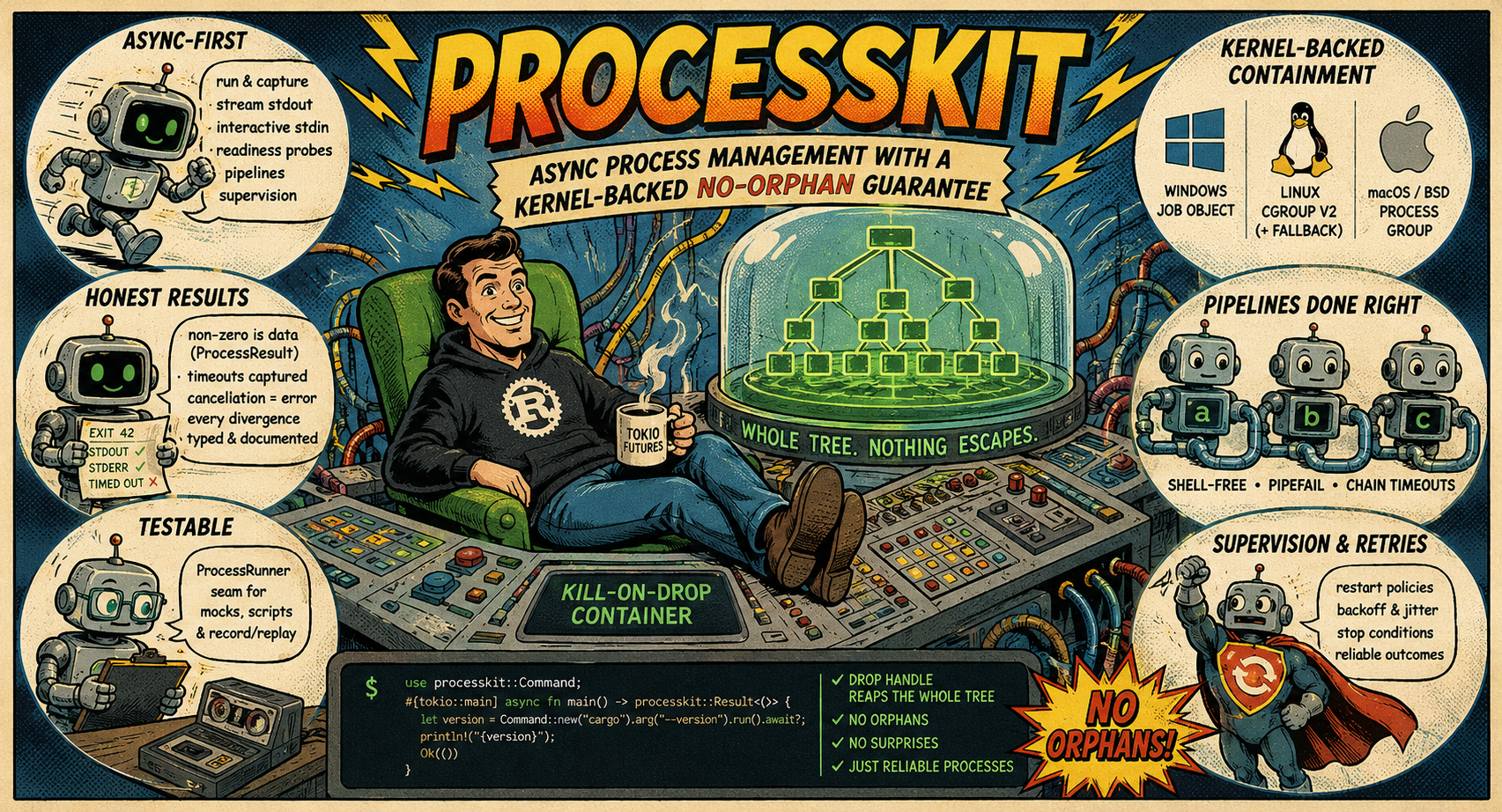
Why processkit?
std::process and tokio::process reach (at most) the direct child. The
processes it spawned — a build tool's compiler children, the real payload
behind a wrapper (cmd /c …, sh -c …), a test's helper servers — survive a
timeout, a panic, or a dropped future, and keep running as orphans.
processkit spawns every child into the operating system's own containment
primitive — a Job Object on Windows, a cgroup v2 on Linux (with a
process-group fallback), a POSIX process group on macOS/BSD — so teardown
is a kernel operation over the whole tree, not a best-effort signal to one pid:
- Nothing escapes silently. Dropping the handle or group reaps every
descendant, grandchildren included. Where a mechanism has a genuine weakness
(a
setsidchild escapes a POSIX process group), the activeMechanismis reported instead of pretending — never a silent downgrade. - Async-first. Run-and-capture, line streaming, interactive stdin, readiness probes, shell-free pipelines, supervision — all tokio futures.
- Honest results. A non-zero exit is data (
ProcessResult) until you ask for success; a timeout is captured in the result; a cancellation is always an error; every platform divergence is typed or documented. - Testable. One trait seam (
ProcessRunner) swaps the real spawner for scripted doubles or record/replay cassettes — no subprocess in your tests.
How it compares
| whole-tree kill-on-drop | async | limits / stats | streaming · pipelines · supervision | |
|---|---|---|---|---|
std::process | — | — | — | — |
tokio::process | — | ✓ | — | — |
command-group | ✓ | ✓ | — | — |
async-process | — | ✓ (smol) | — | — |
duct | — | — | — | pipelines |
processkit | ✓ | ✓ (tokio) | ✓ | ✓ |
The first column is the differentiator: a child's descendants are contained and reaped as a unit (Job Object / cgroup v2 / process group), not just the direct child.
Status: stable — current release 2.2.1. The public API follows Semantic Versioning: breaking changes land only in a new major version, so
2.xupgrades are backward-compatible. SeeCHANGELOG.md.
Install
cargo add processkit
This crate requires a tokio runtime. Minimum Supported Rust Version: 1.88.
Picking a verb
Every run starts with the same builder; the verb you finish with decides what you get back:
| You want | Call | You get |
|---|---|---|
| stdout, success required | .run() | trimmed String; non-zero exit / timeout / kill → typed Error |
| the full outcome, exit code as data | .output_string() / .output_bytes() | ProcessResult — code, stdout, stderr, timed_out; never errors on non-zero |
| just the exit code | .exit_code() | i32 (a timed-out / killed run errors instead of inventing -1) |
| a yes/no answer | .probe() | bool — exit 0 → true, 1 → false, anything else errors |
| a typed value from stdout | .parse(|s| …) / .try_parse(|s| …) | T — success required; fails loud on a truncated capture |
| the first matching output line | .first_line(|l| …) | Option<String> — None when stdout closes without a match |
| a live handle — streaming, stdin, probes | .start() | RunningProcess |
The same vocabulary repeats on every layer (ProcessRunner, CliClient), and
processkit::run("git", ["status"]) / processkit::output_string(…) skip the builder
for one-liners.
Quick start
use processkit::{Command, ProcessGroup, Stdin};

#[tokio::main]
async fn main() -> processkit::Result<()> {
    // Capture output; a non-zero exit does not error on its own.
    let result = Command::new("git").args(["rev-parse", "HEAD"]).output_string().await?;
    println!("HEAD is {}", result.stdout().trim());

    // Require success and get trimmed stdout directly.
    let version = Command::new("cargo").arg("--version").run().await?;
    println!("{version}");

    // Feed stdin.
    let sorted = Command::new("sort")
        .stdin(Stdin::from_string("banana\napple\n"))
        .output_string()
        .await?;
    println!("{}", sorted.stdout());

    // Share one kill-on-drop group across several children; dropping the group
    // reaps the whole tree.
    let group = ProcessGroup::new()?;
    let _server = group.start(&Command::new("some-server")).await?;
    // ... work ...
    group.shutdown().await?; // graceful SIGTERM → wait → SIGKILL (Unix); atomic on Windows

    Ok(())
}
Documentation
This page is the quick tour. The guide set in the sidebar goes deeper on every capability, with more examples and the platform fine print collected in one place. New here? Skim the Cookbook first — it maps "I want to …" tasks to working snippets — then read Running commands end to end:
| Guide | Covers |
|---|---|
| Cookbook | Task → snippet recipes for everything below; the fastest way in |
| Running commands | The full Command builder and every consuming verb, with error semantics |
| Process groups | Containment, teardown, signals, suspend/resume, members, limits, stats |
| Streaming & interactive I/O | Line streaming, conversational stdin, readiness probes, wait_any, profiling |
| Pipelines | Shell-free a | b | c, pipefail attribution, chain timeouts |
| Timeouts, retries & cancellation | Captured vs raised deadlines, retry classifiers, CancellationToken |
| Supervision | Restart policies, backoff & jitter, stop conditions, outcomes |
| Testing your code | The ProcessRunner seam, scripted/recording/mock doubles, cassettes, CliClient |
| Platform support | Mechanisms, all capability matrices, every caveat |
| Upgrading | Per-version consumer upgrade notes — what changed on each release and how to migrate across a major bump |
API reference: docs.rs/processkit.
Using Python instead of Rust? The processkit-py wrapper
provides matching synchronous and asyncio APIs over this same native core,
including context-manager teardown, streaming, pipelines, supervision, resource
limits, and the runner testing seam.
Source, changelog, and development history live in the Rust repository.
Feature flags
Each flag is additive and only gates visibility — the kill-on-drop tree guarantee is unconditional in every configuration.
| Feature | Default | Adds |
|---|---|---|
process-control | ✅ | Signal, ProcessGroup::{signal, suspend, resume, members, adopt} |
stats | — | group/per-run resource measurement, sample_stats, profile (enables an additional windows-sys API feature on Windows) |
limits | — | whole-tree resource caps (implies stats) |
record | — | record/replay cassettes (pulls serde) |
mock | — | mockall-generated MockRunner (test-only; its surface is semver-exempt — prefer ScriptedRunner/RecordingRunner) |
tracing | — | lifecycle events: spawn/exit, timeout/cancel, teardown, retries, storms (never argv/env) |
Capping a group's resources
Requires the limits feature (off by default) — add it to the dependency:
processkit = { version = "…", features = ["limits"] }
ProcessGroupOptions can then bound the whole tree's memory, process count, and CPU
at creation, so a runaway or untrusted child tree can't exhaust the host:
use processkit::{Command, ProcessGroup, ProcessGroupOptions};

#[tokio::main]
async fn main() -> processkit::Result<()> {
    let group = ProcessGroup::with_options(
        ProcessGroupOptions::default()
            .max_memory(512 * 1024 * 1024) // 512 MiB across the tree
            .max_processes(64)
            .cpu_quota(0.5),               // half of one core
    )?;
    let _job = group.start(&Command::new("untrusted-tool")).await?;
    // ... work ...
    Ok(())
}
cpu_quota is a fraction of a single core (0.5 = half a core, 2.0 = two
cores); on Windows it is converted against the host's CPU count and is approximate.
Limits need a real container — a Windows Job Object or a Linux cgroup v2.
There is no whole-tree limit on macOS/the BSDs or the Linux process-group fallback.
A Linux cgroup limit additionally needs this process to run
at the real cgroup-v2 root: the crate creates the limit cgroup under this process's
own cgroup and enables the controllers there, which cgroup v2's "no internal processes"
rule allows only for the real hierarchy root — not a cgroup-namespace root (so an
ordinary container EBUSYs too), and not under a systemd session/scope/service. The crate
does not migrate your process to work around it, so in practice limits apply only at a
minimal non-systemd init. When a requested limit can't be enforced, with_options
returns Error::ResourceLimit instead of a silently-unbounded group — an unapplied cap
is no protection.
Deeper: Process groups → resource limits.
Signalling and pausing the whole tree
Beyond the kill/shutdown teardown verbs, a group can broadcast a signal to every member or freeze and thaw the whole tree:
use processkit::{Command, ProcessGroup, Signal};

#[tokio::main]
async fn main() -> processkit::Result<()> {
    let group = ProcessGroup::new()?;
    let _server = group.start(&Command::new("my-server")).await?;

    group.signal(Signal::Hup)?; // e.g. "reload configuration"
    group.suspend()?;           // freeze the whole tree…
    group.resume()?;            // …and let it run again
    Ok(())
}
Signals are POSIX-only: on Windows just Signal::Kill is deliverable (it maps to
the Job Object terminate) and anything else returns Error::Unsupported.
Signal::Kill always takes the same whole-tree hard-kill path as
kill_all(). Suspend/resume work everywhere a container exists — one
cgroup.freeze write covering the subtree on Linux, SIGSTOP/SIGCONT on
macOS/BSD and the Linux process-group fallback (both idempotent), and
per-thread suspension on Windows (best-effort; only there nested suspends
stack and need matching resumes).
Deeper: Process groups → signals, suspend/resume.
Inspecting the tree
members() snapshots the live member pids, and wait_any races several running
processes, reporting whichever exits first — the natural primitive for
supervising a few long-lived children:
use processkit::{Command, ProcessGroup, wait_any};

#[tokio::main]
async fn main() -> processkit::Result<()> {
    let group = ProcessGroup::new()?;
    let mut a = group.start(&Command::new("server-a")).await?;
    let mut b = group.start(&Command::new("server-b")).await?;

    println!("live pids: {:?}", group.members()?);

    // Borrows only: the loser stays usable after the race.
    let (idx, outcome) = wait_any(&mut [&mut a, &mut b]).await?;
    println!("contender #{idx} exited first with {outcome:?}");
    Ok(())
}
members() lists the whole tree on Windows (Job Object) and Linux (cgroup); the
POSIX process-group backends list the tracked group leaders only. (members
is part of the default-on process-control feature; wait_any is always
available.) wait_any applies no per-process timeout (bound the race with
tokio::time::timeout) and does no output pumping — drain chatty children
first.
Deeper: Process groups → members · Streaming → racing children.
Running many at once
wait_any's siblings cover the join and fan-out cases. wait_all joins a
fixed set of handles you already hold, returning every outcome in order;
output_all runs a whole batch of commands with a concurrency cap, so
fanning out hundreds of commands can't exhaust file descriptors or the process
table:
use processkit::{Command, JobRunner, wait_all, output_all};

#[tokio::main]
async fn main() -> processkit::Result<()> {
    let group = processkit::ProcessGroup::new()?;
    let mut a = group.start(&Command::new("worker-a")).await?;
    let mut b = group.start(&Command::new("worker-b")).await?;
    let outcomes = wait_all(&mut [&mut a, &mut b]).await?; // both, in input order

    // 200 conversions, but never more than 8 processes alive at once.
    let cmds = (0..200).map(|i| Command::new("convert").arg(format!("{i}.png")));
    let results = output_all(cmds, 8, &JobRunner).await;
    let failed = results.iter().filter(|r| !matches!(r, Ok(o) if o.is_success())).count();
    println!("{:?}; {failed} conversions failed", outcomes);
    Ok(())
}
output_all is collect-all: each element is one command's independent
Result, so a non-zero exit (an Ok with a non-zero code) never short-circuits
the batch — the caller folds the outcomes. Pass &group instead of &JobRunner
to keep every child in one shared kill-on-drop group. It is deliberately not a
pool, scheduler, or retrier. For batches whose stdout is binary, output_all_bytes
is the identical fan-out with each result captured as Vec<u8>. wait_all shares
wait_any's two non-features (no per-process timeout, no output pumping).
Sampling stats over time
A point-in-time stats() becomes a series with sample_stats, and a single run
can be profiled end-to-end (requires the opt-in stats feature):
use processkit::prelude::StreamExt;
use processkit::{Command, ProcessGroup};
use std::time::Duration;

#[tokio::main]
async fn main() -> processkit::Result<()> {
    // A CPU/RSS/process-count series for a whole group:
    let group = ProcessGroup::new()?;
    let _worker = group.start(&Command::new("worker")).await?;
    let mut samples = group.sample_stats(Duration::from_millis(250));
    if let Some(s) = samples.next().await {
        println!("procs={} rss={:?}", s.active_process_count, s.peak_memory_bytes);
    }
    drop(samples);

    // …or a one-shot summary of a single run:
    let profile = Command::new("crunch")
        .start().await?
        .profile(Duration::from_millis(100)).await?;
    println!(
        "outcome={:?} took={:?} peak_rss={:?} avg_cpu_cores={:?}",
        profile.outcome, profile.duration, profile.peak_memory_bytes, profile.avg_cpu_cores(),
    );
    Ok(())
}
The series inherits stats()'s platform matrix (full CPU/memory on Windows and
Linux cgroup; counts only on the POSIX process-group backends); profile
samples the started child process itself and applies the run's normal
timeout/output handling.
Deeper: Process groups → stats · Streaming → profiling a run.
Supervising a long-lived child
Where Command::retry replays one run until it succeeds, a Supervisor keeps a
child alive: it restarts the command per policy whenever it exits, with
bounded restarts and exponential backoff (jittered by default so a restarted
fleet doesn't stampede):
use processkit::{Command, RestartPolicy, Supervisor};
use std::time::Duration;

#[tokio::main]
async fn main() -> processkit::Result<()> {
    let outcome = Supervisor::new(Command::new("my-server").args(["--port", "8080"]))
        .restart(RestartPolicy::OnCrash)          // Always | OnCrash | Never
        .max_restarts(5)
        .backoff(Duration::from_millis(200), 2.0) // base, multiplier (cap: .max_backoff)
        .storm_pause(Duration::from_secs(15))     // crash-loop guard (off by default)
        .stop_when(|res| res.code() == Some(0))   // a clean exit ends supervision
        .run()
        .await?;
    println!("ended after {} restarts: {:?}", outcome.restarts, outcome.stopped);
    Ok(())
}
run() reports a SupervisionOutcome — the final run's result, the restart
count, and why supervision stopped. The opt-in failure-storm guard
distinguishes "fails rarely" from "crash-looping": each failure feeds a score
that halves every failure_decay; past failure_threshold the supervisor
takes one collective storm_pause instead of hammering restarts at backoff
speed. Supervision is platform-agnostic and runs through the ProcessRunner
seam: pass .with_runner(&group) to keep every incarnation in one shared
kill-on-drop group, or a ScriptedRunner to test supervision logic
hermetically.
Deeper: Supervision.
Waiting for a child to be ready
"Start a server, then use it" needs the server to be ready, not merely started. Three probes replace the arbitrary sleep:
use processkit::Command;
use std::time::Duration;

#[tokio::main]
async fn main() -> processkit::Result<()> {
    let mut run = Command::new("my-server").start().await?;

    // Wait for the startup banner (returns the matching line)…
    let banner = run
        .wait_for_line(|l| l.contains("listening on"), Duration::from_secs(10))
        .await?;
    println!("server says: {banner}");

    // …or for the port to accept connections…
    let addr = "127.0.0.1:8080".parse().expect("valid socket address");
    run.wait_for_port(addr, Duration::from_secs(10)).await?;

    // …or for any async health check to pass.
    run.wait_for(|| async { health_check().await }, Duration::from_secs(10)).await?;

    // ready — use the server …
    Ok(())
}

async fn health_check() -> bool {
    // e.g. probe an HTTP /health endpoint
    true
}
A probe that doesn't pass within its deadline — or that can no longer pass
(the child exits; for wait_for_line, its stdout closes) — fails with
Error::NotReady (distinct from Error::Timeout, which is the run's own
Command::timeout) and does not kill the child: the caller decides what
happens next. wait_for_line consumes stdout up to the match
(continue with finish); wait_for_port / wait_for don't touch
the pipes at all.
Deeper: Streaming → readiness probes.
Pipelines without a shell
a | b | c without a shell string — stages connected in-process (a relay, not a
shell), so no quoting or injection surface, and every stage lives in one shared
kill-on-drop group:
use processkit::Command;

#[tokio::main]
async fn main() -> processkit::Result<()> {
    let out = Command::new("git").args(["log", "--format=%an"])
        .pipe(Command::new("sort"))
        .pipe(Command::new("uniq").arg("-c"))
        .output_string()
        .await?;
    println!("{}", out.stdout());
    Ok(())
}
The | operator is equivalent sugar: (a | b | c).run().
The outcome is pipefail: stdout is the last stage's output, while the
exit code, stderr, and reported program come from the first stage that didn't
exit cleanly (or the last stage when all succeed). For a consumer that
legitimately stops reading early — the producer | head -1 shape, where the
producer's broken-pipe death (its next write fails once the downstream closes)
is expected — mark that stage .unchecked_in_pipe() and pipefail skips it (a
checked failure still always wins).
The first stage's stdin source is honored; inner stages read from the pipe.
.timeout(d) bounds the whole chain (killing every stage at the deadline),
and run() requires every stage to succeed, returning the trimmed final
stdout.
Deeper: Pipelines.
Environment and privileges
Spawn-time controls for sandboxing and service launch:
use processkit::Command;

#[tokio::main]
async fn main() -> processkit::Result<()> {
    Command::new("worker")
        .inherit_env(["PATH", "HOME", "LANG"]) // allow-list on a cleared env
        .uid(1000).gid(1000)                   // Unix: drop privileges
        .setsid()                              // Unix: new session
        .run()
        .await?;

    Command::new("helper")
        .create_no_window()                    // Windows: no console window
        .run()
        .await?;

    Command::new("daemonish")
        .kill_on_parent_death()                // die with a SIGKILLed parent
        .start()
        .await?;
    Ok(())
}
inherit_env clears the environment and copies only the named parent vars
(explicit env/env_remove still apply on top); it works everywhere. uid /
gid (group id is set before user id) and setsid are POSIX-only — on other
targets the run fails with Error::Unsupported rather than silently skipping
a privilege drop. One Linux caveat: under the cgroup mechanism the child
joins its cgroup after the uid has already dropped, and the auto-created
cgroup isn't writable by the target user — the spawn fails with a permission
error (never an uncontained child); privilege drop currently composes cleanly
with the process-group mechanism. setsid keeps containment: the group
tracks the new session's process group. create_no_window is a harmless
no-op outside Windows and, unlike the raw ProcessGroup::spawn escape hatch,
survives the group's CREATE_SUSPENDED containment flag (they are OR'd
together). kill_on_parent_death hardens the one case Drop can't cover —
the parent dying abruptly (SIGKILL): Windows already guarantees it (the job
handle closes with the process), Linux arms PDEATHSIG on the direct child,
macOS/BSD have no equivalent (documented no-op).
Deeper: Running commands → privileges and spawn flags.
Cancelling a run
Hand a command a
CancellationToken (re-exported from tokio-util); cancelling the token
kills the process tree, and every consuming path reports Error::Cancelled:
use processkit::{CancellationToken, Command};

#[tokio::main]
async fn main() -> processkit::Result<()> {
    let token = CancellationToken::new();

    let job = tokio::spawn({
        let token = token.child_token();
        async move {
            Command::new("long-job").cancel_on(token).run().await
        }
    });

    // elsewhere — a shutdown signal, a sibling failure, a UI button:
    token.cancel();

    assert!(matches!(job.await.unwrap(), Err(processkit::Error::Cancelled { .. })));
    Ok(())
}
Unlike a timeout — whose expiry is captured in the result as timed_out —
cancellation is always an error: the run was abandoned, so there is no
result to inspect. When a cancel and a timeout land together, cancellation
wins. A token cancelled before the run starts short-circuits without
spawning anything. On a shared ProcessGroup handle, cancelling kills the
child itself but leaves the group's siblings alone (same scope as a timeout),
and a supervised command that gets cancelled stops its Supervisor for good —
restarting into a still-cancelled token would loop futilely.
For a typed wrapper whose commands never cross your code, set the token once
on the client: CliClient::new("gh").default_cancel_on(token.child_token())
— cancelling it kills every in-flight command of that client.
Deeper: Timeouts, retries & cancellation.
Async streaming and interactive I/O
The one-shot helpers above buffer the whole output. For long-running or
conversational children, start() returns a live RunningProcess you can
drive asynchronously.
Stream stdout line by line
Process each line as it arrives — no waiting for the child to exit, no buffering
the full output. StreamExt (from processkit::prelude, re-exported from
tokio-stream) provides .next():
use processkit::prelude::StreamExt;
use processkit::{Command, Outcome, Finished};

#[tokio::main]
async fn main() -> processkit::Result<()> {
    let mut run = Command::new("git")
        .args(["log", "--oneline", "-n", "50"])
        .start()
        .await?;

    let mut lines = run.stdout_lines()?;
    while let Some(line) = lines.next().await {
        println!("commit: {line}");
    }

    // After the stream ends, collect the outcome and whatever went to stderr
    // (drained in the background while you streamed stdout). The `Outcome`
    // distinguishes a clean exit, a signal kill, and a timeout.
    let Finished { outcome, stderr, .. } = run.finish().await?;
    if outcome != Outcome::Exited(0) {
        eprintln!("git ended {outcome:?}: {stderr}");
    }
    Ok(())
}
The command's
timeoutbounds the stream: at the deadline the tree is killed, the pipes close, and the stream ends (on a handle that owns its group — thestart()path). Acancel_ontoken ends the stream the same way, and the followingfinishreportsError::Cancelled. For an ad-hoc bound, wrapping the loop intokio::time::timeoutand dropping the handle (which kills the tree) still works.
Interactive stdin — write requests, read responses
Keep stdin open with keep_stdin_open(), take the writer with
take_stdin(), then interleave async writes and reads:
use processkit::prelude::StreamExt;
use processkit::Command;

// `ProcessStdin`'s writer methods return `std::io::Result` (idiomatic for a
// writer), so this example uses `Box<dyn std::error::Error>` to mix them with the
// crate's `Result`; in a `processkit::Result` function, `.map_err(processkit::Error::Io)?`.
#[tokio::main]
async fn main() -> Result<(), Box<dyn std::error::Error>> {
    // `bc` evaluates each stdin line and prints the result on stdout.
    let mut run = Command::new("bc").keep_stdin_open().start().await?;

    let mut stdin = run.take_stdin().expect("stdin was kept open");
    stdin.write_line("2 + 2").await?;
    stdin.write_line("6 * 7").await?;
    stdin.finish().await?; // send EOF so bc finishes

    let mut answers = run.stdout_lines()?;
    while let Some(answer) = answers.next().await {
        println!("bc says: {answer}");
    }
    Ok(())
}
Writing the whole input before reading is fine for a small payload like this. For a large interactive stdin, drain stdout concurrently (write from one task, read
stdout_linesfrom another) — otherwise the child can block writing stdout while you block writing stdin, a full-duplex deadlock. See the note in Streaming & interactive I/O. (The non-interactiveStdin::from_*sources are written on a background task and never deadlock.)
Feed stdin from an async stream, react to stdout as it's read
Stdin::from_lines writes each item of any Stream<Item = String> as a line —
back it with a channel, a file tail, or a network source. Pair it with
on_stdout_line / on_stderr_line to handle output inline (the handler runs on
the read pump, in addition to capture):
use processkit::{Command, Stdin};
use tokio_stream::iter; // any `Stream<Item = String>` works

#[tokio::main]
async fn main() -> processkit::Result<()> {
    let input = iter(vec!["banana".to_owned(), "apple".to_owned(), "cherry".to_owned()]);

    let result = Command::new("sort")
        .stdin(Stdin::from_lines(input))
        .on_stdout_line(|line| println!("sorted: {line}"))
        .output_string()
        .await?;
    let _ = result; // already printed line by line above
    Ok(())
}
Deeper: Streaming & interactive I/O.
Wrapping a CLI tool
CliClient + the cli_client! macro turn a typed wrapper around an external
tool (git, jj, gh, …) into just its parsers — the runner is injectable, so
the wrapper is hermetically testable with a ScriptedRunner (no subprocess).
The seam covers streaming too: a scripted start() feeds canned lines
through the same pump machinery, so stdout_lines/wait_for_line-based
orchestration tests hermetically as well:
#![allow(unused)]
fn main() {
use processkit::{cli_client, ProcessRunner, Result};
use std::path::Path;

cli_client!(pub struct Git => "git");

impl<R: ProcessRunner> Git<R> {
    async fn head(&self, dir: &Path) -> Result<String> {
        self.core.run(self.core.command_in(dir, ["rev-parse", "HEAD"])).await
    }
}
}
Deeper: Testing your code → CliClient.
Recording and replaying runs
Requires the record feature (off by default). RecordReplayRunner turns
real runs into a JSON cassette once, then replays them deterministically —
fast, hermetic, no subprocess in CI:
use processkit::{Command, JobRunner, ProcessRunnerExt};
use processkit::testing::RecordReplayRunner;

#[tokio::main]
async fn main() -> processkit::Result<()> {
    // Record once against the real tool (e.g. an opt-in `--record` test run):
    let runner = RecordReplayRunner::record("fixtures/git.json", JobRunner::new());
    let version = runner.run(&Command::new("git").arg("--version")).await?;
    runner.save()?; // or best-effort on drop

    // Replay everywhere else — no subprocess, identical results:
    let runner = RecordReplayRunner::replay("fixtures/git.json")?;
    assert_eq!(runner.run(&Command::new("git").arg("--version")).await?, version);
    Ok(())
}
Entries are matched by program + args + cwd + a stdin source digest (hashed,
never persisted: in-memory bytes hash their content, a from_file source hashes
its path). Environment override values never reach the file — only the
sorted variable names, so env values can't leak through a committed fixture (and
env differences can't cause spurious misses). Note: argv, cwd, stdout, and
stderr are stored verbatim and can carry secrets (a --password=… flag, a
token echoed to output) — review a fixture before committing it; on Unix the
file is written 0600. When one invocation was recorded
several times, replay serves the entries in capture order and then repeats the
last one — a recorded sequence of changing outputs replays faithfully, while
retry/probe loops keep getting a stable final answer. An invocation absent from
the cassette is a strict Error::CassetteMiss (distinct from a missing program,
so is_not_found() is false; replay never spawns a surprise subprocess), and
the file carries a format version so future readers fail loudly instead of
misreading old fixtures.
Deeper: Testing your code → record/replay.
Contributing
Running the tests and the maintainer-only release process are documented in the contribution guide.
License
Licensed under the MIT License.
Python wrapper
processkit-py brings ProcessKit's
kernel-backed process-tree containment to Python. It is a thin, typed
PyO3 binding over the Rust crate rather than a separate
implementation: Job Objects, cgroup v2, POSIX process groups, process I/O, and
the teardown state machine remain in Rust.
The Python layer adds the conventions Python applications need:
- matching synchronous and asyncio APIs;
- deterministic
with/async withteardown; - Python exception types with structured fields;
- complete type stubs and a
ProcessRunnerprotocol; - prebuilt wheels with the optional Rust capabilities already enabled.

Published package: processkit-py on PyPI
Source: ZelAnton/processkit-py
Full guides: processkit-py/docs.
Install
The distribution name is processkit-py; the import name is processkit:
pip install processkit-py
Version 1.0 supports CPython 3.10 and newer. The project publishes abi3 wheels for regular CPython and a version-specific wheel for free-threaded CPython 3.14t. A source distribution is available for platforms without a matching wheel.
The wrapper currently pins Rust processkit 1.2.0 and enables
process-control, limits, record, and tracing. Unlike Cargo's optional
feature model, every Python wheel exposes one complete API; there are no extras
to select at installation time.
Sync and asyncio
Run-to-completion operations have a synchronous name and an a-prefixed
asyncio twin. Both return the same result types and use the same Rust runtime
semantics:
| Operation | Synchronous | Asyncio |
|---|---|---|
| capture a full result | output() | await aoutput() |
| require success | run() | await arun() |
| read the exit code | exit_code() | await aexit_code() |
| run a 0/1 predicate | probe() | await aprobe() |
| start a live process | start() | await astart() |
from processkit import Command

# Non-zero exit is data: inspect code, stdout, stderr, and timed_out.
result = Command("git", ["status", "--short"]).output()

# Require an accepted exit and return trimmed stdout.
version = Command("python", ["--version"]).run()
The same operations compose naturally under asyncio:
import asyncio
from processkit import Command

async def main() -> None:
    result = await Command("git", ["rev-parse", "HEAD"]).aoutput()
    print(result.stdout.strip())

asyncio.run(main())
Cancelling an awaited run drops the underlying Rust future and tears down its
owned process tree. Blocking calls release the GIL while Rust waits and check
for Python signals, so Ctrl+C can interrupt a synchronous run instead of
waiting for the child to finish.
Whole-tree containment
ProcessGroup is a synchronous and asynchronous context manager. Everything
started into it shares one containment object and is torn down when the block
exits:
from processkit import Command, ProcessGroup

with ProcessGroup() as group:
    group.start(Command("dev-server"))
    group.start(Command("worker"))
    print(group.mechanism)  # job_object | cgroup_v2 | process_group
    print(group.members())
Use the context managers for deterministic cleanup. Windows Job Objects also
close when the process loses its last kernel handle. On Unix, cleanup requires
Python to execute the teardown path; an uncatchable SIGKILL cannot run it.
The POSIX process-group backend also has the same documented setsid escape
caveat as the Rust crate. Inspect group.mechanism when the stronger cgroup or
Job Object guarantee matters.
Group resource limits, statistics, signals, suspend/resume, kill_all(), and
graceful shutdown are exposed directly. Limits require a Windows Job Object or
a writable Linux cgroup-v2 root; an unenforceable limit raises ResourceLimit
instead of being silently ignored.
Streaming and interactive processes
RunningProcess exposes asyncio-native streaming and stdin. Its result methods
consume the handle, matching Rust ownership explicitly: after wait(),
finish(), output(), output_bytes(), profile(), or shutdown(), the
Python handle is spent.
from processkit import Command

async with await Command("my-build", ["--watch"]).astart() as proc:
    async for line in proc.stdout_lines():
        print(line)
Interactive commands use keep_stdin_open() and take_stdin(). Readiness is
provided by the composable Python helpers wait_for, wait_for_line, and
wait_for_port.
Pipelines, supervision, and batch runs
The higher-level Rust features have Python-native surfaces:
Command(...) | Command(...)creates a shell-freePipelinewith pipefail attribution;Supervisorkeeps a command alive using restart, backoff, and storm-guard policies;output_all/aoutput_allrun a bounded batch and preserve input order;CliClientbinds one executable to shared timeout and environment defaults.
Builders are immutable: configuration methods return a new Command, so a
base command can be safely reused for several variants.
Errors and results
Like the Rust API, output() treats a non-zero exit and timeout as inspectable
result data. Success-checking verbs raise typed exceptions when the outcome is
not accepted.
| Python exception | Additional compatibility |
|---|---|
NonZeroExit | carries program, code, stdout, and stderr |
Timeout | also a built-in TimeoutError |
ProcessNotFound | also a built-in FileNotFoundError |
PermissionDenied | also a built-in PermissionError |
Signalled | carries the signal and captured output |
ResourceLimit / Unsupported / OutputTooLarge | preserves the corresponding Rust failure category |
Every package-specific exception derives from ProcessError.
Testing without subprocesses
Application code can depend on the typed ProcessRunner protocol and receive a
real Runner in production. Tests can inject the doubles exported from
processkit.testing:
ScriptedRunnerreturns canned replies and supports scripted streaming;RecordingRunnerrecords invocations for assertions;RecordReplayRunnerrecords real runs to a cassette and replays them without spawning;Replydescribes successful, failed, timed-out, signalled, pending, or line-streamed outcomes.
from processkit import Command
from processkit.testing import Reply, ScriptedRunner

runner = ScriptedRunner()
runner.on(["git", "rev-parse"], Reply.ok("abc123\n"))

assert runner.run(Command("git", ["rev-parse", "HEAD"])) == "abc123"
The package ships py.typed and a complete hand-written .pyi surface, checked
against the compiled extension with mypy.stubtest.
Where to continue
The Python repository contains the detailed
Cookbook,
migration guide from subprocess,
command reference,
streaming guide,
and platform matrix.
Cookbook
Task-oriented recipes: find the thing you're trying to do, copy the snippet,
follow the link when you need the fine print. Every snippet assumes a tokio
runtime and use processkit::Command; unless shown otherwise.
- Run a command and get its output
- Inspect a failure instead of erroring
- Ask a yes/no question
- Accept non-zero exit codes as success
- Bound a run with a timeout
- Let a tool clean up on timeout
- Show a useful error message
- Feed the child's stdin
- Stream output as it arrives
- Talk to an interactive child
- Pipe commands without a shell
- Start a server and wait until it's ready
- Tear down several children as a unit
- React to whichever child exits first
- Sandbox an untrusted tool
- Keep a crash-prone service running
- Retry a flaky command
- Cancel runs on shutdown
- Measure what a run cost
- Contain a process you didn't spawn
- Test code that runs processes — without processes
- Test streaming code — without processes
- Wrap a CLI tool behind a typed API
Run a command and get its output
#![allow(unused)]
fn main() {
let head = Command::new("git").args(["rev-parse", "HEAD"]).run().await?;
}
run() requires a zero exit and returns stdout with trailing whitespace
trimmed; a non-zero exit, spawn failure, or timeout is a typed Error. For a
one-liner without the builder: processkit::run("git", ["rev-parse", "HEAD"]).
Fine print: Running commands → consuming verbs.
Inspect a failure instead of erroring
#![allow(unused)]
fn main() {
let result = Command::new("git").args(["merge", "topic"]).output_string().await?;
if !result.is_success() {
    eprintln!("merge exited {:?}: {}", result.code(), result.stderr());
}
}
output_string() (and output_bytes() for raw bytes) treats the exit code as
data — Err means the run couldn't happen at all. Call
result.ensure_success()? later to convert a stored failure into the same
typed error run() would have produced.
Fine print: Running commands → results and errors.
Ask a yes/no question
#![allow(unused)]
fn main() {
let dirty = !Command::new("git").args(["diff", "--quiet"]).probe().await?;
}
probe() maps exit 0 → true, exit 1 → false, and anything else to an
error — the git diff --quiet / grep -q convention without manual code
matching.
Accept non-zero exit codes as success
#![allow(unused)]
fn main() {
// `grep` exits 1 when it finds no match — not a failure for this call.
let found = Command::new("grep")
    .args(["needle", "haystack.txt"])
    .ok_codes([0, 1])
    .output_string()
    .await?;
let matched = found.code() == Some(0); // 0 = matched, 1 = no match (both "success")
}
ok_codes widens what the checking verbs (run/run_unit) and
is_success/ensure_success treat as success — for tools whose non-zero exit is a
normal result (grep 1 = no match, diff 1 = differs, rsync's code families). It
does not change exit_code (always the raw code) or probe (always the 0/1
convention). An empty set is ignored, so the default stays exit 0.
Bound a run with a timeout
#![allow(unused)]
fn main() {
use std::time::Duration;

let result = Command::new("slow-tool")
    .timeout(Duration::from_secs(30))
    .output_string()
    .await?;
if result.timed_out() {
    eprintln!("gave up after 30s; partial output: {}", result.stdout());
}
}
At the deadline the whole tree is killed. On the capture verbs the timeout is
captured (timed_out(), partial output kept); on the success-checking verbs
(run, exit_code) it surfaces as Error::Timeout.
Let a tool clean up on timeout
#![allow(unused)]
fn main() {
use std::time::Duration;

let result = Command::new("dev-server")
    .timeout(Duration::from_secs(30))
    .timeout_grace(Duration::from_secs(5)) // SIGTERM, wait up to 5s, then SIGKILL
    .output_string()
    .await?;
}
timeout_grace turns the hard deadline kill into a graceful one: SIGTERM (or the
signal from timeout_signal, with the process-control feature), up to the grace
window to exit, then SIGKILL. A signal-handling child exits early; timed_out()
stays true. Windows has no signal tier — the deadline kills atomically.
Fine print: Timeouts → graceful timeout.
Fine print: Timeouts, retries & cancellation.
Show a useful error message
#![allow(unused)]
fn main() {
if let Err(e) = Command::new("git").args(["merge", "topic"]).run().await {
    eprintln!("merge failed: {}", e.diagnostic().unwrap_or("(no output)"));
}
}
Error::diagnostic() picks the most explanatory captured text — stderr,
falling back to stdout (git writes CONFLICT … there) — so callers don't
re-implement the same heuristic.
Feed the child's stdin
#![allow(unused)]
fn main() {
use processkit::Stdin;

// A string you already have:
let sorted = Command::new("sort")
    .stdin(Stdin::from_string("banana\napple\n"))
    .run()
    .await?;

// …or any async source: a reader (file, socket) or a stream of lines.
let from_file = Stdin::from_reader(tokio::fs::File::open("input.txt").await?);
let from_chan = Stdin::from_lines(tokio_stream::iter(vec!["one".to_owned()]));
}
One-shot sources (from_reader/from_lines) feed a single run; re-running the
same Command afterwards fails loud (an Error::Io at launch, D10) instead
of silently seeing empty stdin. For a conversation, see the next recipe but one.
Fine print: Running commands → standard input.
Stream output as it arrives
#![allow(unused)]
fn main() {
use processkit::Finished;
use processkit::prelude::StreamExt; // provides `.next()`

let mut run = Command::new("cargo").args(["build", "--verbose"]).start().await?;
let mut lines = run.stdout_lines()?;
while let Some(line) = lines.next().await {
    println!("build: {line}");
}
let Finished { outcome, stderr, .. } = run.finish().await?; // outcome + buffered stderr
}
No waiting for exit, no full-output buffering; stderr is drained in the
background so the child can't block. A timeout on the command bounds the
stream itself. Prefer a callback? .on_stdout_line(|l| …) runs one per line
while any capture verb drives the run.
Fine print: Streaming & interactive I/O.
Talk to an interactive child
#![allow(unused)]
fn main() {
use processkit::prelude::StreamExt;

let mut run = Command::new("bc").keep_stdin_open().start().await?;
let mut stdin = run.take_stdin().expect("stdin was kept open");
stdin.write_line("2 + 2").await?;
stdin.finish().await?; // EOF — bc exits

let mut answers = run.stdout_lines()?;
while let Some(answer) = answers.next().await {
    println!("{answer}");
}
}
keep_stdin_open() hands you an async writer instead of closing stdin at
spawn; interleave writes with reads for request/response tools. Its writer
methods return std::io::Result (idiomatic for a writer) — convert with
.map_err(processkit::Error::Io)? in a processkit::Result function, or use
Box<dyn std::error::Error>.
Fine print: Streaming & interactive I/O → interactive stdin.
Pipe commands without a shell
#![allow(unused)]
fn main() {
let authors = Command::new("git").args(["log", "--format=%an"])
    .pipe(Command::new("sort"))
    .pipe(Command::new("uniq").arg("-c"))
    .output_string()
    .await?;
}
Native pipes — no shell string, no quoting, no injection surface. The outcome
is pipefail: stdout comes from the last stage, the reported failure from
the first stage that didn't exit cleanly. All stages share one kill-on-drop
group. The | operator is equivalent sugar:
(a | b | c).output_string().
For a consumer that legitimately stops reading early — the | head -1 shape,
where the producer's broken-pipe death (its next write fails once the downstream
closes, or SIGPIPE where the OS delivers it) is expected — mark the producer
unchecked_in_pipe() so that death doesn't fail the chain:
#![allow(unused)]
fn main() {
let first = (Command::new("seq").args(["1", "1000000"]).unchecked_in_pipe()
    | Command::new("head").args(["-n", "1"]))
    .run()
    .await?;
}
Fine print: Pipelines → unchecked stages.
Start a server and wait until it's ready
#![allow(unused)]
fn main() {
use std::time::Duration;

let mut server = Command::new("my-server").args(["--port", "8080"]).start().await?;

// Pick the probe that matches how the server announces readiness:
server.wait_for_line(|l| l.contains("listening"), Duration::from_secs(10)).await?;
// server.wait_for_port("127.0.0.1:8080".parse().unwrap(), Duration::from_secs(10)).await?;
// server.wait_for(|| async { http_health().await }, Duration::from_secs(10)).await?;

// …use the server; dropping `server` kills its whole tree.
}
A probe that can't succeed fails fast with Error::NotReady and never kills
the child — you decide what happens next. No more sleep(2) and hoping.
Fine print: Streaming & interactive I/O → readiness probes.
Tear down several children as a unit
#![allow(unused)]
fn main() {
use processkit::ProcessGroup;

let group = ProcessGroup::new()?;
let _db = group.start(&Command::new("dev-db")).await?;
let _api = group.start(&Command::new("dev-api")).await?;

// Either: graceful — SIGTERM, bounded wait, optional SIGKILL escalation…
group.shutdown().await?;
// …or just drop(group): hard kill-on-drop of everything, grandchildren included.
}
The group is the unit of fate: a panic or early return anywhere reaps every
member. Configure the grace window via ProcessGroupOptions.
Fine print: Process groups.
React to whichever child exits first
#![allow(unused)]
fn main() {
use processkit::{ProcessGroup, wait_any};

let group = ProcessGroup::new()?;
let mut a = group.start(&Command::new("worker-a")).await?;
let mut b = group.start(&Command::new("worker-b")).await?;

let (idx, outcome) = wait_any(&mut [&mut a, &mut b]).await?;
println!("worker #{idx} exited first with {outcome:?}");
// `a` and `b` are only borrowed — the loser is still usable here.
}
Fine print: Streaming & interactive I/O → racing children.
Sandbox an untrusted tool
#![allow(unused)]
fn main() {
use processkit::{ProcessGroup, ProcessGroupOptions};

// Cap the whole tree (requires the `limits` feature; Windows Job / Linux cgroup):
let group = ProcessGroup::with_options(
    ProcessGroupOptions::default()
        .max_memory(512 * 1024 * 1024)
        .max_processes(64)
        .cpu_quota(0.5),
)?;

let result = group
    .start(
        &Command::new("untrusted-tool")
            .inherit_env(["PATH"]) // allow-list: everything else is cleared
            .timeout(std::time::Duration::from_secs(60)),
    )
    .await?
    .output_string()
    .await?;
}
Unenforceable limits are a hard Error::ResourceLimit, never a silently
unbounded group. On Unix, add .uid(…)/.gid(…) to drop privileges (note the
cgroup-mechanism caveat in the guide).
Fine print: Process groups → resource limits · Running commands → privileges.
Keep a crash-prone service running
#![allow(unused)]
fn main() {
use processkit::{RestartPolicy, Supervisor};
use std::time::Duration;

let outcome = Supervisor::new(Command::new("my-service"))
    .restart(RestartPolicy::OnCrash)
    .max_restarts(5)
    .backoff(Duration::from_millis(200), 2.0)
    .storm_pause(Duration::from_secs(15)) // crash-loop guard (off by default)
    .run()
    .await?;
println!(
    "stopped after {} restarts ({} storm pauses): {:?}",
    outcome.restarts, outcome.storm_pauses, outcome.stopped
);
}
Exponential backoff with jitter by default; stop_when(…) ends supervision on
a condition; .with_runner(&group) keeps every incarnation inside one shared
kill-on-drop group. storm_pause arms the failure-storm guard: failures feed
a decaying score, and past the threshold the supervisor takes one collective
pause instead of hammering restarts — "fails rarely" and "crash-looping" stop
being the same case.
Fine print: Supervision, failure storms.
Retry a flaky command
#![allow(unused)]
fn main() {
use processkit::Error;
use std::time::Duration;

let fetched = Command::new("git")
    .args(["fetch", "--quiet"])
    .timeout(Duration::from_secs(10))
    .retry(3, Duration::from_millis(200), |e| {
        matches!(e, Error::Timeout { .. })
            || e.diagnostic().is_some_and(|m| m.contains("Could not resolve host"))
    })
    .run()
    .await?;
}
The classifier sees the typed error and decides whether this failure is worth
another attempt; each attempt is a fresh process. retry replays a run to
success — for keeping a process alive, use a Supervisor (previous recipe).
Fine print: Timeouts, retries & cancellation → retry.
Cancel runs on shutdown
#![allow(unused)]
fn main() {
use processkit::CancellationToken;

let token = CancellationToken::new();

let job = tokio::spawn({
    let token = token.child_token();
    async move { Command::new("long-job").cancel_on(token).run().await }
});

// On Ctrl-C / shutdown signal / sibling failure:
token.cancel(); // kills the tree; the run resolves to Error::Cancelled
let outcome = job.await; // Err(Error::Cancelled { .. }) inside
}
Cancellation is always an error (the run was abandoned, there is no result),
beats a simultaneous timeout, and is terminal for retry and Supervisor
alike.
For a typed wrapper whose commands never cross your code, set the token once on the client — every command it builds carries it:
#![allow(unused)]
fn main() {
use processkit::{CancellationToken, CliClient};

let token = CancellationToken::new();
let gh = CliClient::new("gh").default_cancel_on(token.child_token());
// token.cancel() → every in-flight command of THIS client dies.
}
Fine print: Timeouts, retries & cancellation → cancellation, client-level default.
Measure what a run cost
#![allow(unused)]
fn main() {
use std::time::Duration;

// One run, summarized (requires the opt-in `stats` feature):
let profile = Command::new("crunch").start().await?.profile(Duration::from_millis(100)).await?;
println!("outcome={:?} took={:?} peak_rss={:?} avg_cpu_cores={:?}",
    profile.outcome, profile.duration, profile.peak_memory_bytes, profile.avg_cpu_cores());
}
For a live series over a whole group, group.sample_stats(every) yields a
Stream of snapshots. CPU/memory need a real container (Windows Job / Linux
cgroup); elsewhere you still get process counts.
Fine print: Process groups → stats · Streaming → profiling.
Contain a process you didn't spawn
#![allow(unused)]
fn main() {
use processkit::{Error, ProcessGroup};

// `tokio`/`std` calls return `io::Error`, which the crate does NOT auto-convert
// into `processkit::Error` (there is no blanket `From<io::Error>`, by design) —
// map it explicitly, or use a `Box<dyn std::error::Error>` / `anyhow` return in
// your own code so both error types `?` freely.
let child = tokio::process::Command::new("legacy-launcher")
    .spawn()
    .map_err(Error::Io)?;

let group = ProcessGroup::new()?; // `adopt` is part of `process-control` (default-on)
group.adopt(&child)?;            // from now on the group's teardown covers it
}
Adoption is best-effort by mechanism — on Windows/cgroup the whole running tree joins; on the POSIX process-group backends an exec'd child is contained individually (its future forks too, where it could be re-grouped). The guide spells out exactly what each mechanism can promise.
Fine print: Process groups → adopt · Platform support.
Test code that runs processes — without processes
#![allow(unused)]
fn main() {
use processkit::testing::{Reply, ScriptedRunner};

// Your code takes any `R: ProcessRunner`; in tests, hand it a script.
// Rules match on a prefix of the *program name followed by its arguments*
// (the first element is the program):
let runner = ScriptedRunner::new()
    .on(["git", "rev-parse"], Reply::ok("abc123\n"))
    .on(["git", "push"], Reply::fail(128, "remote: permission denied"))
    .fallback(Reply::ok(""));

// my_deploy(&runner).await? — no subprocess, fully deterministic.
}
RecordingRunner wraps any runner and captures every Invocation for
assertions; MockRunner (feature mock) gives mockall expectations;
DryRunRunner records the commands it would have run without executing
anything, for the simplest "did we call the right thing" checks; and the
record feature's RecordReplayRunner records real runs into a JSON
cassette once and replays them hermetically in CI.
Fine print: Testing your code.
Test streaming code — without processes
#![allow(unused)]
fn main() {
use processkit::{Command, Outcome, ProcessRunner, Finished};
use processkit::testing::{Reply, ScriptedRunner};
use std::time::Duration;

let runner = ScriptedRunner::new()
    .on(["gh", "run", "watch"], Reply::lines(["queued", "in_progress", "completed"])
        .with_line_delay(Duration::from_millis(50))); // paced delivery

let mut run = runner.start(&Command::new("gh").args(["run", "watch", "123"])).await?;
run.wait_for_line(|l| l.contains("completed"), Duration::from_secs(5)).await?;
let Finished { outcome, .. } = run.finish().await?;
assert_eq!(outcome, Outcome::Exited(0));
}
A scripted start() feeds the canned lines through the same pump
machinery a real child uses, so stdout_lines, the readiness probes, and
finish behave identically — and with_line_delay is deterministic
under #[tokio::test(start_paused = true)]. Canned output also replays
through on_stdout_line/on_stderr_line handlers on the bulk verbs, so
progress-reporting paths test hermetically too.
Fine print: Testing → scripted streaming.
Wrap a CLI tool behind a typed API
#![allow(unused)]
fn main() {
use processkit::{cli_client, ProcessRunner, Result};

cli_client!(pub struct Git => "git");

impl<R: ProcessRunner> Git<R> {
    pub async fn current_branch(&self) -> Result<String> {
        // A verb takes the args directly (D7); pass a built `command(..)` only
        // when you need to customize it (per-call timeout, stdin, …).
        self.core.run(["branch", "--show-current"]).await
    }
    pub async fn is_clean(&self) -> Result<bool> {
        self.core.probe(["diff", "--quiet"]).await
    }
}
}
The generated struct carries a runner and per-client defaults
(default_timeout, default_env); your methods are just argument lists and
parsers — and because the runner is injectable, the whole wrapper is testable
with the previous recipe's ScriptedRunner.
Fine print: Testing your code → CliClient.
Running commands
Command is the entry point of the runner layer: a builder describing what
to run and how, plus a family of consuming verbs that decide what you get
back. Every one-shot verb spawns the child into a fresh, private kill-on-drop
process group, so an early return, panic, or dropped
future can never leak a process tree.
- Program, arguments, working directory
- Environment
- Standard input
- Output handling
- Timeouts and retries
- Privileges and spawn flags
- Consuming verbs
- Results and errors
Program, arguments, working directory
#![allow(unused)]
fn main() {
use processkit::Command;

let out = Command::new("git")
    .arg("log")                          // one at a time…
    .args(["--oneline", "-n", "10"])     // …or in bulk
    .current_dir("/path/to/repo")        // run there
    .run()
    .await?;
}
Arguments are passed as an array — there is no shell between you and the
child, so there is no quoting, no word-splitting, and no injection surface.
(When you actually want a | b | c, use a pipeline, which
connects the stages in-process instead of invoking a shell.)
The program name reaches the OS verbatim — two deliberate non-goals
(conveniences some libraries layer on, e.g. duct): a bare name is resolved
on PATH by the OS, never rewritten to ./name; and current_dir does not
re-anchor a relative program path against the new directory — whether
Command::new("./tool").current_dir(dir) resolves tool relative to dir
is the platform's behavior (Unix: yes; Windows: the parent's directory may
win). Pass absolute program paths when combining the two.
prefer_local(dir) steers bare-name resolution without touching any of
that verbatim contract: it probes a directory before the system PATH for
this one run — a project's node_modules/.bin, a target/debug, a vendored
toolchain — so Command::new("eslint").prefer_local("node_modules/.bin") picks
up the local binary ahead of any global one. Repeated calls accumulate in
priority order, all ahead of the PATH fallback, and the lookup reuses the same
PATHEXT-aware machinery, so a .exe/.cmd/.bat on Windows resolves exactly
as it would on PATH. It affects only a bare name (a path-form program is
untouched) and never rewrites the child's own PATH; when resolution still
fails, these directories appear in Error::NotFound's searched alongside the
PATH entries.
For quick one-liners the free functions skip the builder:
#![allow(unused)]
fn main() {
let version = processkit::run("cargo", ["--version"]).await?;       // trimmed stdout, success required
let result  = processkit::output_string("git", ["status", "-s"]).await?;   // full ProcessResult
}
Environment
Four builders compose, applied in a fixed order at spawn:
#![allow(unused)]
fn main() {
use processkit::Command;

Command::new("worker")
    .env("RUST_LOG", "debug")        // set one variable
    .env_remove("GIT_DIR")           // unset one inherited variable
    .run().await?;

// Allow-list mode: clear everything, copy only the named parent variables.
Command::new("sandboxed-tool")
    .inherit_env(["PATH", "HOME", "LANG"])
    .env("MODE", "ci")               // explicit env/env_remove still apply on top
    .run().await?;

// Scorched earth: the child starts with an empty environment.
Command::new("hermetic-tool").env_clear().run().await?;
}
inherit_env is the sandboxing middle ground: it implies env_clear, then
copies the listed variables from the parent at each spawn (so a retry sees
fresh values), and repeated calls accumulate names. A name the parent doesn't
have is skipped, not set to empty.
Standard input
By default stdin is closed at spawn — the child reads EOF immediately and
can never hang waiting for input. Everything else is opt-in via
stdin(Stdin::…):
| Source | Reusable on re-run? | Use for |
|---|---|---|
Stdin::empty() | — | The default, explicit |
Stdin::from_string("…") | ✅ | Text payloads |
Stdin::from_bytes(vec![…]) | ✅ | Binary payloads |
Stdin::from_iter_lines(["a", "b"]) | ✅ | Anything iterable; each item is written \n-terminated |
Stdin::from_file(path) | ✅ (re-opened per run) | Large inputs streamed from disk |
Stdin::from_reader(reader) | ❌ one-shot | Any AsyncRead — a socket, a decompressor, … |
Stdin::from_lines(stream) | ❌ one-shot | Any Stream<Item = String> — a channel, a tail, … |
#![allow(unused)]
fn main() {
use processkit::{Command, Stdin};

let sorted = Command::new("sort")
    .stdin(Stdin::from_iter_lines(["banana", "apple", "cherry"]))
    .run()
    .await?;
assert_eq!(sorted, "apple\nbanana\ncherry");
}
The payload is written on a background task (so a large input can't deadlock
against the child's output) and the pipe is dropped afterwards to signal EOF.
The two one-shot sources are consumed by their first run: a retried or
cloned command reusing them fails loud the second time — re-running a
consumed from_reader/from_lines source is an Error::Io (InvalidInput)
at launch (D10), not a silent empty stdin. Prefer the reusable sources when
a command may run more than once.
For conversational, request/response stdin — write a line, read the answer,
repeat — use keep_stdin_open() and the streaming API instead: see
Streaming & interactive I/O.
Output handling
Encodings
Output is decoded line by line, UTF-8 by default (invalid bytes become
U+FFFD, never an error). Legacy-encoding tools can override per stream:
#![allow(unused)]
fn main() {
use processkit::Command;

let out = Command::new("legacy-tool")
    .encoding(encoding_rs::SHIFT_JIS)          // both streams…
    // .stdout_encoding(…) / .stderr_encoding(…) // …or each its own
    .output_string()
    .await?;
}
(processkit::prelude::Encoding re-exports encoding_rs::Encoding, so any of its
encodings works — the single-byte and ASCII-compatible multibyte ones
(WINDOWS_1252, GBK, SHIFT_JIS, …) and the non-ASCII-compatible ones
(UTF_16LE/UTF_16BE): output is fed through one persistent decoder and split
on decoded newlines, so a 0x0A byte inside a UTF-16 code unit is not mistaken
for a line break. A leading byte-order mark of the chosen encoding is stripped
once at the stream start.)
Line terminators
Output is split into lines on \n by default. Carriage-return progress output
— curl/pip/apt redrawing \rProgress: 50%\rProgress: 100% over one visual
line — otherwise accumulates as a single ever-growing unstreamed line (and can
be dropped whole under a byte cap). Switch the boundary to \r per stream:
#![allow(unused)]
fn main() {
use processkit::{Command, LineTerminator};

let out = Command::new("pip")
    .args(["install", "big-package"])
    .line_terminator(LineTerminator::CarriageReturn)   // both streams…
    // .stdout_line_terminator(…) / .stderr_line_terminator(…) // …or each its own
    .on_stderr_line(|line| eprintln!("[pip] {line}"))
    .output_string()
    .await?;
}
CarriageReturn treats a bare \r as the boundary, while a \r\n pair still
counts as one terminator (whole or split across reads). The choice threads
through every sink that consumes "a line" — the streaming verbs, the
stdout_tee/stderr_tee sinks, the on_stdout_line/on_stderr_line
handlers, and output_string. The default (Newline, \n-only) is unchanged.
Buffer policies — bounding memory on chatty children
Captured lines are held in memory; a multi-gigabyte log would normally grow
the buffer to match. output_buffer bounds retention (the pipe is always
fully drained, so the child never blocks):
#![allow(unused)]
fn main() {
use processkit::{Command, OutputBufferPolicy, OverflowMode};

let tail = Command::new("verbose-build")
    .output_buffer(OutputBufferPolicy::bounded(1_000)) // keep the newest 1000 lines
    .output_string()
    .await?;

// …or keep the head instead of the tail:
let head_policy = OutputBufferPolicy::bounded(1_000).with_overflow(OverflowMode::DropNewest);
}
DropOldest (the default) keeps a rolling tail; DropNewest freezes the
head. bounded(0) retains nothing — useful when a line handler (below) is the
real consumer. Under a line cap, dropped or not, every line still feeds
the handlers and the line counters.
The line cap alone does not bound memory — one enormous newline-free "line"
(base64 -w0) is held whole. Add with_max_bytes to cap the retained bytes
too (either ceiling, or both); the byte cap also bounds the pump's in-flight
assembly buffer, so a never-terminated flood can't exhaust memory. One
consequence: a line whose own length exceeds the byte cap can't be assembled, so
it is dropped whole — counted, but not delivered to a per-line handler or
stdout_tee (don't set a byte cap if a tee must see arbitrarily long lines):
#![allow(unused)]
fn main() {
use processkit::{Command, OutputBufferPolicy};
let policy = OutputBufferPolicy::unbounded().with_max_bytes(8 << 20); // 8 MiB ring
let strict = OutputBufferPolicy::fail_loud(10_000).with_max_bytes(8 << 20); // error on either
}
fail_loud makes the ceiling error instead of dropping: the run fails with
Error::OutputTooLarge once the cumulative output (lines or bytes) crosses the
cap — even when a streaming consumer is draining lines as they arrive. It bounds
memory, not wall-time, so pair it with timeout against a flooding child.
The byte ceiling now reaches output_bytes' raw stdout capture too, not
just the line-pumped streams: under OverflowMode::Error a raw capture past
max_bytes fails with Error::OutputTooLarge (reported with max_lines: None
— raw bytes carry no line count), and the drop modes bound the retained bytes to
a head/tail and set ProcessResult::truncated. Without a byte cap output_bytes
stays unbounded, exactly as before.
Even under a drop policy (DropOldest/DropNewest), the checking verbs that
hand back stdout as if complete — run, parse, try_parse — refuse
silently-truncated output (B12): if the policy dropped lines they fail with
Error::OutputTooLarge rather than feed a parser a truncated tail. The lenient
capture verbs (output_string / output_bytes) are unaffected — they return
the partial result with truncated() set for you to inspect.
Line handlers — tee output as it arrives
on_stdout_line / on_stderr_line run a callback on each decoded line in
addition to capture or streaming — logging, progress bars, metrics:
#![allow(unused)]
fn main() {
use processkit::Command;

let result = Command::new("cargo")
    .args(["build", "--release"])
    .on_stderr_line(|line| eprintln!("[build] {line}"))
    .output_string()
    .await?;
}
The handler runs on the read pump — keep it cheap. The contract is forgiving and precisely specified:
- A panicking handler does not poison the run. The panic is caught, the
handler is disabled for the rest of the run (surfaced as a
tracingwarn when that feature is on), and pumping continues — the final result still carries every line. You can safely re-export this callback seam to your own users without auditing their closures. - Ordering: invocations are FIFO within a stream; there is no ordering between stdout and stderr handlers (two independent pumps). On the consuming verbs, all handler calls happen-before the awaited future resolves — finalize a progress bar the moment the call returns. (One documented exception: a leaked pipe held open past the child's death is cut off after a bounded teardown grace.)
- Handlers are hermetically testable:
ScriptedRunnerreplays canned output through them — see Testing → scripting replies.
For a ready-made tee to an async sink — a file, socket, or any
[tokio::io::AsyncWrite] — reach for stdout_tee / stderr_tee instead of
hand-writing a handler. Each decoded line is written to the sink (plus a \n)
as it is produced, awaited on the pump so a slow sink applies backpressure
(the pump slows, the pipe fills, the child blocks) rather than blocking the
runtime; a write error disables the tee with a tracing warn instead of being
swallowed. It runs independently of on_stdout_line — set both and both
fire per line.
Timeouts and retries
#![allow(unused)]
fn main() {
use processkit::{Command, Error};
use std::time::Duration;

let out = Command::new("flaky-network-tool")
    .timeout(Duration::from_secs(30))                 // kill the tree at the deadline
    .retry(3, Duration::from_millis(200), |e| {       // up to 3 attempts total
        matches!(e, Error::Timeout { .. })            // …but only retry timeouts
    })
    .run()
    .await?;
}
timeoutkills the whole process tree at the deadline. On the capturing verbs the expiry is captured (ProcessResult::timed_out), on the success-checking verbs it raisesError::Timeout— the full decision table lives in Timeouts, retries & cancellation.retryapplies to the success-checking verbs only —run,run_unit,exit_code,probe,checked,parse, andtry_parse(seven in all; each runs through the retry loop). The classifier sees the typed error and decides. The non-erroringoutput_string/output_bytespaths never retry, and neither doesfirst_line(its stream search is single-attempt).- Config-driven variants.
timeout_opt(Option<Duration>)folds theSome(d) => timeout(d)/None => no_timeout()match into one call for a config-sourced deadline, andretry_never()is an explicit per-command opt-out of a clientdefault_retry(symmetric withno_timeout()). Both are covered in full on Timeouts, retries & cancellation.
Privileges and spawn flags
Spawn-time controls for sandboxing and service launch:
#![allow(unused)]
fn main() {
use processkit::Command;

// Unix: drop privileges (uid + gid + supplementary groups) and detach.
Command::new("worker")
    .gid(1000)            // applied before uid (a gid change needs privilege)
    .groups([1000])       // replace the inherited (often root's) supplementary groups
    .uid(1000)            // dropped last
    .setsid()             // new session: survives the controlling terminal
    .run().await?;

// Windows: no console window flashing up from a GUI app.
Command::new("helper").create_no_window().run().await?;

// Hardening: take the direct child down even if THIS process is SIGKILLed
// (Drop never runs). Windows has this for free; Linux arms PDEATHSIG.
Command::new("worker").kill_on_parent_death().start().await?;
}
uid / gid / groups / setsid are POSIX-only — on Windows the run
fails with Error::Unsupported rather than silently skipping a privilege drop.
A correct drop sets all three of uid/gid/groups: dropping the uid alone
leaves the child holding the parent's (often root's) supplementary groups.
create_no_window is a harmless no-op outside Windows.
kill_on_parent_death is best-effort by design: guaranteed on Windows
(regardless of the knob), direct-child-only on Linux, unavailable on
macOS/BSD — the graceful-exit guarantee via Drop holds everywhere either
way. Containment is preserved in every combination; the platform fine print
(the Linux cgroup × uid interaction, setsid × process-group coordination,
the pdeathsig thread caveat) is collected in
Platform support.
Scheduling priority and umask. priority(Priority) launches the child at a
lower — or higher — CPU-scheduling priority, for background/batch work that
shouldn't starve the foreground (or a task that should win over it); umask
sets its file-mode creation mask:
#![allow(unused)]
fn main() {
use processkit::{Command, Priority};

Command::new("ffmpeg")
    .args(["-i", "in.mov", "out.mp4"])
    .priority(Priority::BelowNormal)   // Idle · BelowNormal · Normal · AboveNormal · High
    .umask(0o077)                      // Unix: files this child creates are owner-only
    .run().await?;
}
Idle/BelowNormal/Normal/AboveNormal/High map to nice/setpriority
on Unix and a priority-class flag on Windows. Unlike the privilege builders,
priority never yields Error::Unsupported — every variant is covered on
both platforms. The Unix catch is privilege, not support: lowering nice
below the value the child inherits needs CAP_SYS_NICE/root, or the spawn fails
as Error::Spawn. That bites both High and AboveNormal (nice(-5) is
already a decrease), and — under a positively-niced parent (a niced CI/batch
launcher) — even Priority::Normal: nice(0) there is itself a privileged
decrease from the inherited value, not the no-op it is from an un-niced parent.
Raising nice (Idle/BelowNormal) is always allowed.
umask(u32) sets the child's file-mode creation mask (umask(2)), governing
the default permissions of the files it creates. Like uid/gid/setsid it is
Unix-only (applied via pre_exec); on other targets the run fails with
Error::Unsupported rather than silently ignoring the requested mask.
Interactive auth / TTY. processkit wires pipes, not a pseudo-terminal,
so a tool that demands a tty — an ssh/sudo password prompt, some
credential helpers — won't get one (PTY support is not implemented; the
trade-off is recorded in decisions/permissions-privileges-pty-network.md). Drive
such tools non-interactively instead: key-based auth, ssh -o BatchMode=yes, GIT_SSH_COMMAND / GIT_TERMINAL_PROMPT=0, or feed a known
answer over interactive stdin. Conversational
tools that read stdin without needing a tty already work today via
keep_stdin_open + stdout_lines.
Consuming verbs
| Verb | Returns | Non-zero exit | Timeout | Use when |
|---|---|---|---|---|
output_string() | ProcessResult<String> | captured | captured (timed_out) | You want to inspect the outcome yourself |
output_bytes() | ProcessResult<Vec<u8>> | captured | captured | Binary stdout (images, archives, …) |
run() | trimmed stdout String | Error::Exit | Error::Timeout | "Give me the answer or fail" |
exit_code() | i32 | the code, Ok | Error::Timeout | The code is the answer |
probe() | bool | 0→true, 1→false, else Error::Exit | Error::Timeout | Predicate commands: git diff --quiet, grep -q |
first_line(pred) | Option<String> | — (stream-based) | Error::Timeout | Grab one matching line, kill the rest |
start() | live RunningProcess | — | bounds the stream | Streaming, interactive I/O, probes |
#![allow(unused)]
fn main() {
use processkit::Command;

// probe(): the exit code as a boolean.
let clean = Command::new("git").args(["diff", "--quiet"]).probe().await?;

// first_line(): stop as soon as the interesting line appears.
let first_match = Command::new("git")
    .args(["log", "--oneline"])
    .first_line(|l| l.contains("fix:"))
    .await?;
}
first_line returns Ok(None) when stdout closes without a match, and kills
the (private-group) child once it has its answer — you never wait out a long
log for one line. A cancel_on token that fires
while the search is still running surfaces as Error::Cancelled, so a readiness
probe with a shutdown token can't misread token-driven teardown as "the line
never appeared" — while a run that genuinely ends with no match still reports
Ok(None), even if the token happens to fire an instant later.
Results and errors
The capturing verbs hand back a ProcessResult:
#![allow(unused)]
fn main() {
use processkit::Command;

let result = Command::new("git").args(["merge", "feature"]).output_string().await?;

result.code();         // Option<i32> — None = killed (timeout/signal), no code
result.signal();       // Option<i32> — the signal number (Unix), else None
result.is_success();   // code in ok_codes (default {0})
result.timed_out();    // the run's own deadline expired
result.outcome();      // the explicit three-way enum behind the accessors above
result.stdout();       // &str (or &[u8] from output_bytes)
result.stderr();       // &str
result.combined();     // stdout + stderr concatenated
result.diagnostic();   // stderr if non-empty, else stdout — the human-facing line
                       // (git/jj put "CONFLICT …" on stdout!)

// Opt into erroring whenever you're ready:
let ok = result.ensure_success()?; // Exit / Timeout / Signalled (signal-kill) as typed errors
}
When the three-way distinction matters, match on Outcome instead of
mentally decoding the code()/timed_out() pair:
#![allow(unused)]
fn main() {
use processkit::Outcome;

match result.outcome() {
    Outcome::Exited(0) => println!("clean"),
    Outcome::Exited(code) => println!("failed with {code}"),
    Outcome::Signalled(signal) => println!("killed by signal {signal:?}"),
    Outcome::TimedOut => println!("hit its deadline"),
    _ => {} // non_exhaustive: future dispositions
}
}
For a single query you usually don't need the match (and its
#[non_exhaustive] wildcard): Outcome carries the same code() /
signal() / timed_out() accessors as ProcessResult, so a bare Outcome
(from RunningProcess::wait or Finished::outcome) answers directly —
outcome.code(), outcome.signal(), outcome.timed_out(). There is no
Outcome::is_success (success is ok_codes-aware — use
ProcessResult::is_success).
The error enum is structured and #[non_exhaustive]:
| Variant | Meaning |
|---|---|
Error::Spawn { program, source } | The program was located but the OS couldn't start it (permissions, a bad working directory, a Windows .cmd/.bat needing cmd.exe, …) — not is_not_found() |
Error::NotFound { program, searched } | The program couldn't be located (the single "not found" representation — is_not_found() is true); searched is Some(dirs) for a bare-name PATH lookup, None otherwise |
Error::Exit { program, code, stdout, stderr, stdout_bytes } | Non-zero exit, both streams attached in full (the Display message is bounded, but the fields carry the complete captured text for classification); stdout_bytes: Option<Vec<u8>> holds the raw stdout for an error built over output_bytes (None on the text path) — reach it via stdout_bytes() |
Error::Signalled { program, signal, stdout, stderr, stdout_bytes } | The process was killed by a signal (no exit code); signal carries the number on Unix, None elsewhere; the partial streams captured before the kill are attached (reach them via diagnostic()), with the raw stdout_bytes when built over output_bytes |
Error::OutputTooLarge { program, max_lines, max_bytes, total_lines, total_bytes } | A fail_loud buffer's line or byte ceiling was exceeded; max_lines/max_bytes are each Option<usize> — the configured cap that tripped, None on an axis with no cap (e.g. max_lines: None from a raw output_bytes capture) — mirroring the OutputBufferPolicy knobs, while total_lines/total_bytes report what was seen |
Error::Timeout { program, timeout, stdout, stderr, stdout_bytes } | The run's own deadline killed it; whatever the run captured before the kill is attached — a hung tool's last stderr line tails the Display and is reachable via diagnostic(), with the raw stdout_bytes when built over output_bytes |
Error::NotReady { program, timeout } | A readiness probe gave up |
Error::Parse { program, message } | A try_parse parser (on Command, ProcessRunnerExt, CliClient, or Pipeline) rejected the output (the Display/Debug of message is bounded to a 200-byte preview; the field carries the full text) |
Error::Stdin { program, source } | Feeding the child's stdin failed for a non-broken-pipe reason on an otherwise-successful run (a louder failure — exit/signal/timeout — wins instead); a routine broken pipe never surfaces |
Error::CassetteMiss { program } | (record feature) a cassette replay found no matching recording (stale/incomplete cassette) — kept distinct from a missing program, so is_not_found() is false |
Error::Unsupported { operation } | The platform can't do what was asked (and silently skipping would be wrong) |
Error::Cancelled { program } | the run's token was cancelled |
Error::ResourceLimit { kind, reason, detail } | (limits feature) a requested resource cap couldn't be enforced — kind: LimitKind (Memory/Processes/Cpu) is which limit, reason: LimitReason (Invalid/Unsupported/Unenforceable) is why, detail: String is the human-facing explanation; classify without parsing text via limit_kind()/limit_reason() |
Error::Io(source) | A low-level IO error from the crate's own machinery (driving a child, group control, cassette files) — never an arbitrary foreign io::Error (no blanket From, D13) |
Beyond the enum itself, each data-carrying variant — Exit, Timeout,
Signalled, Spawn, NotFound, Parse, OutputTooLarge, Stdin, and
ResourceLimit — is individually #[non_exhaustive]: outside the crate you
can neither build one with a struct literal nor destructure it
field-exhaustively (a future release may add fields). Match with a trailing ..
and read through the accessors instead — program(),
stdout()/stderr()/combined(), code(), signal(), the is_*()
predicates, stdout_bytes() for the raw stdout of a checking verb over
output_bytes, and limit_kind()/limit_reason() for a ResourceLimit. Going
the other way, building an Error::Parse from your own output parser
(outside the crate's try_parse helpers) is a supported path: the constructor
Error::parse(program, message) is on the public surface.
Error::diagnostic() returns the most useful human-facing line out of a
failure that captured output — Exit, and (D12) Timeout / Signalled (the
partial streams of a hung-then-killed or crashed tool). Each of those variants'
one-line Display also appends a bounded excerpt of that diagnostic (the last
non-empty line, capped at 200 bytes), so a bare eprintln!("{e}") reads
`git` exited with code 2: fatal: boom — actionable in a log line without
dumping multi-KiB streams into it.
Next: Streaming & interactive I/O · Timeouts, retries & cancellation · Process groups
Process groups
A ProcessGroup ties the lifetime of a whole child-process tree to a Rust
value: every process spawned into the group — and everything those processes
spawn — is killed when the group is dropped. An exiting, panicking, or
?-returning owner never leaks subprocesses; the kernel object enforcing this
(Job Object / cgroup / POSIX process group) catches even grandchildren you
never knew about. (Killing grandchildren is the problem duct.py's gotchas
list files under "currently unsolved" for pipe-based designs — kernel
containment is the solution, and the reason this crate exists.)
- Creating a group
- Putting processes in
- Tearing down: drop, terminate, shutdown
- Signalling the whole tree
- Suspending and resuming
- Listing members
- Resource limits
- Stats and sampling
Creating a group
#![allow(unused)]
fn main() {
use processkit::{ProcessGroup, ProcessGroupOptions};
use std::time::Duration;

// Defaults: 2s graceful-shutdown grace, escalate to SIGKILL.
let group = ProcessGroup::new()?;

// Tuned:
let group = ProcessGroup::with_options(
    ProcessGroupOptions::default()
        .shutdown_timeout(Duration::from_secs(10))
        .escalate_to_kill(true),
)?;

// Which kernel mechanism is actually containing the tree?
println!("{:?}", group.mechanism()); // JobObject | CgroupV2 | ProcessGroup
}
mechanism() reports what you actually got: CgroupV2 quietly falls back to
ProcessGroup on Linux hosts without cgroup delegation (see
Platform support).
You rarely create a group explicitly for one-shot runs: every
Command::run()-style call makes a private group automatically. Reach for an
explicit group when several children should share one fate, or when you need
the group verbs below.
Putting processes in
Three doors, in order of preference:
#![allow(unused)]
fn main() {
use processkit::{Command, ProcessGroup};

let group = ProcessGroup::new()?;

// 1. start(): the full Command experience (capture, streaming, timeouts) in a
//    SHARED group. The handle does not own the group — dropping the handle
//    kills that child, dropping the group kills everyone.
let server = group.start(&Command::new("dev-server")).await?;

// 2. spawn(): the raw escape hatch for a tokio::process::Command you already
//    have. You get the bare Child back; pipes and reaping are your problem.
//    spawn() takes the command BY VALUE (reuse would stack pre-exec hooks).
let raw = tokio::process::Command::new("background-helper");
let child = group.spawn(raw)?;

// 3. adopt(): contain a child that was spawned OUTSIDE the group.
let external = tokio::process::Command::new("legacy-launcher").spawn()?;
group.adopt(&external)?;
}
adopt moves only the named process: descendants it already has keep their
old containment (future forks are captured — on Windows/cgroup). A few sharp
edges worth knowing:
- A child that already exited but has not been reaped (no
wait()yet — a zombie whose pid/handle is still valid) is a successful no-op: there is nothing left to contain, soadoptreturnsOkon the containment backends. - A child that already exited and was reaped (
wait()ed) has no pid left —adoptreturns an error rather than silently tracking nothing. - On the POSIX process-group mechanism, a child that has already
exec'd can't be re-grouped (POSIX forbids it), so it is tracked individually: the child itself is signalled/killed with the group, but its future forks are not. The caller keeps theChildhandle and is responsible for reaping.
Tearing down: drop, terminate, shutdown
| Verb | What happens | When |
|---|---|---|
drop(group) | Immediate hard kill of the whole tree (kill-on-close) | The safety net — always on |
group.kill_all() | The same hard kill, group stays usable (cgroup-kill / Job Object / process-group backends). On a pre-5.14 Linux kernel lacking cgroup.kill, the per-pid SIGKILL fallback returns Err if the tree doesn't drain (a fork bomb still out-spawning, or D-state zombies) | Explicit teardown mid-flight; idempotent |
group.shutdown().await | Unix: SIGTERM → wait shutdown_timeout → SIGKILL survivors (if escalate_to_kill); Windows: atomic job kill when escalate_to_kill, else the survivors are spared (handle closed without kill-on-close). Consumes the group (shutdown_ref(&self) is the same teardown, borrowing — for a group held behind an Arc/supervisor) | Graceful service stop |
#![allow(unused)]
fn main() {
use processkit::{Command, ProcessGroup, ProcessGroupOptions};
use std::time::Duration;

let group = ProcessGroup::with_options(
    ProcessGroupOptions::default()
        .shutdown_timeout(Duration::from_secs(5))
        .escalate_to_kill(true),
)?;
let _service = group.start(&Command::new("my-service")).await?;

// SIGTERM, give it 5s to flush and exit, SIGKILL stragglers:
group.shutdown().await?;
}
A child that handles SIGTERM ends the grace early — shutdown returns
as soon as the tree is empty, not after the full timeout. One subtlety: the
liveness probe sees an exited-but-unreaped child (a zombie) as alive on the
process-group backends, so keep wait()ing your handles concurrently if you
want the early return. Drop can't await, which is why the graceful tier
lives in this async method — dropping without calling it performs only the
hard kill.
Signalling the whole tree
signal/suspend/resume/members/adopt— this section and the two below — require the default-onprocess-controlfeature. The teardown verbs above are core and always present.
#![allow(unused)]
fn main() {
use processkit::{Command, ProcessGroup, Signal};

let group = ProcessGroup::new()?;
let _server = group.start(&Command::new("my-server")).await?;

group.signal(Signal::Hup)?;        // "reload your configuration"
group.signal(Signal::Usr1)?;       // whatever the tool defines
group.signal(Signal::Other(34))?;  // raw signal number escape hatch
}
| Platform | Deliverable signals |
|---|---|
| Linux (cgroup or pgroup), macOS/BSD | Any — Term, Kill, Int, Hup, Quit, Usr1, Usr2, Other(n) |
| Windows | Kill only (maps to the Job Object terminate); anything else → Error::Unsupported |
Signal::Kill always takes the same atomic whole-tree kill path as
kill_all (cgroup.kill / killpg / job terminate), so it cannot miss
a process forked mid-broadcast. Other signals are a per-member broadcast —
best-effort against a tree that is forking at that exact moment. An empty
group accepts any deliverable signal trivially. On the cgroup mechanism a
real per-member delivery failure (e.g. EPERM from a member that changed uid, or
a seccomp/container restriction) is surfaced as an Err rather than swallowed —
an ESRCH race (the member already exited) is still success; the pgroup
(macOS/BSD, Linux-without-cgroup) backend remains purely best-effort.
Suspending and resuming
Freeze a tree (to snapshot it, to starve a runaway while you investigate, to pause background work), then thaw it:
#![allow(unused)]
fn main() {
use processkit::{Command, ProcessGroup};

let group = ProcessGroup::new()?;
let _cruncher = group.start(&Command::new("cpu-hog")).await?;

group.suspend()?;   // the whole tree stops consuming CPU
// … inspect, snapshot, wait for the user …
group.resume()?;
}
Per-platform machinery — and its visible differences:
| Platform | Mechanism | Notes |
|---|---|---|
| Linux cgroup | one cgroup.freeze write | Atomic over the subtree; freeze is group state |
| Linux pgroup, macOS/BSD | SIGSTOP / SIGCONT broadcast | Idempotent (level-triggered) |
| Windows | per-thread SuspendThread walk | Counted: N suspends need N resumes; best-effort against mid-walk thread churn |
Two caveats that bite in practice:
- Spawning into a suspended group diverges. Under the cgroup mechanism a
child spawned or adopted while the group is frozen starts frozen — and
start()may never return untilresume(the forked child joins the cgroup beforeexec, so it can freeze before completing the spawn handshake). Windows and the pgroup backends freeze only members present at the call. Rule of thumb: resume before starting new work. - A suspended tree can still be hard-killed (drop /
kill_all/Signal::Killall act on frozen processes), but a gracefulshutdownstarts with aSIGTERMthe frozen tree can't act on — it would wait out the whole grace. Resume first for a clean shutdown.
Listing members
#![allow(unused)]
fn main() {
use processkit::{Command, ProcessGroup};

let group = ProcessGroup::new()?;
let _a = group.start(&Command::new("worker-a")).await?;
let _b = group.start(&Command::new("worker-b")).await?;

let pids: Vec<u32> = group.members()?;
println!("live members: {pids:?}");
}
What "members" means depends on the mechanism: Windows and Linux-cgroup list the whole tree (every descendant pid); the POSIX process-group backends list the tracked group leaders (one pid per started/adopted child) — their descendants are contained but not enumerated. An exited child still counts until it is reaped. The snapshot is point-in-time: a tree that is forking races it.
To wait on members rather than list them, race the handles with
wait_any.
Resource limits
Requires the limits feature. Caps are a property of the group, set once
at creation and enforced by the same kernel object that contains the tree:
#![allow(unused)]
fn main() {
use processkit::{Command, ProcessGroup, ProcessGroupOptions};

let group = ProcessGroup::with_options(
    ProcessGroupOptions::default()
        .max_memory(512 * 1024 * 1024) // bytes, whole tree
        .max_processes(64)             // fork-bomb ceiling
        .cpu_quota(0.5),               // half of one core
)?;
let _sandboxed = group.start(&Command::new("untrusted-tool")).await?;
}
| Capability | Windows Job Object | Linux cgroup v2 | pgroup / macOS / BSD |
|---|---|---|---|
| Memory cap | ✅ whole-tree | ✅ whole-tree (memory.max) | ❌ |
| Process-count cap | ✅ | ✅ (pids.max) | ❌ |
| CPU quota | 🟡 approximate (rate vs. total CPU) | ✅ (cpu.max) | ❌ |
cpu_quota is a fraction of a single core (2.0 = two cores). Limits
need a real container; when a requested cap can't be enforced — no Job
Object/cgroup, or a Linux cgroup whose controllers can't be enabled —
with_options returns the typed Error::ResourceLimit { kind, reason, detail }
instead of handing back a silently-unbounded group: kind says which limit
(LimitKind::Memory/Processes/Cpu), and reason classifies why it was
rejected via LimitReason — Unsupported (no containment mechanism at all on
this platform), Unenforceable (the mechanism exists but the request was
refused, e.g. missing cgroup delegation), or Invalid (a nonsensical value,
like a zero quota). Match on the error or read Error::limit_kind() /
Error::limit_reason() without destructuring.
On Linux this needs the process to run at the
real cgroup-v2 root: the crate enables the controllers in this process's own
cgroup, which cgroup v2's "no internal processes" rule allows only for the real
hierarchy root — not a cgroup-namespace root (so an ordinary container fails
too), not under systemd — and the crate doesn't migrate your process. See the
limits prerequisites in
Platform support. The uid()-drop
interaction lives under its Caveats.
Stats and sampling
Requires the opt-in stats feature (features = ["stats"], or limits).
#![allow(unused)]
fn main() {
use processkit::{Command, ProcessGroup};
use processkit::prelude::StreamExt;
use std::time::Duration;

let group = ProcessGroup::new()?;
let _worker = group.start(&Command::new("worker")).await?;

// Point-in-time:
let snap = group.stats()?;
println!(
    "procs={} cpu={:?} peak_rss={:?}",
    snap.active_process_count, snap.total_cpu_time, snap.peak_memory_bytes,
);

// …or a series: first sample immediate, then every 250ms; missed ticks are
// skipped; the stream ends when the group can no longer report.
let mut samples = group.sample_stats(Duration::from_millis(250));
while let Some(s) = samples.next().await {
    println!("rss now: {:?}", s.peak_memory_bytes);
}
}
CPU time and peak memory are available where the kernel accounts for the
whole tree (Windows, Linux cgroup); the process-group backends report the
member count only — the Option fields stay None. The sampler borrows
the group, so it can neither outlive it nor keep it (and the kill-on-drop
guarantee) alive. For a single run's end-to-end summary, see
profile.
Next: Streaming & interactive I/O · Platform support · Supervision
Streaming & interactive I/O
The one-shot verbs in Running commands buffer the whole output.
For long-running or conversational children, Command::start() returns a live
RunningProcess you drive yourself: stream stdout as it arrives, write stdin
incrementally, probe for readiness, race several children, or profile a run.
- Lifecycle
- Streaming stdout
- Interactive stdin
- Readiness probes
- Racing children with
wait_any - Per-run telemetry
Lifecycle
#![allow(unused)]
fn main() {
use processkit::Command;

let mut run = Command::new("dev-server").start().await?;

run.pid();        // Option<u32> — None once the child is reaped
run.elapsed();    // time since spawn

// Consume the handle exactly one way:
//   output_string() / output_bytes()  → capture everything (same as the one-shot verbs)
//   wait()                            → just the Outcome; output is discarded
//   finish()                 → after streaming stdout (below)
//   profile(every)                    → resource samples; output discarded, like wait() (stats feature)
let outcome = run.wait().await?;   // Outcome: Exited(code) / Signalled(sig) / TimedOut
}
start() puts the child in a private group the handle owns: dropping the
RunningProcess kills the whole tree, exactly like dropping a one-shot run's
future. The shared-group variant — group.start(&cmd) — gives the same handle
but the group controls the tree's fate (see
Process groups).
There is also an explicit run.start_kill() for "stop it now, I'll wait()
for the code myself".
Streaming stdout
stdout_lines() yields decoded lines as the child produces them — no waiting
for exit, no full-output buffering. StreamExt (from processkit::prelude,
re-exported from tokio-stream) provides .next():
use processkit::prelude::StreamExt;
use processkit::{Command, Outcome, Finished};

#[tokio::main]
async fn main() -> processkit::Result<()> {
    let mut run = Command::new("cargo")
        .args(["build", "--release"])
        .start()
        .await?;

    let mut lines = run.stdout_lines()?;
    while let Some(line) = lines.next().await {
        println!("build: {line}");
    }

    // The stream ended (stdout closed). Collect the outcome and stderr —
    // stderr was drained in the background the whole time, so a noisy child
    // could never block on a full pipe.
    let Finished { outcome, stderr, .. } = run.finish().await?;
    if outcome != Outcome::Exited(0) {
        eprintln!("build failed ({outcome:?}):\n{stderr}");
    }
    Ok(())
}
Things to know:
- Call
stdout_lines()once. It is fallible: a secondstdout_lines/output_eventscall (stdout is consumed once), or a non-piped stdout (StdioMode::Inherit/Null), returnsErrrather than a silently-empty stream. - The command's
timeoutbounds the stream on an own-group handle: at the deadline the tree is killed, the pipes close, and the stream ends — a streamed run can't hang past its deadline. Acancel_ontoken ends it the same way; the followingfinishthen reportsError::Cancelled. Details in Timeouts & cancellation. - Line counters tick live:
run.stdout_line_count()/stderr_line_count()are cheap progress gauges even while you stream. - The buffer policy and line handlers apply to streamed runs too — a handler sees each line on the pump, in addition to your loop.
- The whole streaming surface is hermetically testable: a
ScriptedRunner'sstart()returns a handle whose canned lines flow through the same pump machinery —stdout_lines, the readiness probes, andfinishbehave identically with no subprocess. See Testing → scripted streaming.
Interactive stdin
Conversational tools — write a request, read the response, repeat. Keep stdin
open with keep_stdin_open(), take the writer with take_stdin():
use processkit::prelude::StreamExt;
use processkit::{Command, Outcome, Finished};

// `ProcessStdin`'s writer methods return `std::io::Result`; `Box<dyn Error>`
// mixes them with the crate's `Result` (or `.map_err(processkit::Error::Io)?`).
#[tokio::main]
async fn main() -> Result<(), Box<dyn std::error::Error>> {
    // `bc` evaluates each stdin line and prints the result.
    let mut run = Command::new("bc").keep_stdin_open().start().await?;
    let mut stdin = run.take_stdin().expect("stdin was kept open");
    let mut answers = run.stdout_lines()?;

    stdin.write_line("2 + 2").await?;             // writes "2 + 2\n", flushed
    println!("= {}", answers.next().await.unwrap());

    stdin.write_line("6 * 7").await?;
    println!("= {}", answers.next().await.unwrap());

    stdin.finish().await?;                        // send EOF — bc exits
    let Finished { outcome, .. } = run.finish().await?;
    assert_eq!(outcome, Outcome::Exited(0));
    Ok(())
}
ProcessStdin offers write(&[u8]), write_line(&str) (newline + flush),
flush(), and finish() (EOF). Dropping the writer — or the whole
RunningProcess — closes stdin too; finish() just makes the EOF explicit
and awaitable.
To drive a REPL with a control character, send_control(char) writes the
single mapped byte for you — send_control('c') → Ctrl-C (\x03),
send_control('d') → Ctrl-D (\x04) — instead of spelling out the raw
escape with write. This writes one byte into a plain pipe, not a real
terminal signal. A genuine SIGINT/SIGTSTP is something the OS delivers
to a foreground process group attached to a TTY; there is no TTY here, so
the child only "reacts" if it inspects its own stdin for the byte (as many
REPLs and readline-based tools do). Actual signal delivery needs a
pseudo-terminal, which this crate does not yet provide.
Avoid the full-duplex deadlock. A child's stdout pipe has a finite OS
buffer; once it fills, the child blocks writing stdout until something reads
it. If you push a large interactive stdin while nothing drains the child's
stdout, the child stops reading stdin (blocked on stdout), your write parks
waiting for stdin buffer space, and neither side progresses. The bc example
above is safe because it interleaves one write with one read; when you both feed
a sizable stdin and the child produces output, drain stdout_lines from one
task while writing stdin from another. (The non-interactive Stdin::from_*
sources are safe — the crate writes them on a background task that runs
concurrently with the output pumps.)
For one-directional streamed input (a channel, a file tail) you don't need
interactivity — give the command Stdin::from_lines(stream) /
Stdin::from_reader(reader) and let the background writer feed it; see the
stdin source table.
Readiness probes
"Start a server, then use it" needs ready, not merely started. Three probes replace the arbitrary sleep, each bounded by its own deadline:
#![allow(unused)]
fn main() {
use processkit::Command;
use std::time::Duration;

let mut run = Command::new("my-server").start().await?;

// 1. A line on stdout (returns the matching line):
let banner = run
    .wait_for_line(|l| l.contains("listening on"), Duration::from_secs(10))
    .await?;

// 2. A TCP port accepting connections:
run.wait_for_port("127.0.0.1:8080".parse().unwrap(), Duration::from_secs(10))
    .await?;

// 3. Any async predicate (an HTTP /health endpoint, a file appearing, …):
run.wait_for(|| async { health_check().await }, Duration::from_secs(10))
    .await?;

// ready — use the server…
}
Probe semantics, deliberately uniform:
- A probe that can't pass within its deadline fails with
Error::NotReady— distinct fromError::Timeout, which is the run's own deadline. - A probe also fails fast once readiness can no longer happen: the child
exits, or (for
wait_for_line) its stdout closes — no waiting out a 30s deadline on a dead server. - A failed probe never kills the child. You decide: retry, log and continue, or tear down.
- All three probes background-drain the child's stdout/stderr while they
poll — a child that writes a large startup burst before becoming ready
can no longer stall in
write()on a full OS pipe and spuriously fail the probe withError::NotReady.wait_for_lineconsumes stdout up to (and including) the match — continue withfinishor further streaming.wait_for_port/wait_fordrain the same way but hand nothing back mid-probe;wait/output_stringafterward still see the full output, but a freshstdout_lines/output_eventscall doesn't compose with any of the three probes (same restriction as callingwait_for_linefirst).
Racing children with wait_any
The free function wait_any races several running processes and reports
whichever exits first — the natural primitive for "restart whatever died" or
"first answer wins":
#![allow(unused)]
fn main() {
use processkit::{Command, ProcessGroup, wait_any};

let group = ProcessGroup::new()?;
let mut a = group.start(&Command::new("replica-a")).await?;
let mut b = group.start(&Command::new("replica-b")).await?;

let (index, outcome) = wait_any(&mut [&mut a, &mut b]).await?;
println!("contender #{index} exited first with {outcome:?}");

// Only borrows: the loser is still usable.
let survivor = if index == 0 { &mut b } else { &mut a };
}
wait_any takes &mut borrows, applies no timeout of its own (wrap it in
tokio::time::timeout to bound the race), and does no output pumping — drain
chatty children first or give them bounded
buffer policies.
Per-run telemetry
With the opt-in stats feature, a running child reports its own
resource usage, and profile() turns a whole run into a summary:
#![allow(unused)]
fn main() {
use processkit::Command;
use std::time::Duration;

let run = Command::new("crunch").start().await?;
run.cpu_time();          // Option<Duration> — user+kernel so far
run.peak_memory_bytes(); // Option<u64>

// …or capture + sample on an interval until exit:
let profile = Command::new("crunch")
    .start().await?
    .profile(Duration::from_millis(100))
    .await?;

println!(
    "outcome={:?} wall={:?} cpu={:?} peak_rss={:?} avg_cpu_cores={:?} ({} samples)",
    profile.outcome,            // Exited(code) / Signalled(sig) / TimedOut
    profile.duration,
    profile.cpu_time,
    profile.peak_memory_bytes,
    profile.avg_cpu_cores(),    // cpu / wall — e.g. Some(1.7) ≈ 1.7 cores busy
    profile.samples,
);
}
These read the child process itself (not a whole tree — that's
ProcessGroup::stats), and
availability follows the platform: full CPU/memory on Windows and Linux,
None where the kernel doesn't account per-process cheaply — see
Platform support.
Next: Pipelines · Timeouts, retries & cancellation · Supervision
Pipelines
a | b | c without a shell. Each stage's stdout feeds the next stage's
stdin through an in-process relay (a tokio::io::copy task per boundary) — there
is no shell string anywhere, so no quoting rules, no word splitting, no injection
surface. Each stage spawns into its own kill-on-drop
process group sub-group rather than one shared across the
chain, so a per-stage Command::timeout tears down that stage's
whole subtree — including a forking stage's grandchildren (sh -c …), not just
its direct child — while a chain-wide Pipeline::timeout still
tears every stage down together, so the chain lives and dies as a unit. (The
relay is an implementation detail, not a kernel splice: a producer whose consumer
exits early stops on a broken pipe when the relay's next write fails, rather
than instantly via SIGPIPE.)
- Building and running
- Semantics: pipefail and the ends
- Unchecked stages
- Timeouts
- Re-running a pipeline
Building and running
Command::pipe(next) starts a Pipeline; chain more stages with
Pipeline::pipe; drive it with output_string() or run():
use processkit::Command;

#[tokio::main]
async fn main() -> processkit::Result<()> {
    // git log --format=%an | sort | uniq -c
    let authors = Command::new("git").args(["log", "--format=%an"])
        .pipe(Command::new("sort"))
        .pipe(Command::new("uniq").arg("-c"))
        .run()                         // require every stage to succeed
        .await?;
    println!("{authors}");
    Ok(())
}
The verbs mirror Command's, each operating on the pipefail outcome:
| Verb | Returns | A failing stage is… |
|---|---|---|
output_string() | ProcessResult<String> | …reported in the result (code/stderr/program of the first unclean stage) |
output_bytes() | ProcessResult<Vec<u8>> | …same, with the last stage's stdout captured raw (binary pipes) |
run() | trimmed final stdout | …raised as that stage's Error::Exit; fails loud on a truncated capture |
checked() | full ProcessResult<String> | …raised as Error::Exit (untrimmed stdout) |
run_unit() | () | …raised as Error::Exit (output discarded) |
exit_code() | i32 | …its attributed code (no code → Error::Timeout/Signalled) |
probe() | bool | 0 → true, 1 → false, else Err |
parse(|s| …) / try_parse(|s| …) | T | …raised as Error::Exit; fails loud on a truncated capture |
Err from output_string itself means a stage couldn't be started or
driven at all (spawn failure, broken plumbing) — never a mere non-zero exit.
The streaming first_line probe is deliberately not a pipeline verb: a chain
consumes its last stage in full to fold the pipefail outcome. To capture the
first matching line of a finished chain, add a | head -n1 (Unix) / grep -m1
/ findstr stage and capture. This does not cover a streaming readiness
probe over a chain that must keep running (e.g. wait for a banner line, then
leave the chain alive) — | head would tear it down; use a single Command
with first_line for that.
The | operator is sugar for the same thing — a | b | c ≡
a.pipe(b).pipe(c). Parenthesize the chain before a terminal verb, since
method calls bind tighter than |:
#![allow(unused)]
fn main() {
use processkit::Command;

let authors = (Command::new("git").args(["log", "--format=%an"])
    | Command::new("sort")
    | Command::new("uniq").arg("-c"))
    .run()
    .await?;
}
Semantics: pipefail and the ends
The outcome is pipefail, like set -o pipefail in a shell:
stdoutis always the last stage's output — that's what the chain produced.code,stderr, and the reported program come from the culprit stage: the leftmost stage that didn't exit cleanly (non-zero, signal-killed, or timed out), but preferring a real failure over a downstreamSIGPIPEvictim — a stage killed only because a later stage closed the pipe early. A checked stage's failure also fires an internal teardown that kills every other stage's subtree proactively, concurrently with the ordered gather — not only passively through pipe EOF — so a quiet upstream producer that never writes (and so never dies of a broken pipe) can't hold the run open indefinitely after a downstream failure. Stages ended by that teardown are flaggedtorn_downand deprioritized in the fold the same way aSIGPIPEvictim is, so the blame stays on the stage that actually failed. If every failure is such a victim (broken-pipe or torn-down), the leftmost one wins; when every stage succeeded, the last stage speaks.
#![allow(unused)]
fn main() {
use processkit::Command;

let result = Command::new("cat").arg("data.txt")
    .pipe(Command::new("grep").arg("ERROR"))      // suppose grep exits 2 (bad pattern)
    .pipe(Command::new("wc").arg("-l"))
    .output_string()
    .await?;

// Diagnostics point at grep — the first unclean stage — while stdout is
// whatever wc managed to print:
assert_eq!(result.code(), Some(2));
println!("blamed: {}", result.ensure_success().unwrap_err()); // names `grep`
}
The ends of the chain behave like a single Command:
- The first stage's configured
stdinsource is honored — feed the whole pipeline from a string, file, or stream. - Inner stages read from the pipe, full stop: any
stdinsource orkeep_stdin_openconfigured on them is overridden. - Inner stages' stderr is captured per-stage for pipefail diagnostics; only the last stage's stdout reaches you.
#![allow(unused)]
fn main() {
use processkit::{Command, Stdin};

let unique_count = Command::new("sort")
    .stdin(Stdin::from_iter_lines(["b", "a", "b", "c"]))
    .pipe(Command::new("uniq"))
    .pipe(Command::new("wc").arg("-l"))
    .run()
    .await?;
assert_eq!(unique_count.trim(), "3");
}
Unchecked stages
Strict pipefail has one classic false positive: a consumer that legitimately
stops reading early. In producer | head -1 the consumer exits 0 after one
line and closes the pipe; the producer then stops on a broken pipe — its
next write fails once the relay's downstream is gone (a broken-pipe write error,
or SIGPIPE where the OS delivers it) — a perfectly normal death that strict
pipefail would blame the chain for. Mark that stage unchecked_in_pipe():
#![allow(unused)]
fn main() {
use processkit::Command;

// seq 1 1000000 | head -1 — the producer's broken-pipe death is expected.
let first = (Command::new("seq").args(["1", "1000000"]).unchecked_in_pipe()
    | Command::new("head").args(["-n", "1"]))
    .run()
    .await?;
assert_eq!(first.trim(), "1");
}
The rules (a design borrowed from duct's unchecked() — the idea, not the
code):
- An unchecked stage's unclean exit — a non-zero code, a broken-pipe write
failure (or
SIGPIPEwhere the OS delivers it) from a consumer that closed early, or its own per-stage timeout kill — is skipped when the chain decides what to report. - A checked failure always trumps an unchecked one, regardless of
position:
uncheckednever shields another stage's real failure. - A chain whose only failures are unchecked reports success with the last
stage's stdout and its real exit code preserved (not a fabricated
0— the accepted-code set is widened to include it). The carve-out is for an exit status only: a last stage killed by a signal or its own timeout is not a status to forgive and still surfaces as the failure. uncheckedforgives exit status only — never a whole-chainPipeline::timeout, and it has no effect on aCommandrun outside a pipeline (a single run's status is already plain data in itsProcessResult).
Timeouts
Two scopes, deliberately distinct:
#![allow(unused)]
fn main() {
use processkit::Command;
use std::time::Duration;

let out = Command::new("producer")
    .timeout(Duration::from_secs(10))      // per-STAGE: kills just `producer`
    .pipe(Command::new("consumer"))
    .timeout(Duration::from_secs(30))      // whole-CHAIN: Pipeline::timeout
    .output_string()
    .await?;
}
Pipeline::timeoutbounds the whole chain: at the deadline every stage's sub-group is torn down together and the result reportstimed_out(no partial stdout — unlike a single command's captured timeout).- A per-stage
Command::timeouttears down just that stage's own sub-group — its whole subtree, including a forking stage's grandchildren (sh -c …), not just its direct child. Every stage is evaluated by the same pipefail rule (D14): a stage that hit its own deadline — inner or last — surfaces onrun()as that stage'sError::Timeout, reporting that stage's own deadline (not the chain's, and never0ns).
Cancellation has two forms. Pipeline::cancel_on(token) is the chain-level
control: the token gap-fills into every stage that doesn't already carry its
own [Command::cancel_on] (an explicit per-stage token is left intact), so firing
it tears the whole chain down and the run resolves to Error::Cancelled. (A
cancel_on token on an individual stage Command also cancels that stage and
errors the pipeline, but
the pipeline-level builder is the clearer authority.) See
Timeouts & cancellation.
Re-running a pipeline
A Pipeline is Clone and re-runnable — stages are re-cloned per run. The
one caveat is inherited from Command: a one-shot stdin source on the
first stage (Stdin::from_reader / from_lines) is consumed by the first run;
re-running then fails loud (an Error::Io at launch, D10) rather than
silently feeding empty stdin. Use the reusable sources
(from_string / from_bytes / from_iter_lines / from_file) when a chain
runs more than once.
Next: Timeouts, retries & cancellation · Running commands · Process groups
Timeouts, retries & cancellation
Three ways a run ends early, with three different philosophies:
-
a timeout is data — the deadline was part of the run's contract, so its expiry is captured in the result (and only the success-checking verbs turn it into an error);
-
a retry is a policy — the success-checking verbs replay the run while your classifier says the failure is transient;
-
a cancellation is an abandonment — the caller changed its mind, so every path reports an error; there is no result worth inspecting.
Timeouts
Command::timeout(d) kills the whole process tree at the deadline — not
just the direct child, so a wrapper script's grandchildren die too.
#![allow(unused)]
fn main() {
use processkit::Command;
use std::time::Duration;

// Captured: inspect the flag yourself.
let result = Command::new("slow-tool")
    .timeout(Duration::from_secs(5))
    .output_string()
    .await?;
if result.timed_out() {
    println!("partial output before the kill: {}", result.stdout());
}

// Raised: the checking verbs convert the flag into a typed error.
let err = Command::new("slow-tool")
    .timeout(Duration::from_secs(5))
    .run()
    .await
    .unwrap_err();
assert!(matches!(err, processkit::Error::Timeout { .. }));
}
Where each verb lands:
| Verb | Deadline expiry becomes |
|---|---|
output_string() / output_bytes() | Ok result with timed_out() == true, code() == None, partial output kept |
run() / exit_code() / probe() / checked() | Error::Timeout { program, timeout, stdout, stderr } — the partial output captured before the kill is attached (err.diagnostic() surfaces a hung tool's last words) |
first_line(pred) | Error::Timeout (the line never arrived in time) |
start() + streaming | the stream ends at the deadline (tree killed, pipes closed); finish then reports the kill (outcome == Outcome::TimedOut) |
ensure_success() on a captured result | Error::Timeout, checked before the exit code |
Pipeline | chain deadline → timed_out result; per-stage deadlines fold into pipefail |
Error::Timeout is #[non_exhaustive] (like Exit and Signalled), so read it
through accessors instead of destructuring { program, timeout, stdout, stderr }
— a full literal no longer compiles, and a later field would break one. Alongside
the lossy-UTF-8 err.stdout() / err.stderr() strings it now carries
err.stdout_bytes() -> Option<&[u8]>: the exact captured bytes when the
failure rose from a byte path (output_bytes().await?.ensure_success()?), and
None on the text verbs (run / output_string / checked), whose decoded
stdout is already complete. The full error table
lists every variant.
Two distinct deadline families to keep apart:
Command::timeout— the run's own contract, this section.- The readiness probes'
withinparameter — givesError::NotReadyand never kills the child.
Optional and explicitly-unbounded deadlines
A CliClient's default_timeout is a
gap-fill: it lends its deadline to any command that didn't set one, and a
per-command timeout overrides it. Two verbs shape that fill:
Command::no_timeout()marks a command explicitly unbounded — atail -f, awatchloop — so the client'sdefault_timeoutleaves it alone. That is not the same as simply never setting a timeout (which the client does fill): you are opting out on purpose. The last oftimeout/no_timeouton the chain wins, so a lateno_timeout()clears an earlier deadline and a latetimeout(d)restores one.Command::timeout_opt(Option<Duration>)folds a config value straight in:Some(d)is exactlytimeout(d),Noneis exactlyno_timeout()— the deliberate opt-out, not a silent fall back to the client default. It collapses thematch cfg { Some(d) => c.timeout(d), None => c.no_timeout() }dance at a config-driven call site into one call.
#![allow(unused)]
fn main() {
use processkit::Command;
use std::time::Duration;

// Config-driven deadline: `Some(d)` behaves like `timeout(d)`, `None` like
// `no_timeout()` (stay unbounded — do NOT fall back to a client default_timeout).
let deadline: Option<Duration> = None;
Command::new("worker")
    .timeout_opt(deadline)
    .run()
    .await?;

// A follower that must outlive an ambient default_timeout — opt out explicitly:
Command::new("tail").args(["-f", "app.log"]).no_timeout().run().await?;
}
Graceful timeout
By default the deadline hard-kills at once. Add timeout_grace(d) to give the
tree a chance to clean up: at the deadline it is sent SIGTERM (or the signal chosen
with timeout_signal, which needs the process-control feature), allowed up to the
grace window to exit, then SIGKILLed — the same SIGTERM → wait → SIGKILL tier as
ProcessGroup::shutdown. A signal-handling child that exits ends
the grace early.
#![allow(unused)]
fn main() {
use processkit::Command;
use std::time::Duration;

let result = Command::new("slow-tool")
    .timeout(Duration::from_secs(30))
    .timeout_grace(Duration::from_secs(5)) // SIGTERM, wait up to 5s, then SIGKILL
    .output_string()
    .await?;
}
timed_out() is true regardless of whether the child exited on the signal or was
SIGKILLed after the grace — the deadline is what fired. Windows has no signal
tier: timeout_grace is accepted but the deadline kills the job atomically.
The explicit RunningProcess::shutdown(grace) verb (stop a started
handle on demand) composes with a Command::timeout: its own SIGTERM → grace →
SIGKILL is the single teardown (it does not also fire the run's timeout
teardown), and if the deadline has already elapsed when you call shutdown,
the outcome is reported as Outcome::TimedOut — the grace you pass governs the
teardown timing.
Retries
retry(max_attempts, backoff, classifier) replays a failed run — up to
max_attempts total attempts, sleeping backoff between tries, retrying
only while the classifier accepts the error:
#![allow(unused)]
fn main() {
use processkit::{Command, Error};
use std::time::Duration;

let out = Command::new("curl")
    .args(["-fsS", "https://example.com/api"])
    .timeout(Duration::from_secs(10))
    .retry(3, Duration::from_millis(250), |e| {
        // transient: network timeouts and curl's "couldn't connect" (7)
        matches!(e, Error::Timeout { .. })
            || matches!(e, Error::Exit { code: 7, .. })
    })
    .run()
    .await?;
}
Ground rules:
- Retries apply to the success-checking paths only (
run,exit_code,probe,ProcessRunnerExt::checked— and everything built on them, e.g.CliClient). The non-erroringoutput_stringcapture never retries: it didn't fail. - The classifier sees the typed error — match on variants, codes, even the captured stderr.
- Each attempt re-runs the same
Command: a one-shot stdin source (table) is consumed by attempt #1, so attempt #2 fails loud with anError::Io(InvalidInput) at launch (D10) rather than silently feeding empty stdin. Use reusable sources for retried commands. - A
Cancellederror is never retried, classifier or not — the token stays cancelled forever, so another attempt could only fail the same way.
Exponential backoff with RetryPolicy
retry's backoff is a fixed delay — the same pause between every attempt,
unchanged. For network-style load, reach for retry_with(policy, classifier) and
a RetryPolicy: exponential growth, a per-delay cap, and optional
AWS-style full jitter (each wait spread uniformly over [0, delay], so a herd
of retriers doesn't resynchronize). It drives the same retry loop as retry —
only the delay schedule differs.
#![allow(unused)]
fn main() {
use processkit::{Command, Error, RetryPolicy};
use std::time::Duration;

let policy = RetryPolicy::new()   // == RetryPolicy::default()
    .max_retries(5)               // 5 retries after the first → 6 attempts total
    .initial_backoff(Duration::from_millis(100))
    .multiplier(2.0)              // 100ms, 200ms, 400ms, … (before cap + jitter)
    .max_backoff(Duration::from_secs(30))
    .jitter(true);

let out = Command::new("curl")
    .args(["-fsS", "https://example.com/api"])
    .timeout(Duration::from_secs(10))
    .retry_with(policy, |e| matches!(e, Error::Timeout { .. }))
    .run()
    .await?;
}
RetryPolicy is #[non_exhaustive]; build it with new() / default() and the
setters above. Mind the counting difference: retry(n, …) counts n
total attempts, but a RetryPolicy counts max_retries — the runs after
the first — so retry(3, …) corresponds to RetryPolicy::new().max_retries(2).
Default is a sane cloud client: 3 retries (4 attempts) / 100 ms initial / ×2 /
30 s cap / jitter on.
Client-wide retries and opting out
Set a policy once on a CliClient and every
verb it runs retries on it — the client-wide analogue of a per-command retry:
#![allow(unused)]
fn main() {
use processkit::{CliClient, RetryPolicy};

let gh = CliClient::new("gh")
    .default_retry(RetryPolicy::default(), |e| e.is_transient());
// every gh.run(...) / gh.checked(...) now retries a transient failure
}
A per-command retry or retry_with wins over the client default (gap-fill,
not override — the same rule as timeout vs. default_timeout). To make one
command a single shot despite the default, chain Command::retry_never(): it runs
exactly once and suppresses the fill, symmetric with no_timeout() (and tidier
than the retry(1, Duration::ZERO, |_| false) idiom it replaces).
For "keep it alive" (restart a service whenever it exits) rather than
"replay this one operation", use a Supervisor — same
backoff shape, different loop condition.
Every backoff sleep is cancelable: it is raced against the command's
cancellation token, so a cancel landing mid-backoff resolves promptly with
Error::Cancelled instead of waiting out a (possibly 30 s) delay. The same holds
for a Supervisor's restart backoff and its storm-pause
windows.
Cancellation
Hand any command a CancellationToken (re-exported at the crate root);
cancelling the token kills the run's tree and makes every consuming path
report Error::Cancelled:
use processkit::{CancellationToken, Command};

#[tokio::main]
async fn main() -> processkit::Result<()> {
    let shutdown = CancellationToken::new();

    // Wire the same parent token into many jobs via child tokens:
    let job = tokio::spawn({
        let token = shutdown.child_token();
        async move {
            Command::new("long-export").cancel_on(token).run().await
        }
    });

    // Ctrl-C handler, sibling failure, UI button, …
    shutdown.cancel();

    assert!(matches!(
        job.await.unwrap(),
        Err(processkit::Error::Cancelled { .. })
    ));
    Ok(())
}
The contract, path by path:
| Situation | Behavior |
|---|---|
Cancel during run / output_string / output_bytes / wait / profile / exit_code / probe | tree killed, Error::Cancelled { program } |
Cancel during streaming (stdout_lines) | the stream ends; the following finish reports Error::Cancelled |
| Token already cancelled before the run | short-circuits before spawning — no process is ever created |
Cancel on a shared-ProcessGroup handle | kills the child itself, leaves the group's siblings alone (same scope as a timeout) |
A Pipeline stage's token cancels | that stage dies; the cancellation errors the whole pipeline and the private group reaps the other stages |
Under retry | terminal — never retried, whatever the classifier says |
Under a Supervisor | terminal — supervision returns Err(Cancelled) instead of restarting into a still-cancelled token |
wait_any mid-run | surfaces Err(Cancelled) — each racer's wait path resolves to Cancelled when its token fires, the same as a bulk verb (a pre-cancelled token still hits the pre-spawn short-circuit) |
first_line mid-run | surfaces Error::Cancelled once the token fires — a cancelled stream that closes without a match is reported as cancellation, not Ok(None) |
Client-level default
A typed wrapper built on CliClient usually constructs
and consumes its Commands internally — there is no place to chain a
per-call cancel_on. Set the token once on the client; every command it
builds carries it:
#![allow(unused)]
fn main() {
use processkit::{CancellationToken, CliClient};

let token = CancellationToken::new();
let gh = CliClient::new("gh").default_cancel_on(token.child_token());
// ... controller cancels `token` → every in-flight command of THIS client
// dies (whole tree), surfacing Error::Cancelled to the awaiting call.
}
Clients are cheap — scope cancellation by building one client per
cancellable scope with its own (child) token, instead of threading tokens
through call signatures. cli_client!-generated wrappers re-emit the builder,
so Git::new().default_cancel_on(t) works for downstream crates too.
Precedence: a per-command cancel_on chained on a built command
replaces the client default (explicit beats default, like a per-command
timeout after default_timeout). To honor both sources, wire it
explicitly — CancellationToken has no built-in merge: derive a child of the
default (let c = default.child_token()), hand the command
cancel_on(c.clone()), and have the second source call c.cancel(). Or
simpler: build a dedicated client per scope.
Precedence and interactions
Timeout vs. cancellation. A timeout is captured; a cancellation is always an error. When both land on the same run, cancellation wins — you asked the run to stop mattering, so no result is synthesized:
#![allow(unused)]
fn main() {
use processkit::{CancellationToken, Command};
use std::time::Duration;

let token = CancellationToken::new();
token.cancel();

let err = Command::new("tool")
    .timeout(Duration::from_millis(1))   // would have been a Timeout…
    .cancel_on(token)                    // …but cancellation takes priority
    .run()
    .await
    .unwrap_err();
assert!(matches!(err, processkit::Error::Cancelled { .. }));
}
Which knob for which job:
| You want | Reach for |
|---|---|
| "This run may not take longer than X" | Command::timeout |
| "This operation is flaky, try a few times" | Command::retry |
| "Stop everything when the app shuts down" | cancel_on + one shared token |
| "Keep this service alive across crashes" | Supervisor |
| "Tell me when it's ready, don't kill it" | readiness probes |
Next: Supervision · Streaming & interactive I/O · Running commands
Supervision
Where retry answers "run this once,
replaying on failure", a Supervisor answers the different question "keep
this alive": restart a child per policy whenever it exits, with bounded
restarts, exponential backoff, and jitter — a minimal runit/systemd-style
keeper, platform-agnostic because it sits entirely on the
ProcessRunner seam.
- The shape
- Policies: what counts as a crash
- Backoff and jitter
- Failure storms
- Stopping
- Giving up on permanent failures
- Outcomes
- Supervising inside a shared group
- Errors and cancellation
The shape
use processkit::{Command, RestartPolicy, Supervisor};
use std::time::Duration;

#[tokio::main]
async fn main() -> processkit::Result<()> {
    let outcome = Supervisor::new(Command::new("my-server").args(["--port", "8080"]))
        .restart(RestartPolicy::OnCrash)           // default
        .max_restarts(5)                           // default: unlimited
        .backoff(Duration::from_millis(200), 2.0)  // default: 200ms × 2.0
        .max_backoff(Duration::from_secs(30))      // default: 30s cap
        .jitter(true)                              // default: on
        .stop_when(|res| res.code() == Some(0))    // optional exit condition
        .run()
        .await?;

    println!(
        "ended after {} restarts, reason: {:?}, last exit: {:?}",
        outcome.restarts, outcome.stopped, outcome.final_result.code(),
    );
    Ok(())
}
Each incarnation is one full captured run of the command (so the command's
own timeout, stdin, env, … all apply per run — with the usual
one-shot-stdin caveat for the second run
onward).
Policies: what counts as a crash
A crash is any run that is not a success (ProcessResult::is_success,
which honors the command's ok_codes): an exit code outside the accepted set
(default {0}), a timeout, a signal-kill, or a spawn failure. A command with
ok_codes([0, 2]) that exits 2 is a success, so OnCrash treats it as clean,
not a crash.
RestartPolicy | Restarts after… |
|---|---|
OnCrash (default) | crashes only; a clean exit ends supervision (PolicySatisfied) |
Always | every completed run, clean or not — pair it with stop_when/max_restarts or it loops forever |
Never | nothing: one run, reported as-is |
Backoff and jitter
The n-th restart (0-based) sleeps
delay(n) = min(base × factor^n, max_backoff) × jitter
with jitter drawn uniformly from [0.5, 1.5) per restart. Jitter is on by
default so a fleet of supervised workers restarted by the same incident
doesn't stampede back in lockstep; jitter(false) gives deterministic delays
(useful in tests with a paused tokio clock). A non-finite or < 1.0 factor is
treated as 1.0 — constant delay, never a shrinking one.
base=200ms, factor=2.0, cap=30s:
restart #0 → ~200ms   #1 → ~400ms   #2 → ~800ms … #7 → ~25.6s   #8+ → 30s (cap)
The exponent n is not the lifetime restart count — it resets whenever a
run stays up at least as long as max_backoff. So a long-lived service that
crashes now and then restarts near base each time (it demonstrated health
between crashes), while only a tight loop — each incarnation shorter than the cap
— climbs to the ceiling. The floor is on uptime, not exit kind: under Always
a worker that exits (cleanly or not) in under max_backoff is treated as
flapping and escalates, which is what stops an exit 0 spin loop from hammering
at the base delay. A single jittered delay can reach up to 1.5 × max_backoff.
Failure storms
Backoff spaces individual restarts; max_restarts is a lifetime cap.
Neither distinguishes a service that fails once a day from one that is
suddenly crash-looping. The opt-in storm guard does (a design borrowed
from Go's suture supervisor — the
idea, not the code):
#![allow(unused)]
fn main() {
use processkit::{Command, Supervisor};
use std::time::Duration;

let outcome = Supervisor::new(Command::new("worker"))
    .storm_pause(Duration::from_secs(15))     // master switch — off by default
    .failure_decay(Duration::from_secs(30))   // score half-life (default 30s)
    .failure_threshold(5.0)                   // trip point (default 5.0)
    .run()
    .await?;

println!("storm pauses taken: {}", outcome.storm_pauses);
}
Each failed run adds 1 to a score that halves every failure_decay:
score = score × 0.5^(Δt / failure_decay) + 1
- Fails rarely: the score decays back toward
1between failures and never reaches the threshold — the guard stays out of the way. - Failure storm: failures arrive faster than the half-life drains them, the
score climbs past
failure_threshold, and the supervisor takes one collective pause ofstorm_pause(jittered into[0.5, 1.5)like the backoff), resets the score, and resumes.
Only failures feed the score — crashes and spawn errors, not clean exits
restarted under RestartPolicy::Always. The pause stacks with (runs before)
the per-restart backoff, and the max_restarts budget is checked first, so a
storm pause never extends an exhausted budget. Pauses taken are reported in
SupervisionOutcome::storm_pauses.
Stopping
Four gates, checked in this order after every completed run:
stop_when(predicate)— sees the run'sProcessResult; returningtrueends supervision regardless of policy (→StopReason::Predicate). "Exit 0 is done, anything else is a crash" is the classic:stop_when(|res| res.code() == Some(0))underRestartPolicy::Always.- The policy —
OnCrashstops on a clean exit (→PolicySatisfied). give_up_when(classifier)— only consulted for a crash the policy would otherwise restart; recognizing it as permanent ends supervision (→StopReason::GaveUp). See Giving up on permanent failures.max_restarts(n)— at most n restarts = n + 1 total runs; an exhausted budget reports the last result (→RestartsExhausted).max_restarts(0)means exactly one run.
give_up_when is checked before max_restarts, so a recognized-permanent
crash reports the more specific GaveUp even when the budget hasn't run out
yet — and before the failure-storm guard, so giving up
never pays for a storm pause it was going to end anyway.
Giving up on permanent failures
Without more, the supervisor cannot tell a transient crash from a
permanent one — a command that can never succeed (a missing binary, a
config error that crashes on startup, a permanently-taken port) restarts
forever under the default unlimited OnCrash, throttled only by backoff.
give_up_when lets you recognize the unrecoverable case and stop instead:
#![allow(unused)]
fn main() {
use processkit::{Command, GiveUpAttempt, Supervisor};

let outcome = Supervisor::new(Command::new("maybe-typo'd-binary"))
    .give_up_when(|attempt| match attempt {
        // The child never even started — e.g. ENOENT for a mistyped name.
        GiveUpAttempt::Failed(err) => err.is_not_found(),
        // A completed crash your own domain knows is permanent, e.g. a
        // documented "config invalid, do not restart" exit code.
        GiveUpAttempt::Crashed(res) => res.code() == Some(78),
        _ => false,
    })
    .run()
    .await?;

println!("stopped: {:?}", outcome.stopped);
}
GiveUpAttempt distinguishes the two shapes a permanent failure can take:
Crashed(&ProcessResult<String>)— a completed run that counts as a crash. A match reportsStopReason::GaveUpin theSupervisionOutcome, same as any other stop reason.Failed(&Error)— the child never started at all (spawn/IO failure, e.g.ENOENT). There is noProcessResultto report here, so a match surfaces the classified error directly asrun()'sErr— the same contract an exhausted budget already has on this path (see Errors and cancellation).
Unset by default: a permanent failure restarts forever exactly as before,
bounded only by max_restarts / the storm guard — adding give_up_when never
changes existing behavior until you set it.
Outcomes
run() resolves to a SupervisionOutcome:
#![allow(unused)]
fn main() {
let outcome = Supervisor::new(Command::new("job")).run().await?;

outcome.final_result; // ProcessResult<String> of the LAST run
outcome.restarts;     // how many restarts happened (not counting run #1)
outcome.stopped;      // StopReason::{Predicate, PolicySatisfied, GaveUp, RestartsExhausted}
outcome.storm_pauses; // failure-storm pauses taken (0 unless storm_pause is set)
}
Note run() returning Ok does not mean the child succeeded — it means
supervision concluded. Inspect final_result (or ensure_success() it) for
the child's own verdict.
Supervising inside a shared group
The supervisor runs through any ProcessRunner. The headline production
variant injects a ProcessGroup so every incarnation —
and everything it spawns — lives in one kill-on-drop container:
#![allow(unused)]
fn main() {
use processkit::{Command, ProcessGroup, RestartPolicy, Supervisor};

let group = ProcessGroup::new()?;

let outcome = Supervisor::new(Command::new("worker"))
    .with_runner(&group)                 // &group is itself a ProcessRunner
    .restart(RestartPolicy::OnCrash)
    .max_restarts(10)
    .run()
    .await?;

// The group outlives supervision: drop it (or shutdown) to reap any strays.
}
Mind one interaction: don't supervise into a group you've suspended — under the cgroup mechanism the restarted child would start frozen (and the spawn itself can block). Resume first.
The same injection point makes supervision logic hermetically testable — script a sequence of fake results and assert the restart/stop behavior with no real process; see Testing your code.
Errors and cancellation
A run that produces no result at all (spawn/IO failure) can't be judged by
stop_when (it needs a ProcessResult) — but it is visible to
give_up_when as GiveUpAttempt::Failed. The policy treats it as a crash and
restarts (with backoff) unless the policy is Never, give_up_when
classifies it as permanent, or the budget is exhausted — any of those
surfaces the error itself as run()'s Err.
A cancelled incarnation is
terminal: run() returns
Err(Error::Cancelled) immediately. The token never un-cancels, so a restart
could only produce another instantly-cancelled run — the supervisor refuses
the futile loop.
The backoff sleep itself (and a storm pause) is also cancellable: a token
firing mid-delay resolves promptly with Error::Cancelled instead of waiting
out the full — possibly 30s+ — delay.
Next: Testing your code · Timeouts, retries & cancellation · Process groups
Testing your code
Code that shells out is miserable to test — unless the subprocess is behind a
seam. In processkit that seam is one small trait. Only output_string is required;
output_bytes (raw-byte stdout) and start (a live handle for streaming/probes)
are defaulted, so a minimal double implements just output_string:
#[async_trait]
pub trait ProcessRunner: Send + Sync {
    async fn output_string(&self, command: &Command) -> Result<ProcessResult<String>>;
    // Defaulted (route through `start`); override for byte/streaming support:
    async fn output_bytes(&self, command: &Command) -> Result<ProcessResult<Vec<u8>>>;
    async fn start(&self, command: &Command) -> Result<RunningProcess>;
}
Production code takes a runner (generically or as &dyn ProcessRunner); tests
hand it a double. Five doubles ship with the crate, plus a macro that makes
whole CLI wrappers testable for free.
- The
ProcessRunnerseam - Scripting replies:
ScriptedRunner - Asserting invocations:
RecordingRunner - Dry-run rendering:
DryRunRunner - Expectation-style:
MockRunner - Record/replay cassettes:
RecordReplayRunner - Wrapping a CLI tool:
CliClient
The ProcessRunner seam
JobRunner is the real implementation (each run in a fresh private group); a
ProcessGroup is also a runner (runs land in that
shared group); and impl ProcessRunner for &R means a borrowed runner
works wherever an owned one does — inject &group or &recording without
giving ownership away.
Every runner — real or double — gets the convenience helpers of
ProcessRunnerExt for free: run (trimmed stdout, success required),
run_unit, exit_code, probe (exit code as a boolean), checked
(success-checked full result), and parse/try_parse (feed stdout to a
closure). These are all callable on a &dyn ProcessRunner; being generic over
the closure, parse/try_parse/first_line simply can't be dispatched through
a dyn ProcessRunnerExt object (the ext trait isn't object-safe). Retry
policies work through the seam too, so
a double exercises your retry handling hermetically.
The seam covers streaming as well as bulk runs: ProcessRunner::start
returns a live RunningProcess, and a ScriptedRunner's start hands back a
scripted handle whose canned lines flow through the same pump machinery a real
child uses — stdout_lines, wait_for_line, and finish behave
identically, with no subprocess (see
Scripted streaming below). An output_string-only custom
runner keeps compiling: start is defaulted to Error::Unsupported.
#![allow(unused)]
fn main() {
use processkit::{Command, ProcessRunner, ProcessRunnerExt, Result};

// Production code: generic over the runner.
async fn current_branch(runner: &impl ProcessRunner) -> Result<String> {
    runner
        .run(&Command::new("git").args(["branch", "--show-current"]))
        .await
}
}
Scripting replies
ScriptedRunner returns canned Replys for matched commands — the
work-horse double:
#![allow(unused)]
fn main() {
use processkit::{Command, ProcessRunnerExt};
use processkit::testing::{Reply, ScriptedRunner};

#[tokio::test]
async fn detects_the_branch() {
    let runner = ScriptedRunner::new()
        // Match by program + argument PREFIX (element-wise; first element is
        // the program name, in registration order):
        .on(["git", "branch", "--show-current"], Reply::ok("main\n"))
        // …or by any predicate over the full Command:
        .when(
            |cmd| cmd.working_dir().is_some(),
            Reply::fail(128, "fatal: not a git repository"),
        )
        // …with an optional catch-all:
        .fallback(Reply::ok(""));

    assert_eq!(current_branch(&runner).await.unwrap(), "main");
}
}
The pieces:
Reply::ok(stdout)— exit 0.Reply::fail(code, stderr)— non-zero with stderr.Reply::lines(["a", "b"])— exit 0 with the lines joined (and streamed one by one on a scriptedstart).Reply::timeout()— a timed-out run (the checking helpers raiseError::Timeoutfrom it, carrying the command's own configured deadline). On a scriptedstartit resolves immediately as timed-out; to exercise a real deadline race, useReply::pending()+ aCommand::timeout..with_stdout(text)— attach stdout to any of them (e.g. theCONFLICT …text git prints on a failing merge)..with_stderr(text)— attach stderr to any reply, including a successful one (Reply::ok("out").with_stderr("warning\n")) to model a CLI that writes warnings to stderr even on exit 0; on aReply::failit overrides thefail-supplied stderr..with_line_delay(d)— pace a scripted stream's lines.Reply::pending()— parks the call until the command's cancellation token (per-commandcancel_onor the client-leveldefault_cancel_on) fires, then resolves withError::Cancelled— so a test can prove an orchestration actually cancels a blocked call, not just that it formats a canned error. With no token it parks forever, like a hung child.- Rules are tried in registration order; first match wins. Prefix
matching is element-wise over the program name then the arguments (the
first element is the program) —
on(["git", "foo"])matchesgit foo barbut notgit foobar(and notrm foo). Useon_sequenceto serve an ordered sequence of replies (each once, then the last repeats) for a fail-then-succeed scenario. - No match and no fallback is a loud error (
Error::Spawn, not-found) — an unexpected invocation can't slip through a test silently. - Bulk runs also replay the canned lines through the command's
on_stdout_line/on_stderr_linehandlers, so a wrapper's progress-reporting path is exercised without a subprocess.
Scripted streaming
ScriptedRunner::start returns a live RunningProcess backed by the canned
reply instead of an OS child. The canned stdout/stderr feed the same pump
machinery a real child uses, so the whole streaming surface works
hermetically — stdout_lines yields the lines, wait_for_line probes them,
finish reports the canned outcome and stderr:
#![allow(unused)]
fn main() {
use processkit::{Command, Outcome, ProcessRunner, Finished};
use processkit::prelude::StreamExt;
use processkit::testing::{Reply, ScriptedRunner};
use std::time::Duration;

#[tokio::test]
async fn server_becomes_ready() {
    let runner = ScriptedRunner::new()
        .on(["server", "serve"], Reply::lines(["booting", "listening on 8080"]));

    let mut run = runner.start(&Command::new("server").arg("serve")).await.unwrap();
    run.wait_for_line(|l| l.contains("listening"), Duration::from_secs(5))
        .await
        .unwrap(); // satisfied by the canned banner — no subprocess

    let Finished { outcome, .. } = run.finish().await.unwrap();
    assert_eq!(outcome, Outcome::Exited(0));
}
}
Reply::lines([...]) scripts the stdout lines; .with_line_delay(d) paces
them (deterministic under #[tokio::test(start_paused = true)]), and the
scripted run "exits" after the last line. The honest boundaries: a scripted
handle has no OS identity (pid() is None, profile reports empty
samples), does not compose into a real Pipeline, and does not model
interactive stdin. Reply::pending() scripts a run that never exits on its
own — cancel or time it out through the command's own knobs. A command
timeout does bound a scripted stream (it ends at the deadline and reports
Outcome::TimedOut, like a real child), but a scripted handle has no signal
tier, so — like on Windows — it ignores timeout_grace and ends at once.
Asserting invocations
RecordingRunner wraps another runner and records every Invocation — what
was asked — so a test asserts inputs, not just outputs:
#![allow(unused)]
fn main() {
use processkit::{Command, ProcessRunnerExt};
use processkit::testing::{RecordingRunner, Reply, ScriptedRunner};

#[tokio::test]
async fn passes_the_right_flags() {
    let runner = RecordingRunner::new(
        ScriptedRunner::new().fallback(Reply::ok("done")),
    );

    runner
        .run(&Command::new("gh").args(["pr", "create", "--draft"]).current_dir("/repo"))
        .await
        .unwrap();

    let call = runner.only_call(); // panics unless exactly one call
    assert_eq!(call.args_str(), ["pr", "create", "--draft"]);
    assert!(call.has_flag("--draft"));
    assert_eq!(call.cwd.as_deref().map(|c| c.to_str().unwrap()), Some("/repo"));
    assert!(!call.has_stdin);
}
}
An Invocation captures the routing knobs — program, args, cwd,
envs (explicit overrides, None = removal), has_stdin — not the
I/O-shaping ones (timeout, encodings, buffer policy); assert those through a
when predicate over the Command itself. For the captured env overrides,
env(name) returns the raw entry (Some(Some(value)) set, Some(None)
removed, None untouched), while env_is(name, value) and has_env(name)
answer the common yes/no checks directly (a removal is not "having" it, so
has_env is false there). calls() returns the full list when more than one
run is expected.
Dry-run rendering
DryRunRunner never spawns. It renders each command through the crate's own
Command::command_line quoting and returns a synthetic successful result — the
seam behind a tool's own --dry-run/--echo mode, so a test can prove what
your code would run without running it. The rendered command lines are captured
as a collected snapshot (commands() / only_command(), like
RecordingRunner) and/or streamed to a live on_invocation callback — usable
together or alone.
#![allow(unused)]
fn main() {
use processkit::{Command, ProcessRunnerExt};
use processkit::testing::DryRunRunner;

#[tokio::test]
async fn renders_without_spawning() {
    let runner = DryRunRunner::new();

    runner
        .run(&Command::new("git").args(["push", "--force"]))
        .await
        .unwrap(); // never spawns — returns a synthetic success

    // The rendered line uses the crate's own quoting (an arg with spaces or
    // shell specials comes back safely quoted):
    assert_eq!(runner.only_command(), "git push --force");
}
}
Expectation-style: MockRunner
With the mock feature, mockall generates a MockRunner for
expectation-style tests (call counts, argument matchers, ordered
expectations) — the right tool when the interaction is the contract.
Note:
MockRunner'sexpect_*surface is generated bymockalland is exempt from this crate's semver guarantees — it tracks themockalldependency, not a frozen API. For a stable double, preferScriptedRunner(canned replies) orRecordingRunner(input assertions) above.
use processkit::testing::MockRunner;

let mut mock = MockRunner::new();
mock.expect_output_string()
    .times(1)
    .returning(|_cmd| /* build a Result<ProcessResult<String>> */ …);
MockRunnerdoes not inherit the defaults. Unlike a hand-written runner (whereoutput_bytes/startare defaulted),mockall::automockreplaces every method with an expectation — so a verb that routes throughstartoroutput_bytesneeds its ownexpect_start()/expect_output_bytes(), or the unset call panics ("no expectation").ScriptedRunnerprovides the defaults and the streaming seam out of the box.
For most tests ScriptedRunner/RecordingRunner read better; reach for the
mock when you need mockall's matching machinery.
Record/replay cassettes
With the record feature, RecordReplayRunner closes the loop: record
real runs to a JSON cassette once, then replay them deterministically —
fast, hermetic, byte-stable, no subprocess in CI:
#![allow(unused)]
fn main() {
use processkit::{Command, JobRunner, ProcessRunnerExt};
use processkit::testing::RecordReplayRunner;

// Record once against the real tool (an opt-in `--record` test run, say):
let runner = RecordReplayRunner::record("fixtures/git.json", JobRunner::new());
let version = runner.run(&Command::new("git").arg("--version")).await?;
runner.save()?;                                  // the error-surfacing flush
                                                 // (best-effort on drop too)

// Replay everywhere else:
let runner = RecordReplayRunner::replay("fixtures/git.json")?;
assert_eq!(runner.run(&Command::new("git").arg("--version")).await?, version);
}
Semantics worth knowing before you commit a cassette:
| Aspect | Behavior |
|---|---|
| Match key | program + args + a stdin source digest (hashed, never persisted: in-memory bytes hash their content, a from_file source hashes its path) — no stdin (absent or Stdin::empty()) keys distinctly; lossy UTF-8 on the text parts. cwd is not matched — it's stored verbatim on each entry for visibility but no longer discriminates two otherwise-identical runs, so a cassette recorded in one working directory replays from another (a dev box → a CI workspace) |
| Environment | values never reach the file — only sorted variable names, so env secrets can't leak through a committed fixture; env is not matched, so env differences can't cause spurious misses |
| Duplicates of one key | replay in capture order, then the last entry repeats — a recorded sequence (git rev-parse HEAD before/after a commit) replays faithfully, while retry/probe loops keep getting a stable final answer |
| Miss | strict Error::CassetteMiss (distinct from a missing program — is_not_found() is false) — replay never spawns a surprise subprocess; a stale cassette fails loudly |
| Timeouts | a recorded timed-out run replays as one, surfacing Error::Timeout with the replaying command's deadline |
| Format | pretty-printed JSON with a version field; unknown versions / corrupt files / an entry with a contradictory outcome / a file over 64 MiB are Error::Io(InvalidData), a missing file keeps NotFound |
| Err results | records and replays failed calls — an Err from output_string/start (Error::Spawn/NotFound/Stdin/OutputTooLarge/Unsupported/Io, its ErrorKind preserved by name, plus an Other fallback) is captured and reconstructed on replay, not silently dropped into a spurious CassetteMiss. Error::Cancelled is deliberately never recorded — replay short-circuits on the replaying command's own token first. Non-zero exits and captured timeouts are results and record as before |
Verbs (output_string + start) | a cassette is verb-agnostic: record through either and replay through either. Replaying start hands back a scripted RunningProcess whose recorded lines flow through the command's real pumps (stdout_lines / wait_for_line / finish), no subprocess. Recording a start captures the run whole (the child runs to completion before the handle returns), so an interactive run fed stdin mid-stream can't be recorded that way — bound it with Command::timeout or script it with ScriptedRunner |
output_bytes | unsupported (Error::Unsupported) in both modes — a lossy-UTF-8 text fixture can't reproduce exact raw bytes; capture bytes from a real or scripted runner |
Only env values are redacted. program, args, cwd, stdout, and
stderr are stored verbatim and can carry secrets (a --password=… flag, a
token echoed to output), so review a fixture before committing it. On Unix the
file is written 0600 and the write refuses to follow a symlink at the
cassette path (O_NOFOLLOW, so a planted link can't redirect the secret-bearing
write — it fails loud instead). On Windows the file inherits the containing
directory's ACL, so restrict that directory (or use a per-user temp dir, not a
world-writable shared one) for secret-bearing fixtures.
A neat trick: in tests, record against a ScriptedRunner instead of
JobRunner — the whole record→save→replay round trip is then itself
hermetic.
Wrapping a CLI tool
CliClient is the foundation for typed wrappers around external tools
(git, jj, gh, kubectl, …): it owns the program name, per-client
defaults, and the runner; your wrapper contributes only commands and parsers.
The cli_client! macro generates the boilerplate:
#![allow(unused)]
fn main() {
use processkit::{cli_client, Error, ProcessRunner, Result};
use std::path::Path;
use std::time::Duration;

cli_client!(
    /// A typed `git` client.
    pub struct Git => "git"
);

impl<R: ProcessRunner> Git<R> {
    /// HEAD's commit id.
    pub async fn head(&self, repo: &Path) -> Result<String> {
        self.core.run(self.core.command_in(repo, ["rev-parse", "HEAD"])).await
    }

    /// Is the work tree clean? (exit code IS the answer)
    pub async fn is_clean(&self, repo: &Path) -> Result<bool> {
        self.core.probe(self.core.command_in(repo, ["diff", "--quiet"])).await
    }

    /// Branch list, parsed — the parser is fallible and returns the crate's
    /// `Result`, typically an `Error::Parse` naming the program.
    pub async fn branches(&self, repo: &Path) -> Result<Vec<String>> {
        self.core
            .try_parse(
                self.core.command_in(repo, ["branch", "--format=%(refname:short)"]),
                |out| {
                    let list: Vec<String> = out.lines().map(str::to_owned).collect();
                    if list.is_empty() {
                        Err(Error::parse("git", "no branches"))
                    } else {
                        Ok(list)
                    }
                },
            )
            .await
    }
}

// Production: the real runner, with per-client defaults.
let git = Git::new().default_timeout(Duration::from_secs(30));
let head = git.head(Path::new(".")).await?;
}
The generated type is Git<R: ProcessRunner = JobRunner> with Git::new(),
Git::with_runner(runner), default_timeout / default_env /
default_env_remove builders, and a module-private core: CliClient<R> (reach
it as self.core from the wrapper's own methods) whose helpers
speak the crate-wide verb vocabulary: run (trimmed stdout), output_string (full
result), run_unit (success only), exit_code, probe, plus parse
(infallible) and try_parse (fallible → Error::Parse).
And the payoff — the wrapper tests hermetically with any double:
#![allow(unused)]
fn main() {
#[tokio::test]
async fn head_is_trimmed() {
    let git = Git::with_runner(
        ScriptedRunner::new().on(["git", "rev-parse", "HEAD"], Reply::ok("abc123\n")),
    );
    assert_eq!(git.head(Path::new("/repo")).await.unwrap(), "abc123");
}
}
…or with a cassette recorded against the real tool once.
Next: Platform support · Supervision · Running commands
Platform support
processkit supports Unix and Windows only — it requires tokio::process
and OS job / process-group primitives that have no equivalent on bare targets
like wasm. Building for such a target fails at compile time (a compile_error!
guard, or earlier in tokio's own dependencies). Within the supported set, it
treats platform support as first-class: every capability is either fully
implemented, honestly partial (documented and typed), or refused with
Error::Unsupported — never silently skipped. This page collects all the
matrices and fine print in one place.
Containment mechanisms
ProcessGroup::mechanism() reports which one you actually got:
Mechanism | Platform | How containment works |
|---|---|---|
JobObject | Windows | A Job Object with kill-on-close; children are created suspended, assigned to the job, then resumed — so even a grandchild forked in the first instant is contained |
CgroupV2 | Linux (with delegation) | A private cgroup; children join in pre_exec, before exec, so descendants can never escape; teardown is cgroup.kill |
ProcessGroup | macOS, BSDs, Linux fallback | POSIX process groups (setpgid); teardown is killpg; tracked per started/adopted child |
On Linux the cgroup backend requires controller delegation, and resource
limits specifically need this process to run at the real cgroup-v2 root. The
crate creates the limit cgroup under this process's own cgroup and enables the
controllers in that cgroup's subtree_control, which cgroup v2's "no internal
processes" rule allows only for the real hierarchy root (the one exempt cgroup). A
cgroup namespace root does not qualify — it only virtualizes the view — so an
ordinary (private-cgroupns) container fails EBUSY just like a systemd
session/scope/service. The crate does not migrate your process into a sub-cgroup
to work around it, so in practice limits apply only at a minimal non-systemd init
sitting at the real root. Without a usable cgroup it quietly falls back to ProcessGroup —
unless you requested resource limits, which fail fast
instead (Error::ResourceLimit), because an unapplied cap is no protection.
That failure is typed rather than left as opaque text: LimitKind
(Memory/Processes/Cpu) says which limit, and LimitReason
(Unsupported/Unenforceable/Invalid) says why —
Unsupported when the platform has no whole-tree containment mechanism at
all (macOS/BSD, or Linux with no cgroup v2 mounted), Unenforceable when a
capable mechanism exists but this request was rejected (missing cgroup
delegation, a failing Windows Job Object call), Invalid for a nonsensical
value caught before the OS is ever touched. Read both off the error via
Error::limit_kind() / Error::limit_reason() without parsing English text.
Capability matrices
Teardown & containment
| Capability | Windows JobObject | Linux cgroup | Linux pgroup | macOS/BSD |
|---|---|---|---|---|
| Kill-on-drop, whole tree | ✅ | ✅ | ✅ groups-based | ✅ groups-based |
Graceful shutdown (TERM → grace → KILL) | 🟡 atomic kill only | ✅ | ✅ | ✅ |
adopt an external child | ✅ (future forks contained) | ✅ (future forks contained) | 🟡 exec'd child tracked individually | 🟡 same |
Windows has no signal tier, so a graceful shutdown collapses to the atomic Job
kill — but it still honors escalate_to_kill: false spares the survivors
(closes the Job handle without KILL_ON_JOB_CLOSE) rather than killing them, so
the Windows column is "atomic kill when it kills", not an unconditional kill.
Signals & freezing
| Capability | Windows | Linux cgroup | Linux pgroup | macOS/BSD |
|---|---|---|---|---|
Arbitrary signal (Hup, Usr1, Other(n), …) | ❌ Kill only | ✅ | ✅ | ✅ |
suspend / resume | 🟡 per-thread counts | ✅ cgroup.freeze | ✅ SIGSTOP/CONT | ✅ SIGSTOP/CONT |
On the cgroup mechanism, a non-Kill signal (and the SIGSTOP/SIGCONT
fallback used for suspend/resume on pre-5.2 kernels without cgroup.freeze)
surfaces a real per-member delivery failure (e.g. EPERM) as an Err rather
than swallowing it — consistent with the "never silently skipped" philosophy; an
ESRCH race (the member already exited) is still success.
Inspection & accounting
| Capability | Windows | Linux cgroup | Linux pgroup | macOS/BSD |
|---|---|---|---|---|
members() | ✅ whole tree | ✅ whole tree | 🟡 leaders only | 🟡 leaders only |
| Group CPU / peak memory | ✅ | ✅ | ❌ count only | ❌ count only |
Per-run cpu_time / peak_memory_bytes / profile | ✅ | ✅ | ✅ (/proc) | ❌ None |
members() is gated on the process-control feature; the CPU / memory /
profile rows are gated on the stats feature.
Resource limits (limits feature)
| Capability | Windows | Linux cgroup | Linux pgroup | macOS/BSD |
|---|---|---|---|---|
max_memory (whole tree) | ✅ | ✅ | ❌ | ❌ |
max_processes | ✅ | ✅ | ❌ | ❌ |
cpu_quota | 🟡 approximate | ✅ | ❌ | ❌ |
Spawn-time controls
| Capability | Windows | Unix (all) |
|---|---|---|
inherit_env allow-list | ✅ | ✅ |
uid / gid drop | ❌ Unsupported | ✅ |
setsid | ❌ Unsupported | ✅ |
create_no_window | ✅ | no-op |
kill_on_parent_death | ✅ always on (kernel) | Linux: direct child; macOS/BSD: no-op |
priority | ✅ | ✅ |
umask | ❌ Unsupported | ✅ |
priority never yields Error::Unsupported on either platform — every
Priority variant maps to a native primitive (Unix nice/setpriority,
Windows a priority-class creation flag). On Unix, raising priority above the
inherited value needs CAP_SYS_NICE/root and fails as Error::Spawn
without it rather than silently applying a smaller change — see the caveat
below. umask is Unix-only (umask(2) applied via pre_exec); non-Unix
targets get Error::Unsupported instead of silently ignoring the requested
mask.
Everything not listed — capture, streaming, interactive stdin, encodings, buffer policies, timeouts, retry, pipelines, supervision, readiness probes, the test doubles, cassettes, cancellation — is platform-agnostic and behaves identically everywhere.
Caveats
The honest fine print, mostly consequences of OS semantics:
Windows: termination is an exit code, never Signalled (D18). Windows has
no signal abstraction, so a killed process reports
Outcome::Exited,
not Outcome::Signalled. TerminateProcess / TerminateJobObject(_, 1) is
Exited(1) — indistinguishable from a voluntary exit(1) — and Ctrl-C
surfaces as Exited(-1073741510) (STATUS_CONTROL_C_EXIT as a signed i32).
The crate reports the platform truth rather than fabricating a Signalled from
an NTSTATUS code (that mapping would be a lossy guess). When you need to know
the run was killed, use a ProcessGroup deadline or a cancellation token (which
surface as TimedOut / Error::Cancelled on every platform). Outcome::Signalled
is therefore Unix-only.
Unix: raising priority needs privilege. Lowering nice below its
inherited value — Priority::High (nice(-10)) and Priority::AboveNormal
(nice(-5)) — needs CAP_SYS_NICE/root; without it the spawn fails as
Error::Spawn rather than silently applying a smaller increase.
Priority::Normal (nice(0)) is usually a no-op, but under a
positively-niced parent (e.g. a niced CI/batch launcher) it too asks the
kernel to raise priority back to the default — the same privileged decrease,
and the same failure mode. Windows needs no special privilege for any
priority class, so Command::priority never yields Error::Unsupported on
either platform — only, on Unix, this conditional Error::Spawn.
Linux cgroup delegation. Creating the per-group cgroup needs write access
to the cgroup v2 hierarchy. Dev boxes typically lack it → the pgroup fallback.
CI inside containers usually has it. Check mechanism() when behavior must
not silently degrade.
uid()/gid() × the cgroup mechanism. The OS applies the uid drop
before pre_exec hooks, and the cgroup join runs in pre_exec — as the
already-dropped user, who can't write the root-owned cgroup.procs. The spawn
fails with a permission error (never an uncontained child). Privilege drop
composes cleanly with the process-group mechanism.
setsid() × process groups. A new session implies a new process group;
the crate coordinates the two (the containment tracking follows the new
session's group), so setsid keeps the kill-on-drop guarantee instead of
breaking out of it.
kill_on_parent_death() is thread-scoped on Linux. PR_SET_PDEATHSIG
fires when the spawning thread dies, not only the process. On a
multi-threaded tokio runtime a retired worker thread could kill the child
early; spawn from a current-thread runtime for the strongest guarantee. It
covers the direct child only — with the parent SIGKILLed, nothing tears
the cgroup/pgroup down, so grandchildren survive. The
parent-died-before-arming race is closed by re-checking getppid() in the
child against the spawner's pid captured before the fork — which stays
correct when the spawner itself is PID 1 (a container entrypoint).
Windows: the suspended-spawn handshake. Children are created
CREATE_SUSPENDED, assigned to the job, then resumed — closing the classic
race where a fast child forks before it's in the job. A consequence: a raw
ProcessGroup::spawn caller passing its own creation flags gets them OR'd
with CREATE_SUSPENDED (the Command-driven paths handle this for you, incl.
create_no_window).
Windows: nested suspends. SuspendThread keeps per-thread counts — two
suspend() calls need two resume()s. The POSIX backends are level-triggered
(idempotent). Suspension is also best-effort against a tree that is spawning
threads mid-walk. Each thread's owning process is re-verified as still a
member of this job (IsProcessInJob) immediately before
SuspendThread/ResumeThread — closing a recycle-window race where a
member's pid exits and is reused by an unrelated foreign process between the
member snapshot and the system-wide thread walk; any failure to open or
query the owner is fail-safe (the thread is left alone).
Spawning into a suspended cgroup group. The freeze is group state: a
child spawned or adopted while suspended joins frozen — the forked child
joins the cgroup before exec, so it can freeze before completing the
spawn handshake and start() may never return until resume. Resume
before starting new work; details in
Process groups.
Frozen trees and graceful shutdown. Hard kills penetrate a frozen tree
(SIGKILL / cgroup.kill / job terminate), but a graceful shutdown leads
with a SIGTERM the frozen processes can't handle — it waits out the full
grace. Resume first.
pgroup backends: leaders, zombies, pid reuse. members() lists tracked
group leaders only; an exited-but-unreaped child (zombie) still probes as
alive (keep wait()ing handles if you need prompt liveness, e.g. for
shutdown's early return); and pid-based signalling is inherently
best-effort against pid reuse — the crate prunes dead entries on every probe
to keep the window minimal.
Next: Process groups · Running commands · docs index
Upgrading processkit
Per-version notes for consumers moving their dependency forward: what breaks, who it affects, and the exact change to make. The CHANGELOG is the full record; this page is the "I depend on it, what do I do" view.
Versioning. From 1.0.0 onward
processkitfollows Semantic Versioning: the public API is stable, and any breaking change lands only in a new major version, so2.xupgrades are backward-compatible. The default Cargo requirementprocesskit = "2"already does the right thing — it allows2.*but not3.0. Skim the relevant section here before each major bump. (Themockfeature'smockall-generatedexpect_*surface stays semver-exempt — it tracks themockallversion.)
2.0.0 (from 1.x)
The 2.0 line lands a batch of breaking changes accumulated over the 2.0-series
minors (2.1.0/2.1.1). Most are caught by the compiler, but two are
behavioral rather than structural — output_bytes's new byte cap and
RecordReplayRunner's dropped cwd match — and are worth a deliberate read
even if your build still passes after the bump.
Error variants are now #[non_exhaustive]
Every data-carrying variant of Error — Exit, Timeout, Signalled,
Spawn, NotFound, Parse, OutputTooLarge, Stdin, and ResourceLimit
(limits feature) — is now individually #[non_exhaustive]. A struct-literal
construction or a field-exhaustive match/destructuring of any of these
variants outside the crate no longer compiles.
Affected if you build one of these variants directly (e.g. in a custom
ProcessRunner double or cassette replay) or match on one without a
trailing ... The symptom is a compiler error like "cannot construct ... due
to private fields" or "pattern does not mention field ...".
Fix:
- Add
..to every field pattern:Error::Exit { program, code, .. } => .... - Read fields through the existing accessors instead of destructuring —
program(),stdout()/stderr()/combined(),code(),signal(),is_*(). - Build a variant through the new
#[doc(hidden)](butpub, semver-covered) constructors instead of a struct literal:Error::exit(program, code, stdout, stderr),Error::timeout(program, timeout, stdout, stderr),Error::signalled(program, signal, stdout, stderr),Error::spawn(program, io_error),Error::not_found(program, searched),Error::stdin(program, io_error).Error::parse(program, message) -> Error::Parseis the one constructor left on the documented surface — building anError::Parsefrom your own output parser is a normal production path, not just a test-doubling convenience.
Error::Exit/Timeout/Signalled carry the raw stdout bytes
Each of the three gains a field, stdout_bytes: Option<Vec<u8>>. Since all
three are #[non_exhaustive] (see above), this alone breaks nothing by
itself — it only matters if you were already matching one of these variants;
follow the fix above. Read the bytes through the new accessor:
Error::stdout_bytes(&self) -> Option<&[u8]>. It's Some only for an error
built over output_bytes (e.g. output_bytes().await?.ensure_success()?);
every text-path error (output_string/run/checked/…) reports None —
the decoded stdout string there is already the complete capture.
Error::ResourceLimit restructured again
(limits feature.) The 1.0 shape, Error::ResourceLimit { message: String }, is now Error::ResourceLimit { kind: LimitKind, reason: LimitReason, detail: String } — kind is Memory / Processes / Cpu (which limit),
reason is Invalid / Unsupported / Unenforceable (why), and detail
is a human-readable message replacing the old message field 1:1.
Fix a match on the old field — Error::ResourceLimit { message } => ...
no longer compiles (the field is gone, and the variant is #[non_exhaustive]
besides, see above). Either match with .. and read detail, or — better —
classify without parsing English at all via the new accessors:
Error::limit_kind(&self) -> Option<LimitKind> /
Error::limit_reason(&self) -> Option<LimitReason>. reason reflects a real
backend signal: Unsupported when the platform has no whole-tree containment
mechanism at all, Unenforceable when a capable mechanism exists but this
particular request was rejected, Invalid for a nonsensical value caught
before the OS is ever touched.
Field and builder renames
| Before | After | Notes |
|---|---|---|
Error::OutputTooLarge { line_limit, byte_limit, .. } | Error::OutputTooLarge { max_lines, max_bytes, .. } | matches the OutputBufferPolicy knobs they report |
ResourceLimits::memory_max | ResourceLimits::max_memory | limits feature; matches max_processes's word order |
ProcessGroupOptions::memory_max(bytes) | ProcessGroupOptions::max_memory(bytes) | same rename, on the builder |
ProcessResult::output_contains_any takes any string collection
Was fn output_contains_any(&self, needles: &[&str]) -> bool, now fn output_contains_any(&self, needles: impl IntoIterator<Item = impl AsRef<str>>) -> bool. Backward-compatible for most call sites — a &[&str]
slice still works, since &[&str] implements IntoIterator<Item = &&str>
and &&str: AsRef<str> — and a bare array literal that previously needed an
explicit & (output_contains_any(&["a", "b"])) now also works without it
(output_contains_any(["a", "b"])); a Vec<String> or any other
IntoIterator<Item = impl AsRef<str>> now passes directly too, where it
previously needed collecting into a slice first. These are all additive, not
breaking. The one call shape that stops compiling: a single bare &str
passed where &[&str] previously coerced through an implicit reborrow —
wrap it in an array instead: output_contains_any([needle]).
Removed: two deprecated aliases and a duplicated field
ProcessGroup::terminate_all(deprecated since 1.1.0) is removed — useProcessGroup::kill_all.RunProfile::avg_cpu(deprecated since 1.1.0) is removed — useRunProfile::avg_cpu_cores.RunProfile::exit_code(the field) is removed — it duplicatedoutcome.code(); useRunProfile::code() -> Option<i32>instead ofprofile.exit_code.
Encoding and StreamExt move into processkit::prelude
The flat crate-root re-exports of two upstream 0.x dependencies' vocabulary
types — Encoding (from encoding_rs) and StreamExt (from tokio-stream)
— moved behind a new processkit::prelude module.
Fix — update the use:
| Before | After |
|---|---|
use processkit::Encoding; | use processkit::prelude::Encoding; |
use processkit::StreamExt; | use processkit::prelude::StreamExt; |
This keeps use processkit::* from pulling in a StreamExt trait that
collides with futures::StreamExt, and contains a future 0.x major bump of
either dependency to the prelude module instead of the whole crate surface.
output_bytes now enforces the OutputBufferPolicy byte cap
output_bytes now honors OutputBufferPolicy::max_bytes on its raw stdout
capture — previously the byte ceiling applied only to the line-pumped stderr
path, not to output_bytes's own stdout collection. Affected if you set
with_max_bytes(..) (or OutputBufferPolicy::bounded(..)/fail_loud(..))
and called output_bytes expecting an unbounded stdout capture regardless:
past the cap, OverflowMode::Error now errors with Error::OutputTooLarge
(max_lines: None — raw bytes have no lines), and the drop modes now bound
the retained bytes to a head/tail and set ProcessResult::truncated. The
default (no byte cap, OutputBufferPolicy::unbounded()) is unchanged — an
output_bytes call with the default policy still captures everything, same
as before.
RecordReplayRunner cassettes no longer match on cwd
(record feature.) A cassette entry recorded from one absolute working
directory now replays against the same invocation run from a different one,
instead of Error::CassetteMissing — the main blocker to recording on one
machine and replaying on another (a dev box vs. CI vs. a teammate's checkout).
cwd is still stored on each entry, verbatim, for visibility; it just no
longer discriminates two otherwise-identical recorded runs. The on-disk
cassette format revision bumped to 3, but this is not a compatibility
gate — a cassette written by a previous build still loads and replays fine,
unchanged. The only behavior change: if your test suite relied on two entries
that differed only in cwd to answer two different invocations, they now
collide and the first-recorded entry answers for both — give such entries a
distinguishing argument instead.
1.0.0 (from 0.11.x)
A few breaking changes, all caught by the compiler — if it builds after the bump, you're done.
OutputLine.text is now an accessor
OutputLine (the per-line payload of RunningProcess::output_events) no longer
exposes text as a public field — read it via line.text() -> &str (or
line.into_text() -> String to take ownership). This frees the line
representation to evolve. Fix: line.text → line.text().
Error::ResourceLimit is now a struct variant
Error::ResourceLimit(String) became Error::ResourceLimit { message: String }
(parity with the other rich variants, room for structured detail later). Fix a
match Error::ResourceLimit(m) → Error::ResourceLimit { message: m }.
(Only relevant with the limits feature.)
This was the 1.0 shape only, kept here for historical context. 2.0 restructured the variant again — the current fields are
{ kind: LimitKind, reason: LimitReason, detail: String }, not{ message: String }; see the 2.0.0 section below.
The text-capture verb is renamed output → output_string
The verb that runs to completion and returns the full ProcessResult<String>
is now spelled output_string on every layer, matching output_bytes (and
the spelling Command/Pipeline/RunningProcess already used). Two reasons:
the same operation no longer has two names depending on the type, and a bare
output clashed with std::process::Command::output, which returns bytes —
the explicit name removes that footgun.
Affected if you call ProcessRunner::output, CliClient::output, the free
fn processkit::output, or implement a custom ProcessRunner / use MockRunner.
The symptom is a build error like "no method named output" /
"cannot find function output in crate processkit".
Fix — rename the calls (mechanical):
| Before | After |
|---|---|
runner.output(&cmd) / client.output(args) | runner.output_string(&cmd) / client.output_string(args) |
processkit::output(prog, args) | processkit::output_string(prog, args) |
impl ProcessRunner { async fn output(..) } | async fn output_string(..) (the required method) |
mock.expect_output() | mock.expect_output_string() |
output_bytes is unchanged, and Command/Pipeline/RunningProcess callers
need no change (those already used output_string).
0.11.0 (from 0.10.x)
Two breaking changes, both small and caught by the compiler — if it builds after the bump, you're done. Plus one internal fix that needs no action.
1. stats is now opt-in — a Cargo.toml change
The default feature set is now just process-control; stats is no longer on by
default. (It is the one feature carrying an extra build dependency — the Windows
ProcessStatus FFI used solely for the peak-memory readout — and it gates a
specialized metrics surface the core never needs.)
Affected if you use any metrics API: ProcessGroup::stats /
ProcessGroupStats, RunningProcess::cpu_time / peak_memory_bytes, or
RunProfile / RunningProcess::profile. The symptom is a build error like
"no method named stats / cpu_time / peak_memory_bytes / profile" or
"cannot find type ProcessGroupStats / RunProfile".
Fix — add the feature:
[dependencies]
processkit = { version = "0.11", features = ["stats"] }
If you already enable limits, do nothing — limits still implies stats.
If you don't use metrics: nothing to do. Your default build is now slightly
leaner (no Windows ProcessStatus dependency).
2. OutputEvent carries OutputLine — a code change
Affects only callers of RunningProcess::output_events (the ordered
lifecycle+output event stream). The per-line payload changed from a bare String
to a #[non_exhaustive] OutputLine struct with a public text field.
Before:
#![allow(unused)]
fn main() {
use processkit::OutputEvent;

while let Some(ev) = events.next().await {
    match ev {
        OutputEvent::Stdout(s) => println!("out: {s}"),
        OutputEvent::Stderr(s) => eprintln!("err: {s}"),
        _ => {}
    }
}
}
After — read line.text (in 1.0 this becomes line.text(); see the
1.0.0 section above):
#![allow(unused)]
fn main() {
match ev {
    OutputEvent::Stdout(line) => println!("out: {}", line.text),
    OutputEvent::Stderr(line) => eprintln!("err: {}", line.text),
    _ => {}
}
}
Or, when you don't care which stream produced the line, use the new accessor:
#![allow(unused)]
fn main() {
if let Some(text) = ev.text() {
    println!("{text}");
}
}
OutputLine is #[non_exhaustive]: you receive it from the crate and read its
fields — you don't construct it, and a match on it should use ... The change
exists to reserve room for per-line metadata (e.g. a timestamp or a monotonic line
index) in a later release without another break.
3. Cancel-precedence fix ("Issue 7") — no action
A run that reaps on its own is no longer at risk of being misreported as
Err(Cancelled) by a cancellation token that fires in the narrow window between
the reap and the disposition check. This is an internal correctness fix with no
public-API change. If you carried a workaround that tolerated a spurious
Cancelled on a self-completing run, you can remove it.
Verify the upgrade
cargo update -p processkit
cargo build      # both breaking changes are compiler-caught
cargo test
Upgrading from older than 0.10
The jumps below 0.10 predate this guide. Read the dated sections of the
CHANGELOG for each minor you cross — every breaking entry there
is marked Breaking and carries its own migration note. Notable recent
non-breaking additions you gain along the way: Command::checked / run_unit
(0.10.2) and the record-cassette symlink/Display-injection hardening (0.10.2).
What's next
ProcessKit is published for Rust as processkit on crates.io. Its first cross-language binding is also available for Python as processkit-py, with a separate overview on this site, a full guide set, and a source repository.
The longer-term plan is to bring the same approach — kernel-backed whole-tree containment, honest error semantics, and testable seams — to Go, F#, and Kotlin. Each implementation will follow the same philosophy and receive its own language-appropriate documentation.